Slovakia Industrial Dryers Market Size, Share & Growth Rate
The Slovakia Industrial Dryers Market was estimated at USD 123 Million in 2025 and is projected to reach USD 134 Million by 2032, growing at a CAGR of 1.2% from 2026 to 2032. This growth trajectory is primarily driven by the country's expanding industrial sectors, notably manufacturing and food processing, which are increasingly investing in advanced drying technologies. Additionally, the rising demand for energy-efficient solutions further supports this positive outlook.
Slovakia Industrial Dryers Market Year-wise Growth Rate and Key Drivers
This graph highlights how the Slovakia Industrial Dryers Market has steadily grown over the years, supported by major growth factors.
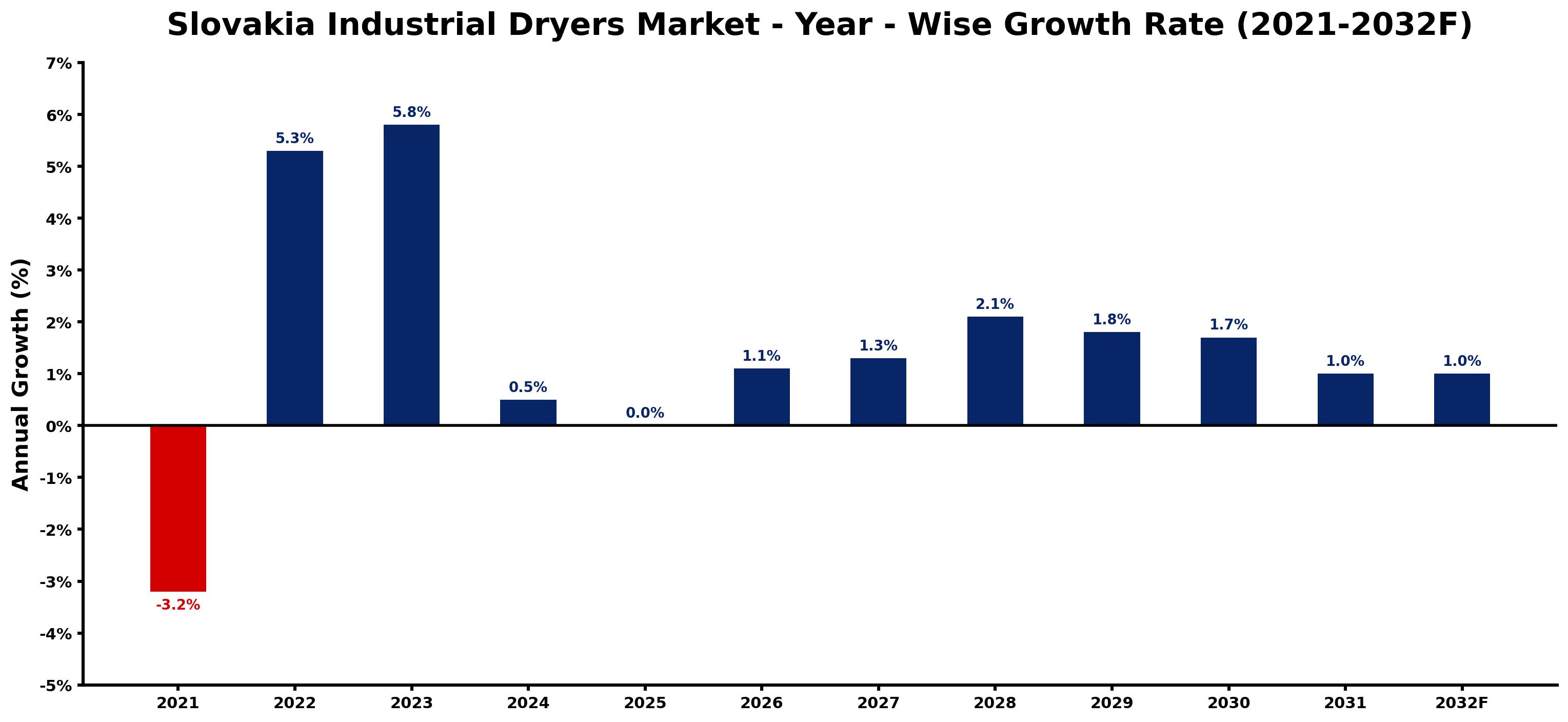
The table below presents the year‑wise growth rates along with the key drivers influencing the market
| Year | Growth Rate | Major Drivers |
| 2021 | -3.2% | Increasing industrial automation investments |
| 2022 | 5.3% | Rising electricity demand across industries |
| 2023 | 5.8% | Increasing industrial automation investments |
| 2024 | 0.5% | Expansion of manufacturing activities |
| 2025 | 0.0% | Rapid growth in telecom and data center sectors |
| 2026 | 1.1% | Expansion of transportation and logistics networks |
| 2027 | 1.3% | Increasing industrial automation investments |
| 2028 | 2.1% | Government infrastructure modernization initiatives |
| 2029 | 1.8% | Increasing smart city development projects |
| 2030 | 1.7% | Increasing industrial infrastructure investments |
| 2031 | 1.0% | Rising electricity demand across industries |
| 2032 | 1.0% | Increasing smart city development projects |
Note - Market size estimations and growth projections presented in this report are based on 6Wresearch’s advanced forecasting approach, validated with industry datasets as of June 2026.
Slovakia Industrial Dryers Market Synopsis
The most significant force currently shaping the Slovakia Industrial Dryers Market is the push for energy efficiency and sustainability. Companies are recognizing the need to reduce their environmental footprint, leading to increased investments in eco-friendly drying solutions. This trend is reinforced by stringent regulations aimed at minimizing emissions and promoting responsible manufacturing practices.
Furthermore, technological advancements play a crucial role in redefining the market landscape. Automation and digitalization are becoming integral, allowing for optimized drying processes that enhance productivity and reduce operational costs. These developments not only meet regulatory demands but also cater to the growing preferences of various industries for more versatile and compact drying equipment.
Slovakia Industrial Dryers Market Key Takeaways
- Growing industrial sectors, including manufacturing and food processing, are driving demand for advanced drying technologies.
- Energy efficiency and sustainability are paramount, influencing product innovation and consumer preferences.
- Technological advancements, such as automation and smart technology integration, are reshaping the market landscape.
- Competitive pressure from foreign manufacturers poses challenges for local producers seeking to innovate.
- Investment opportunities exist in eco-friendly and energy-efficient drying solutions tailored for diverse applications.
Evaluation of Restraints in Slovakia Industrial Dryers Market
Despite the positive growth outlook, the Slovakia Industrial Dryers Market faces notable restraints. Local manufacturers grapple with the increasing competition from foreign firms that offer technologically advanced and cost-competitive solutions. This situation challenges local players to enhance their product offerings continuously. Furthermore, fluctuations in raw material prices and energy costs can negatively impact profitability, complicating the operational landscape for Slovak manufacturers. Additionally, adherence to stringent environmental regulations necessitates further investment in compliance efforts, often stretching financial resources thin for smaller players.
Slovakia Industrial Dryers Market Trends
One of the most prominent trends in the Slovakia Industrial Dryers Market is the heightened demand for energy-efficient and eco-friendly solutions. As industries prioritize sustainability, manufacturers are focusing on developing dryers that consume less energy and minimize environmental impact. Compact and versatile dryers that can efficiently handle varied materials are gaining traction as well, allowing companies to adapt more easily to fluctuating market demands.
Moreover, the integration of smart technologies into drying processes is becoming commonplace. Remote monitoring and optimization capabilities not only enhance operational efficiencies but also facilitate predictive maintenance, leading to reduced downtime and increased productivity. The adoption of heat pump dryers is also on the rise, reflecting the industry's shift towards innovative and sustainable technology solutions.
Slovakia Industrial Dryers Market Opportunities
The Slovakia Industrial Dryers Market offers a multitude of promising investment opportunities, particularly as industrialization continues to expand. Sectors such as food processing, pharmaceuticals, and textiles are increasingly seeking efficient drying solutions, paving the way for innovative technologies. Investors focusing on eco-friendly industrial dryer technologies stand to gain significantly, given the current emphasis on reducing energy consumption and operational costs.
Strategic partnerships with local manufacturers can also prove advantageous, allowing investors to penetrate the market more effectively. This collaboration could enhance distribution networks and provide insights into local market dynamics, ensuring a competitive edge. Overall, the investment landscape appears favorable for those looking to capitalize on Slovakia's industrial growth and modernization.
Government Initiatives in the Slovakia Industrial Dryers Market
Government policies in Slovakia play a crucial role in shaping the Industrial Dryers Market. With a focus on promoting energy efficiency and environmental sustainability, regulatory frameworks are being established to ensure that industrial dryers meet specific energy efficiency criteria and emission limits. Companies investing in eco-friendly technologies or energy-efficient dryers may benefit from incentives, such as tax breaks or subsidies, designed to encourage sustainable manufacturing practices.
Moreover, there are stringent regulations aimed at ensuring the safe operation of industrial dryers, promoting worker safety and environmental protection. These initiatives not only bolster public interest in sustainability but also align with broader European Union directives on environmental responsibility.
Future Insights of the Slovakia Industrial Dryers Market
Looking ahead to 2026-2032, the Slovakia Industrial Dryers Market is expected to maintain steady growth, driven by continuous demand from key sectors like food processing, pharmaceuticals, and chemicals. The market will likely benefit from ongoing technological advancements that improve efficiency and reduce energy costs. Furthermore, the increasing emphasis on sustainable practices will accelerate the adoption of eco-friendly drying solutions. Companies that prioritize innovation and customization to meet specific industry requirements are well-positioned for success as the market evolves.
Slovakia Industrial Dryers Market Latest Developments (May 2025 - June 2026)
In recent months, the Slovakia Industrial Dryers Market has seen a notable shift towards innovative technology, with an emphasis on automation and smart systems integration. Many manufacturers are exploring collaboration opportunities to enhance their product offerings and expand into new markets. Additionally, there is a growing trend of investment in R&D to address specific industry challenges, aligning with the increasing demand for energy-efficient and sustainable drying solutions. Overall, the market is responding dynamically to both consumer preferences and regulatory pressures, paving the way for exciting developments ahead.
Slovakia Industrial Dryers Market - Key Attractiveness of the Report
- 10 Years of Market Numbers
- Historical Data Starting from 2022 to 2025
- Base Year: 2025
- Forecast Data until 2032
- Key Performance Indicators Impacting the Market
- Major Upcoming Developments and Projects
Key Highlights of the Report:
- Slovakia Industrial Dryers Market Outlook
- Market Size of Slovakia Industrial Dryers Market, 2025
- Forecast of Slovakia Industrial Dryers Market, 2032
- Historical Data and Forecast of Slovakia Industrial Dryers Revenues & Volume for the Period 2022-2032F
- Slovakia Industrial Dryers Market Trend Evolution
- Slovakia Industrial Dryers Market Drivers and Challenges
- Slovakia Industrial Dryers Price Trends
- Slovakia Industrial Dryers Porter's Five Forces
- Slovakia Industrial Dryers Industry Life Cycle
- Historical Data and Forecast of Slovakia Industrial Dryers Market Revenues & Volume By Product for the Period 2022-2032F
- Historical Data and Forecast of Slovakia Industrial Dryers Market Revenues & Volume By Direct Dryers for the Period 2022-2032F
- Historical Data and Forecast of Slovakia Industrial Dryers Market Revenues & Volume By Indirect Dryers for the Period 2022-2032F
- Historical Data and Forecast of Slovakia Industrial Dryers Market Revenues & Volume By Specialty Dryers for the Period 2022-2032F
- Historical Data and Forecast of Slovakia Industrial Dryers Market Revenues & Volume By Type for the Period 2022-2032F
- Historical Data and Forecast of Slovakia Industrial Dryers Market Revenues & Volume By Rotary Dryers for the Period 2022-2032F
- Historical Data and Forecast of Slovakia Industrial Dryers Market Revenues & Volume By Fluidized Bed Dryers for the Period 2022-2032F
- Historical Data and Forecast of Slovakia Industrial Dryers Market Revenues & Volume By Spray Dryers for the Period 2022-2032F
- Historical Data and Forecast of Slovakia Industrial Dryers Market Revenues & Volume By Flash Dryers for the Period 2022-2032F
- Historical Data and Forecast of Slovakia Industrial Dryers Market Revenues & Volume By Conveyor Dryers for the Period 2022-2032F
- Historical Data and Forecast of Slovakia Industrial Dryers Market Revenues & Volume By Drum Dryers for the Period 2022-2032F
- Historical Data and Forecast of Slovakia Industrial Dryers Market Revenues & Volume By Freeze Dryers for the Period 2022-2032F
- Historical Data and Forecast of Slovakia Industrial Dryers Market Revenues & Volume By Applications for the Period 2022-2032F
- Historical Data and Forecast of Slovakia Industrial Dryers Market Revenues & Volume By Food for the Period 2022-2032F
- Historical Data and Forecast of Slovakia Industrial Dryers Market Revenues & Volume By Pharmaceutical for the Period 2022-2032F
- Historical Data and Forecast of Slovakia Industrial Dryers Market Revenues & Volume By Fertilizer for the Period 2022-2032F
- Historical Data and Forecast of Slovakia Industrial Dryers Market Revenues & Volume By Chemicals for the Period 2022-2032F
- Historical Data and Forecast of Slovakia Industrial Dryers Market Revenues & Volume By Cement for the Period 2022-2032F
- Historical Data and Forecast of Slovakia Industrial Dryers Market Revenues & Volume By Others for the Period 2022-2032F
- Slovakia Industrial Dryers Import Export Trade Statistics
- Market Opportunity Assessment By Product
- Market Opportunity Assessment By Type
- Market Opportunity Assessment By Applications
- Slovakia Industrial Dryers Top Companies Market Share
- Slovakia Industrial Dryers Competitive Benchmarking By Technical and Operational Parameters
- Slovakia Industrial Dryers Company Profiles
- Slovakia Industrial Dryers Key Strategic Recommendations






































