Slovakia Infant Formula Market Size (2020-2030)
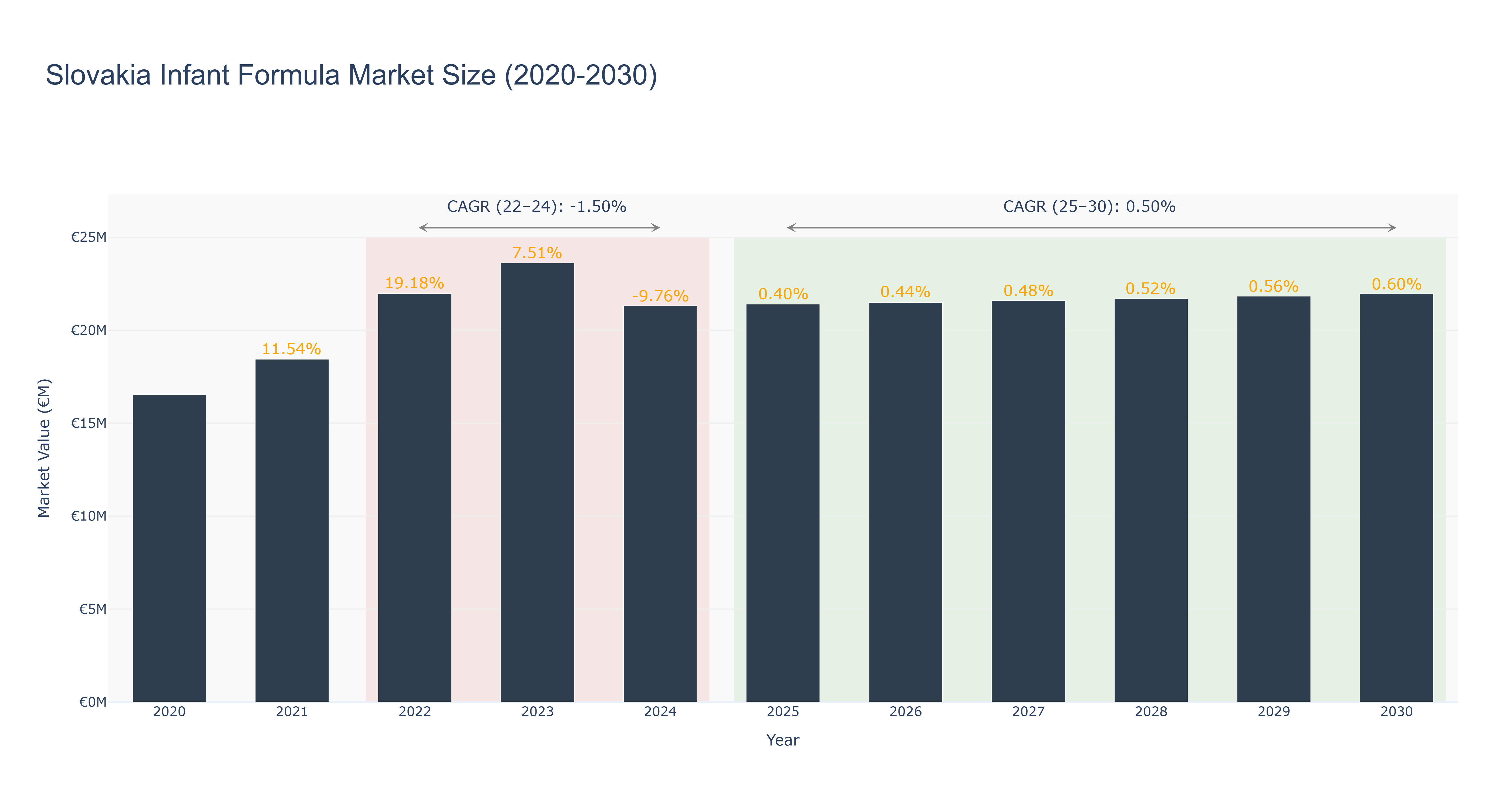
Slovakia Infant Formula Market has seen fluctuations in market size over the years. The peak market size of €23.62 million was achieved in 2023, followed by a decline to €21.32 million in 2024. However, the market has stabilized since then, with a slight increase to €21.40 million in 2025 and a steady growth trajectory forecasted to reach €21.96 million by 2030. The CAGR for the period 2022-24 was -1.50%, reflecting a temporary downturn, while the CAGR for 2025-30 is projected at 0.50%, indicating a more positive outlook. Industry drivers such as increasing birth rates and rising disposable incomes are expected to support market growth. Looking ahead, Slovakia is set to introduce new regulations promoting organic infant formula products, which could further boost market demand in the coming years.
Slovakia Infant Formula Market: Production & Trade Performance (2019-2025)
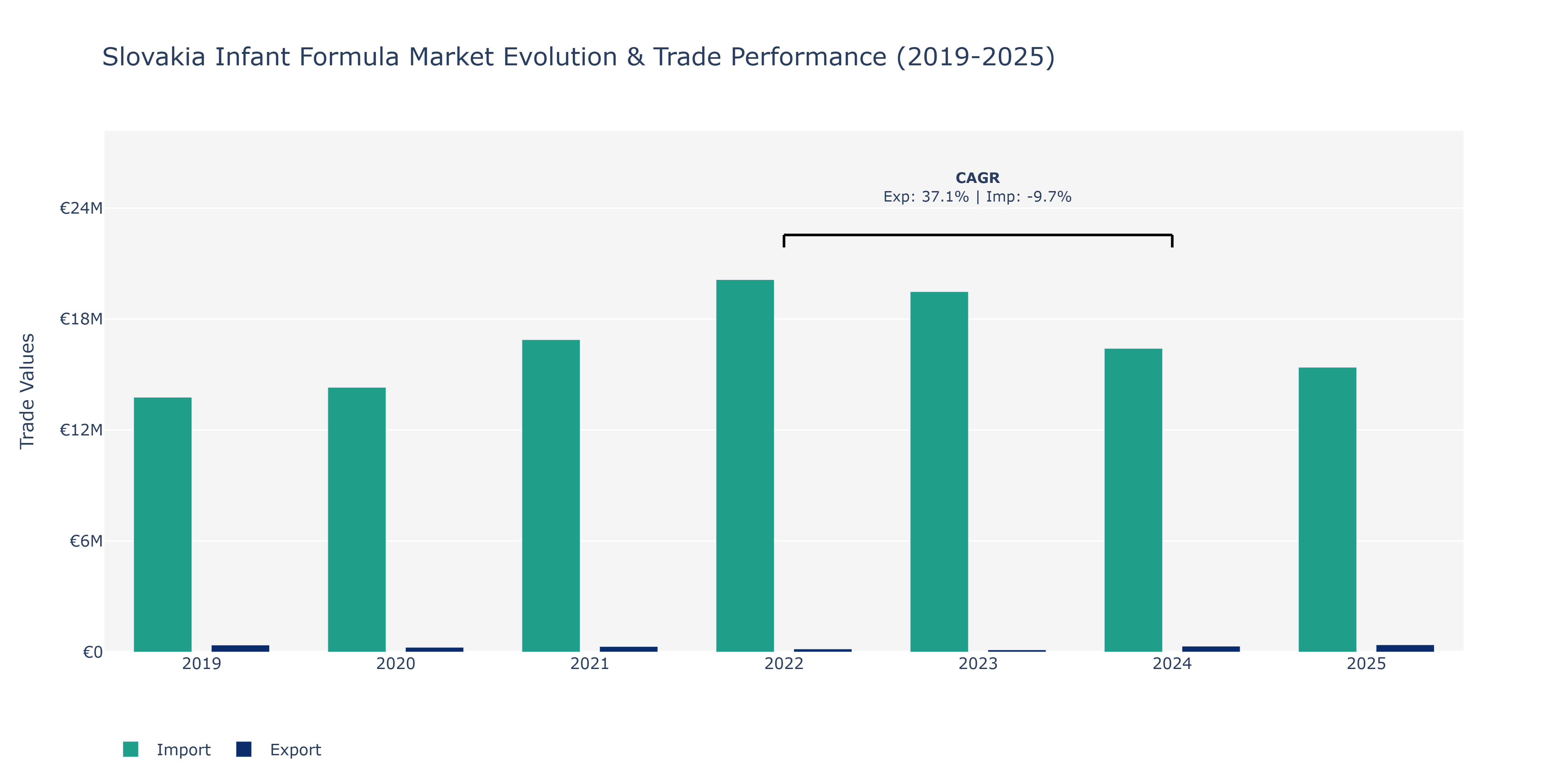
The Slovakia Infant Formula Market saw fluctuations in both Exports and Imports during the period under review. In 2019, Imports were notably higher than Exports, indicating a reliance on foreign suppliers. However, in 2020, there was a considerable decline in both Exports and Imports, possibly due to supply chain disruptions caused by the global pandemic. The trend reversed in 2021 with an increase in both Exports and Imports, showcasing a recovery in trade activities. Interestingly, in 2022, Exports experienced a sharp decline, while Imports surged significantly, possibly due to changes in domestic consumption patterns or shifts in market dynamics. This trend continued in 2023, with Imports maintaining a higher value compared to Exports. By 2024, Exports rebounded strongly, surpassing the previous peak in 2019, while Imports decreased. These fluctuations could be attributed to factors such as changes in consumer preferences, regulatory developments influencing international trade agreements, or shifts in production capacities within the domestic market. The consistent growth in Exports from 2022 to 2024 at a CAGR of 37.14% indicates an expanding market presence in foreign markets, while the negative CAGR in Imports during the same period could suggest efforts to enhance local production capabilities or reduce dependency on imports. Continued monitoring of these trends alongside regulatory changes and consumer behavior will be crucial for stakeholders in the Slovakia Infant Formula Market to capitalize on emerging opportunities and mitigate risks effectively.
Key Highlights of the Report:
- Slovakia Infant Formula Market Outlook
- Market Size of Slovakia Infant Formula Market, 2025
- Forecast of Slovakia Infant Formula Market, 2032
- Historical Data and Forecast of Slovakia Infant Formula Revenues & Volume for the Period 2022 - 2032
- Slovakia Infant Formula Market Trend Evolution
- Slovakia Infant Formula Market Drivers and Challenges
- Slovakia Infant Formula Price Trends
- Slovakia Infant Formula Porter's Five Forces
- Slovakia Infant Formula Industry Life Cycle
- Historical Data and Forecast of Slovakia Infant Formula Market Revenues & Volume By Type for the Period 2022 - 2032
- Historical Data and Forecast of Slovakia Infant Formula Market Revenues & Volume By Infant Milk for the Period 2022 - 2032
- Historical Data and Forecast of Slovakia Infant Formula Market Revenues & Volume By Follow on Milk for the Period 2022 - 2032
- Historical Data and Forecast of Slovakia Infant Formula Market Revenues & Volume By Specialty Baby Milk for the Period 2022 - 2032
- Historical Data and Forecast of Slovakia Infant Formula Market Revenues & Volume By Growing-up Milk for the Period 2022 - 2032
- Historical Data and Forecast of Slovakia Infant Formula Market Revenues & Volume By Ingredient for the Period 2022 - 2032
- Historical Data and Forecast of Slovakia Infant Formula Market Revenues & Volume By Carbohydrate for the Period 2022 - 2032
- Historical Data and Forecast of Slovakia Infant Formula Market Revenues & Volume By Fat for the Period 2022 - 2032
- Historical Data and Forecast of Slovakia Infant Formula Market Revenues & Volume By Protein for the Period 2022 - 2032
- Historical Data and Forecast of Slovakia Infant Formula Market Revenues & Volume By Minerals for the Period 2022 - 2032
- Historical Data and Forecast of Slovakia Infant Formula Market Revenues & Volume By Vitamins for the Period 2022 - 2032
- Historical Data and Forecast of Slovakia Infant Formula Market Revenues & Volume By Others for the Period 2022 - 2032
- Historical Data and Forecast of Slovakia Infant Formula Market Revenues & Volume By Distribution Channel for the Period 2022 - 2032
- Historical Data and Forecast of Slovakia Infant Formula Market Revenues & Volume By Online for the Period 2022 - 2032
- Historical Data and Forecast of Slovakia Infant Formula Market Revenues & Volume By Offline for the Period 2022 - 2032
- Slovakia Infant Formula Import Export Trade Statistics
- Market Opportunity Assessment By Type
- Market Opportunity Assessment By Ingredient
- Market Opportunity Assessment By Distribution Channel
- Slovakia Infant Formula Top Companies Market Share
- Slovakia Infant Formula Competitive Benchmarking By Technical and Operational Parameters
- Slovakia Infant Formula Company Profiles
- Slovakia Infant Formula Key Strategic Recommendations






































