Slovakia Intelligent Automation Market Size, Share & Growth Rate
The Slovakia Intelligent Automation Market was estimated at USD 976 Million in 2025 and is projected to reach USD 1729 Million by 2032, growing at a CAGR of 8.5% from 2026 to 2032. This impressive growth trajectory is fueled by the increasing integration of automation technologies across various sectors, particularly in manufacturing, healthcare, and finance. Companies are investing in innovative solutions to enhance operational efficiency, streamline workflows, and adapt to the digital evolution rapidly reshaping the Slovakian business landscape.
Slovakia Intelligent Automation Market Year-wise Growth Rate and Key Drivers
This graph highlights how the Slovakia Intelligent Automation Market has steadily grown over the years, supported by major growth factors.
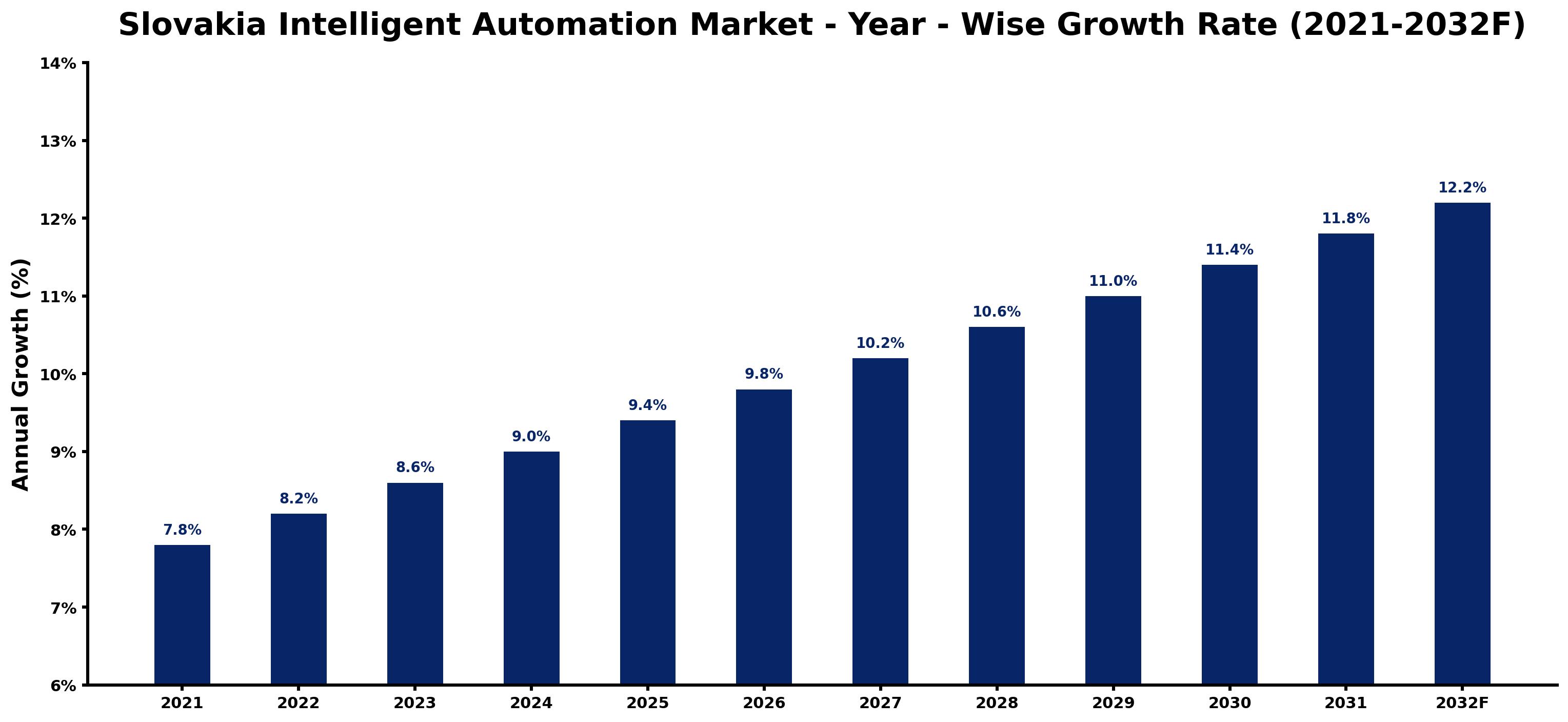
The table below presents the year‑wise growth rates along with the key drivers influencing the market
| Year | Growth Rate | Major Drivers |
| 2021 | 7.8% | Rising electricity demand across industries |
| 2022 | 8.2% | Expansion of transportation and logistics networks |
| 2023 | 8.6% | Expansion of manufacturing activities |
| 2024 | 9.0% | Rising electricity demand across industries |
| 2025 | 9.4% | Rapid growth in telecom and data center sectors |
| 2026 | 9.8% | Increasing adoption of advanced technologies |
| 2027 | 10.2% | Growing urbanization and commercial development |
| 2028 | 10.6% | Increasing adoption of advanced technologies |
| 2029 | 11.0% | Expansion of commercial construction activities |
| 2030 | 11.4% | Expansion of transportation and logistics networks |
| 2031 | 11.8% | Increasing smart city development projects |
| 2032 | 12.2% | Increasing smart city development projects |
Note - Market size estimations and growth projections presented in this report are based on 6Wresearch's advanced forecasting approach, validated with industry datasets as of June 2026.
Slovakia Intelligent Automation Market Synopsis
Recent momentum in Slovakia's intelligent automation landscape highlights a robust uptake of technologies such as robotic process automation (RPA) and artificial intelligence (AI). As businesses transition towards automation, they are poised to unlock new efficiencies and improved service delivery. Looking ahead, this market is set to further accelerate as organizations strive to enhance customer experiences and maintain competitive advantages.
The ongoing digital transformation initiatives have underscored the importance of automation in business operations. Companies are beginning to recognize that intelligent automation not only streamlines processes but also opens avenues for innovative product offerings and enhanced customer engagement. This forward momentum indicates a promising future, as organizations in Slovakia become increasingly committed to harnessing the full potential of intelligent automation.
Slovakia Intelligent Automation Market Key Takeaways
- The market is projected to grow significantly, reaching USD 1729 Million by 2032.
- Industries such as banking, healthcare, and manufacturing are leading the adoption of intelligent automation technologies.
- There is a strong emphasis on cognitive automation, merging AI capabilities with traditional RPA.
- Investment opportunities are rich, particularly in software solutions, consulting, and innovative technology development.
- Government initiatives are actively promoting the adoption and integration of automation technologies across various sectors.
Evaluation of Restraints in Slovakia Intelligent Automation Market
Despite the promising outlook, the Slovakia Intelligent Automation Market faces several key restraints. One primary limitation is the shortage of skilled professionals adept in implementing and managing advanced automation technologies. The market is currently struggling to meet the demand for expertise in artificial intelligence, robotic process automation, and machine learning. Additionally, integrating new automation solutions into existing systems poses challenges, as it often requires significant resource investment and strategic planning. Furthermore, internal resistance to adopting these technologies can slow down implementation, driven by employee concerns regarding job displacement and a general lack of understanding of the automation benefits.
Slovakia Intelligent Automation Market Trends
Emerging trends in the Slovakia Intelligent Automation Market are shaping the future of business operations. Cognitive automation is gaining traction, combining AI with traditional RPA to tackle more complex decision-making challenges. Additionally, companies are increasingly prioritizing customer-centric strategies, utilizing automation tools to enhance service delivery and personalize customer experiences. Another notable trend is the growing investment in cloud-based automation solutions, enabling businesses to scale their operations more flexibly and efficiently.
Slovakia Intelligent Automation Market Opportunities
There are significant growth and investment opportunities within the Slovakia Intelligent Automation Market, particularly in key sectors such as manufacturing, healthcare, finance, and customer service. Companies are keen to leverage automation technologies to increase efficiency, reduce operational costs, and enhance performance metrics. Key areas ripe for investment include RPA, AI, machine learning, and cognitive technologies. Furthermore, partnerships with local entities and governmental organizations can facilitate navigation through regulatory landscapes, providing a robust foundation for market entry and expansion.
Government Initiatives in the Slovakia Intelligent Automation Market
The Slovakian government has rolled out several initiatives aimed at bolstering the Intelligent Automation Market. Policies promoting digital transformation across various industries are at the forefront, alongside incentives encouraging businesses to adopt automation technologies. There are also funding programs supporting research and development in intelligent automation, reflecting a strong commitment to enhancing the country's digital infrastructure and workforce capabilities. Such measures are designed to foster innovation and improve overall market competitiveness.
Future Insights of the Slovakia Intelligent Automation Market
Looking ahead to 2026-2032, the Slovakia Intelligent Automation Market is poised for substantial growth. The convergence of technological advancements and increasing business demand for operational efficiency signals a bright future. Companies are expected to invest more heavily in automation solutions that can improve processes and customer engagement. Furthermore, the supportive regulatory environment and emphasis on workforce development position Slovakia to capitalize on these trends, establishing itself as a leader in intelligent automation in the region.
Slovakia Intelligent Automation Market Latest Developments (May 2025 - June 2026)
In recent months, the Slovakia Intelligent Automation Market has seen a flurry of activity driven by advancements in AI and RPA technologies. Organizations are increasingly focusing on enhancing their digital capabilities to address evolving market demands and improve service efficiency. Notably, several partnerships between tech firms and local businesses have been established to accelerate the adoption of automation solutions. These collaborations aim to harness emerging technologies effectively, fostering a more competitive landscape.
Slovakia Intelligent Automation Market - Key Attractiveness of the Report
- 10 Years of Market Numbers
- Historical Data Starting from 2022 to 2025
- Base Year: 2025
- Forecast Data until 2032
- Key Performance Indicators Impacting the Market
- Major Upcoming Developments and Projects
Key Highlights of the Report:
- Slovakia Intelligent Automation Market Outlook
- Market Size of Slovakia Intelligent Automation Market, 2025
- Forecast of Slovakia Intelligent Automation Market, 2032
- Historical Data and Forecast of Slovakia Intelligent Automation Revenues & Volume for the Period 2022-2032F
- Slovakia Intelligent Automation Market Trend Evolution
- Slovakia Intelligent Automation Market Drivers and Challenges
- Slovakia Intelligent Automation Price Trends
- Slovakia Intelligent Automation Porter's Five Forces
- Slovakia Intelligent Automation Industry Life Cycle
- Historical Data and Forecast of Slovakia Intelligent Automation Market Revenues & Volume By Component for the Period 2022-2032F
- Historical Data and Forecast of Slovakia Intelligent Automation Market Revenues & Volume By Solutions for the Period 2022-2032F
- Historical Data and Forecast of Slovakia Intelligent Automation Market Revenues & Volume By Services for the Period 2022-2032F
- Historical Data and Forecast of Slovakia Intelligent Automation Market Revenues & Volume By Managed Services for the Period 2022-2032F
- Historical Data and Forecast of Slovakia Intelligent Automation Market Revenues & Volume By Verticals for the Period 2022-2032F
- Historical Data and Forecast of Slovakia Intelligent Automation Market Revenues & Volume By BFSI for the Period 2022-2032F
- Historical Data and Forecast of Slovakia Intelligent Automation Market Revenues & Volume By Healthcare for the Period 2022-2032F
- Historical Data and Forecast of Slovakia Intelligent Automation Market Revenues & Volume By Retail for the Period 2022-2032F
- Historical Data and Forecast of Slovakia Intelligent Automation Market Revenues & Volume By Government for the Period 2022-2032F
- Historical Data and Forecast of Slovakia Intelligent Automation Market Revenues & Volume By Telecommunication for the Period 2022-2032F
- Historical Data and Forecast of Slovakia Intelligent Automation Market Revenues & Volume By Utilities for the Period 2022-2032F
- Historical Data and Forecast of Slovakia Intelligent Automation Market Revenues & Volume By Others for the Period 2022-2032F
- Historical Data and Forecast of Slovakia Intelligent Automation Market Revenues & Volume By End users for the Period 2022-2032F
- Historical Data and Forecast of Slovakia Intelligent Automation Market Revenues & Volume By Natural Language Processing for the Period 2022-2032F
- Historical Data and Forecast of Slovakia Intelligent Automation Market Revenues & Volume By Machine & Deep Learning for the Period 2022-2032F
- Historical Data and Forecast of Slovakia Intelligent Automation Market Revenues & Volume By Virtual Agents for the Period 2022-2032F
- Historical Data and Forecast of Slovakia Intelligent Automation Market Revenues & Volume By Mini Bots & RPA for the Period 2022-2032F
- Historical Data and Forecast of Slovakia Intelligent Automation Market Revenues & Volume By Computer Vision for the Period 2022-2032F
- Historical Data and Forecast of Slovakia Intelligent Automation Market Revenues & Volume By Others for the Period 2022-2032F
- Slovakia Intelligent Automation Import Export Trade Statistics
- Market Opportunity Assessment By Component
- Market Opportunity Assessment By Verticals
- Market Opportunity Assessment By End users
- Slovakia Intelligent Automation Top Companies Market Share
- Slovakia Intelligent Automation Competitive Benchmarking By Technical and Operational Parameters
- Slovakia Intelligent Automation Company Profiles
- Slovakia Intelligent Automation Key Strategic Recommendations






































