Slovakia Licensed Merchandise Market Size, Share & Growth Rate
The Slovakia Licensed Merchandise Market was estimated at USD 936 Million in 2025 and is projected to reach USD 1335 Million by 2032, growing at a CAGR of 5.2% from 2026 to 2032. This steady growth trajectory is being fueled by a rising consumer appetite for branded products, particularly in categories such as apparel, toys, and accessories. The increasing penetration of international brands, alongside the popularity of licensed merchandise tied to films, sports teams, and television series, underpins the evolving landscape of consumer preferences in Slovakia.
Slovakia Licensed Merchandise Market Year-wise Growth Rate and Key Drivers
This graph highlights how the Slovakia Licensed Merchandise Market has steadily grown over the years, supported by major growth factors.
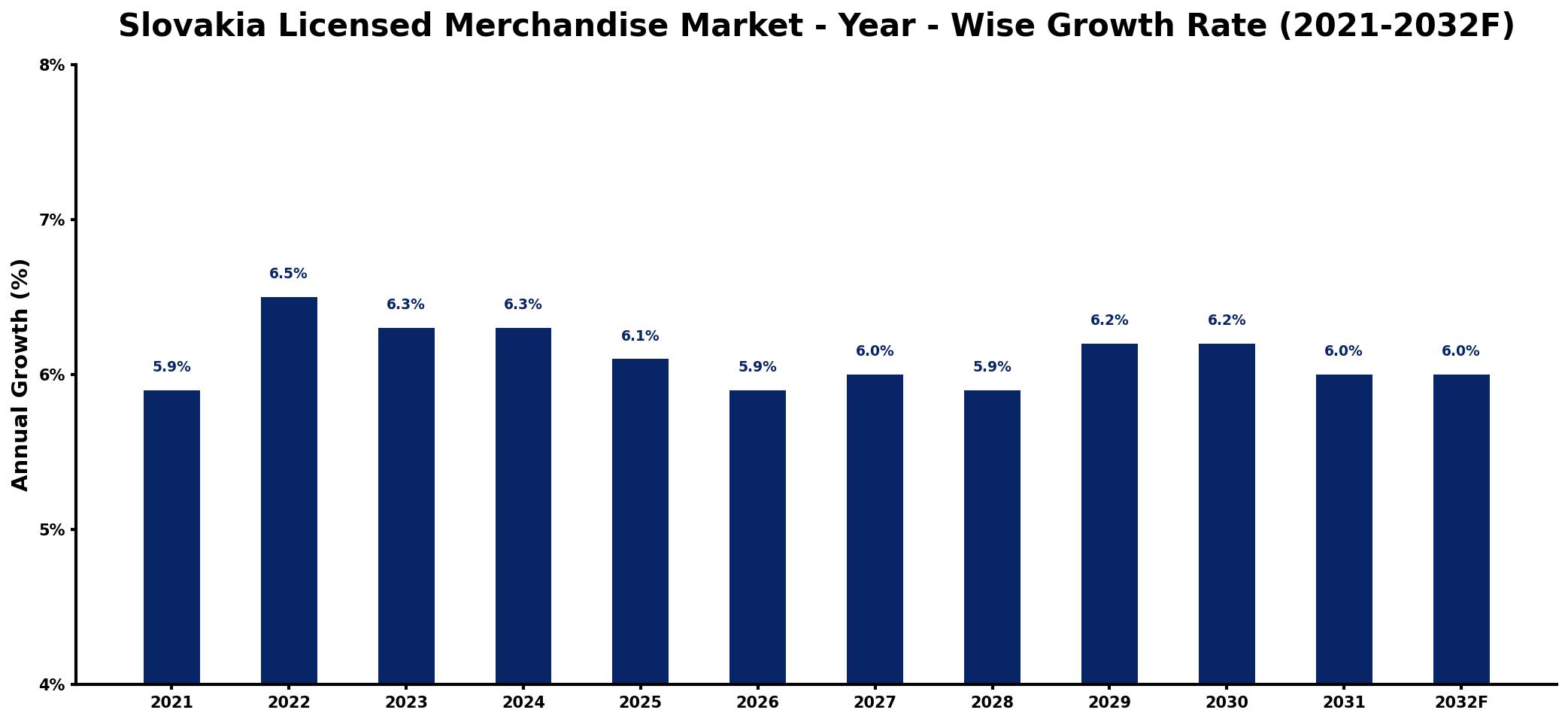
The table below presents the year‑wise growth rates along with the key drivers influencing the market
| Year | Growth Rate | Major Drivers |
| 2021 | 5.9% | Increased consumer spending on collectibles |
| 2022 | 6.5% | Expansion of e-commerce distribution channels |
| 2023 | 6.3% | expanding healthcare application demand |
| 2024 | 6.3% | Rising interest in nostalgic brands |
| 2025 | 6.1% | Increase in youth engagement initiatives |
| 2026 | 5.9% | Development of innovative marketing strategies |
| 2027 | 6.0% | Collaboration with popular influencers |
| 2028 | 5.9% | Enhanced product customization options |
| 2029 | 6.2% | Growth in international market access |
| 2030 | 6.2% | Diversification of product offerings |
| 2031 | 6.0% | Strengthened brand loyalty programs |
| 2032 | 6.0% | Emergence of new consumer trends |
Note: Market size estimations and growth projections presented in this report are based on 6Wresearch's proprietary forecasting methodology, utilizing the latest available industry data, government publications, and primary research inputs.
Slovakia Licensed Merchandise Market Synopsis
In recent years, the Slovakia Licensed Merchandise Market has experienced robust momentum, driven by expanding e-commerce platforms and a growing consumer base eager for branded products. As this momentum continues, the market is poised for further evolution, with increasing collaboration between licensing firms and local creators paving the way for innovative offerings.
While the current focus remains on popular franchises from entertainment and sports, the market's future seems set to embrace unique, eco-friendly merchandise options. Such diversification not only attracts various consumer segments but also aligns with a growing demand for sustainable products, indicating a vibrant path forward for the industry.
Slovakia Licensed Merchandise Market Key Takeaways
- The market is on a growth trajectory, expected to reach USD 1335 Million by 2032.
- Consumer interest in branded products spans various demographics and product categories.
- E-commerce is significantly enhancing accessibility and sales of licensed merchandise.
- Collaborations with local artists are fostering unique product offerings that resonate with niche markets.
- Environmental consciousness is shaping consumer demand for sustainable licensed products.
Evaluation of Restraints in Slovakia Licensed Merchandise Market
Despite the positive trends, the Slovakia Licensed Merchandise Market faces certain limitations. A notable issue is the prevalence of counterfeit products, which erodes brand trust and diminishes sales for legitimate merchandise. Additionally, the markets smaller scale relative to larger regions can restrict growth potential and complicate entry for new players. Furthermore, understanding and navigating the intricate legal landscape governing licensing agreements remains a challenge for businesses aiming to establish or expand their presence in Slovakia.
Slovakia Licensed Merchandise Market Trends
The market is increasingly witnessing a shift towards sustainable and eco-friendly licensed merchandise, driven by heightened consumer awareness. This trend is complemented by the enduring popularity of products featuring iconic characters from major entertainment franchises and sports teams. Moreover, partnerships between licensing firms and local artists are emerging, leading to creative collaborations that provide unique product offerings tailored to local cultural nuances.
Slovakia Licensed Merchandise Market Opportunities
There is considerable potential for investment in the Slovakia Licensed Merchandise Market across various sectors, such as apparel, toys, and collectibles. Companies that strategically align with popular franchises, sports teams, or iconic brands can enhance visibility and drive sales. The growing relevance of digital platforms offers substantial opportunities for marketing and e-commerce, enabling businesses to broaden their customer reach and engagement. Additionally, leveraging collaborations with local artists and influencers can tap into Slovakia's rich cultural landscape, providing a competitive advantage in the marketplace.
Government Initiatives in the Slovakia Licensed Merchandise Market
Government policies in Slovakia are focused on the protection of intellectual property rights and the regulation of licensing practices. Robust laws are in place to enforce copyrights and trademarks, ensuring a fair and transparent licensing process. Efforts to combat counterfeiting are also part of the regulatory framework, aimed at safeguarding the integrity of the licensed merchandise market while promoting ethical business practices.
Future Insights of the Slovakia Licensed Merchandise Market
Looking ahead to 2026-2032, the Slovakia Licensed Merchandise Market is projected to continue its trajectory of growth, bolstered by increasing consumer disposable incomes and a vibrant economy. The market will likely see a rise in demand for licensed merchandise as consumers seek to express their identities and affiliations through branded products. As international brands expand their footprint and new collaborations emerge, the landscape will evolve, enriching the variety of licensed offerings available and fostering sustained market growth.
Slovakia Licensed Merchandise Market Latest Developments (2025 - 2026)
Recent developments in the Slovakia Licensed Merchandise Market indicate a continued focus on sustainability and innovation. Companies are increasingly prioritizing eco-friendly materials in their product lines while enhancing collaborations with local creatives. These shifts not only resonate with consumer preferences but also position brands favorably in a competitive landscape. Additionally, advancements in e-commerce technology are providing businesses with improved tools for reaching and engaging their target audiences, further driving market dynamics.
Slovakia Licensed Merchandise Market - Key Attractiveness of the Report
- 10 Years of Market Numbers
- Historical Data Starting from 2022 to 2025
- Base Year: 2025
- Forecast Data until 2032
- Key Performance Indicators Impacting the Market
- Major Upcoming Developments and Projects
Key Highlights of the Report:
- Slovakia Licensed Merchandise Market Outlook
- Market Size of Slovakia Licensed Merchandise Market, 2025
- Forecast of Slovakia Licensed Merchandise Market, 2032
- Historical Data and Forecast of Slovakia Licensed Merchandise Revenues & Volume for the Period 2022-2032F
- Slovakia Licensed Merchandise Market Trend Evolution
- Slovakia Licensed Merchandise Market Drivers and Challenges
- Slovakia Licensed Merchandise Price Trends
- Slovakia Licensed Merchandise Porter's Five Forces
- Slovakia Licensed Merchandise Industry Life Cycle
- Historical Data and Forecast of Slovakia Licensed Merchandise Market Revenues & Volume By Product Type for the Period 2022-2032F
- Historical Data and Forecast of Slovakia Licensed Merchandise Market Revenues & Volume By Apparel and Footwear for the Period 2022-2032F
- Historical Data and Forecast of Slovakia Licensed Merchandise Market Revenues & Volume By Accessories and Gifts for the Period 2022-2032F
- Historical Data and Forecast of Slovakia Licensed Merchandise Market Revenues & Volume By Toys and Games for the Period 2022-2032F
- Historical Data and Forecast of Slovakia Licensed Merchandise Market Revenues & Volume By Others for the Period 2022-2032F
- Historical Data and Forecast of Slovakia Licensed Merchandise Market Revenues & Volume By for the Period 2022-2032F
- Historical Data and Forecast of Slovakia Licensed Merchandise Market Revenues & Volume By Distribution Channel for the Period 2022-2032F
- Historical Data and Forecast of Slovakia Licensed Merchandise Market Revenues & Volume By Online Stores for the Period 2022-2032F
- Historical Data and Forecast of Slovakia Licensed Merchandise Market Revenues & Volume By Supermarkets and Hypermarkets for the Period 2022-2032F
- Historical Data and Forecast of Slovakia Licensed Merchandise Market Revenues & Volume By Departmental Stores for the Period 2022-2032F
- Historical Data and Forecast of Slovakia Licensed Merchandise Market Revenues & Volume By Specialty Stores for the Period 2022-2032F
- Historical Data and Forecast of Slovakia Licensed Merchandise Market Revenues & Volume By Others for the Period 2022-2032F
- Historical Data and Forecast of Slovakia Licensed Merchandise Market Revenues & Volume By for the Period 2022-2032F
- Historical Data and Forecast of Slovakia Licensed Merchandise Market Revenues & Volume By Price Range for the Period 2022-2032F
- Historical Data and Forecast of Slovakia Licensed Merchandise Market Revenues & Volume By Premium for the Period 2022-2032F
- Historical Data and Forecast of Slovakia Licensed Merchandise Market Revenues & Volume By Economic for the Period 2022-2032F
- Historical Data and Forecast of Slovakia Licensed Merchandise Market Revenues & Volume By for the Period 2022-2032F
- Historical Data and Forecast of Slovakia Licensed Merchandise Market Revenues & Volume By End-User for the Period 2022-2032F
- Historical Data and Forecast of Slovakia Licensed Merchandise Market Revenues & Volume By Men for the Period 2022-2032F
- Historical Data and Forecast of Slovakia Licensed Merchandise Market Revenues & Volume By Women for the Period 2022-2032F
- Historical Data and Forecast of Slovakia Licensed Merchandise Market Revenues & Volume By Children for the Period 2022-2032F
- Slovakia Licensed Merchandise Import Export Trade Statistics
- Market Opportunity Assessment By Product Type
- Market Opportunity Assessment By Distribution Channel
- Market Opportunity Assessment By Price Range
- Market Opportunity Assessment By End-User
- Slovakia Licensed Merchandise Top Companies Market Share
- Slovakia Licensed Merchandise Competitive Benchmarking By Technical and Operational Parameters
- Slovakia Licensed Merchandise Company Profiles
- Slovakia Licensed Merchandise Key Strategic Recommendations






































