Slovakia Metal Recycling Market Size, Share & Growth Rate
The Slovakia Metal Recycling Market was estimated at USD 228 Million in 2025 and is projected to reach USD 305 Million by 2032, growing at a CAGR of 4.2% from 2026 to 2032. This growth is largely attributed to heightened awareness surrounding environmental sustainability, alongside supportive government initiatives that encourage recycling practices. As the automotive and construction sectors continue to generate substantial volumes of scrap metal, the demand for recycled materials is expected to surge, further driving market expansion.
Slovakia Metal Recycling Market Year-wise Growth Rate and Key Drivers
This graph highlights how the Slovakia Metal Recycling Market has steadily grown over the years, supported by major growth factors.
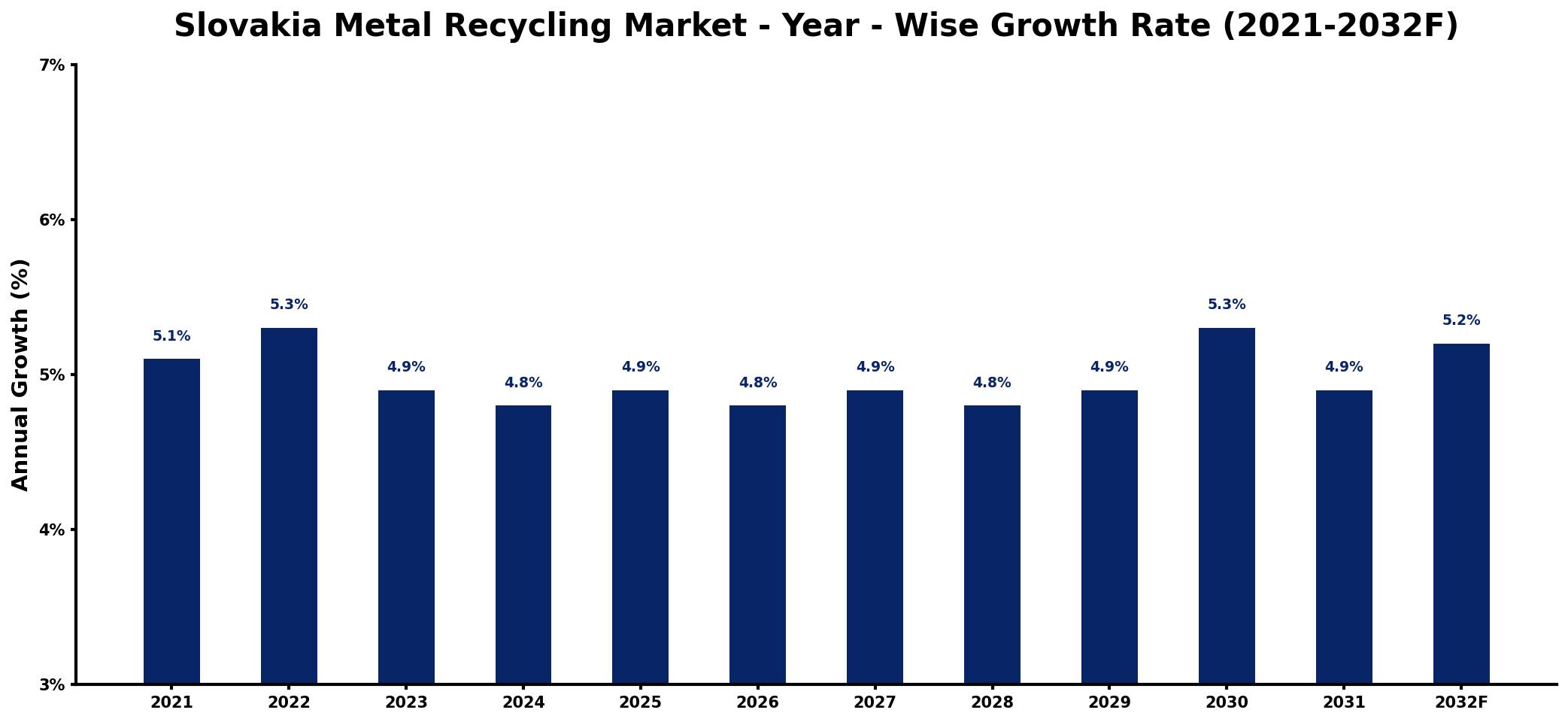
The table below presents the year‑wise growth rates along with the key drivers influencing the market
| Year | Growth Rate | Major Drivers |
| 2021 | 5.1% | Rising industrial production levels |
| 2022 | 5.3% | Increased construction sector activity |
| 2023 | 4.9% | Growing consumer electronics demand |
| 2024 | 4.8% | Expansion of automotive manufacturing |
| 2025 | 4.9% | Boost in renewable energy projects |
| 2026 | 4.8% | Higher urban infrastructure investments |
| 2027 | 4.9% | Increased government sustainability initiatives |
| 2028 | 4.8% | Surge in technological innovations |
| 2029 | 4.9% | Growing awareness of environmental impact |
| 2030 | 5.3% | Enhanced international trade agreements |
| 2031 | 4.9% | Strengthened local manufacturing capabilities |
| 2032 | 5.2% | Increased circular economy practices |
Note: Market size estimations and growth projections presented in this report are based on 6Wresearch's proprietary forecasting methodology, utilizing the latest available industry data, government publications, and primary research inputs.
Slovakia Metal Recycling Market Synopsis
In Slovakia, the automotive industry remains a prominent source of scrap metal, significantly impacting recycling demand. This sector is increasingly prioritizing the use of recycled metals, reflecting a broader trend toward sustainable manufacturing practices. Enhanced collection and sorting systems are essential to capitalize on this growing supply of scrap.
The construction industry also plays a pivotal role in the metal recycling landscape, contributing to the overall volume of recyclable materials. With rising infrastructure projects, the need for recycled metals as a cost-effective and environmentally-friendly alternative is more pressing than ever, stimulating growth in the Slovakia Metal Recycling Market.
Slovakia Metal Recycling Market Key Takeaways
- The market is driven by significant contributions from the automotive and construction sectors.
- Government regulations are increasingly supporting sustainable recycling practices.
- Technological advancements are improving recycling efficiency and output quality.
- Investment in recycling infrastructure is becoming essential to meet growing demand.
- Awareness initiatives are vital for enhancing recycling rates across different demographics.
Evaluation of Restraints in Slovakia Metal Recycling Market
Despite its growth potential, the Slovakia Metal Recycling Market encounters several limitations. A lack of comprehensive awareness regarding the benefits of recycling persists among both businesses and the general public, which hinders overall recycling rates. Furthermore, inconsistent collection infrastructure poses logistical hurdles that complicate the efficient handling of scrap metal. Informal trading activities further obscure transparency and create competition that can negatively impact organized recycling efforts. Addressing these issues is critical for unlocking the full potential of the market.
Slovakia Metal Recycling Market Trends
The focus on sustainable practices is becoming increasingly prevalent across Slovakia, leading to a heightened commitment to recycling metal materials. This shift is underscored by regulatory frameworks that mandate higher recycling rates. Additionally, advancements in technology are enabling more effective sorting and separation processes, enhancing the quality of recycled metal and driving down costs for manufacturers. This confluence of environmental necessity and economic advantage marks a significant trend within the Slovakia Metal Recycling Market.
Slovakia Metal Recycling Market Opportunities
The Slovakia Metal Recycling Market is ripe for investment, particularly as the country aligns with EU recycling targets. Opportunities abound in developing innovative recycling technologies and enhancing existing infrastructure to better serve growing demands. Additionally, as global demand for recycled metals escalates due to increasing circular economy initiatives, Slovakia presents a favorable landscape for new ventures. Strategic partnerships with local scrap collectors could also amplify investment returns, leveraging synergies within the market.
Government Initiatives in the Slovakia Metal Recycling Market
The Slovak government is actively promoting metal recycling through various policies aimed at enhancing sustainability. Legislative frameworks such as the Waste Act establish clear guidelines for the collection, sorting, and recycling of waste materials. Financial support from the Slovak Environmental Fund encourages projects that advance recycling initiatives. Furthermore, compliance with the EU's Circular Economy Package underscores Slovakia's commitment to elevating recycling rates and minimizing the environmental impact of resource consumption.
Future Insights of the Slovakia Metal Recycling Market
Looking forward to the years 2026-2032, the Slovakia Metal Recycling Market is on a trajectory of substantial growth. Increasing environmental awareness among both consumers and industries will fuel the demand for recycled metals across diverse applications. Technological improvements in recycling processes will not only enhance efficiency but also reduce environmental impacts, aligning with global sustainability efforts. As the circular economy continues to gain momentum, Slovakia stands poised to become a leader in metal recycling in the Central European region.
Slovakia Metal Recycling Market Latest Developments (2025 - 2026)
Recent developments in the Slovakia Metal Recycling Market include increased governmental focus on enhancing recycling infrastructure and boosting public engagement in recycling initiatives. Innovative projects aimed at modernizing sorting technologies are also gaining traction, facilitating better recovery rates of recyclable materials. Moreover, collaborations between various stakeholders in the supply chain are becoming more common, fostering a unified approach toward sustainable recycling practices.
Slovakia Metal Recycling Market - Key Attractiveness of the Report
- 10 Years of Market Numbers
- Historical Data Starting from 2022 to 2025
- Base Year: 2025
- Forecast Data until 2032
- Key Performance Indicators Impacting the Market
- Major Upcoming Developments and Projects
Key Highlights of the Report:
- Slovakia Metal Recycling Market Outlook
- Market Size of Slovakia Metal Recycling Market, 2025
- Forecast of Slovakia Metal Recycling Market, 2032
- Historical Data and Forecast of Slovakia Metal Recycling Revenues & Volume for the Period 2022-2032F
- Slovakia Metal Recycling Market Trend Evolution
- Slovakia Metal Recycling Market Drivers and Challenges
- Slovakia Metal Recycling Price Trends
- Slovakia Metal Recycling Porter's Five Forces
- Slovakia Metal Recycling Industry Life Cycle
- Historical Data and Forecast of Slovakia Metal Recycling Market Revenues & Volume By Scrap Type for the Period 2022-2032F
- Historical Data and Forecast of Slovakia Metal Recycling Market Revenues & Volume By Old Scrap for the Period 2022-2032F
- Historical Data and Forecast of Slovakia Metal Recycling Market Revenues & Volume By New Scrap for the Period 2022-2032F
- Historical Data and Forecast of Slovakia Metal Recycling Market Revenues & Volume By Type for the Period 2022-2032F
- Historical Data and Forecast of Slovakia Metal Recycling Market Revenues & Volume By Ferrous for the Period 2022-2032F
- Historical Data and Forecast of Slovakia Metal Recycling Market Revenues & Volume By Non-Ferrous for the Period 2022-2032F
- Historical Data and Forecast of Slovakia Metal Recycling Market Revenues & Volume By Equipment for the Period 2022-2032F
- Historical Data and Forecast of Slovakia Metal Recycling Market Revenues & Volume By Shredders for the Period 2022-2032F
- Historical Data and Forecast of Slovakia Metal Recycling Market Revenues & Volume By Shears for the Period 2022-2032F
- Historical Data and Forecast of Slovakia Metal Recycling Market Revenues & Volume By Granulating Machines for the Period 2022-2032F
- Historical Data and Forecast of Slovakia Metal Recycling Market Revenues & Volume By Briquetting Machines for the Period 2022-2032F
- Historical Data and Forecast of Slovakia Metal Recycling Market Revenues & Volume By End-use Sector for the Period 2022-2032F
- Historical Data and Forecast of Slovakia Metal Recycling Market Revenues & Volume By Building & Construction for the Period 2022-2032F
- Historical Data and Forecast of Slovakia Metal Recycling Market Revenues & Volume By Automotive for the Period 2022-2032F
- Historical Data and Forecast of Slovakia Metal Recycling Market Revenues & Volume By Equipment Manufacturing for the Period 2022-2032F
- Historical Data and Forecast of Slovakia Metal Recycling Market Revenues & Volume By Shipbuilding for the Period 2022-2032F
- Historical Data and Forecast of Slovakia Metal Recycling Market Revenues & Volume By Packaging for the Period 2022-2032F
- Historical Data and Forecast of Slovakia Metal Recycling Market Revenues & Volume By Consumer Appliances for the Period 2022-2032F
- Historical Data and Forecast of Slovakia Metal Recycling Market Revenues & Volume By Others for the Period 2022-2032F
- Slovakia Metal Recycling Import Export Trade Statistics
- Market Opportunity Assessment By Scrap Type
- Market Opportunity Assessment By Type
- Market Opportunity Assessment By Equipment
- Market Opportunity Assessment By End-use Sector
- Slovakia Metal Recycling Top Companies Market Share
- Slovakia Metal Recycling Competitive Benchmarking By Technical and Operational Parameters
- Slovakia Metal Recycling Company Profiles
- Slovakia Metal Recycling Key Strategic Recommendations






































