Slovakia Pectin Market Top 5 Importing Countries and Market Competition (HHI) Analysis
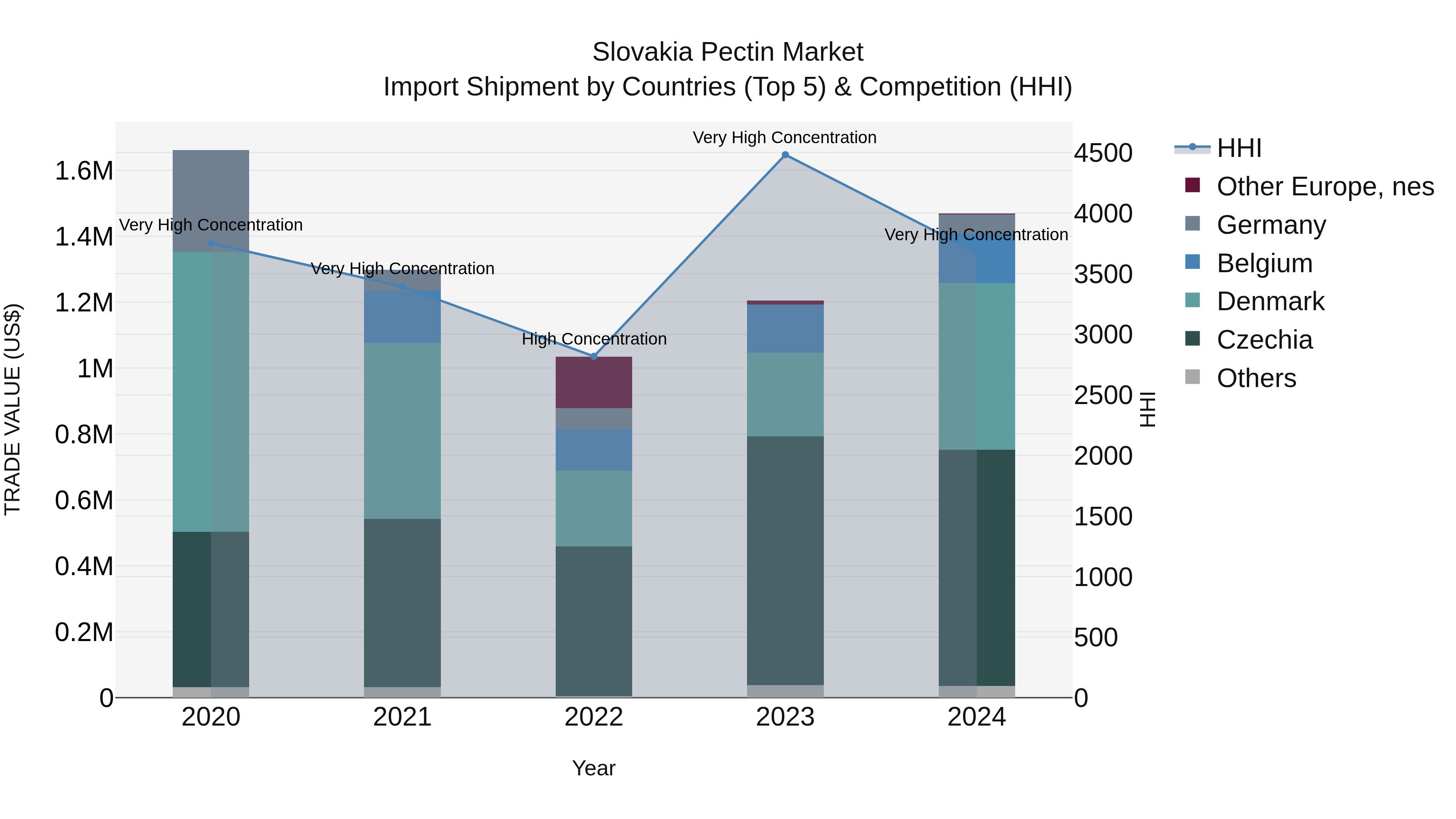
Slovakia continues to rely on key pectin imports from neighboring countries such as Czechia, Denmark, Belgium, Germany, and Hungary in 2024. The high Herfindahl-Hirschman Index (HHI) indicates a concentrated Market Top 5 Importing Countries and Market Competition (HHI) Analysis. Despite a negative Compound Annual Growth Rate (CAGR) from 2020 to 2024, there was a notable growth spike of 21.86% from 2023 to 2024, suggesting potential shifts and opportunities in the Slovakian pectin import Market Top 5 Importing Countries and Market Competition (HHI) Analysis. Stakeholders should closely monitor Market Top 5 Importing Countries and Market Competition (HHI) Analysis dynamics and emerging trends to capitalize on this growth momentum.
Slovakia Pectin Market Synopsis
The Slovakia pectin market is experiencing steady growth due to the increasing demand for natural and clean label ingredients in the food and beverage industry. Pectin, a natural gelling agent derived from fruits, is widely used in jams, jellies, confectionery, and dairy products. The market is driven by the growing health consciousness among consumers, leading to a preference for products with natural ingredients. Furthermore, the rising trend of vegan and vegetarian diets is also boosting the demand for pectin as a plant-based alternative to gelatin. Key players in the Slovakia pectin market are focusing on product innovation, quality enhancement, and strategic partnerships to gain a competitive edge. The market is expected to continue its growth trajectory as consumers seek healthier and sustainable food options.
Slovakia Pectin Market Trends
The Slovakia pectin market is experiencing a growing demand due to the increasing awareness about the health benefits of pectin as a natural and plant-based ingredient. Consumers are seeking products with clean labels and natural ingredients, driving the use of pectin in various food and beverage applications such as jams, jellies, and dairy products. Additionally, the rising popularity of vegan and vegetarian diets is also fueling the demand for pectin as a gelling agent in plant-based products. Manufacturers are focusing on product innovation and developing pectin variants to cater to the diverse needs of the market. Sustainability and traceability are becoming key factors influencing purchasing decisions, leading to a shift towards sustainably sourced and organic pectin in Slovakia.
Slovakia Pectin Market Challenges
In the Slovakia pectin market, some key challenges include fluctuating raw material prices, increasing competition from other hydrocolloids, and limited consumer awareness about the benefits of pectin. The volatility in raw material prices, especially fruits used for pectin production, can impact the overall cost structure for manufacturers. Additionally, the growing popularity of alternative hydrocolloids such as agar-agar and guar gum poses a competitive threat to pectin suppliers. Furthermore, the lack of consumer knowledge about pectin`s functionalities and health benefits hinders market growth and adoption. Addressing these challenges would require market players to focus on stable supply chains, product differentiation, and targeted marketing efforts to educate consumers and enhance the value proposition of pectin in Slovakia.
Slovakia Pectin Market Investment Opportunities
In the Slovakia pectin market, there are several promising investment opportunities worth considering. With the growing consumer preference for natural and organic ingredients in food and beverages, there is a rising demand for pectin as a gelling agent and stabilizer in various products. Investing in pectin production facilities or partnering with pectin manufacturers in Slovakia can be a lucrative opportunity. Additionally, the pharmaceutical and cosmetic industries are also utilizing pectin in their products, providing avenues for diversification and expansion. Research and development in pectin extraction methods and product innovation can further enhance market presence and competitiveness. Overall, the Slovakia pectin market offers potential for growth and profitability, especially for investors keen on tapping into the expanding natural ingredient segment.
Jordan Agar Market Government Policies
The Slovakia Pectin Market is influenced by government policies related to agriculture, food safety, and trade. Slovakia`s agricultural policies focus on supporting sustainable agricultural practices and promoting local food production. The government provides subsidies and incentives to farmers to enhance productivity and quality in the pectin production process. Additionally, food safety regulations play a crucial role in ensuring the quality of pectin products in the market, with strict adherence to EU standards and regulations. Trade policies also impact the Slovakia Pectin Market, with the government working to facilitate export opportunities and maintain favorable trade relationships with other countries. Overall, government policies in Slovakia aim to support the growth and competitiveness of the pectin market while ensuring consumer safety and quality standards are met.
Slovakia Pectin Market Future Outlook
The Slovakia pectin market is expected to witness steady growth in the coming years due to increasing demand for natural and clean-label ingredients in the food and beverage industry. Pectin, known for its gelling, thickening, and stabilizing properties, is widely used in various applications such as jams, jellies, and confectionery products. The rising consumer awareness regarding the health benefits of pectin, such as its role in gut health and cholesterol reduction, is further driving market growth. Additionally, the growing trend of plant-based and vegan diets is likely to boost the demand for pectin as a key ingredient in these products. Companies in the Slovakia pectin market are focusing on product innovation and expanding their product portfolios to cater to the evolving consumer preferences, which will contribute to the market`s positive outlook in the future.
Key Highlights of the Report:
- Slovakia Pectin Market Outlook
- Market Size of Slovakia Pectin Market, 2024
- Forecast of Slovakia Pectin Market, 2031
- Historical Data and Forecast of Slovakia Pectin Revenues & Volume for the Period 2021 - 2031
- Slovakia Pectin Market Trend Evolution
- Slovakia Pectin Market Drivers and Challenges
- Slovakia Pectin Price Trends
- Slovakia Pectin Porter's Five Forces
- Slovakia Pectin Industry Life Cycle
- Historical Data and Forecast of Slovakia Pectin Market Revenues & Volume By Type for the Period 2021 - 2031
- Historical Data and Forecast of Slovakia Pectin Market Revenues & Volume By HM Pectin for the Period 2021 - 2031
- Historical Data and Forecast of Slovakia Pectin Market Revenues & Volume By LM Pectin for the Period 2021 - 2031
- Historical Data and Forecast of Slovakia Pectin Market Revenues & Volume By Raw Material for the Period 2021 - 2031
- Historical Data and Forecast of Slovakia Pectin Market Revenues & Volume By Citrus Fruits for the Period 2021 - 2031
- Historical Data and Forecast of Slovakia Pectin Market Revenues & Volume By Apple for the Period 2021 - 2031
- Historical Data and Forecast of Slovakia Pectin Market Revenues & Volume By Sugar Beet for the Period 2021 - 2031
- Historical Data and Forecast of Slovakia Pectin Market Revenues & Volume By Others for the Period 2021 - 2031
- Historical Data and Forecast of Slovakia Pectin Market Revenues & Volume By Application for the Period 2021 - 2031
- Historical Data and Forecast of Slovakia Pectin Market Revenues & Volume By Food & Beverages for the Period 2021 - 2031
- Historical Data and Forecast of Slovakia Pectin Market Revenues & Volume By Jams, Jellies, And Spreads for the Period 2021 - 2031
- Historical Data and Forecast of Slovakia Pectin Market Revenues & Volume By Dairy Products for the Period 2021 - 2031
- Historical Data and Forecast of Slovakia Pectin Market Revenues & Volume By Beverages for the Period 2021 - 2031
- Historical Data and Forecast of Slovakia Pectin Market Revenues & Volume By Bakery & Confectionery for the Period 2021 - 2031
- Historical Data and Forecast of Slovakia Pectin Market Revenues & Volume By Others for the Period 2021 - 2031
- Historical Data and Forecast of Slovakia Pectin Market Revenues & Volume By Function for the Period 2021 - 2031
- Historical Data and Forecast of Slovakia Pectin Market Revenues & Volume By Gelling Agents for the Period 2021 - 2031
- Historical Data and Forecast of Slovakia Pectin Market Revenues & Volume By Thickener for the Period 2021 - 2031
- Historical Data and Forecast of Slovakia Pectin Market Revenues & Volume By Stabilizer for the Period 2021 - 2031
- Historical Data and Forecast of Slovakia Pectin Market Revenues & Volume By Fat Replacer for the Period 2021 - 2031
- Historical Data and Forecast of Slovakia Pectin Market Revenues & Volume By Others for the Period 2021 - 2031
- Slovakia Pectin Import Export Trade Statistics
- Market Opportunity Assessment By Type
- Market Opportunity Assessment By Raw Material
- Market Opportunity Assessment By Application
- Market Opportunity Assessment By Function
- Slovakia Pectin Top Companies Market Share
- Slovakia Pectin Competitive Benchmarking By Technical and Operational Parameters
- Slovakia Pectin Company Profiles
- Slovakia Pectin Key Strategic Recommendations






































