Slovakia Power Convertor Market Summary
The slovakia power convertor market was estimated at USD 425 Million in 2025 and is projected to reach USD 579 Million by 2032, growing at a CAGR of 5.3% from 2026 to 2032.
Slovakia Power Convertor Market Year-wise Growth Rate and Key Drivers
This graph highlights how the Slovakia Power Convertor Market has steadily grown over the past five years, supported by major growth factors.
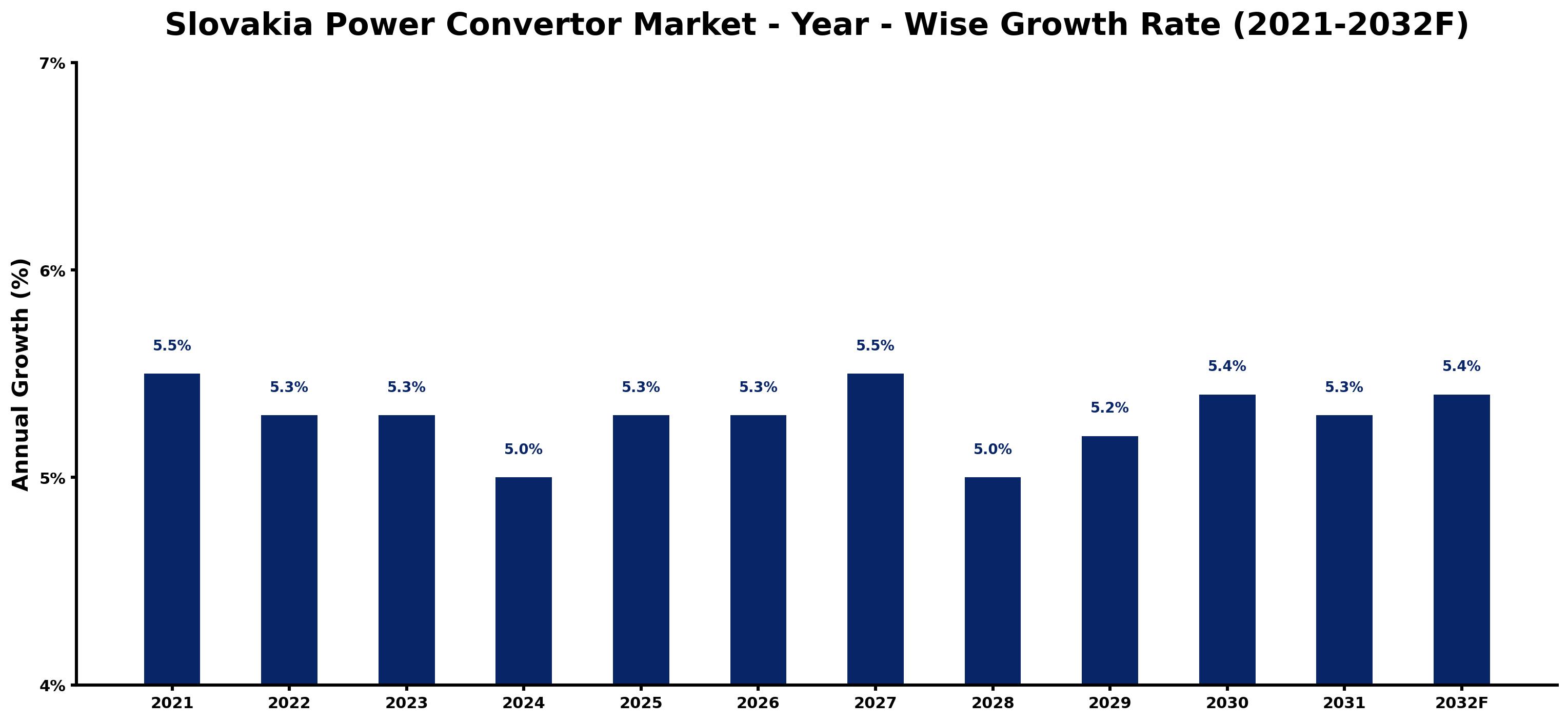
The table below presents the year wise growth rates along with the key drivers influencing the market
| Year | Growth Rate | Major Drivers |
| 2021 | 5.5% | Post-lockdown economic recovery spurs investment in energy efficiency upgrades across sectors. |
| 2022 | 5.3% | Legacy infrastructure challenges highlight the need for modern power conversion solutions. |
| 2023 | 5.3% | Corporate sustainability targets demand innovative technologies for energy conversion processes. |
| 2024 | 5.0% | Emerging smart grid technologies create new avenues for power convertor utilization. |
| 2025 | 5.3% | Significant industrial expansion in Slovakia requires robust and reliable power systems. |
| 2026 | 5.3% | Increased emphasis on renewable energy integration shapes market dynamics for converters. |
| 2027 | 5.5% | Technological partnerships foster advancements in compact and efficient power conversion designs. |
| 2028 | 5.0% | Market competition stimulates product innovation, enhancing converter capabilities and performance. |
| 2029 | 5.2% | Shift towards electric vehicles boosts the demand for high-efficiency power converters. |
| 2030 | 5.4% | Consumer electronics trends drive the need for smaller, more efficient power solutions. |
| 2031 | 5.3% | Environmental regulations push industries to adopt cleaner power conversion technologies. |
| 2032 | 5.4% | Investments in infrastructure modernization ensure sustained growth in power convertor applications. |
Note - Market size estimations and growth projections presented in this report are based on 6Wresearch's advanced forecasting approach, validated with industry datasets as of June 2026.
Slovakia Power Convertor Market Synopsis
The Slovakia Power Convertor Market is projected to reach 5.3% and witness significant growth during the forecast period (2026-2032). This expansion is anticipated to be driven by numerous factors including the increasing investments in renewable energy, heightened demand for smart grids, and the adoption of efficient electricity distribution systems. As the region moves towards more sustainable energy solutions, the necessity for advanced power converters becomes paramount. Technological advancements such as component miniaturization, enhanced efficiency, and improved reliability are further propelling market acceptance, rendering these devices indispensable for both consumers and industries across Slovakia.
Slovakia Power Convertor Market Growth Drivers
The Slovakia Power Convertor Market is influenced by several key growth drivers. Firstly, the government's focus on renewable energy sources is fostering a conducive environment for the installation of photovoltaic systems, which in turn increases the demand for power converters.
- Investments in renewable energy technologies are expected to escalate as Slovakia aligns with EU directives aiming for greener energy solutions.
- Smart grid technology adoption is on the rise, leading to an increasing need for sophisticated power conversion systems to manage energy distribution effectively.
- The surge in energy efficiency initiatives by both consumers and businesses is creating a favorable landscape for advanced power converter adoption.
- Government policies that promote solar energy use, such as exempting small-scale photovoltaic plants from licensing fees, are incentivizing consumers to invest in power conversion technologies.
- Technological innovations in power electronics are enhancing the performance and reliability of converters, thereby driving consumer preference towards higher-quality solutions.
Slovakia Power Convertor Market Trends and Opportunities
The Slovakia Power Convertor Market is witnessing notable trends that indicate promising opportunities for growth. A shift towards sustainability is leading to an increased emphasis on the development of eco-friendly power conversion solutions. Additionally, the integration of smart technologies in power systems is reshaping the market landscape.
- The trend of miniaturization in electronic components is resulting in more compact and efficient power converters, appealing to modern consumers who prioritize space and efficiency.
- Emerging smart home technologies are creating new avenues for power converter manufacturers, as consumers seek innovative solutions for energy management.
- Partnerships between technology providers and energy companies are fostering the development of integrated solutions, providing robust opportunities for growth.
- Increased awareness of energy security and sustainability among consumers is prompting higher investments in renewable energy systems, directly impacting the demand for power converters.
- The rise of electric vehicles is boosting the demand for specialized power converters that can efficiently handle energy conversion and management needs.
Slovakia Power Convertor Market Challenges and Restraints
Despite significant growth prospects, the Slovakia Power Convertor Market faces some challenges that may hinder its progress. Identifying and addressing these obstacles is crucial for ensuring sustained development in the sector.
- High initial investment costs associated with advanced power conversion technologies can deter consumers and businesses from making the switch to more efficient systems.
- Regulatory challenges and varying standards can complicate the development and deployment of power converters, especially for new entrants in the market.
- Market competition is intensifying, placing pressure on manufacturers to continuously innovate while managing production costs effectively.
- Fluctuations in raw material prices can impact the profitability of power converter manufacturers, leading to potential disruptions in supply chains.
- The lack of awareness regarding the benefits of advanced power converters among residential consumers may slow down market adoption rates.
Slovakia Power Convertor Market Government Investment and Initiatives
The Slovak government has been actively promoting initiatives to boost the development of renewable energy sources, thereby impacting the Slovakia Power Convertor Market favorably. Various policies have been introduced to enhance investment in clean energy technologies and facilitate the adoption of power conversion systems.
- Government incentives for renewable energy installations, including tax benefits and financial aids for small-scale solar projects, are encouraging local entrepreneurs to enter the market.
- Initiatives aimed at upgrading the existing grid infrastructure are enabling more efficient energy distribution and management, which directly supports the growth of advanced power converters.
- Public funding is being directed towards research and development projects focused on innovative power conversion technologies that promise higher efficiency and sustainability.
- Collaboration between government bodies and private enterprises is being fostered through various grants and funding programs aimed at promoting energy transition.
- Regulatory measures aimed at simplifying the licensing process for energy systems are further encouraging wider adoption of efficient power conversion solutions.
Slovakia Power Convertor Market Latest Developments (May 2025 - June 2026)
The period from May 2025 to June 2026 has seen pivotal developments within the Slovakia Power Convertor Market as industry stakeholders adapt to evolving energy demands. A marked increase in the integration of smart technologies into power conversion systems has been observed, reflecting the rising consumer preference for enhanced energy management solutions.
- Recent collaborations among technology providers and energy firms have led to improved product offerings, focusing on smart inverters and microgrid solutions.
- Innovations in power converter designs are emerging, with a focus on increased efficiency and adaptability to various energy sources, particularly solar energy.
- Regulatory reforms have streamlined processes for renewable energy projects, propelling more households and businesses to invest in solar energy systems.
- Research initiatives supported by public funding are paving the way for next-generation power conversion technologies that will meet future energy demands.
- Consumer awareness campaigns led by governmental and non-governmental organizations are educating the public on the benefits of advanced power converters and renewable energy systems.
Slovakia Power Convertor Market - Key Attractiveness of the Report
- 10 Years of Market Numbers
- Historical Data Starting from 2022 to 2025
- Base Year: 2025
- Forecast Data until 2032
- Key Performance Indicators Impacting the Market
- Major Upcoming Developments and Projects
Key Highlights of the Report:
- Slovakia Power Convertor Market Outlook
- Market Size of Slovakia Power Convertor Market, 2025
- Forecast of Slovakia Power Convertor Market, 2032F
- Historical Data and Forecast of Slovakia Power Convertor Revenues & Volume for the Period 2022-2032F
- Slovakia Power Convertor Market Trend Evolution
- Slovakia Power Convertor Market Drivers and Challenges
- Slovakia Power Convertor Price Trends
- Slovakia Power Convertor Porter's Five Forces
- Slovakia Power Convertor Industry Life Cycle
- Historical Data and Forecast of Slovakia Power Convertor Market Revenues & Volume By Product Types for the Period 2022-2032F
- Historical Data and Forecast of Slovakia Power Convertor Market Revenues & Volume By Low Voltage Power Converter for the Period 2022-2032F
- Historical Data and Forecast of Slovakia Power Convertor Market Revenues & Volume By High Voltage Power Converter for the Period 2022-2032F
- Historical Data and Forecast of Slovakia Power Convertor Market Revenues & Volume By Applications for the Period 2022-2032F
- Historical Data and Forecast of Slovakia Power Convertor Market Revenues & Volume By Electronics for the Period 2022-2032F
- Historical Data and Forecast of Slovakia Power Convertor Market Revenues & Volume By Industrial for the Period 2022-2032F
- Historical Data and Forecast of Slovakia Power Convertor Market Revenues & Volume By Infrastructure & Transportation for the Period 2022-2032F
- Historical Data and Forecast of Slovakia Power Convertor Market Revenues & Volume By Power Utilities for the Period 2022-2032F
- Historical Data and Forecast of Slovakia Power Convertor Market Revenues & Volume By Others for the Period 2022-2032F
- Slovakia Power Convertor Import Export Trade Statistics
- Market Opportunity Assessment By Product Types
- Market Opportunity Assessment By Applications
- Slovakia Power Convertor Top Companies Market Share
- Slovakia Power Convertor Competitive Benchmarking By Technical and Operational Parameters
- Slovakia Power Convertor Company Profiles
- Slovakia Power Convertor Key Strategic Recommendations






































