Slovakia Power Supply Market Summary
The slovakia power supply market was estimated at USD 321 Million in 2025 and is projected to reach USD 450 Million by 2032, growing at a CAGR of 5.9% from 2026 to 2032.
Slovakia Power Supply Market Year-wise Growth Rate and Key Drivers
This graph highlights how the Slovakia Power Supply Market has steadily grown over the past five years, supported by major growth factors.
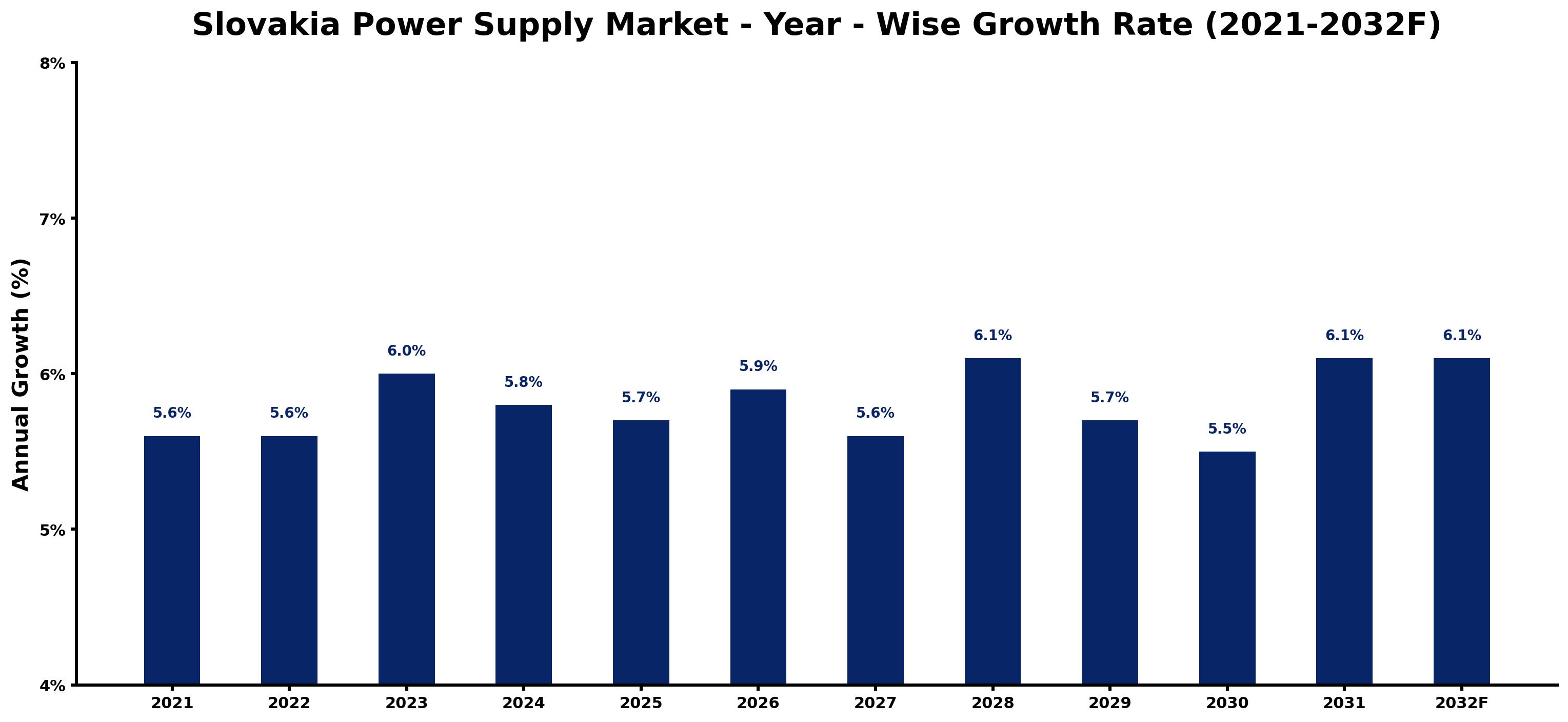
The table below presents the year wise growth rates along with the key drivers influencing the market
| Year | Growth Rate | Major Drivers |
| 2021 | 5.6% | Transformation in energy consumption patterns began shaping the overall power supply landscape. |
| 2022 | 5.6% | Investments in renewable energy projects gained traction, influencing long-term supply strategies. |
| 2023 | 6.0% | Public interest in sustainable energy options led utilities to diversify their portfolios. |
| 2024 | 5.8% | Infrastructure upgrades became essential to modernize aging grid systems across regions. |
| 2025 | 5.7% | Technological innovations in energy storage provided new opportunities for reliability improvements. |
| 2026 | 5.9% | Increased competition among suppliers stimulated pricing strategies beneficial for consumers. |
| 2027 | 5.6% | Consumer preferences shifted toward energy efficiency, urging companies to adapt their offerings. |
| 2028 | 6.1% | Emerging startups entered the market, introducing disruptive business models and technologies. |
| 2029 | 5.7% | Partnerships with local governments facilitated community-driven energy projects across urban areas. |
| 2030 | 5.5% | Growing emphasis on smart grid solutions enhanced energy distribution and consumption insights. |
| 2031 | 6.1% | International collaborations focused on energy transition efforts reshaped regional investment landscapes. |
| 2032 | 6.1% | Increased reliance on digital platforms for energy management transformed consumer engagement methods. |
Note - Market size estimations and growth projections presented in this report are based on 6Wresearch's advanced forecasting approach, validated with industry datasets as of June 2026.
Slovakia Power Supply Market Synopsis
The Slovakia Power Supply Market is projected to reach 5.9% and witness significant growth during the forecast period (2026-2032). This dynamic market is characterized by a combination of traditional energy sources, such as nuclear and coal, alongside an increasing share of renewable energy sources. As Slovakia progresses towards its ambitious energy goals, the landscape is shifting with a focus on sustainability, modernization, and technological integration.
Slovakia Power Supply Market Growth Drivers
Several key drivers are propelling the growth of the Slovakia Power Supply Market. The government has established regulatory frameworks that encourage investments in renewable energy, aiming to reduce reliance on fossil fuels. Additionally, the rising demand for electricity, particularly from the industrial sector, is contributing to the expansion of power generation capacities. Environmental concerns are also pushing for a transition towards cleaner energy solutions, making renewable energy more attractive. Furthermore, advancements in smart grid technologies are enhancing the efficiency and reliability of energy distribution systems. Lastly, public awareness and support for sustainable energy practices are encouraging further investment into renewable sources.
Slovakia Power Supply Market Trends and Opportunities
The Slovakia Power Supply Market is witnessing an array of trends that reflect its ongoing transformation. A notable trend is the increasing prioritization of renewable energy sources such as solar and wind, driven by governmental incentives and climate change imperatives. There is a heightened focus on energy storage solutions to support the integration of variable renewable energy into the grid, ensuring stability and efficiency. The adoption of smart grid technologies is also on the rise, facilitating better energy management and consumer engagement. Moreover, the liberalization of the energy market is fostering competition and innovation, providing consumers with more choices. Finally, the modernization of existing infrastructure is becoming crucial, as there is a need to upgrade aging facilities to meet contemporary energy demands efficiently.
Slovakia Power Supply Market Challenges and Restraints
The Slovakia Power Supply Market faces several challenges that could hinder its growth trajectory. Outdated infrastructure is a critical issue, as it leads to inefficiencies and reliability concerns, often resulting in service disruptions. The slow integration of renewable energy sources remains a significant barrier, as Slovakia still relies heavily on coal, raising both environmental and economic vulnerabilities. Furthermore, navigating the complex regulatory landscape can deter new entrants and affect the market dynamics negatively. Investment in the necessary technological innovations and upgrades is also required to overcome these challenges effectively. Addressing these issues will be paramount for achieving a sustainable and resilient energy future in Slovakia.
Slovakia Power Supply Market Investment Opportunities
Investment opportunities within the Slovakia Power Supply Market are increasingly attractive, particularly in the renewable energy sector. The government's ambitious targets for increasing the proportion of renewables present lucrative prospects for investors, especially in solar and wind project developments. Furthermore, the ongoing demand for upgrades to existing energy infrastructure represents a significant opportunity for modernization efforts. The market also shows potential for investment in smart grid technologies and energy storage solutions, which are critical for enhancing the grid's capability to accommodate renewable energy sources. Overall, the Slovakia Power Supply Market is emerging as a favorable environment for investments aimed at supporting the transition towards sustainable energy systems.
Slovakia Power Supply Market Government Investment and Initiatives
Government initiatives play a pivotal role in shaping the Slovakia Power Supply Market. The Energy Regulatory Office (ERU) is tasked with overseeing the electricity and gas sectors, ensuring a competitive market while protecting consumer interests. Policies supporting renewable energy adoption, such as feed-in tariffs and various incentive schemes, are designed to drive investment in this sector. Furthermore, public spending is directed towards enhancing energy efficiency and reducing greenhouse gas emissions, aligning with European Union directives. Strategic development plans focus on creating a resilient and competitive energy landscape, fostering an environment conducive to both traditional and renewable energy sources. Overall, these initiatives reflect the government's commitment to creating a sustainable energy future in Slovakia.
Slovakia Power Supply Market Latest Developments (May 2025 - June 2026)
In the recent period from May 2025 to June 2026, the Slovakia Power Supply Market has undergone notable developments. There has been an increase in government support for renewable energy projects as public and private stakeholders collaborate on clean energy initiatives. The implementation of smart grid solutions has gained momentum, enhancing the efficiency of energy distribution systems. Additionally, discussions surrounding policy reforms aimed at further market liberalization have continued, promising to create a more competitive landscape. Efforts to address infrastructural shortcomings have also been prioritized, with plans for investments aimed at modernizing aging facilities. Overall, these developments signal a robust trajectory towards a sustainable energy framework in Slovakia.
Slovakia Power Supply Market - Key Attractiveness of the Report
- 10 Years of Market Numbers
- Historical Data Starting from 2022 to 2025
- Base Year: 2025
- Forecast Data until 2032
- Key Performance Indicators Impacting the Market
- Major Upcoming Developments and Projects
Key Highlights of the Report:
- Slovakia Power Supply Market Outlook
- Market Size of Slovakia Power Supply Market, 2025
- Forecast of Slovakia Power Supply Market, 2032F
- Historical Data and Forecast of Slovakia Power Supply Revenues & Volume for the Period 2022-2032F
- Slovakia Power Supply Market Trend Evolution
- Slovakia Power Supply Market Drivers and Challenges
- Slovakia Power Supply Price Trends
- Slovakia Power Supply Porter's Five Forces
- Slovakia Power Supply Industry Life Cycle
- Historical Data and Forecast of Slovakia Power Supply Market Revenues & Volume By Output Power for the Period 2022-2032F
- Historical Data and Forecast of Slovakia Power Supply Market Revenues & Volume By Power Supply With Low Output (500 W and Below) for the Period 2022-2032F
- Historical Data and Forecast of Slovakia Power Supply Market Revenues & Volume By Power Supply With Medium Output (500?1,000 W) for the Period 2022-2032F
- Historical Data and Forecast of Slovakia Power Supply Market Revenues & Volume By Power Supply With High Output (More Than 1,000 W) for the Period 2022-2032F
- Historical Data and Forecast of Slovakia Power Supply Market Revenues & Volume By Type for the Period 2022-2032F
- Historical Data and Forecast of Slovakia Power Supply Market Revenues & Volume By AC-DC Power Supply for the Period 2022-2032F
- Historical Data and Forecast of Slovakia Power Supply Market Revenues & Volume By DC-DC Power Supply for the Period 2022-2032F
- Historical Data and Forecast of Slovakia Power Supply Market Revenues & Volume By Vertical for the Period 2022-2032F
- Historical Data and Forecast of Slovakia Power Supply Market Revenues & Volume By Medical & Healthcare for the Period 2022-2032F
- Historical Data and Forecast of Slovakia Power Supply Market Revenues & Volume By Military & Aerospace for the Period 2022-2032F
- Historical Data and Forecast of Slovakia Power Supply Market Revenues & Volume By Telecommunications for the Period 2022-2032F
- Historical Data and Forecast of Slovakia Power Supply Market Revenues & Volume By Consumer Electronics for the Period 2022-2032F
- Historical Data and Forecast of Slovakia Power Supply Market Revenues & Volume By Transportation for the Period 2022-2032F
- Historical Data and Forecast of Slovakia Power Supply Market Revenues & Volume By Lighting for the Period 2022-2032F
- Historical Data and Forecast of Slovakia Power Supply Market Revenues & Volume By Food & Beverages for the Period 2022-2032F
- Historical Data and Forecast of Slovakia Power Supply Market Revenues & Volume By Industrial for the Period 2022-2032F
- Slovakia Power Supply Import Export Trade Statistics
- Market Opportunity Assessment By Output Power
- Market Opportunity Assessment By Type
- Market Opportunity Assessment By Vertical
- Slovakia Power Supply Top Companies Market Share
- Slovakia Power Supply Competitive Benchmarking By Technical and Operational Parameters
- Slovakia Power Supply Company Profiles
- Slovakia Power Supply Key Strategic Recommendations






































