Slovakia Predictive Maintenance Market Size & Growth Rate (2026-2032)
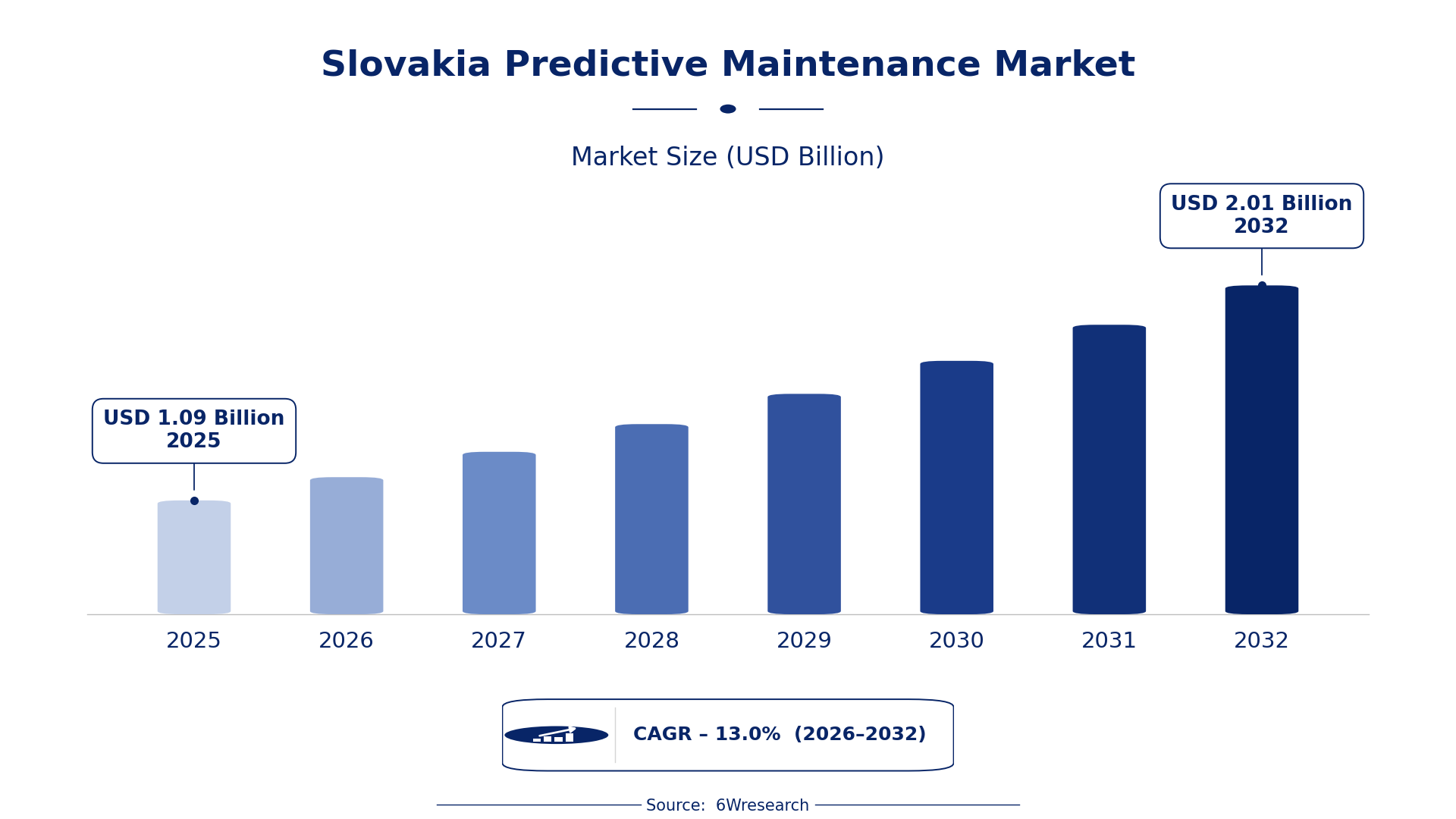
The Slovakia Predictive Maintenance Market was estimated at USD 1086 Million in 2025 and is projected to reach USD 2009 Million by 2032, growing at a CAGR of 13.0% from 2026 to 2032.
Slovakia Predictive Maintenance Market Synopsis
The Slovakia Predictive Maintenance Market is rapidly expanding as industries increasingly turn to advanced technologies to enhance maintenance operations. This growth reflects a broader trend where businesses are leveraging data analytics, machine learning, and IoT sensors to boost asset reliability and minimize downtime.
Key sectors such as manufacturing, energy, and healthcare are at the forefront of this shift, adopting predictive maintenance solutions to streamline their processes. As these industries evolve, the demand for tailored predictive maintenance offerings is set to rise, presenting a fertile ground for both local and international providers.
Slovakia Predictive Maintenance Market Year-wise Growth Rate and Key Drivers
This graph illustrates the annual growth rates of the Slovakia Predictive Maintenance Market from 2021 to 2032, highlighting a steady upward trajectory and projected expansion over the forecast period.
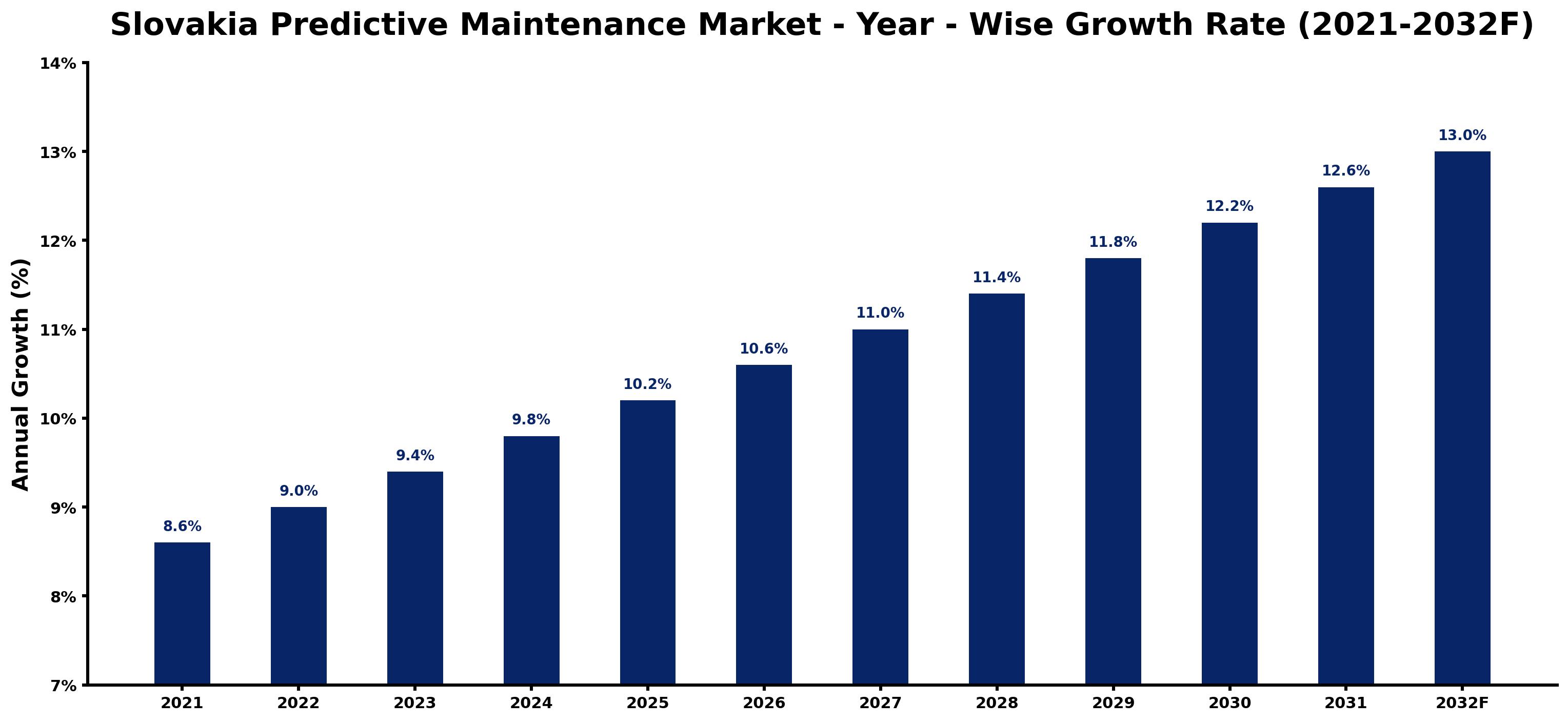
The table below presents the year‑wise growth rates along with the key drivers influencing the market
| Year | Growth Rate | Major Drivers |
| 2021 | 8.6% | Increased demand for smart manufacturing solutions in Slovakia |
| 2022 | 9.0% | Government incentives for Industry 4.0 technology adoption |
| 2023 | 9.4% | Growing awareness of equipment downtime costs among businesses |
| 2024 | 9.8% | Investment in IoT infrastructure by Slovakian manufacturers |
| 2025 | 10.2% | Regulatory push for predictive analytics in industrial sectors |
| 2026 | 10.6% | Rising number of technology startups focusing on maintenance solutions |
| 2027 | 11.0% | Increased government funding for digital transformation projects |
| 2028 | 11.4% | Implementation of EU-backed initiatives for maintenance optimization |
| 2029 | 11.8% | Growing labor cost pressures driving efficiency solutions adoption |
| 2030 | 12.2% | Advancements in AI technology tailored for manufacturing applications |
| 2031 | 12.6% | Enhanced data analytics capabilities in Slovakian industries |
| 2032 | 13.0% | Strong export demand influencing predictive maintenance investments |
Note: Market size estimations and growth projections presented in this report are based on 6Wresearch's proprietary forecasting methodology, utilizing the latest available industry data, government publications, and primary research inputs.
Slovakia Predictive Maintenance Market Key Takeaways
Below are some of the specific key takeaways from the market, including:
- The market is witnessing substantial investment in AI and machine learning technologies to enhance predictive capabilities.
- Real-time monitoring through IoT sensors is becoming a standard practice for many organizations.
- Government initiatives are actively promoting the adoption of digital maintenance solutions.
- Challenges related to initial costs and skilled labor are significant but manageable with strategic planning.
- Collaboration between technology providers and local industries is vital for custom solutions that meet specific needs.
Evaluation of Restraints in Slovakia Predictive Maintenance Market
The Slovakia Predictive Maintenance Market faces challenges that could hinder its growth trajectory. High initial investment costs for implementing predictive maintenance solutions can deter smaller businesses from adopting these technologies. on top of that, a shortage of skilled professionals proficient in data analytics and predictive modeling presents a significant barrier to successful implementation. Integration complexities with existing systems can further complicate the transition, and data security concerns are paramount as companies navigate the collection and analysis of sensitive operational data.
Slovakia Predictive Maintenance Market Trends
A noticeable trend in the Slovakia Predictive Maintenance Market is the increasing integration of AI and machine learning to predict equipment failures and optimize maintenance schedules. Companies are shifting their focus toward IoT-enabled solutions that facilitate real-time monitoring, thereby allowing for proactive maintenance actions. This strategic pivot aims to reduce downtime and enhance operational efficiency, highlighting the growing recognition of predictive maintenance as an essential component of modern industrial practices.
Slovakia Predictive Maintenance Market Opportunities
The Slovakia Predictive Maintenance Market is ripe with opportunities for investors and technology providers. Key industries such as transportation and energy are particularly promising, as they increasingly seek predictive maintenance solutions to enhance operational efficiency. Advanced analytics, machine learning algorithms, and IoT sensor technologies present significant avenues for investment. Establishing partnerships with local manufacturing firms can lead to tailored solutions that address specific industry needs, thereby creating a competitive advantage.
Government Initiatives in the Slovakia Predictive Maintenance Market
The Slovak government is actively fostering an environment conducive to digital innovation and the adoption of predictive maintenance technologies. Various initiatives are underway to promote collaboration between industry and research institutions, aimed at enhancing operational efficiency and ensuring Slovakia remains competitive on the global stage.
- A national initiative launched in early 2025 supports digital transformation in the manufacturing sector, including predictive maintenance technology adoption.
- Currently ongoing, a government-backed program is facilitating partnerships between tech providers and local businesses to drive innovation in maintenance practices.
- Upcoming regulations planned for 2026 are expected to encourage transparency and data-sharing practices within the predictive maintenance ecosystem.
- Funding opportunities are currently available for companies investing in smart technologies that enhance predictive maintenance capabilities.
- A public-private partnership initiative, recently announced, aims to develop a training program for skilled professionals in data analytics relevant to predictive maintenance.
Future Insights of the Slovakia Predictive Maintenance Market
Looking ahead, the Slovakia Predictive Maintenance Market is expected to experience robust growth driven by the continued integration of IoT and AI technologies across various sectors. As businesses focus on minimizing downtime and optimizing maintenance processes, the demand for predictive maintenance solutions will only intensify. This evolution will likely foster greater technological advancements, positioning Slovakia as a leader in the predictive maintenance field.
Slovakia Predictive Maintenance Market Latest Developments
In the past year, activity in the Slovakia Predictive Maintenance Market has ramped up significantly, reflecting a keen interest in advanced maintenance solutions. Companies are increasingly investing in technologies that enhance their operational capabilities and reduce costs.
- A leading regional operator initiated a rollout of new IoT-enabled predictive maintenance sensors in Q1 2025, aimed at enhancing equipment monitoring.
- A major technology vendor launched an advanced analytics platform in mid-2025, designed specifically for the energy sector to optimize maintenance schedules.
- Ongoing collaboration between industry players and academic institutions, started in late 2025, focuses on developing innovative predictive maintenance strategies.
- A new public-private initiative expected to begin in early 2026 aims to expand the workforce skilled in predictive maintenance technologies.
- A recent pilot project launched in Q3 2025 is testing the integration of AI-driven algorithms in manufacturing maintenance operations.
Slovakia Predictive Maintenance Market - Key Attractiveness of the Report
- 10 Years of Market Numbers
- Historical Data Starting from 2022 to 2025
- Base Year: 2025
- Forecast Data until 2032
- Key Performance Indicators Impacting the Market
- Major Upcoming Developments and Projects
Key Highlights of the Report:
- Slovakia Predictive Maintenance Market Outlook
- Market Size of Slovakia Predictive Maintenance Market, 2025
- Forecast of Slovakia Predictive Maintenance Market, 2032
- Historical Data and Forecast of Slovakia Predictive Maintenance Revenues & Volume for the Period 2022-2032F
- Slovakia Predictive Maintenance Market Trend Evolution
- Slovakia Predictive Maintenance Market Drivers and Challenges
- Slovakia Predictive Maintenance Price Trends
- Slovakia Predictive Maintenance Porter's Five Forces
- Slovakia Predictive Maintenance Industry Life Cycle
- Historical Data and Forecast of Slovakia Predictive Maintenance Market Revenues & Volume By Component for the Period 2022-2032F
- Historical Data and Forecast of Slovakia Predictive Maintenance Market Revenues & Volume By Solutions for the Period 2022-2032F
- Historical Data and Forecast of Slovakia Predictive Maintenance Market Revenues & Volume By Services for the Period 2022-2032F
- Historical Data and Forecast of Slovakia Predictive Maintenance Market Revenues & Volume By Organization Size for the Period 2022-2032F
- Historical Data and Forecast of Slovakia Predictive Maintenance Market Revenues & Volume By Large Enterprises for the Period 2022-2032F
- Historical Data and Forecast of Slovakia Predictive Maintenance Market Revenues & Volume By SME for the Period 2022-2032F
- Historical Data and Forecast of Slovakia Predictive Maintenance Market Revenues & Volume By Deployment Mode for the Period 2022-2032F
- Historical Data and Forecast of Slovakia Predictive Maintenance Market Revenues & Volume By On-premises for the Period 2022-2032F
- Historical Data and Forecast of Slovakia Predictive Maintenance Market Revenues & Volume By Cloud for the Period 2022-2032F
- Historical Data and Forecast of Slovakia Predictive Maintenance Market Revenues & Volume By Vertical for the Period 2022-2032F
- Historical Data and Forecast of Slovakia Predictive Maintenance Market Revenues & Volume By Government and Defense for the Period 2022-2032F
- Historical Data and Forecast of Slovakia Predictive Maintenance Market Revenues & Volume By Manufacturing for the Period 2022-2032F
- Historical Data and Forecast of Slovakia Predictive Maintenance Market Revenues & Volume By Energy and Utilities for the Period 2022-2032F
- Historical Data and Forecast of Slovakia Predictive Maintenance Market Revenues & Volume By Transportation and Logistics for the Period 2022-2032F
- Historical Data and Forecast of Slovakia Predictive Maintenance Market Revenues & Volume By Healthcare and Life Sciences for the Period 2022-2032F
- Slovakia Predictive Maintenance Import Export Trade Statistics
- Market Opportunity Assessment By Component
- Market Opportunity Assessment By Organization Size
- Market Opportunity Assessment By Deployment Mode
- Market Opportunity Assessment By Vertical
- Slovakia Predictive Maintenance Top Companies Market Share
- Slovakia Predictive Maintenance Competitive Benchmarking By Technical and Operational Parameters
- Slovakia Predictive Maintenance Company Profiles
- Slovakia Predictive Maintenance Key Strategic Recommendations






































