Slovakia Retail And Wholesale Market Size, Share & Growth Rate
The Slovakia Retail And Wholesale Market was estimated at USD 840 Million in 2025 and is projected to reach USD 1488 Million by 2032, growing at a CAGR of 8.5% from 2026 to 2032. This growth trajectory is fueled by a burgeoning middle class and increasing disposable incomes, which are fostering a demand for diverse retail offerings. Additionally, the rapid rise of e-commerce, particularly among younger consumers, is transforming shopping habits and driving further expansion in the sector.
Slovakia Retail And Wholesale Market Year-wise Growth Rate and Key Drivers
This graph highlights how the Slovakia Retail And Wholesale Market has steadily grown over the years, supported by major growth factors.
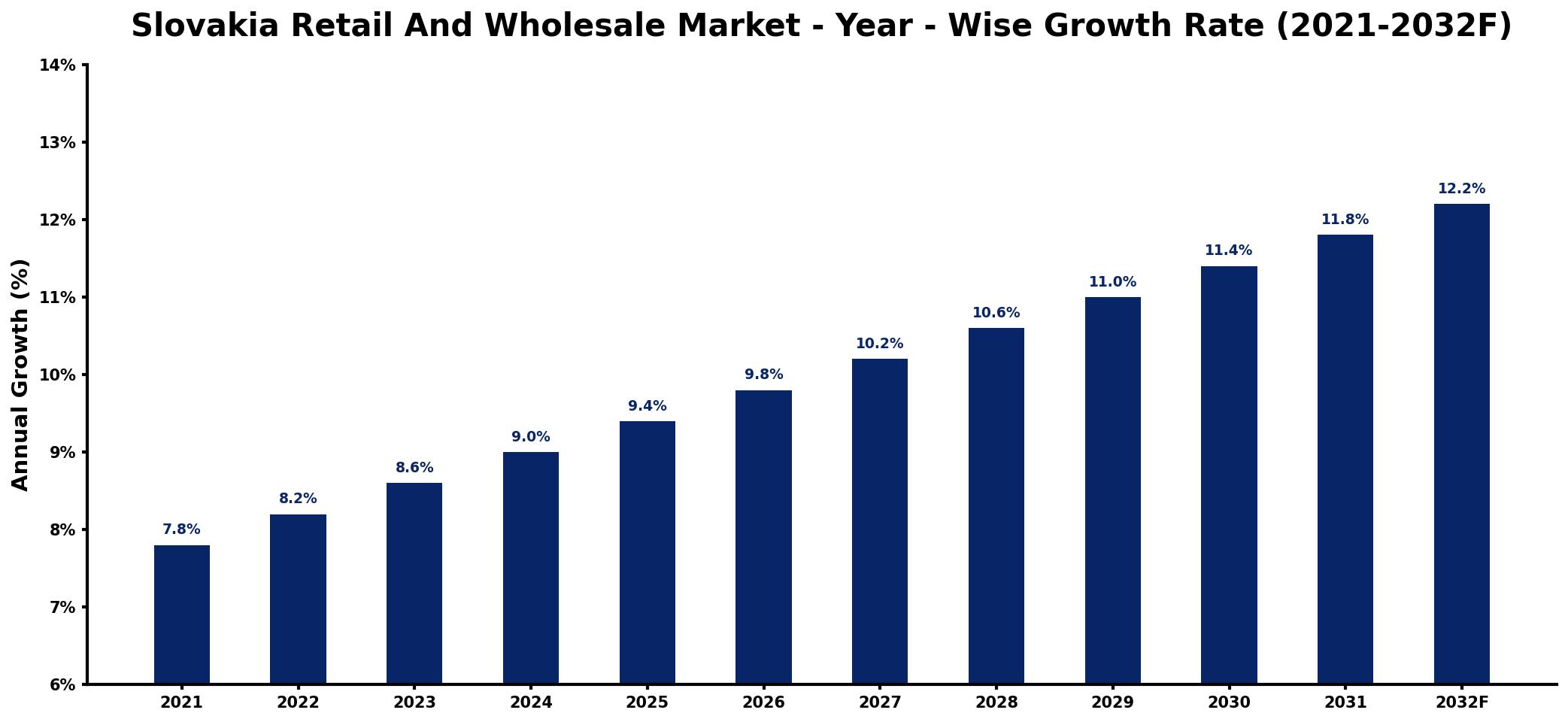
The table below presents the year‑wise growth rates along with the key drivers influencing the market
| Year | Growth Rate | Major Drivers |
| 2021 | 7.8% | E-commerce adoption accelerates significantly |
| 2022 | 8.2% | Consumer spending increases substantially |
| 2023 | 8.6% | Technological advancements drive efficiency |
| 2024 | 9.0% | Investment in infrastructure expands rapidly |
| 2025 | 9.4% | Sustainable practices gain consumer favor |
| 2026 | 9.8% | Urbanization boosts market accessibility |
| 2027 | 10.2% | Diverse product offerings attract customers |
| 2028 | 10.6% | Digital payment solutions enhance convenience |
| 2029 | 11.0% | Rising disposable incomes stimulate purchases |
| 2030 | 11.4% | Innovative marketing strategies engage consumers |
| 2031 | 11.8% | Supply chain improvements reduce costs |
| 2032 | 12.2% | Brand loyalty programs strengthen retention |
Note: Market size estimations and growth projections presented in this report are based on 6Wresearch's proprietary forecasting methodology, utilizing the latest available industry data, government publications, and primary research inputs.
Slovakia Retail And Wholesale Market Synopsis
Recent momentum in the Slovakia retail and wholesale market showcases a sector in transition, heavily influenced by digital advancements and evolving consumer preferences. Looking ahead, the market is poised for significant growth, underpinned by a stable economic environment and an increasingly sophisticated consumer base.
The competitive landscape is marked by the dominance of large supermarket chains and a surge in online retailing. As businesses adapt to the dual demands of sustainability and convenience, they are expanding product ranges to include ethically sourced and eco-friendly options, indicating a progressive shift towards a more responsible retail framework.
Slovakia Retail And Wholesale Market Key Takeaways
- The market is set to grow significantly, transitioning towards a more digital and customer-centric approach.
- Consumer preferences are increasingly leaning towards sustainability and ethical practices, influencing product offerings.
- Online shopping is becoming a dominant force, with retailers investing in omnichannel strategies to meet demand.
- The wholesale sector is evolving as businesses seek efficient supply chains and broader product ranges.
- Investment opportunities abound for both domestic and foreign entities looking to tap into the growing middle class.
Evaluation of Restraints in Slovakia Retail And Wholesale Market
Despite its promising trajectory, the Slovakia retail and wholesale market faces certain restraints. Increasing competition from online retailers presents a challenge for traditional stores, compelling them to innovate rapidly. Additionally, rising operational costs related to rent and labor can significantly impact profit margins, forcing businesses to rethink their pricing strategies and operational efficiencies. Moreover, navigating the complex regulatory environment can present hurdles for new entrants, making it imperative for firms to have a strong understanding of local laws and compliance standards to thrive.
Slovakia Retail And Wholesale Market Trends
Key trends driving the Slovakia retail and wholesale market include a marked shift towards digital and e-commerce platforms, with retailers optimizing their online presence to capture the growing segment of tech-savvy consumers. Furthermore, the demand for personalized shopping experiences is on the rise; retailers are leveraging data analytics to tailor offerings to individual preferences. Sustainability is another significant trend, with consumers increasingly favoring products that are environmentally friendly and ethically produced, pushing retailers to adapt their strategies accordingly.
Slovakia Retail And Wholesale Market Opportunities
Opportunities for growth in the Slovakia retail and wholesale market are abundant. The expansion of e-commerce presents a lucrative landscape for investment, with online retailers poised to capture an increasingly significant share of consumer spending. As the middle class continues to grow, there is a heightened demand for a variety of retail products and services, providing businesses an opportunity to innovate and differentiate themselves. Additionally, collaboration with local suppliers and the introduction of unique offerings can further enhance market positioning and profitability.
Government Initiatives in the Slovakia Retail And Wholesale Market
The Slovak government is actively promoting a healthy retail and wholesale environment through various policies aimed at fostering fair competition and safeguarding consumer rights. Regulatory frameworks are established to prevent anti-competitive practices, while consumer protection laws ensure that businesses adhere to safety and quality standards. Additionally, the government encourages transparency in the market, mandating clear and accurate information dissemination to consumers, all of which contributes to a robust retail landscape.
Future Insights of the Slovakia Retail And Wholesale Market
Looking ahead to 2026-2032, the Slovakia retail and wholesale market is expected to continue its upward momentum. Factors such as rising consumer confidence, increased disposable income, and a steadfast inclination toward e-commerce are likely to play pivotal roles in market expansion. As businesses increasingly focus on technological integration and sustainable practices, the landscape will evolve, paving the way for innovative solutions and market differentiation, which are essential for success in this dynamic environment.
Slovakia Retail And Wholesale Market Latest Developments (2025 - 2026)
The industry is currently witnessing significant changes, with various retail players enhancing their digital capabilities to compete effectively in the e-commerce space. A surge in environmentally friendly product lines is also observed, as consumers demand greater sustainability from brands. Furthermore, collaboration between retailers and local producers is gaining traction, aimed at enhancing product variety and quality, while meeting the rising consumer preference for locally sourced goods.
Slovakia Retail And Wholesale Market - Key Attractiveness of the Report
- 10 Years of Market Numbers
- Historical Data Starting from 2022 to 2025
- Base Year: 2025
- Forecast Data until 2032
- Key Performance Indicators Impacting the Market
- Major Upcoming Developments and Projects
Key Highlights of the Report:
- Slovakia Retail And Wholesale Market Outlook
- Market Size of Slovakia Retail And Wholesale Market, 2025
- Forecast of Slovakia Retail And Wholesale Market, 2032
- Historical Data and Forecast of Slovakia Retail And Wholesale Revenues & Volume for the Period 2022-2032F
- Slovakia Retail And Wholesale Market Trend Evolution
- Slovakia Retail And Wholesale Market Drivers and Challenges
- Slovakia Retail And Wholesale Price Trends
- Slovakia Retail And Wholesale Porter's Five Forces
- Slovakia Retail And Wholesale Industry Life Cycle
- Historical Data and Forecast of Slovakia Retail And Wholesale Market Revenues & Volume By Type for the Period 2022-2032F
- Historical Data and Forecast of Slovakia Retail And Wholesale Market Revenues & Volume By Retail for the Period 2022-2032F
- Historical Data and Forecast of Slovakia Retail And Wholesale Market Revenues & Volume By Wholesale for the Period 2022-2032F
- Historical Data and Forecast of Slovakia Retail And Wholesale Market Revenues & Volume By Ownership for the Period 2022-2032F
- Historical Data and Forecast of Slovakia Retail And Wholesale Market Revenues & Volume By Retail Chain/Wholesale Chain for the Period 2022-2032F
- Historical Data and Forecast of Slovakia Retail And Wholesale Market Revenues & Volume By Independent Retailer/Independent Wholesalers for the Period 2022-2032F
- Historical Data and Forecast of Slovakia Retail And Wholesale Market Revenues & Volume By Price Range for the Period 2022-2032F
- Historical Data and Forecast of Slovakia Retail And Wholesale Market Revenues & Volume By Premium for the Period 2022-2032F
- Historical Data and Forecast of Slovakia Retail And Wholesale Market Revenues & Volume By Mid-Range for the Period 2022-2032F
- Historical Data and Forecast of Slovakia Retail And Wholesale Market Revenues & Volume By Economy for the Period 2022-2032F
- Historical Data and Forecast of Slovakia Retail And Wholesale Market Revenues & Volume By Distribution Channel for the Period 2022-2032F
- Historical Data and Forecast of Slovakia Retail And Wholesale Market Revenues & Volume By Supermarkets/Hypermarkets for the Period 2022-2032F
- Historical Data and Forecast of Slovakia Retail And Wholesale Market Revenues & Volume By Convenience Stores for the Period 2022-2032F
- Historical Data and Forecast of Slovakia Retail And Wholesale Market Revenues & Volume By Department Stores for the Period 2022-2032F
- Historical Data and Forecast of Slovakia Retail And Wholesale Market Revenues & Volume By Specialty Stores for the Period 2022-2032F
- Slovakia Retail And Wholesale Import Export Trade Statistics
- Market Opportunity Assessment By Type
- Market Opportunity Assessment By Ownership
- Market Opportunity Assessment By Price Range
- Market Opportunity Assessment By Distribution Channel
- Slovakia Retail And Wholesale Top Companies Market Share
- Slovakia Retail And Wholesale Competitive Benchmarking By Technical and Operational Parameters
- Slovakia Retail And Wholesale Company Profiles
- Slovakia Retail And Wholesale Key Strategic Recommendations






































