Slovakia Retail Industry Market Size, Share & Growth Rate
The Slovakia Retail Industry Market was estimated at USD 175 Million in 2025 and is projected to reach USD 222 Million by 2032, growing at a CAGR of 3.5% from 2026 to 2032. This growth is being fueled by increasing disposable incomes among consumers, who are demanding more variety and convenience in their shopping experiences. Additionally, the rapid expansion of e-commerce and the integration of advanced technologies are creating significant opportunities for retailers across the sector.
Slovakia Retail Industry Market Year-wise Growth Rate and Key Drivers
This graph highlights how the Slovakia Retail Industry Market has steadily grown over the years, supported by major growth factors.
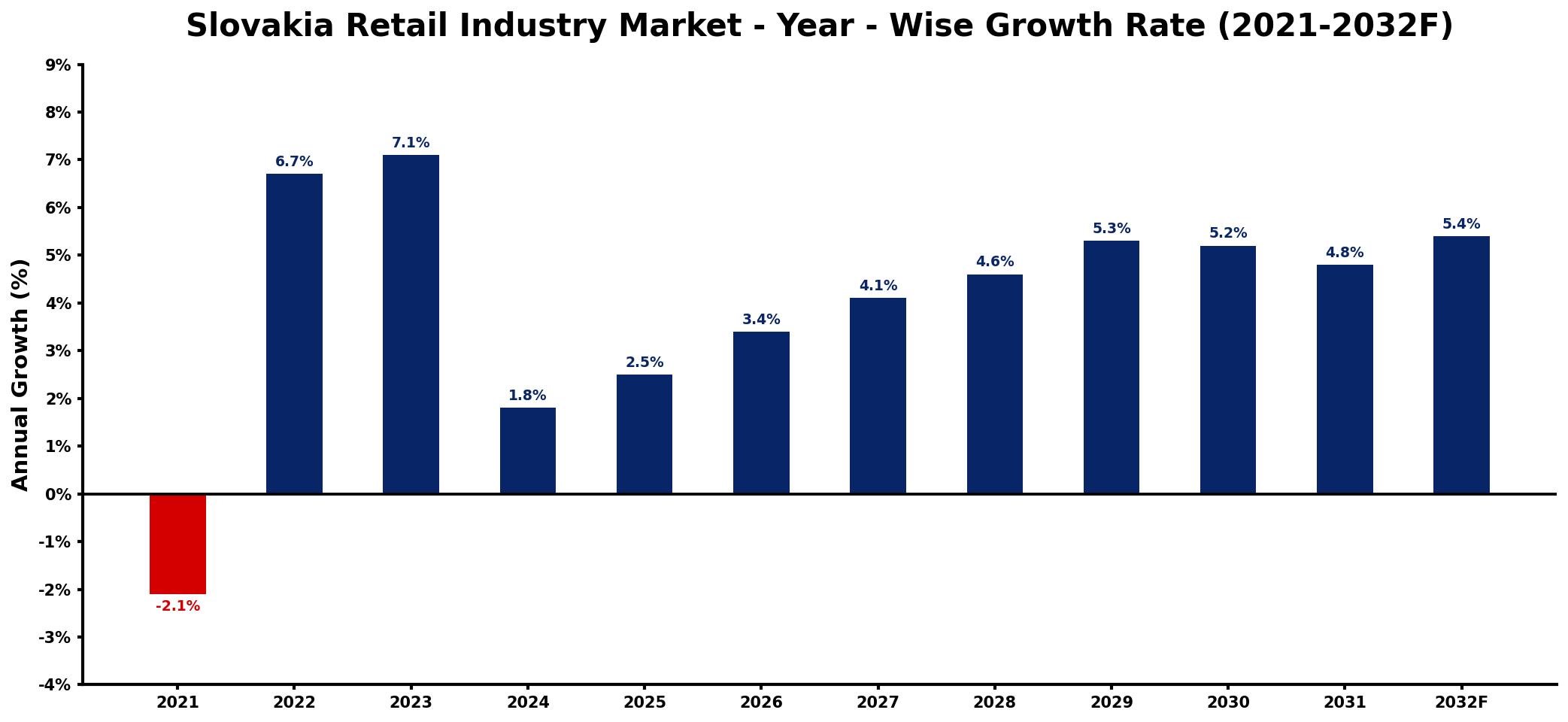
The table below presents the year‑wise growth rates along with the key drivers influencing the market
| Year | Growth Rate | Major Drivers |
| 2021 | -2.1% | Consumer spending showed significant decline |
| 2022 | 6.7% | E-commerce platforms saw rapid growth |
| 2023 | 7.1% | Increased focus on sustainability initiatives |
| 2024 | 1.8% | Investment in technology integration rises |
| 2025 | 2.5% | Expansion of local supply chains |
| 2026 | 3.4% | Rising demand for personalized services |
| 2027 | 4.1% | strengthening international trade flows |
| 2028 | 4.6% | Emergence of new shopping formats |
| 2029 | 5.3% | Boost in cross-border online sales |
| 2030 | 5.2% | Adoption of innovative payment solutions |
| 2031 | 4.8% | Strengthening of customer loyalty programs |
| 2032 | 5.4% | Enhanced focus on omnichannel strategies |
Note: Market size estimations and growth projections presented in this report are based on 6Wresearch's proprietary forecasting methodology, utilizing the latest available industry data, government publications, and primary research inputs.
Slovakia Retail Industry Market Synopsis
A major driving force in the Slovakia Retail Industry Market is the accelerating trend towards digitalization. Retailers are increasingly adopting omnichannel strategies, blending online and offline experiences to meet the evolving preferences of consumers. The emphasis on e-commerce is reshaping the competitive landscape, pushing traditional players to innovate and adapt.
In tandem with digital transformation, consumer demand for personalized shopping experiences is transforming retail strategies. Local businesses are harnessing their unique insights into regional preferences to complement the offerings of larger international retailers. This diversity enhances market dynamics and fosters an environment of healthy competition.
Slovakia Retail Industry Market Key Takeaways
- The market is experiencing a strong shift towards e-commerce and omnichannel retailing, driven by changing consumer behaviors.
- Increasing disposable income levels are expanding the consumer base and enhancing demand for various product categories.
- Technological innovations, such as AI and IoT, are enabling retailers to streamline operations and enhance customer engagement.
- Sustainability and ethical sourcing are emerging as critical factors influencing consumer purchasing decisions.
- Competitive pricing and product quality remain fundamental to success in this rapidly evolving market.
Evaluation of Restraints in Slovakia Retail Industry Market
Despite a positive growth trajectory, the Slovakia Retail Industry Market faces several restraints. The intensification of competition, particularly from international retailers entering the market, is forcing local businesses to rethink their strategies. Additionally, rising operating costs, such as rent and labor, put pressure on profit margins. Retailers are also challenged by the need to adapt to the swift pace of technological change while navigating fluctuating consumer spending patterns. As a result, businesses must continually innovate to maintain their competitive edge.
Slovakia Retail Industry Market Trends
Current trends in the Slovakia Retail Industry are largely focused on enhancing the online shopping experience. Retailers are investing significantly in digital marketing and customer personalization to capture a broader audience. Sustainability is becoming more important, with an increasing number of companies highlighting eco-friendly practices and products. The integration of AI and advanced analytics is allowing for better inventory management and customer insights, which are crucial in todays fast-paced retail environment.
Slovakia Retail Industry Market Opportunities
Investment opportunities abound in the Slovakia retail market, particularly in e-commerce and digital logistics. As online shopping continues to gain traction, there is a significant demand for efficient delivery and fulfillment solutions. Niche markets, such as organic products and sustainable fashion, present lucrative prospects for specialized retailers. Moreover, the development of modern shopping centers and specialty stores offers opportunities for traditional retail growth, catering to a diverse consumer base eager for innovative shopping experiences.
Government Initiatives in the Slovakia Retail Industry Market
The Slovak government is committed to fostering a competitive retail landscape through various policies that promote consumer protection and fair competition. Regulations are in place to ensure clear pricing, return policies, and product safety standards. Additionally, governmental support programs aim to bolster small and medium-sized enterprises, enabling them to thrive and contribute to the market's growth. These initiatives create a conducive environment for both domestic and foreign retailers.
Future Insights of the Slovakia Retail Industry Market
Looking ahead to 2026-2032, the Slovakia Retail Industry Market is expected to sustain moderate growth, primarily driven by rising disposable income, urbanization, and an expanding middle-class demographic. The digital shopping paradigm will likely evolve further, with an emphasis on omnichannel retailing to accommodate diverse consumer preferences. However, retailers must remain agile, responding to competitive pressures and regulatory changes while also capitalizing on technological advancements to enhance customer engagement and operational efficiency.
Slovakia Retail Industry Market Latest Developments (2025 - 2026)
Recent developments in the Slovakia retail sector indicate a marked shift towards digital platforms, with many retailers enhancing their e-commerce capabilities. Innovations in payment methods and logistics solutions are becoming increasingly prevalent, facilitating smoother online transactions. Additionally, there is growing interest in sustainability, with retailers making concerted efforts to integrate eco-friendly practices into their operations. These trends reflect the market's adaptation to evolving consumer expectations and technological advancements.
Slovakia Retail Industry Market - Key Attractiveness of the Report
- 10 Years of Market Numbers
- Historical Data Starting from 2022 to 2025
- Base Year: 2025
- Forecast Data until 2032
- Key Performance Indicators Impacting the Market
- Major Upcoming Developments and Projects
Key Highlights of the Report:
- Slovakia Retail Industry Market Outlook
- Market Size of Slovakia Retail Industry Market, 2025
- Forecast of Slovakia Retail Industry Market, 2032
- Historical Data and Forecast of Slovakia Retail Industry Revenues & Volume for the Period 2022-2032F
- Slovakia Retail Industry Market Trend Evolution
- Slovakia Retail Industry Market Drivers and Challenges
- Slovakia Retail Industry Price Trends
- Slovakia Retail Industry Porter's Five Forces
- Slovakia Retail Industry Industry Life Cycle
- Historical Data and Forecast of Slovakia Retail Industry Market Revenues & Volume By Product for the Period 2022-2032F
- Historical Data and Forecast of Slovakia Retail Industry Market Revenues & Volume By Food and Beverages for the Period 2022-2032F
- Historical Data and Forecast of Slovakia Retail Industry Market Revenues & Volume By Personal and Household Care for the Period 2022-2032F
- Historical Data and Forecast of Slovakia Retail Industry Market Revenues & Volume By Apparel, Footwear, and Accessories for the Period 2022-2032F
- Historical Data and Forecast of Slovakia Retail Industry Market Revenues & Volume By Furniture, Toys, and Hobby for the Period 2022-2032F
- Historical Data and Forecast of Slovakia Retail Industry Market Revenues & Volume By Electronic and Household Appliances for the Period 2022-2032F
- Historical Data and Forecast of Slovakia Retail Industry Market Revenues & Volume By Other Products for the Period 2022-2032F
- Historical Data and Forecast of Slovakia Retail Industry Market Revenues & Volume By Distribution Channel for the Period 2022-2032F
- Historical Data and Forecast of Slovakia Retail Industry Market Revenues & Volume By Supermarkets/Hypermarkets for the Period 2022-2032F
- Historical Data and Forecast of Slovakia Retail Industry Market Revenues & Volume By Convenience Stores for the Period 2022-2032F
- Historical Data and Forecast of Slovakia Retail Industry Market Revenues & Volume By Department Stores for the Period 2022-2032F
- Historical Data and Forecast of Slovakia Retail Industry Market Revenues & Volume By Specialty Stores for the Period 2022-2032F
- Historical Data and Forecast of Slovakia Retail Industry Market Revenues & Volume By Online for the Period 2022-2032F
- Historical Data and Forecast of Slovakia Retail Industry Market Revenues & Volume By Other Distribution Channels for the Period 2022-2032F
- Slovakia Retail Industry Import Export Trade Statistics
- Market Opportunity Assessment By Product
- Market Opportunity Assessment By Distribution Channel
- Slovakia Retail Industry Top Companies Market Share
- Slovakia Retail Industry Competitive Benchmarking By Technical and Operational Parameters
- Slovakia Retail Industry Company Profiles
- Slovakia Retail Industry Key Strategic Recommendations






































