Slovakia Retail Market Size, Share & Growth Rate
The Slovakia Retail Market was estimated at USD 950 Million in 2025 and is projected to reach USD 1664 Million by 2032, growing at a CAGR of 8.3% from 2026 to 2032. This promising growth trajectory is fueled by a combination of rising disposable incomes, a burgeoning interest in quality consumer goods, and the increasing digitalization of shopping channels. As Slovak consumers seek both convenience and variety, retailers are increasingly adapting to meet these evolving demands.
Slovakia Retail Market Year-wise Growth Rate and Key Drivers
This graph highlights how the Slovakia Retail Market has steadily grown over the years, supported by major growth factors.
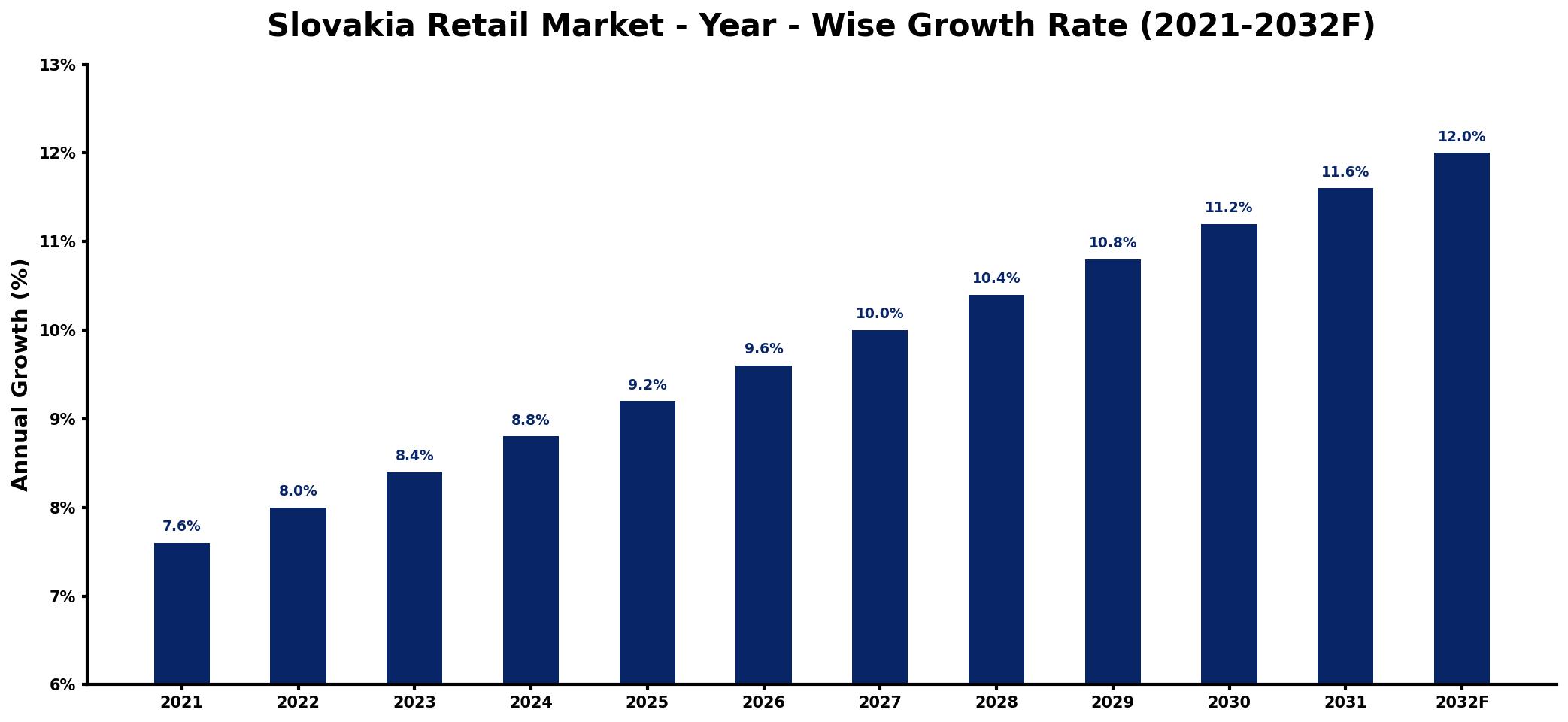
The table below presents the year‑wise growth rates along with the key drivers influencing the market
| Year | Growth Rate | Major Drivers |
| 2021 | 7.6% | E-commerce adoption accelerates rapidly |
| 2022 | 8.0% | Consumer spending increases significantly |
| 2023 | 8.4% | Technological innovations drive engagement |
| 2024 | 8.8% | Sustainability trends attract investments |
| 2025 | 9.2% | Urbanization boosts shopping experiences |
| 2026 | 9.6% | Health and wellness demand rises |
| 2027 | 10.0% | Omnichannel strategies gain traction |
| 2028 | 10.4% | Personalization enhances customer loyalty |
| 2029 | 10.8% | Mobile commerce expands rapidly |
| 2030 | 11.2% | New market entrants diversify offerings |
| 2031 | 11.6% | Social commerce influences purchasing behavior |
| 2032 | 12.0% | Digital payment solutions grow popularity |
Note: Market size estimations and growth projections presented in this report are based on 6Wresearch's proprietary forecasting methodology, utilizing the latest available industry data, government publications, and primary research inputs.
Slovakia Retail Market Synopsis
In recent years, Slovakia has witnessed a significant transformation in its retail landscape. The fusion of traditional shopping with a rapidly expanding online presence has led to a dynamic environment where consumer preferences are rapidly evolving. This shift is particularly pronounced among younger demographics, who favor digital shopping platforms.
Retailers are compelled to innovate in order to maintain competitive advantages. With a focus on enhancing customer experiences and integrating sustainability into their offerings, businesses in Slovakia are poised to respond to the demands of increasingly discerning consumers.
Slovakia Retail Market Key Takeaways
- Consumers in Slovakia are increasingly favoring a blend of quality and convenience in their shopping experiences.
- Brick-and-mortar stores are investing heavily in digital platforms to cater to the rising e-commerce trend.
- There is a notable consumer shift towards sustainable and ethically produced products.
- The government is fostering a regulatory environment that encourages fair competition and innovation in the retail sector.
- Investment opportunities abound, particularly in urban centers and e-commerce segments.
Evaluation of Restraints in Slovakia Retail Market
While the Slovakia retail market is expanding, it faces some significant restraints. Intense competition from both local and international retailers compels businesses to continuously differentiate their offerings. Furthermore, the market is experiencing shifts in consumer preferences that necessitate rapid adaptation. Retailers also grapple with rising operational costs, such as rent and wages, which can impact overall profitability. The integration of online and offline channels must be seamless to remain competitive, requiring investment in technology and infrastructure that can pose financial strains.
Slovakia Retail Market Trends
A pivotal trend within the Slovakia retail market is the emergence of omnichannel retailing. Traditional retailers are increasingly leveraging digital channels to enhance their reach. E-commerce is growing rapidly, particularly as younger consumers prioritize convenience. Retailers are focusing on personalization, utilizing data analytics to create customized shopping experiences that resonate with individual consumer preferences. Additionally, sustainability is becoming a key theme, as more consumers seek out eco-friendly options, prompting retailers to adapt their product offerings accordingly.
Slovakia Retail Market Opportunities
Investment opportunities in the Slovakia retail market are plentiful. As disposable income rises, there is a growing demand for high-quality goods across various sectors, including food and beverage, fashion, and electronics. Major urban areas such as Bratislava, Kosice, and Banska Bystrica present lucrative prospects for new retail establishments. The expanding e-commerce landscape also offers significant potential for online retail ventures, particularly for businesses that tailor their platforms to local consumer preferences and leverage partnerships with regional distributors.
Government Initiatives in the Slovakia Retail Market
Government initiatives in Slovakia are aimed at promoting a competitive retail environment that benefits both consumers and businesses. Key policies focus on ensuring transparency in pricing and advertising, thereby safeguarding consumer rights. There is also a concerted effort to attract foreign investment, which is seen as vital for fostering innovation within the retail sector. Regulatory frameworks are designed to prevent monopolistic practices, promoting diversity and ensuring a level playing field for all retailers.
Future Insights of the Slovakia Retail Market
Looking ahead to 2026-2032, the Slovakia retail market is on course for sustained growth. Increasing disposable incomes and a heightened focus on convenience will drive further expansion, particularly in the e-commerce sector. As more consumers prioritize sustainable and ethical consumption, retailers will need to adapt their product lines accordingly. The integration of innovative technologies will also be critical in enhancing customer engagement and operational efficiency, setting the stage for a robust retail future in Slovakia.
Slovakia Retail Market Latest Developments (2025 - 2026)
Recent developments in the Slovakia retail market indicate a shift towards more comprehensive digital strategies among retailers. Many are investing in advanced technologies to enhance the shopping experience and improve operational efficiencies. Furthermore, collaborative efforts between local producers and retailers are becoming more common, aimed at meeting the growing consumer demand for local and sustainable products. Overall, the market is adapting rapidly to both consumer trends and technological advancements, setting a forward-looking agenda.
Slovakia Retail Market - Key Attractiveness of the Report
- 10 Years of Market Numbers
- Historical Data Starting from 2022 to 2025
- Base Year: 2025
- Forecast Data until 2032
- Key Performance Indicators Impacting the Market
- Major Upcoming Developments and Projects
Key Highlights of the Report:
- Slovakia Retail Market Outlook
- Market Size of Slovakia Retail Market, 2025
- Forecast of Slovakia Retail Market, 2032
- Historical Data and Forecast of Slovakia Retail Revenues & Volume for the Period 2022-2032F
- Slovakia Retail Market Trend Evolution
- Slovakia Retail Market Drivers and Challenges
- Slovakia Retail Price Trends
- Slovakia Retail Porter's Five Forces
- Slovakia Retail Industry Life Cycle
- Historical Data and Forecast of Slovakia Retail Market Revenues & Volume By Product for the Period 2022-2032F
- Historical Data and Forecast of Slovakia Retail Market Revenues & Volume By Food and Beverages for the Period 2022-2032F
- Historical Data and Forecast of Slovakia Retail Market Revenues & Volume By Personal and Household Care for the Period 2022-2032F
- Historical Data and Forecast of Slovakia Retail Market Revenues & Volume By Apparel for the Period 2022-2032F
- Historical Data and Forecast of Slovakia Retail Market Revenues & Volume By Footwear and Accessories for the Period 2022-2032F
- Historical Data and Forecast of Slovakia Retail Market Revenues & Volume By Furniture for the Period 2022-2032F
- Historical Data and Forecast of Slovakia Retail Market Revenues & Volume By Toys for the Period 2022-2032F
- Historical Data and Forecast of Slovakia Retail Market Revenues & Volume By Electronic and Household Appliances for the Period 2022-2032F
- Historical Data and Forecast of Slovakia Food and Beverages Retail Market Revenues & Volume By Other Products for the Period 2022-2032F
- Historical Data and Forecast of Slovakia Retail Market Revenues & Volume By Distribution Channel for the Period 2022-2032F
- Historical Data and Forecast of Slovakia Retail Market Revenues & Volume By Supermarkets/Hypermarkets for the Period 2022-2032F
- Historical Data and Forecast of Slovakia Retail Market Revenues & Volume By Convenience Stores for the Period 2022-2032F
- Historical Data and Forecast of Slovakia Retail Market Revenues & Volume By Department Stores for the Period 2022-2032F
- Historical Data and Forecast of Slovakia Retail Market Revenues & Volume By Specialty Stores for the Period 2022-2032F
- Historical Data and Forecast of Slovakia Retail Market Revenues & Volume By Online for the Period 2022-2032F
- Historical Data and Forecast of Slovakia Retail Market Revenues & Volume By Other Distribution Channels for the Period 2022-2032F
- Slovakia Retail Import Export Trade Statistics
- Market Opportunity Assessment By Product
- Market Opportunity Assessment By Distribution Channel
- Slovakia Retail Top Companies Market Share
- Slovakia Retail Competitive Benchmarking By Technical and Operational Parameters
- Slovakia Retail Company Profiles
- Slovakia Retail Key Strategic Recommendations






































