Slovakia Sensor Market Top 5 Importing Countries and Market Competition (HHI) Analysis
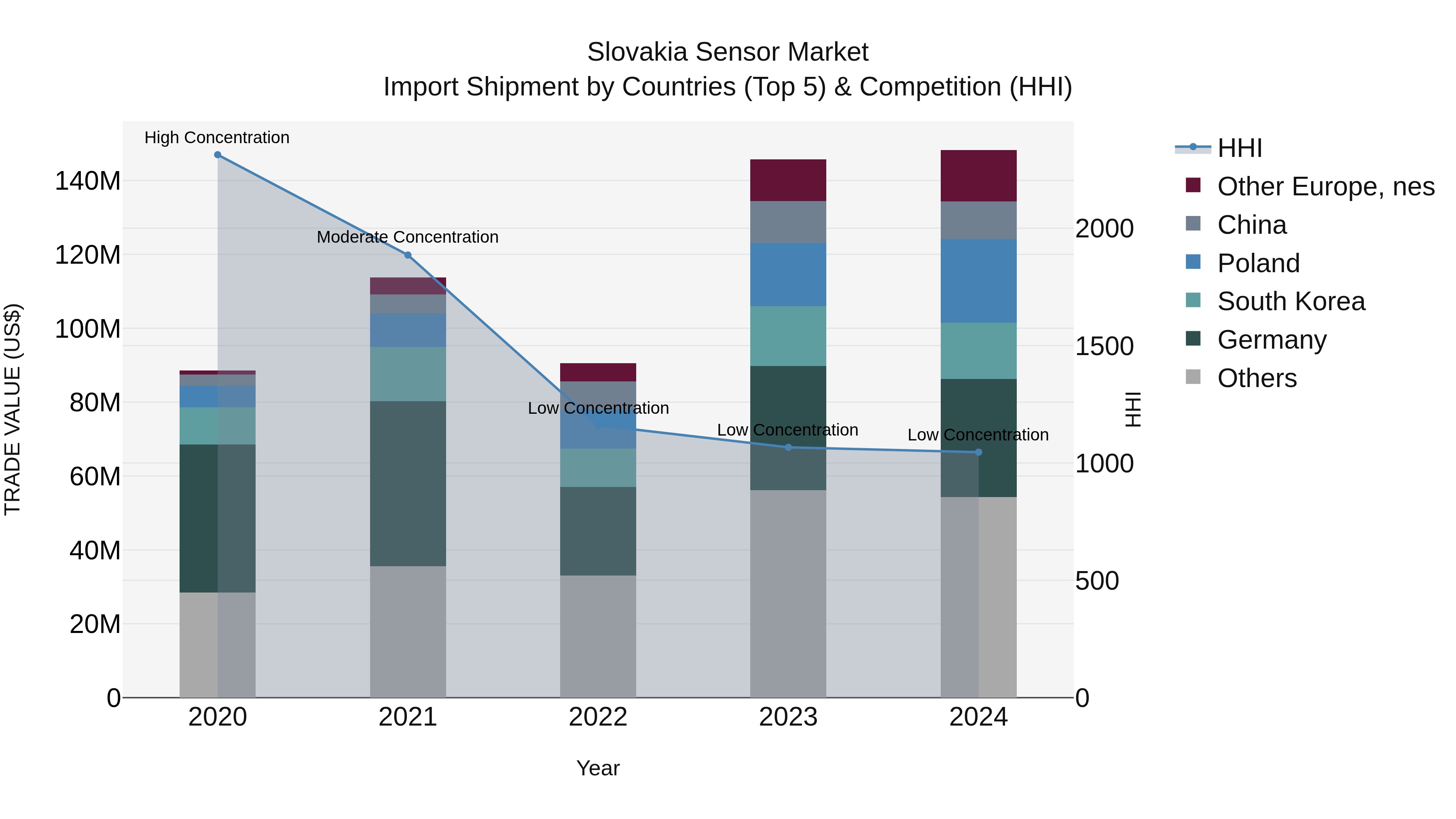
Slovakia`s sensor import Market Top 5 Importing Countries and Market Competition (HHI) Analysis in 2024 saw significant contributions from top exporters like Germany, Poland, South Korea, and China. The low Herfindahl-Hirschman Index (HHI) indicates a competitive Market Top 5 Importing Countries and Market Competition (HHI) Analysis landscape. With a Compound Annual Growth Rate (CAGR) of 13.74% from 2020 to 2024 and a growth rate of 1.68% from 2023 to 2024, Slovakia`s sensor import sector is showing steady growth and attracting diverse sources of supply from both within Europe and internationally.
Slovakia Sensor Market Overview
The Slovakia Sensor Market is experiencing steady growth driven by increasing adoption of sensors across various sectors such as automotive, healthcare, consumer electronics, and industrial automation. The market is witnessing a rise in demand for advanced sensors like MEMS sensors, optical sensors, and IoT sensors due to their efficiency in data collection and analysis. The automotive sector is a key contributor to the market growth, with sensors being widely used in advanced driver assistance systems and autonomous vehicles. Additionally, the healthcare sector is increasingly utilizing sensors for monitoring patient health and enhancing medical devices. The market is highly competitive with key players focusing on research and development to introduce innovative sensor technologies catering to the evolving market demands.
Slovakia Sensor Market Trends and Opportunities
In the Slovakia sensor market, there is a growing demand for sensors in various industries such as automotive, healthcare, and manufacturing. One prominent trend is the increasing adoption of IoT technology, driving the need for sensors to enable connectivity and data collection. Smart city projects and the rising importance of automation are also fueling the demand for sensors in Slovakia. Opportunities lie in the development of advanced sensor technologies like MEMS sensors and the integration of artificial intelligence for data analysis. Additionally, the push towards environmental sustainability is driving the need for sensors to monitor and optimize energy consumption and reduce waste. Overall, the Slovakia sensor market presents promising prospects for companies to innovate and cater to the evolving needs of industries in the country.
Slovakia Sensor Market Challenges
In the Slovakia Sensor Market, some key challenges include increasing competition from international sensor manufacturers, technological advancements leading to a need for continuous innovation and upgrades, and the growing demand for sensors across various industries requiring customization and specialization. Additionally, issues related to data privacy and security concerns are becoming more prominent as sensors collect and transmit sensitive information. Furthermore, the need for skilled workforce to develop, maintain, and integrate sensor technology poses a challenge in the market. Overall, navigating these challenges requires companies in the Slovakia Sensor Market to stay agile, invest in research and development, foster collaborations with technology partners, and ensure compliance with regulations to maintain a competitive edge in the evolving landscape.
Slovakia Sensor Market Drivers
The Slovakia Sensor Market is primarily driven by factors such as the increasing adoption of sensors across various industries for process automation, the growing demand for IoT devices and connected technologies, and the rising focus on enhancing efficiency and productivity in manufacturing processes. Additionally, the automotive sector is a significant driver of sensor market growth in Slovakia, with the increasing integration of advanced driver-assistance systems (ADAS) and other sensor-based technologies in vehicles. The expanding use of sensors in smart homes, healthcare applications, and environmental monitoring further contributes to market expansion. Overall, the need for real-time data monitoring, predictive maintenance, and improved safety measures fuels the demand for sensors in Slovakia across multiple sectors.
Slovakia Sensor Market Government Policies
Government policies related to the Slovakia Sensor Market focus on promoting innovation and technological development, particularly in the fields of automation, automotive, and industrial manufacturing. The government provides support through various initiatives such as research and development grants, tax incentives for companies investing in sensor technologies, and partnerships with educational institutions to nurture a skilled workforce. Additionally, there are regulations in place to ensure the quality and safety standards of sensors produced and used in Slovakia. The government aims to strengthen the country`s position in the global sensor market by fostering a competitive and innovative business environment while also prioritizing sustainability and environmental considerations in sensor technology development.
Slovakia Sensor Market Future Outlook
The Slovakia Sensor Market is poised for significant growth in the coming years, driven by increasing industrial automation, smart manufacturing initiatives, and the adoption of IoT technologies across various sectors such as automotive, healthcare, and consumer electronics. The demand for sensors in Slovakia is expected to rise due to their crucial role in enabling data collection, analysis, and decision-making processes. Additionally, the focus on enhancing operational efficiency, improving product quality, and ensuring regulatory compliance will further boost the sensor market in Slovakia. With advancements in sensor technologies, including the development of miniaturized, wireless, and energy-efficient sensors, the market is likely to witness a surge in innovation and product offerings, making Slovakia a key player in the global sensor industry.
Key Highlights of the Report:
- Slovakia Sensor Market Outlook
- Market Size of Slovakia Sensor Market, 2024
- Forecast of Slovakia Sensor Market, 2031
- Historical Data and Forecast of Slovakia Sensor Revenues & Volume for the Period 2021- 2031
- Slovakia Sensor Market Trend Evolution
- Slovakia Sensor Market Drivers and Challenges
- Slovakia Sensor Price Trends
- Slovakia Sensor Porter's Five Forces
- Slovakia Sensor Industry Life Cycle
- Historical Data and Forecast of Slovakia Sensor Market Revenues & Volume By Type for the Period 2021- 2031
- Historical Data and Forecast of Slovakia Sensor Market Revenues & Volume By Pressure for the Period 2021- 2031
- Historical Data and Forecast of Slovakia Sensor Market Revenues & Volume By Level for the Period 2021- 2031
- Historical Data and Forecast of Slovakia Sensor Market Revenues & Volume By Flow for the Period 2021- 2031
- Historical Data and Forecast of Slovakia Sensor Market Revenues & Volume By Chemical for the Period 2021- 2031
- Historical Data and Forecast of Slovakia Sensor Market Revenues & Volume By Inertial for the Period 2021- 2031
- Historical Data and Forecast of Slovakia Sensor Market Revenues & Volume By Magnetic for the Period 2021- 2031
- Historical Data and Forecast of Slovakia Sensor Market Revenues & Volume By Others for the Period 2021- 2031
- Historical Data and Forecast of Slovakia Sensor Market Revenues & Volume By Mode of Operation for the Period 2021- 2031
- Historical Data and Forecast of Slovakia Sensor Market Revenues & Volume By Optical for the Period 2021- 2031
- Historical Data and Forecast of Slovakia Sensor Market Revenues & Volume By Biosensor for the Period 2021- 2031
- Historical Data and Forecast of Slovakia Sensor Market Revenues & Volume By Image for the Period 2021- 2031
- Historical Data and Forecast of Slovakia Sensor Market Revenues & Volume By Capacitive for the Period 2021- 2031
- Historical Data and Forecast of Slovakia Sensor Market Revenues & Volume By Lidar for the Period 2021- 2031
- Historical Data and Forecast of Slovakia Sensor Market Revenues & Volume By Radar for the Period 2021- 2031
- Historical Data and Forecast of Slovakia Sensor Market Revenues & Volume By Others for the Period 2021- 2031
- Historical Data and Forecast of Slovakia Sensor Market Revenues & Volume By End-User Industry for the Period 2021- 2031
- Historical Data and Forecast of Slovakia Sensor Market Revenues & Volume By Automotive for the Period 2021- 2031
- Historical Data and Forecast of Slovakia Sensor Market Revenues & Volume By Industrial for the Period 2021- 2031
- Historical Data and Forecast of Slovakia Sensor Market Revenues & Volume By Construction for the Period 2021- 2031
- Historical Data and Forecast of Slovakia Sensor Market Revenues & Volume By Agriculture for the Period 2021- 2031
- Historical Data and Forecast of Slovakia Sensor Market Revenues & Volume By Mining for the Period 2021- 2031
- Historical Data and Forecast of Slovakia Sensor Market Revenues & Volume By Aerospace for the Period 2021- 2031
- Historical Data and Forecast of Slovakia Sensor Market Revenues & Volume By Others for the Period 2021- 2031
- Slovakia Sensor Import Export Trade Statistics
- Market Opportunity Assessment By Type
- Market Opportunity Assessment By Mode of Operation
- Market Opportunity Assessment By End-User Industry
- Slovakia Sensor Top Companies Market Share
- Slovakia Sensor Competitive Benchmarking By Technical and Operational Parameters
- Slovakia Sensor Company Profiles
- Slovakia Sensor Key Strategic Recommendations






































