Slovakia Small Wind Turbine Market Top 5 Importing Countries and Market Competition (HHI) Analysis
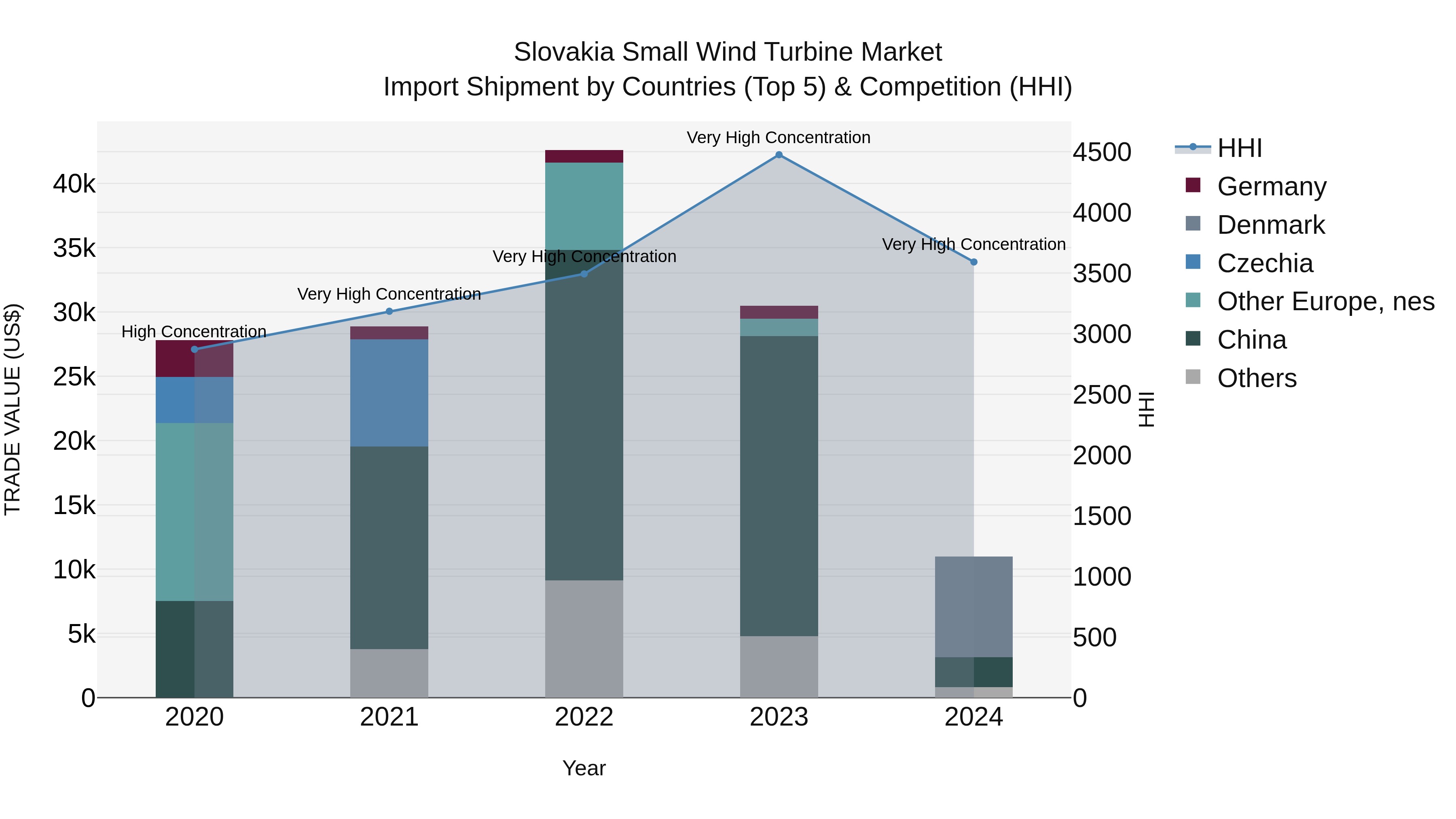
Despite the high concentration of small wind turbine imports in Slovakia in 2024, the top exporting countries such as Denmark, China, USA, Czechia, and Belgium continue to dominate the Market Top 5 Importing Countries and Market Competition (HHI) Analysis. However, the negative CAGR of -20.76 from 2020 to 2024 and a steep decline in growth rate of -64.03 from 2023 to 2024 indicate a challenging environment for small wind turbine imports. Stakeholders should closely monitor Market Top 5 Importing Countries and Market Competition (HHI) Analysis dynamics and innovations to navigate these turbulent times effectively.
Slovakia Small Wind Turbine Market Overview
The Slovakia small wind turbine market is experiencing steady growth driven by increasing awareness of renewable energy sources and government support for clean energy initiatives. Small wind turbines, with capacities typically ranging from a few kilowatts to 100 kW, are gaining popularity among residential, agricultural, and small-scale commercial users in Slovakia due to their ability to generate electricity for local consumption and reduce reliance on the grid. Key market players are focusing on developing efficient and cost-effective small wind turbine solutions to cater to the growing demand in the country. Factors such as favorable wind conditions in certain regions, coupled with rising environmental concerns and favorable regulatory frameworks, are expected to further propel the growth of the small wind turbine market in Slovakia in the coming years.
Slovakia Small Wind Turbine Market Trends
In the Slovakia Small Wind Turbine Market, the current trend is a growing interest in renewable energy sources driven by government incentives and increasing environmental awareness. Small wind turbines are gaining popularity among residential and small business owners looking to reduce their carbon footprint and energy costs. Technological advancements have improved the efficiency and reliability of small wind turbines, making them a more viable option for decentralized energy generation. Additionally, the increasing focus on energy independence and resilience is driving the adoption of small wind turbines as a reliable source of clean energy. Overall, the Slovakia Small Wind Turbine Market is expected to continue growing as renewable energy becomes a more prominent part of the country`s energy mix.
Slovakia Small Wind Turbine Market Challenges
In the Slovakia Small Wind Turbine Market, some challenges that are commonly faced include regulatory hurdles, limited government support and incentives, high initial investment costs, and the need for public awareness and acceptance of renewable energy sources. Regulatory hurdles such as permitting processes and grid connection requirements can delay project implementation and increase costs. The limited government support and incentives for small wind turbine installations make it less financially attractive for businesses and individuals to invest in this technology. Additionally, the high initial investment costs of small wind turbines can be a barrier for potential buyers, especially in comparison to other renewable energy options. Lastly, there is a need for increased public awareness and acceptance of small wind turbines to drive market growth and adoption. Addressing these challenges will be crucial for the development and expansion of the small wind turbine market in Slovakia.
Slovakia Small Wind Turbine Market Investment Opportunities
The Slovakia Small Wind Turbine Market presents promising investment opportunities for companies looking to capitalize on the country`s increasing focus on renewable energy sources. With the government`s support through various incentives and subsidies for renewable energy projects, the demand for small wind turbines is expected to rise. Additionally, Slovakia`s favorable wind conditions in certain regions make it conducive for small wind turbine installations, providing an attractive market for investors. Companies specializing in small wind turbine manufacturing, installation, and maintenance services could find success in tapping into this growing market and contributing to Slovakia`s renewable energy goals. Conducting thorough market research, understanding regulatory frameworks, and establishing strategic partnerships with local stakeholders will be essential for investors looking to maximize their opportunities in the Slovakia Small Wind Turbine Market.
Slovakia Small Wind Turbine Market Government Policy
In Slovakia, the Small Wind Turbine Market is governed by a set of policies and regulations aimed at promoting renewable energy sources. The main policy tool in place is the support scheme for electricity generated from renewable sources, including small wind turbines, which provides financial incentives such as feed-in tariffs and premium payments to encourage the production of clean energy. Additionally, Slovakia has implemented legislation to support the development of small wind turbine projects through simplified permitting procedures and grid connection processes. The government also offers various grants and subsidies to support the installation and operation of small wind turbines, further driving the growth of this market within the country.
Slovakia Small Wind Turbine Market Future Outlook
The future outlook for the Slovakia Small Wind Turbine Market appears promising, with anticipated growth driven by increasing awareness of renewable energy sources and government initiatives to promote clean energy production. Factors such as rising energy costs, concerns about climate change, and the need for energy independence are likely to fuel demand for small wind turbines among residential, commercial, and industrial users in Slovakia. Technological advancements, such as improved efficiency and cost-effectiveness of small wind turbines, are expected to further boost market growth. Additionally, favorable regulatory policies and financial incentives for renewable energy projects are likely to create a conducive environment for the expansion of the small wind turbine market in Slovakia in the coming years.
Key Highlights of the Report:
- Slovakia Small Wind Turbine Market Outlook
- Market Size of Slovakia Small Wind Turbine Market, 2024
- Forecast of Slovakia Small Wind Turbine Market, 2031
- Historical Data and Forecast of Slovakia Small Wind Turbine Revenues & Volume for the Period 2021 - 2031
- Slovakia Small Wind Turbine Market Trend Evolution
- Slovakia Small Wind Turbine Market Drivers and Challenges
- Slovakia Small Wind Turbine Price Trends
- Slovakia Small Wind Turbine Porter's Five Forces
- Slovakia Small Wind Turbine Industry Life Cycle
- Historical Data and Forecast of Slovakia Small Wind Turbine Market Revenues & Volume By Axis Type for the Period 2021 - 2031
- Historical Data and Forecast of Slovakia Small Wind Turbine Market Revenues & Volume By Horizontal Axis Wind Turbine for the Period 2021 - 2031
- Historical Data and Forecast of Slovakia Small Wind Turbine Market Revenues & Volume By Vertical Axis Wind Turbine for the Period 2021 - 2031
- Historical Data and Forecast of Slovakia Small Wind Turbine Market Revenues & Volume By Application for the Period 2021 - 2031
- Historical Data and Forecast of Slovakia Small Wind Turbine Market Revenues & Volume By On-grid for the Period 2021 - 2031
- Historical Data and Forecast of Slovakia Small Wind Turbine Market Revenues & Volume By Off-grid for the Period 2021 - 2031
- Slovakia Small Wind Turbine Import Export Trade Statistics
- Market Opportunity Assessment By Axis Type
- Market Opportunity Assessment By Application
- Slovakia Small Wind Turbine Top Companies Market Share
- Slovakia Small Wind Turbine Competitive Benchmarking By Technical and Operational Parameters
- Slovakia Small Wind Turbine Company Profiles
- Slovakia Small Wind Turbine Key Strategic Recommendations






































