Slovakia Sorbitol Market Size (2020-2030)
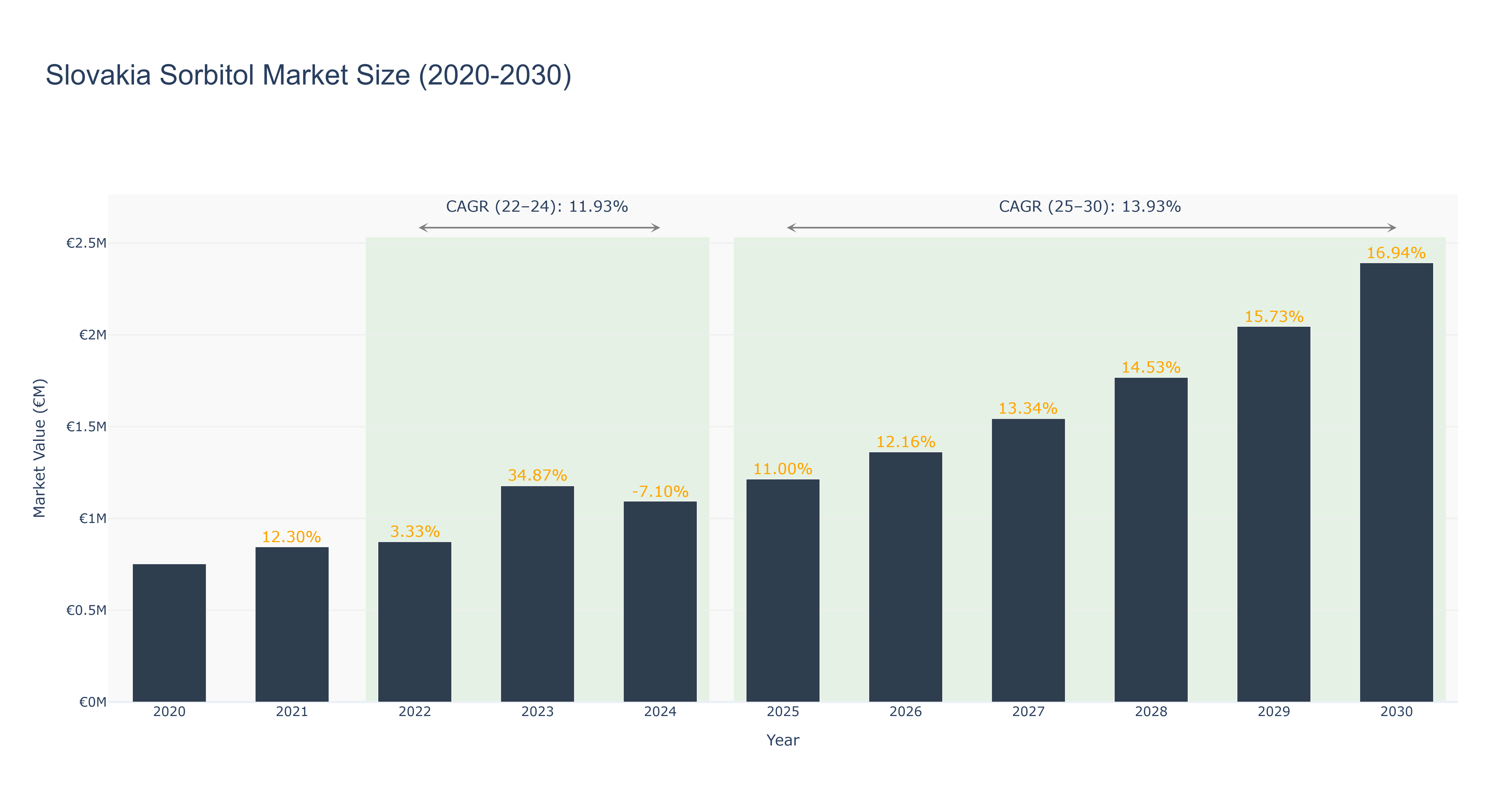
Slovakia Sorbitol Market has shown a positive growth trend over the years. The market size increased from €0.75 million in 2020 to €1.09 million in 2024, experiencing a slight decline in that year. However, from 2025 to 2030, the market is forecasted to grow steadily, reaching €2.39 million in 2030. The CAGR for the period 2022-24 is 11.93%, while for 2025-30, it stands at 13.93%. The market's growth can be attributed to increasing consumer awareness about health benefits associated with sorbitol consumption, driving demand for products containing this ingredient. Looking ahead, Slovakia's sorbitol market is poised for further expansion with upcoming investments in research and development for innovative sorbitol-based products catering to evolving consumer preferences for healthier alternatives in the food and beverage industry.
Slovakia Sorbitol Market: Production & Trade Performance (2019-2025)
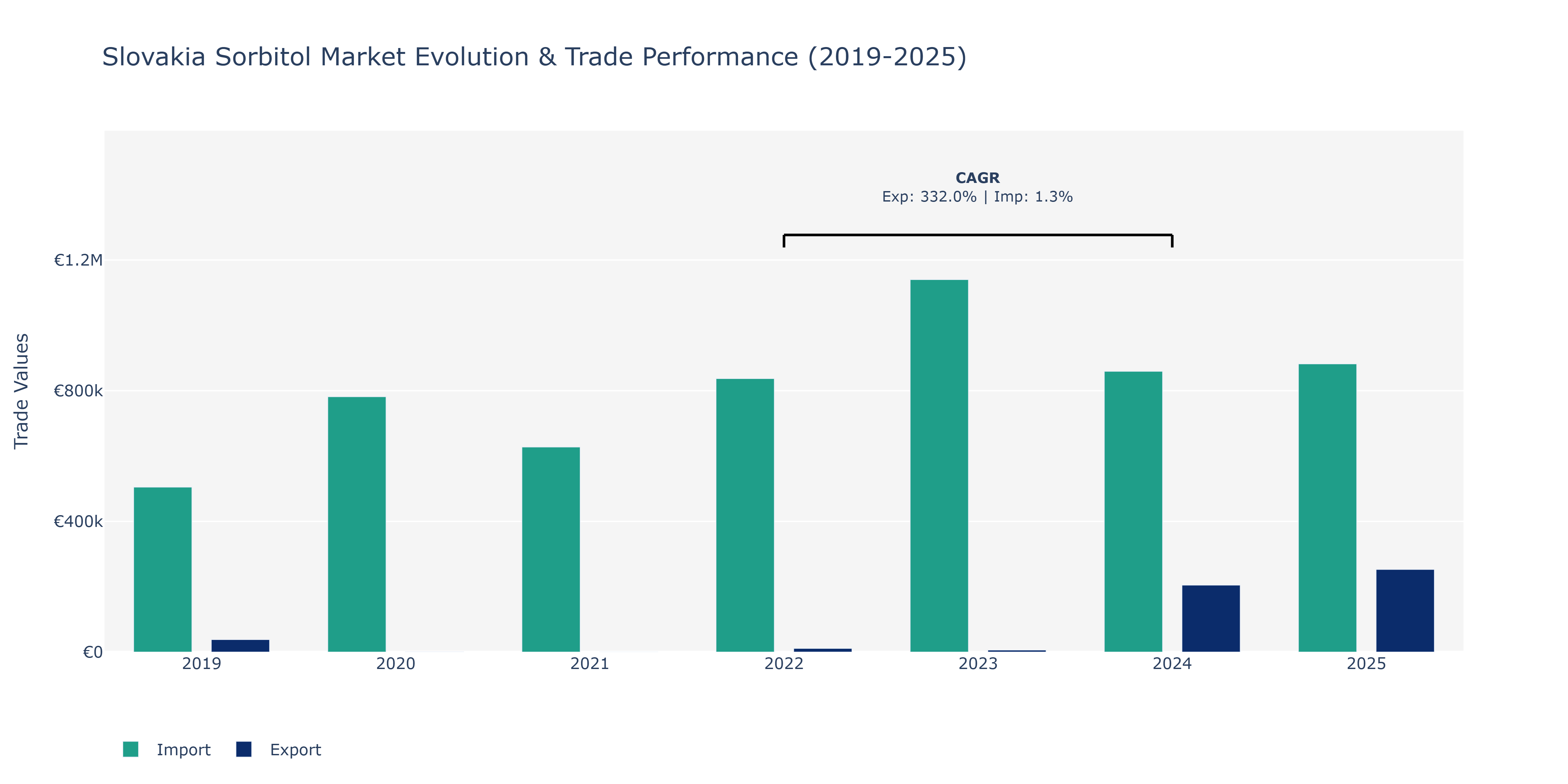
Between 2019 and 2025, Slovakia's Sorbitol Market displayed varying trends in exports and imports. Exports saw a significant increase from €37.86 thousand in 2019 to €252.63 thousand in 2025, with a peak in 2024 at €204.80 thousand. In contrast, imports peaked in 2023 at €1.14 million, after a steady rise since 2019 when they stood at €504.72 thousand. The notable fluctuations in exports and imports can be attributed to dynamic market demand, changing global prices of sorbitol, and shifts in supply chains. The surge in exports may reflect Slovakia's enhanced production capabilities, while the peak in imports could be due to increased domestic consumption or shifts in sourcing strategies influenced by geopolitical factors. These trends suggest a growing role for Slovakia in the global sorbitol trade, potentially driven by the country's strategic positioning in the European market and evolving trade agreements.
Slovakia Sorbitol Market Overview
The Slovakia Sorbitol market is experiencing steady growth due to increasing demand from various industries such as food and beverage, pharmaceuticals, and personal care. Sorbitol, a sugar alcohol derived from fruits and berries, is widely used as a low-calorie sweetener and humectant in food products, toothpaste, and cosmetics. The market is driven by the growing health-conscious consumer base seeking sugar-free and low-calorie alternatives in their diet. Additionally, sorbitol`s properties as a sugar substitute that does not cause tooth decay further contribute to its popularity. Key players in the Slovakia Sorbitol market include Roquette Frères, Cargill, Ingredion Incorporated, and Archer Daniels Midland Company, who are actively involved in product innovations and expansions to cater to the increasing demand. The market is poised for further growth with ongoing research and development efforts in the field of sugar substitutes and increasing consumer awareness regarding health and wellness trends.
Slovakia Sorbitol Market Trends
The Slovakia sorbitol market is experiencing steady growth driven by increasing demand from various industries such as food and beverage, pharmaceuticals, and personal care. The market is witnessing a rising preference for sorbitol as a low-calorie sweetener and texturizing agent due to its natural origin and sugar-like taste. Manufacturers are also focusing on developing innovative sorbitol-based products to cater to the evolving consumer preferences for healthier food and personal care products. The growing awareness about the benefits of sorbitol, such as its tooth-friendly properties and diabetic-friendly nature, is further driving its adoption in various applications. Additionally, the increasing emphasis on clean-label ingredients and sustainable production practices is expected to shape the future landscape of the Slovakia sorbitol market.
Slovakia Sorbitol Market Challenges
In the Slovakia Sorbitol Market, potential challenges include increasing competition from substitute products like xylitol and stevia, fluctuating raw material prices, and regulatory changes impacting production and distribution. Additionally, consumer demand for natural and organic ingredients may pose a challenge for sorbitol manufacturers who are perceived as artificial or less healthy. Adapting to these trends by investing in research and development for innovative sorbitol applications, improving supply chain management to mitigate price fluctuations, and enhancing marketing strategies to address changing consumer preferences will be key for companies operating in the Slovakia Sorbitol Market to maintain a competitive edge and sustain growth.
Slovakia Sorbitol Market Investment Opportunities
The Slovakia sorbitol market presents various investment opportunities due to the increasing demand for sorbitol in industries such as food and beverage, pharmaceuticals, and personal care. With the rising awareness of health benefits associated with sorbitol as a low-calorie sweetener and its applications as a humectant and texturizing agent, there is a growing market for sorbitol in Slovakia. Investors can consider opportunities in sorbitol production facilities, distribution networks, and research and development for expanding the product portfolio. Additionally, partnerships with key players in the food and pharmaceutical industries can facilitate market penetration and growth. Overall, investing in the Slovakia sorbitol market holds potential for significant returns driven by the expanding applications and consumer demand for this versatile ingredient.
Slovakia Sorbitol Market Government Policy
The government policies related to the Slovakia Sorbitol Market primarily focus on regulations set by the European Union in terms of food safety standards and labeling requirements. Slovakia follows the EU regulations regarding the production, import, and distribution of sorbitol in the market. These regulations ensure that sorbitol products meet the necessary quality and safety standards, thereby safeguarding consumer health and promoting fair trade practices. Additionally, the government may also have specific taxation policies or incentives in place to support the growth of the sorbitol market within the country. Overall, adherence to EU regulations and local government policies is crucial for businesses operating in the Slovakia Sorbitol Market to maintain compliance and sustain market growth.
Slovakia Sorbitol Market Future Outlook
The Slovakia Sorbitol Market is expected to show steady growth in the coming years, driven by the increasing demand for sugar substitutes in various industries such as food and beverage, pharmaceuticals, and personal care products. The growing awareness of health concerns related to excessive sugar consumption is a key factor fueling the demand for sorbitol as a low-calorie sweetener. Additionally, the versatility of sorbitol as a humectant and texturizing agent in various applications is further propelling its market growth. With rising consumer preferences for healthier alternatives and the continuous innovation in product formulations, the Slovakia Sorbitol Market is anticipated to witness a positive outlook in the foreseeable future. However, factors such as fluctuating raw material prices and regulatory constraints may pose challenges to market expansion.
Key Highlights of the Report:
- Slovakia Sorbitol Market Outlook
- Market Size of Slovakia Sorbitol Market, 2021
- Forecast of Slovakia Sorbitol Market, 2027
- Historical Data and Forecast of Slovakia Sorbitol Revenues & Volume for the Period 2018 - 2027
- Slovakia Sorbitol Market Trend Evolution
- Slovakia Sorbitol Market Drivers and Challenges
- Slovakia Sorbitol Price Trends
- Slovakia Sorbitol Porter's Five Forces
- Slovakia Sorbitol Industry Life Cycle
- Historical Data and Forecast of Slovakia Sorbitol Market Revenues & Volume By Product Type for the Period 2018 - 2027
- Historical Data and Forecast of Slovakia Sorbitol Market Revenues & Volume By Liquid/Syrup Sorbitol for the Period 2018 - 2027
- Historical Data and Forecast of Slovakia Sorbitol Market Revenues & Volume By Crystal/Powder Sorbitol for the Period 2018 - 2027
- Historical Data and Forecast of Slovakia Sorbitol Market Revenues & Volume By Application for the Period 2018 - 2027
- Historical Data and Forecast of Slovakia Sorbitol Market Revenues & Volume By Cosmetics & Personal Care for the Period 2018 - 2027
- Historical Data and Forecast of Slovakia Sorbitol Market Revenues & Volume By Food & Beverage for the Period 2018 - 2027
- Historical Data and Forecast of Slovakia Sorbitol Market Revenues & Volume By Pharmaceuticals for the Period 2018 - 2027
- Historical Data and Forecast of Slovakia Sorbitol Market Revenues & Volume By Creams and emulsions for the Period 2018 - 2027
- Historical Data and Forecast of Slovakia Sorbitol Market Revenues & Volume By Medicated confectionery for the Period 2018 - 2027
- Historical Data and Forecast of Slovakia Sorbitol Market Revenues & Volume By Chemical for the Period 2018 - 2027
- Historical Data and Forecast of Slovakia Sorbitol Market Revenues & Volume By Other Industries for the Period 2018 - 2027
- Slovakia Sorbitol Import Export Trade Statistics
- Market Opportunity Assessment By Product Type
- Market Opportunity Assessment By Application
- Slovakia Sorbitol Top Companies Market Share
- Slovakia Sorbitol Competitive Benchmarking By Technical and Operational Parameters
- Slovakia Sorbitol Company Profiles
- Slovakia Sorbitol Key Strategic Recommendations






































