Slovakia Soy Flour Market Size (2020-2030)
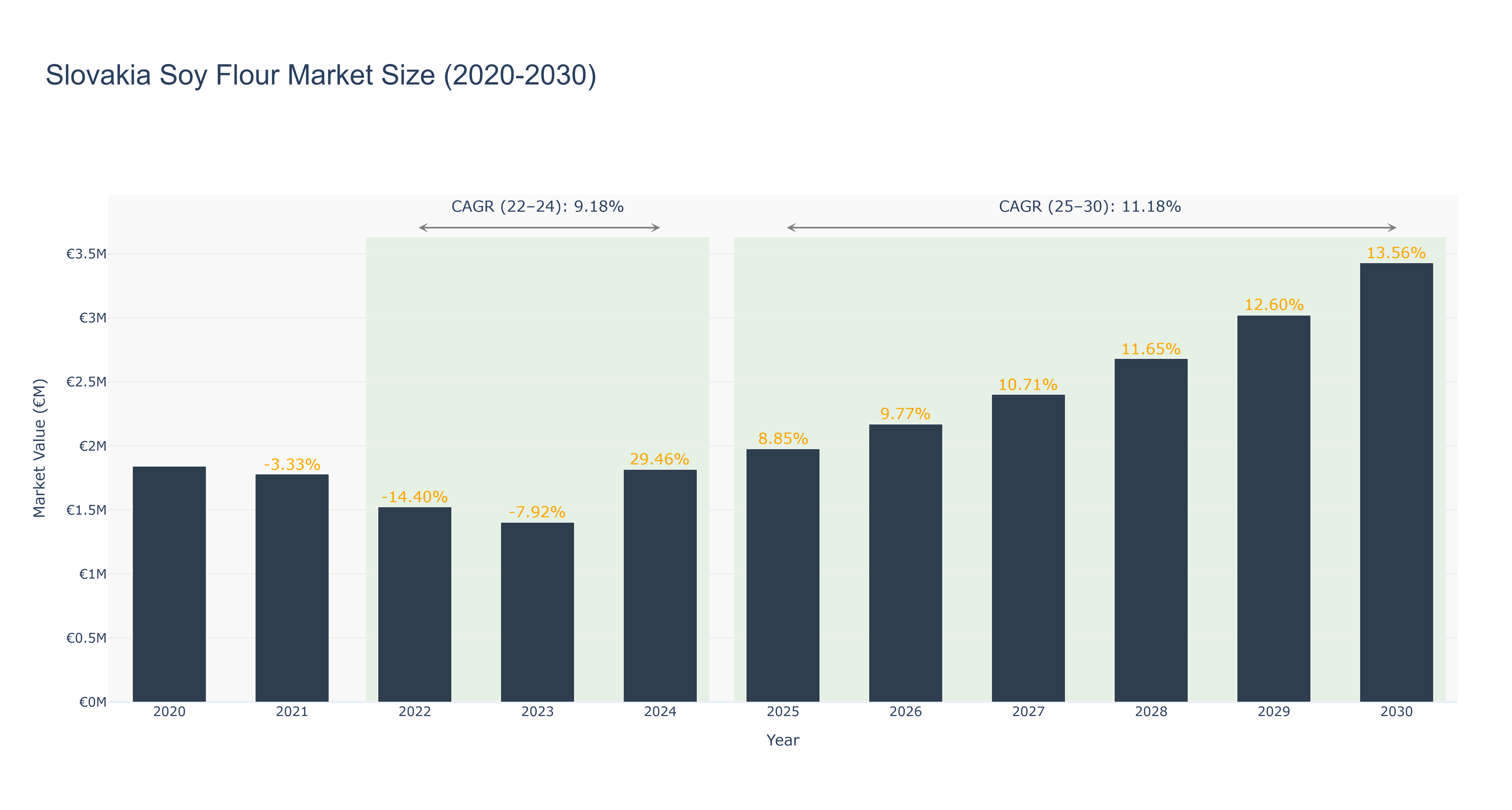
Slovakia Soy Flour Market shows a declining trend in the early years followed by a gradual recovery, with the market projected to reach a peak of €3.43 million by 2030. The market decreased from €1.84 million in 2020 to €1.78 million in 2021 and further to €1.52 million in 2022, before dropping to €1.40 million in 2023 due to weak demand from the food processing sector and supply chain disruptions. However, it rebounded to €1.82 million in 2024, reflecting a CAGR of 9.18% during 2022–24, supported by recovery in the bakery and animal feed industries. From 2025 onwards, the market is forecasted to grow steadily from €1.98 million to €3.43 million by 2030, at a CAGR of 11.18%, driven by increasing demand for plant-based proteins, rising health awareness, and expanding applications in functional foods and feed products.
Slovakia Soy Flour Market: Production & Trade Performance (2019-2025)
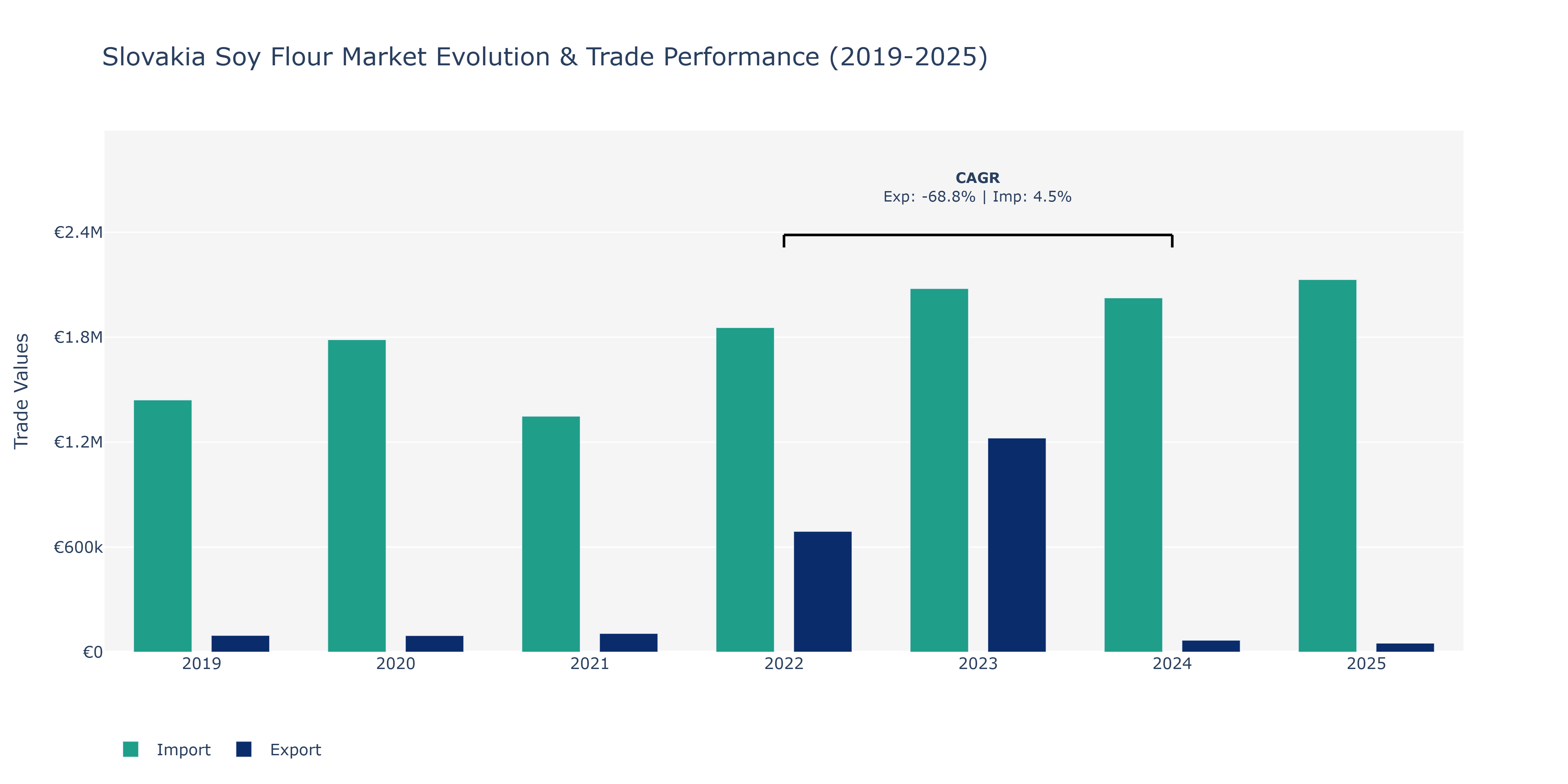
In the Slovakia Soy Flour Market, exports experienced fluctuations over the analyzed period, starting at €94.81 thousand in 2019, dropping slightly in 2020 to €93.85 thousand, then sharply increasing to €106.0 thousand in 2021, and peaking at €1.22 million in 2023 before dropping to €67.01 thousand in 2024 and further to €50.37 thousand in 2025. On the other hand, imports consistently increased from €1.44 million in 2019 to €2.13 million in 2025. The significant decline in exports in 2024 and 2025 could be attributed to challenges in production or market demand fluctuations. Conversely, the consistent rise in imports reflects a growing demand for soy flour in Slovakia, possibly due to increased consumer awareness of its health benefits or a shift towards plant-based diets in the country. The market's dynamics suggest a need for exporters to address production or quality issues to remain competitive and capitalize on the expanding import market.
Slovakia Soy Flour Market Overview
The Slovakia Soy Flour Market is experiencing steady growth, driven by increasing consumer awareness of the health benefits associated with soy products. Soy flour is gaining popularity as a versatile ingredient in various food products due to its high protein content, gluten-free nature, and ability to enhance texture and flavor. The market is witnessing a surge in demand from the food industry, particularly in bakery and confectionery products, as well as in the production of meat alternatives and plant-based protein products. Key players in the Slovakia Soy Flour Market are focusing on product innovation, quality enhancement, and strategic partnerships to cater to the evolving consumer preferences and dietary trends. The market is expected to continue its growth trajectory, supported by rising health consciousness and the growing adoption of vegetarian and vegan diets among consumers.
Slovakia Soy Flour Market Trends
In the Slovakia Soy Flour Market, there is a growing trend towards plant-based diets and a focus on health and wellness, driving the demand for soy flour as a versatile and nutritious ingredient. Consumers are increasingly seeking alternative sources of protein, and soy flour, being rich in protein and fiber, is gaining popularity as a functional ingredient in various food products. Furthermore, the rising awareness of the environmental impact of animal agriculture is also contributing to the shift towards plant-based protein sources like soy flour. Manufacturers in Slovakia are incorporating soy flour into a wide range of products such as baked goods, snacks, and meat alternatives to cater to the increasing demand for plant-based options. As a result, the Slovakia Soy Flour Market is expected to continue growing as health-conscious consumers embrace the benefits of soy-based products.
Slovakia Soy Flour Market Challenges
In the Slovakia Soy Flour Market, some key challenges include limited consumer awareness and acceptance of soy products as compared to traditional flour options, such as wheat or rye flour. Additionally, the relatively higher cost of soy flour compared to conventional flours can act as a barrier to its widespread adoption in the market. Distribution channels and availability of soy flour products may also pose challenges in reaching a broader customer base. Furthermore, the lack of government support or incentives for the production and consumption of soy products in Slovakia could hinder the growth of the soy flour market. Overcoming these challenges would require targeted marketing efforts to educate consumers about the benefits of soy flour, strategic pricing strategies, improved distribution networks, and advocacy for policies that promote the use of soy products in the food industry.
Slovakia Soy Flour Market Investment Opportunities
In the Slovakia Soy Flour Market, there are several promising investment opportunities for potential investors to consider. With the growing trend towards plant-based diets and the increasing awareness of the health benefits associated with soy products, the demand for soy flour is expected to rise. Investing in soy flour production facilities or partnering with existing manufacturers to expand their operations could be lucrative. Additionally, diversifying product offerings to include value-added soy flour products such as gluten-free or organic options could attract a niche market segment. Furthermore, exploring export opportunities to neighboring countries within the European Union could provide avenues for growth and increased profitability in the Slovakia Soy Flour Market. Conducting thorough market research and understanding consumer preferences will be crucial in identifying the most suitable investment opportunities in this sector.
Slovakia Soy Flour Market Government Policy
The Slovak government does not have specific policies tailored specifically to the soy flour market. However, Slovakia is a member of the European Union (EU), and as such, the market is influenced by EU regulations and policies regarding food safety, labeling, and trade agreements. The EU has regulations in place to ensure the safety and quality of food products, including soy flour, through measures such as labeling requirements and maximum residue limits for pesticides. Additionally, Slovakia may have its own regulations related to food safety and labeling that businesses operating in the soy flour market must comply with. Overall, businesses in the Slovakia soy flour market should adhere to both EU and Slovak regulations to ensure compliance and market access.
Slovakia Soy Flour Market Future Outlook
The future outlook for the Slovakia Soy Flour Market appears promising, driven by the increasing consumer awareness of the health benefits associated with soy products. As more people adopt plant-based diets and seek out protein-rich alternatives, the demand for soy flour is expected to rise. Furthermore, the versatility of soy flour in various food applications, including bakery products, meat alternatives, and beverages, is likely to fuel market growth. Manufacturers are also focusing on product innovation and development to cater to changing consumer preferences, such as organic and non-GMO soy flour options. With a growing emphasis on sustainable and environmentally friendly practices in the food industry, the Slovakia Soy Flour Market is projected to experience steady growth in the coming years.
Key Highlights of the Report:
- Slovakia Soy Flour Market Outlook
- Market Size of Slovakia Soy Flour Market, 2021
- Forecast of Slovakia Soy Flour Market, 2031
- Historical Data and Forecast of Slovakia Soy Flour Revenues & Volume for the Period 2018 - 2031
- Slovakia Soy Flour Market Trend Evolution
- Slovakia Soy Flour Market Drivers and Challenges
- Slovakia Soy Flour Price Trends
- Slovakia Soy Flour Porter's Five Forces
- Slovakia Soy Flour Industry Life Cycle
- Historical Data and Forecast of Slovakia Soy Flour Market Revenues & Volume By Type for the Period 2018 - 2031
- Historical Data and Forecast of Slovakia Soy Flour Market Revenues & Volume By Full-fat Soy Flour for the Period 2018 - 2031
- Historical Data and Forecast of Slovakia Soy Flour Market Revenues & Volume By Defatted Soy Flour for the Period 2018 - 2031
- Historical Data and Forecast of Slovakia Soy Flour Market Revenues & Volume By Application for the Period 2018 - 2031
- Historical Data and Forecast of Slovakia Soy Flour Market Revenues & Volume By Bakery & Confectionery for the Period 2018 - 2031
- Historical Data and Forecast of Slovakia Soy Flour Market Revenues & Volume By Meat Substitute for the Period 2018 - 2031
- Historical Data and Forecast of Slovakia Soy Flour Market Revenues & Volume By Soup & Sausages for the Period 2018 - 2031
- Historical Data and Forecast of Slovakia Soy Flour Market Revenues & Volume By Meat and Poultry for the Period 2018 - 2031
- Historical Data and Forecast of Slovakia Soy Flour Market Revenues & Volume By Others for the Period 2018 - 2031
- Historical Data and Forecast of Slovakia Soy Flour Market Revenues & Volume By Distribution Channel for the Period 2018 - 2031
- Historical Data and Forecast of Slovakia Soy Flour Market Revenues & Volume By Online Stores for the Period 2018 - 2031
- Historical Data and Forecast of Slovakia Soy Flour Market Revenues & Volume By Convenience Store for the Period 2018 - 2031
- Historical Data and Forecast of Slovakia Soy Flour Market Revenues & Volume By Departmental Store for the Period 2018 - 2031
- Historical Data and Forecast of Slovakia Soy Flour Market Revenues & Volume By Direct Sales for the Period 2018 - 2031
- Historical Data and Forecast of Slovakia Soy Flour Market Revenues & Volume By Others for the Period 2018 - 2031
- Slovakia Soy Flour Import Export Trade Statistics
- Market Opportunity Assessment By Type
- Market Opportunity Assessment By Application
- Market Opportunity Assessment By Distribution Channel
- Slovakia Soy Flour Top Companies Market Share
- Slovakia Soy Flour Competitive Benchmarking By Technical and Operational Parameters
- Slovakia Soy Flour Company Profiles
- Slovakia Soy Flour Key Strategic Recommendations






































