Slovakia Synthetic Fiber Market Top 5 Importing Countries and Market Competition (HHI) Analysis
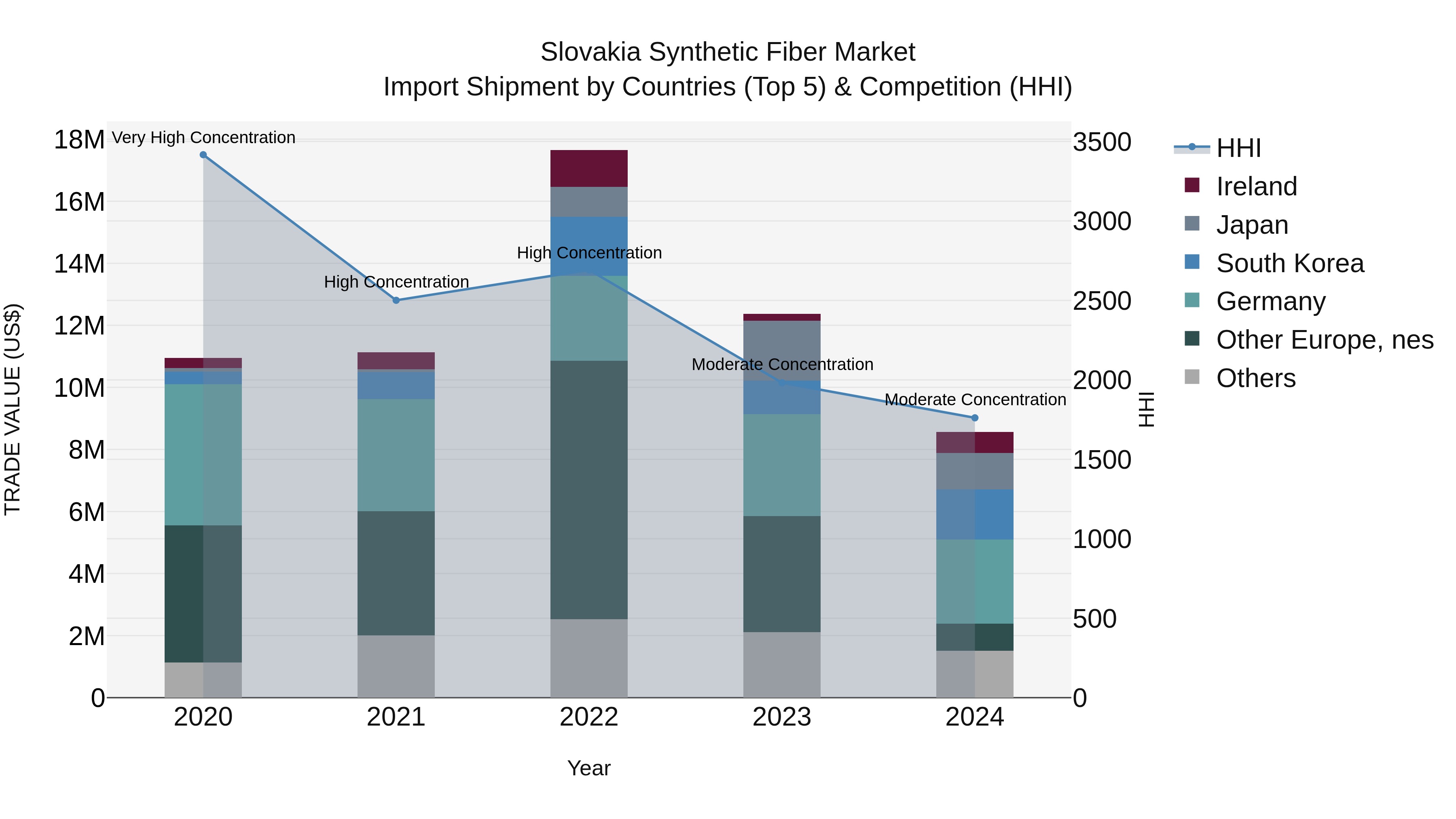
In 2024, Slovakia saw a decline in synthetic fiber import shipments with a negative CAGR of -5.95% from 2020 to 2024, and a sharp growth rate decrease of -30.8% from 2023 to 2024. Despite the challenging Market Top 5 Importing Countries and Market Competition (HHI) Analysis conditions, top exporting countries to Slovakia included Germany, South Korea, Japan, and other European nations, demonstrating a diverse sourcing strategy. The Market Top 5 Importing Countries and Market Competition (HHI) Analysis concentration, as measured by the HHI, remained at a moderate level in 2024, indicating a balanced competitive landscape within the synthetic fiber import Market Top 5 Importing Countries and Market Competition (HHI) Analysis in Slovakia.
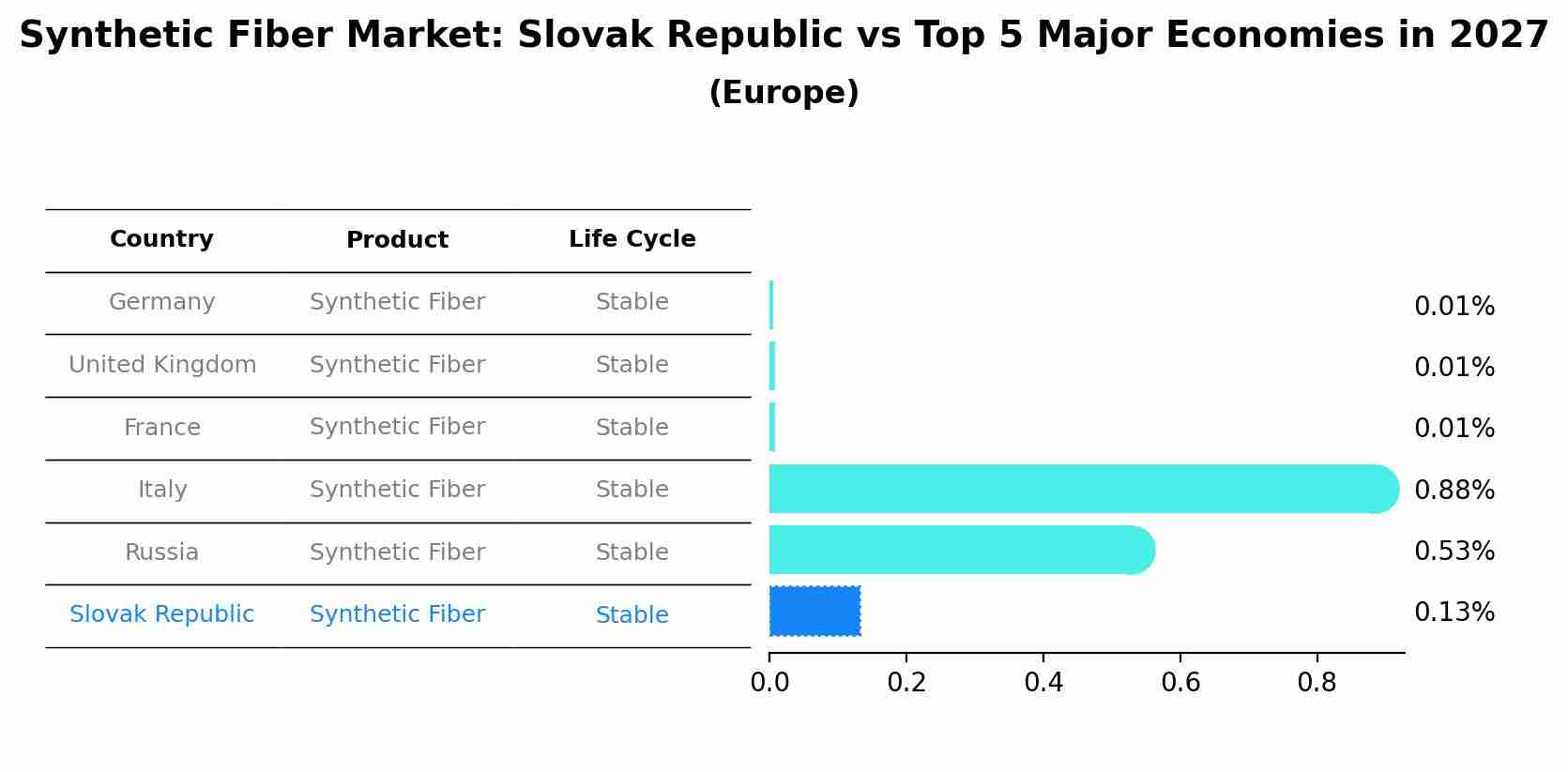
Synthetic Fiber Market: Slovak Republic vs Top 5 Major Economies in 2027 (Europe)
By 2027, the Synthetic Fiber market in Slovak Republic is anticipated to reach a growth rate of 0.13%, as part of an increasingly competitive Europe region, where Germany remains at the forefront, supported by United Kingdom, France, Italy and Russia, driving innovations and market adoption across sectors.
Slovakia Synthetic Fiber Market Synopsis
The Slovakia Synthetic Fiber Market is witnessing steady growth driven by increasing demand from various end-use industries such as textiles, automotive, and construction. Polyester and nylon are the dominant synthetic fibers in the market, offering properties like durability, strength, and versatility that cater to diverse applications. The textile industry remains a key consumer of synthetic fibers in Slovakia, with a growing trend towards eco-friendly and sustainable fiber options. The automotive sector is another significant contributor to the market, with synthetic fibers being used in interior upholstery, carpets, and other components. As the economy continues to develop and consumer preferences evolve, the Slovakia Synthetic Fiber Market is expected to expand further, with innovation and sustainability being key focus areas for market players.
Slovakia Synthetic Fiber Market Trends
The Slovakia Synthetic Fiber Market is experiencing a shift towards eco-friendly and sustainable materials, with a growing demand for recycled synthetic fibers. Consumers are increasingly conscious of the environmental impact of their purchases, leading to a greater emphasis on sustainability in the textile industry. Additionally, there is a trend towards the use of high-performance synthetic fibers in technical textiles for applications such as sports apparel, automotive components, and medical textiles. Advances in technology and innovation are driving the development of synthetic fibers with enhanced properties such as moisture-wicking, UV protection, and durability. Overall, the market is evolving towards a more sustainable and technologically advanced landscape, with a focus on meeting the changing needs of consumers and industries.
Slovakia Synthetic Fiber Market Challenges
In the Slovakia Synthetic Fiber Market, one of the major challenges faced is increasing competition from low-cost producers in other countries. This competition puts pressure on local manufacturers to reduce prices, impacting their profit margins. Additionally, fluctuations in raw material prices and currency exchange rates can also pose challenges for companies operating in the market. Another issue is the need for continuous innovation and investment in research and development to stay competitive in the global market. Furthermore, environmental concerns regarding the use of synthetic fibers and the growing demand for sustainable and eco-friendly alternatives are also influencing the market dynamics and requiring companies to adapt their production processes to meet these changing consumer preferences.
Slovakia Synthetic Fiber Market Investment Opportunities
The Slovakia Synthetic Fiber Market presents lucrative investment opportunities due to the increasing demand for synthetic fibers in various industries such as textiles, automotive, and construction. With a growing trend towards sustainability and eco-friendly materials, there is a rising demand for recycled and bio-based synthetic fibers in Slovakia. Investments in research and development of innovative synthetic fibers, such as those with improved performance characteristics or reduced environmental impact, could offer significant returns. Additionally, partnerships with local textile manufacturers and businesses to supply high-quality synthetic fibers can be a profitable venture in the Slovakian market. Overall, the Slovakia Synthetic Fiber Market offers promising investment prospects for companies looking to capitalize on the growing demand for synthetic fibers in diverse sectors.
Jordan Agar Market Government Policies
Government policies related to the Slovakia Synthetic Fiber Market are primarily focused on promoting sustainable development and environmental protection. The Slovak government has implemented regulations to ensure that synthetic fiber manufacturers comply with environmental standards, such as waste management and emissions control. Additionally, there are initiatives to support research and development in the synthetic fiber industry to drive innovation and competitiveness. The government also provides financial incentives and support for companies investing in advanced technologies to reduce the environmental impact of synthetic fiber production. Overall, the policies aim to balance economic growth with environmental sustainability in the synthetic fiber market in Slovakia.
Slovakia Synthetic Fiber Market Future Outlook
The Slovakia Synthetic Fiber Market is expected to witness steady growth in the coming years due to increasing demand from various end-use industries such as textiles, automotive, and packaging. Factors driving this growth include the rising disposable income of consumers, changing fashion trends, and the shift towards sustainable and eco-friendly materials. Additionally, advancements in technology leading to the development of innovative synthetic fibers with enhanced properties such as moisture-wicking, durability, and lightweight characteristics are expected to further boost market growth. However, challenges such as fluctuating raw material prices and environmental concerns regarding the use of synthetic fibers may hinder the market`s progress. Overall, the Slovakia Synthetic Fiber Market is poised for expansion, driven by evolving consumer preferences and technological innovations.
Key Highlights of the Report:
- Slovakia Synthetic Fiber Market Outlook
- Market Size of Slovakia Synthetic Fiber Market, 2021
- Forecast of Slovakia Synthetic Fiber Market, 2031
- Historical Data and Forecast of Slovakia Synthetic Fiber Revenues & Volume for the Period 2018 - 2031
- Slovakia Synthetic Fiber Market Trend Evolution
- Slovakia Synthetic Fiber Market Drivers and Challenges
- Slovakia Synthetic Fiber Price Trends
- Slovakia Synthetic Fiber Porter's Five Forces
- Slovakia Synthetic Fiber Industry Life Cycle
- Historical Data and Forecast of Slovakia Synthetic Fiber Market Revenues & Volume By Type for the Period 2018 - 2031
- Historical Data and Forecast of Slovakia Synthetic Fiber Market Revenues & Volume By Polyester for the Period 2018 - 2031
- Historical Data and Forecast of Slovakia Synthetic Fiber Market Revenues & Volume By Nylon for the Period 2018 - 2031
- Historical Data and Forecast of Slovakia Synthetic Fiber Market Revenues & Volume By Acrylics for the Period 2018 - 2031
- Historical Data and Forecast of Slovakia Synthetic Fiber Market Revenues & Volume By Polyolefin for the Period 2018 - 2031
- Historical Data and Forecast of Slovakia Synthetic Fiber Market Revenues & Volume By Others for the Period 2018 - 2031
- Historical Data and Forecast of Slovakia Synthetic Fiber Market Revenues & Volume By Application for the Period 2018 - 2031
- Historical Data and Forecast of Slovakia Synthetic Fiber Market Revenues & Volume By Clothing for the Period 2018 - 2031
- Historical Data and Forecast of Slovakia Synthetic Fiber Market Revenues & Volume By Home Furnishing for the Period 2018 - 2031
- Historical Data and Forecast of Slovakia Synthetic Fiber Market Revenues & Volume By Automotive for the Period 2018 - 2031
- Historical Data and Forecast of Slovakia Synthetic Fiber Market Revenues & Volume By Filtration for the Period 2018 - 2031
- Historical Data and Forecast of Slovakia Synthetic Fiber Market Revenues & Volume By Others for the Period 2018 - 2031
- Slovakia Synthetic Fiber Import Export Trade Statistics
- Market Opportunity Assessment By Type
- Market Opportunity Assessment By Application
- Slovakia Synthetic Fiber Top Companies Market Share
- Slovakia Synthetic Fiber Competitive Benchmarking By Technical and Operational Parameters
- Slovakia Synthetic Fiber Company Profiles
- Slovakia Synthetic Fiber Key Strategic Recommendations






































