Slovakia Television Broadcasting Market Size, Share & Growth Rate
The Slovakia Television Broadcasting Market was estimated at USD 1171 Million in 2025 and is projected to reach USD 2190 Million by 2032, growing at a CAGR of 9.4% from 2026 to 2032. This growth trajectory is primarily driven by increasing consumer demand for high-quality content and the ongoing shift towards digital platforms. Furthermore, innovations in technology and the rise of on-demand services are compelling broadcasters to evolve their content strategies to retain and expand their audiences.
Slovakia Television Broadcasting Market Year-wise Growth Rate and Key Drivers
This graph highlights how the Slovakia Television Broadcasting Market has steadily grown over the years, supported by major growth factors.
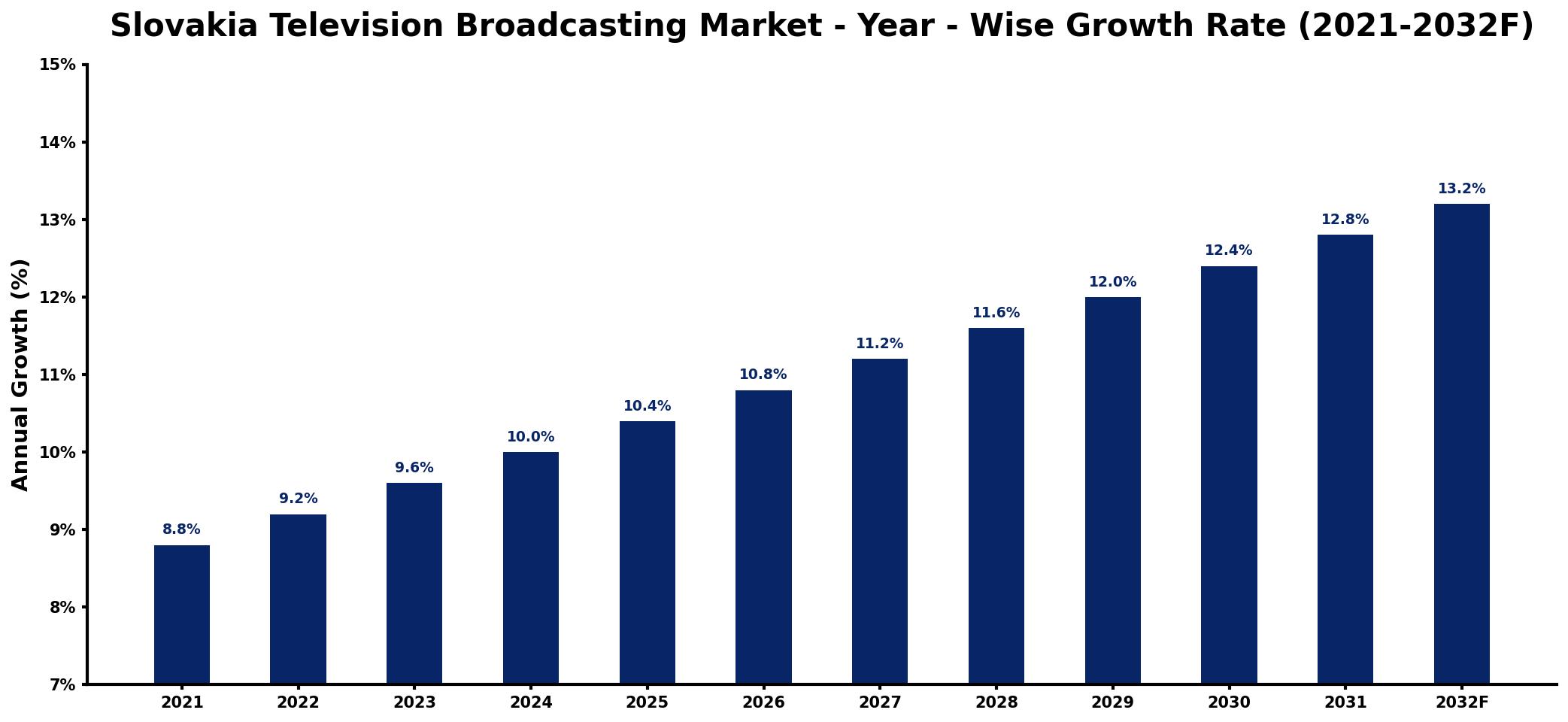
The table below presents the year‑wise growth rates along with the key drivers influencing the market
| Year | Growth Rate | Major Drivers |
| 2021 | 8.8% | increased demand for streaming services |
| 2022 | 9.2% | growing investment in local content |
| 2023 | 9.6% | rise in mobile viewing habits |
| 2024 | 10.0% | rising demand from electronics |
| 2025 | 10.4% | enhanced viewer engagement technologies |
| 2026 | 10.8% | broader access to high-speed internet |
| 2027 | 11.2% | increased popularity of original programming |
| 2028 | 11.6% | growth in subscription-based models |
| 2029 | 12.0% | rising interest in interactive content |
| 2030 | 12.4% | development of immersive viewing experiences |
| 2031 | 12.8% | strengthened partnerships with content creators |
| 2032 | 13.2% | surge in cross-platform content availability |
Note: Market size estimations and growth projections presented in this report are based on 6Wresearch's proprietary forecasting methodology, utilizing the latest available industry data, government publications, and primary research inputs.
Slovakia Television Broadcasting Market Synopsis
Despite a competitive landscape characterized by major public and commercial broadcasters, the Slovakia Television Broadcasting Market is transitioning towards a more digitized framework. Recent momentum has seen traditional broadcasters facing increased pressure from digital streaming platforms, urging them to innovate and diversify their content offerings.
Looking ahead, the market is poised for considerable growth as broadcasters adapt to viewer preferences shifting towards on-demand and high-definition content. The landscape is likely to evolve with new entrants and technological advancements, fostering an environment ripe for both competition and collaboration.
Slovakia Television Broadcasting Market Key Takeaways
- The market is experiencing a notable shift towards digitalization and online streaming services.
- Investment in high-definition content production is becoming increasingly important for audience retention.
- Broadcasters are adapting to changing viewer preferences by diversifying content across multiple platforms.
- Advertising strategies are evolving, with a greater focus on targeted and digital advertising solutions.
- Government policies are aimed at promoting a competitive and diverse broadcasting environment.
Evaluation of Restraints in Slovakia Television Broadcasting Market
Despite its dynamic nature, the Slovakia Television Broadcasting Market faces significant restraints that can impede growth. Increasing competition from global streaming services poses a critical challenge for traditional broadcasters, whose viewership is declining as audiences shift towards on-demand content. Furthermore, regulatory constraints, including stringent licensing requirements and advertising regulations, can limit broadcasters' operational flexibility. The necessity for continual investment in technology and infrastructure to meet the demands for high-definition content also presents financial hurdles, requiring strategic allocation of resources.
Slovakia Television Broadcasting Market Trends
Currently, the Slovakia Television Broadcasting Market is undergoing substantial transformation driven by digitalization. Viewers are increasingly favoring streaming services and on-demand content, leading broadcasters to invest heavily in original programming to maintain relevance. Additionally, there is a pronounced demand for high-definition and ultra-high-definition content, prompting an upgrade of technological capabilities among broadcasters. The focus is shifting towards creating innovative advertising solutions that can leverage data analytics for more effective audience targeting.
Slovakia Television Broadcasting Market Opportunities
The evolving landscape presents numerous investment opportunities for stakeholders in the Slovakia Television Broadcasting Market. The increasing consumer appetite for original and localized content offers a ripe avenue for investment in production. Additionally, the growth of video-on-demand services creates prospects for new entrants aiming to capture the audience seeking personalized viewing experiences. There is also potential in developing targeted advertising solutions that cater to specific audience demographics, thereby enhancing revenue streams for broadcasters.
Government Initiatives in the Slovakia Television Broadcasting Market
The Slovak government plays an active role in shaping the television broadcasting landscape through policies aimed at promoting competition and diversity. The Council for Broadcasting and Retransmission regulates licensing and ensures compliance with content standards. Current policies encourage local content production and cultural programming by providing financial incentives and support for domestic productions. Moreover, rules are enforced to protect consumer rights, including those concerning advertising standards and content appropriateness.
Future Insights of the Slovakia Television Broadcasting Market
Looking towards 2026 and beyond, the Slovakia Television Broadcasting Market is expected to continue its growth trajectory, driven by advances in technology and a robust demand for high-quality, diverse content. As viewer preferences further shift towards subscription-based models and personalized content, traditional broadcasters will need to pivot their strategies accordingly. The emergence of new market players and enhanced digital platforms are likely to encourage innovative collaborations, ultimately benefiting viewers with richer, more varied programming options.
Slovakia Television Broadcasting Market Latest Developments (2025 - 2026)
Recent developments in the Slovakia Television Broadcasting Market indicate a heightened focus on digital transformation among traditional broadcasters. Many companies are exploring partnerships with technology firms to enhance their streaming capabilities and broaden their content distribution channels. There's an observable trend toward the production of localized content, reflecting a deeper commitment to cultural programming that resonates with Slovak audiences. Additionally, the advertising landscape is witnessing innovations, as broadcasters seek to align their strategies with evolving consumer behaviors.
Slovakia Television Broadcasting Market - Key Attractiveness of the Report
- 10 Years of Market Numbers
- Historical Data Starting from 2022 to 2025
- Base Year: 2025
- Forecast Data until 2032
- Key Performance Indicators Impacting the Market
- Major Upcoming Developments and Projects
Key Highlights of the Report:
- Slovakia Television Broadcasting Market Outlook
- Market Size of Slovakia Television Broadcasting Market, 2025
- Forecast of Slovakia Television Broadcasting Market, 2032
- Historical Data and Forecast of Slovakia Television Broadcasting Revenues & Volume for the Period 2022-2032F
- Slovakia Television Broadcasting Market Trend Evolution
- Slovakia Television Broadcasting Market Drivers and Challenges
- Slovakia Television Broadcasting Price Trends
- Slovakia Television Broadcasting Porter's Five Forces
- Slovakia Television Broadcasting Industry Life Cycle
- Historical Data and Forecast of Slovakia Television Broadcasting Market Revenues & Volume By Type for the Period 2022-2032F
- Historical Data and Forecast of Slovakia Television Broadcasting Market Revenues & Volume By Television Station for the Period 2022-2032F
- Historical Data and Forecast of Slovakia Television Broadcasting Market Revenues & Volume By Television Network for the Period 2022-2032F
- Historical Data and Forecast of Slovakia Television Broadcasting Market Revenues & Volume By Broadcaster Type for the Period 2022-2032F
- Historical Data and Forecast of Slovakia Television Broadcasting Market Revenues & Volume By Public for the Period 2022-2032F
- Historical Data and Forecast of Slovakia Television Broadcasting Market Revenues & Volume By Commercial for the Period 2022-2032F
- Historical Data and Forecast of Slovakia Television Broadcasting Market Revenues & Volume By Revenue Source for the Period 2022-2032F
- Historical Data and Forecast of Slovakia Television Broadcasting Market Revenues & Volume By Subscription-based for the Period 2022-2032F
- Historical Data and Forecast of Slovakia Television Broadcasting Market Revenues & Volume By Advertisement-based for the Period 2022-2032F
- Slovakia Television Broadcasting Import Export Trade Statistics
- Market Opportunity Assessment By Type
- Market Opportunity Assessment By Broadcaster Type
- Market Opportunity Assessment By Revenue Source
- Slovakia Television Broadcasting Top Companies Market Share
- Slovakia Television Broadcasting Competitive Benchmarking By Technical and Operational Parameters
- Slovakia Television Broadcasting Company Profiles
- Slovakia Television Broadcasting Key Strategic Recommendations






































