Slovakia Tractor Market Size, Share & Growth Rate
The Slovakia Tractor Market was estimated at USD 361 Million in 2025 and is projected to reach USD 503 Million by 2032, growing at a CAGR of 4.9% from 2026 to 2032. This growth trajectory is primarily propelled by the increasing mechanization of the agricultural sector, coupled with government subsidies aimed at modernizing farming practices. Additionally, the rising adoption of advanced technologies, such as precision farming tools, is expected to further stimulate market expansion.
Slovakia Tractor Market Year-wise Growth Rate and Key Drivers
This graph highlights how the Slovakia Tractor Market has steadily grown over the years, supported by major growth factors.
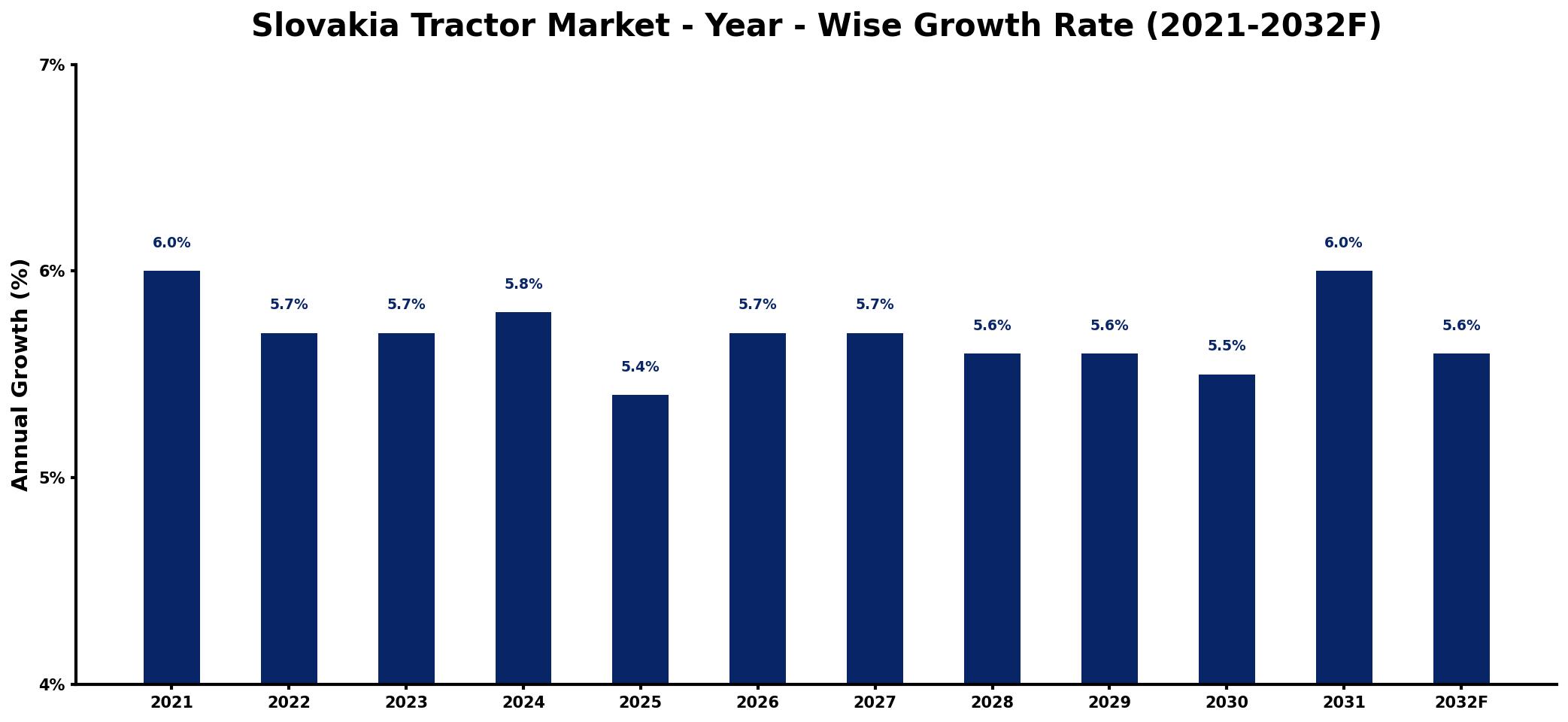
The table below presents the year‑wise growth rates along with the key drivers influencing the market
| Year | Growth Rate | Major Drivers |
| 2021 | 6.0% | Rising agricultural automation demand |
| 2022 | 5.7% | Increased investment in rural infrastructure |
| 2023 | 5.7% | Growing precision farming adoption |
| 2024 | 5.8% | Expansion of agricultural technology sector |
| 2025 | 5.4% | Strengthening export market opportunities |
| 2026 | 5.7% | Improved financing options for farmers |
| 2027 | 5.7% | Enhanced governmental agricultural support |
| 2028 | 5.6% | Surge in sustainable farming practices |
| 2029 | 5.6% | Growing demand for eco-friendly solutions |
| 2030 | 5.5% | Increased focus on food security |
| 2031 | 6.0% | Innovations in agricultural machinery |
| 2032 | 5.6% | Rising interest in agritech startups |
Note: Market size estimations and growth projections presented in this report are based on 6Wresearch's proprietary forecasting methodology, utilizing the latest available industry data, government publications, and primary research inputs.
Slovakia Tractor Market Synopsis
The Slovakia tractor market is currently witnessing a notable phase of development, influenced by the demands of its robust agriculture sector. Tractors have become indispensable for small to medium-sized farms, underpinning their operational efficiency and productivity.
Several key trends are shaping the market dynamics. The shift towards eco-friendly farming practices and the implementation of precision agriculture technologies are becoming increasingly significant, indicating a transformative phase for farmers in Slovakia.
Slovakia Tractor Market Key Takeaways
- Technological advancements are driving the demand for precision farming solutions.
- Government subsidies are instrumental in encouraging the purchase of modern tractors.
- The market is trending towards sustainable and efficient farming practices.
- Compact tractors are gaining traction among hobby farmers and small-scale operations.
- Investment opportunities in distribution and servicing networks are on the rise.
Evaluation of Restraints in Slovakia Tractor Market
Despite the promising outlook, the Slovakia tractor market faces several limitations that could hinder its growth. Intense competition among manufacturers—both local and international—creates pricing pressures that may affect profitability. Furthermore, fluctuating agricultural commodity prices can impact farmers' investment capabilities and purchasing power. Another significant restraint is the evolving environmental regulations, necessitating a swift transition to sustainable tractor models, which could be challenging for smaller producers. These factors compel market participants to innovate continually while finding ways to offer flexible financing solutions to support farmers in upgrading their equipment.
Slovakia Tractor Market Trends
In recent years, a noticeable trend in the Slovakia tractor market has been the increasing demand for technologically advanced machinery. Farmers are gravitating towards tractors that incorporate GPS guidance, telematics, and automated steering systems. This shift not only boosts productivity but also aligns with the broader movement towards sustainable farming. Additionally, there is a growing interest in electric and hybrid models, which promise lower emissions and operational costs, making them attractive for environmentally conscious farmers.
Slovakia Tractor Market Opportunities
The Slovakia tractor market is ripe with investment opportunities, particularly for those looking to capitalize on the rising demand for modern agricultural machinery. As the agricultural sector continues to grow, investors can explore ventures in supplying innovative tractors and enhancing distribution networks. The integration of smart technologies into tractors presents an additional layer of opportunity, with precision agriculture gaining momentum among Slovak farmers. This convergence of technology and agriculture opens doors for manufacturers and suppliers to meet the evolving needs of the market.
Government Initiatives in the Slovakia Tractor Market
The Slovakian government plays a crucial role in shaping the tractor market through various supportive policies and initiatives. By offering subsidies for the purchase of modern tractors, the government is promoting efficiency and technological advancement in the agriculture sector. Additionally, regulations ensuring compliance with environmental standards encourage manufacturers to innovate sustainably. Financial support for research and development in agricultural machinery further bolsters the industry, enabling local manufacturers to stay competitive and meet the demands of modern farming practices.
Future Insights of the Slovakia Tractor Market
Looking ahead, the Slovakia tractor market is poised for sustained growth from 2026 to 2032. This growth will likely be fueled by the increasing adoption of advanced agricultural technologies and ongoing government support. Moreover, farmers' growing awareness of the advantages of mechanization, such as enhanced productivity and reduced operational costs, is expected to bolster demand for modern tractors. As the market evolves, manufacturers are encouraged to innovate continuously and introduce products that cater to the specific needs of Slovak farmers, ensuring a dynamic and competitive landscape.
Slovakia Tractor Market Latest Developments (2025 - 2026)
In the past year, the Slovakia tractor market has experienced several noteworthy developments. Manufacturers have been increasingly focused on integrating smart technologies into their products to enhance precision farming capabilities. Additionally, several companies have initiated partnerships aimed at expanding their distribution networks and improving customer service. This trend is indicative of a broader shift towards ensuring that farmers have access to the latest innovations and support for their operations.
Slovakia Tractor Market - Key Attractiveness of the Report
- 10 Years of Market Numbers
- Historical Data Starting from 2022 to 2025
- Base Year: 2025
- Forecast Data until 2032
- Key Performance Indicators Impacting the Market
- Major Upcoming Developments and Projects
Key Highlights of the Report:
- Slovakia Tractor Market Outlook
- Market Size of Slovakia Tractor Market, 2025
- Forecast of Slovakia Tractor Market, 2032
- Historical Data and Forecast of Slovakia Tractor Revenues & Volume for the Period 2022-2032F
- Slovakia Tractor Market Trend Evolution
- Slovakia Tractor Market Drivers and Challenges
- Slovakia Tractor Price Trends
- Slovakia Tractor Porter's Five Forces
- Slovakia Tractor Industry Life Cycle
- Historical Data and Forecast of Slovakia Tractor Market Revenues & Volume By Power Output for the Period 2022-2032F
- Historical Data and Forecast of Slovakia Tractor Market Revenues & Volume By Less Than 30 HP for the Period 2022-2032F
- Historical Data and Forecast of Slovakia Tractor Market Revenues & Volume By 30-50 HP for the Period 2022-2032F
- Historical Data and Forecast of Slovakia Tractor Market Revenues & Volume By 51-100 HP for the Period 2022-2032F
- Historical Data and Forecast of Slovakia Tractor Market Revenues & Volume By More Than 100 HP for the Period 2022-2032F
- Historical Data and Forecast of Slovakia Tractor Market Revenues & Volume By Drive Type for the Period 2022-2032F
- Historical Data and Forecast of Slovakia Tractor Market Revenues & Volume By 2 Wheel Drive for the Period 2022-2032F
- Historical Data and Forecast of Slovakia Tractor Market Revenues & Volume By 4 Wheel Drive for the Period 2022-2032F
- Historical Data and Forecast of Slovakia Tractor Market Revenues & Volume By Application for the Period 2022-2032F
- Historical Data and Forecast of Slovakia Tractor Market Revenues & Volume By Agriculture for the Period 2022-2032F
- Slovakia Tractor Import Export Trade Statistics
- Market Opportunity Assessment By Power Output
- Market Opportunity Assessment By Drive Type
- Market Opportunity Assessment By Application
- Slovakia Tractor Top Companies Market Share
- Slovakia Tractor Competitive Benchmarking By Technical and Operational Parameters
- Slovakia Tractor Company Profiles
- Slovakia Tractor Key Strategic Recommendations






































