Slovakia Transport Packaging Market Summary
The slovakia transport packaging market was estimated at USD 465 Million in 2025 and is projected to reach USD 642 Million by 2032, growing at a CAGR of 5.6% from 2026 to 2032.
Slovakia Transport Packaging Market Year-wise Growth Rate and Key Drivers
This graph highlights how the Slovakia Transport Packaging Market has steadily grown over the past five years, supported by major growth factors.
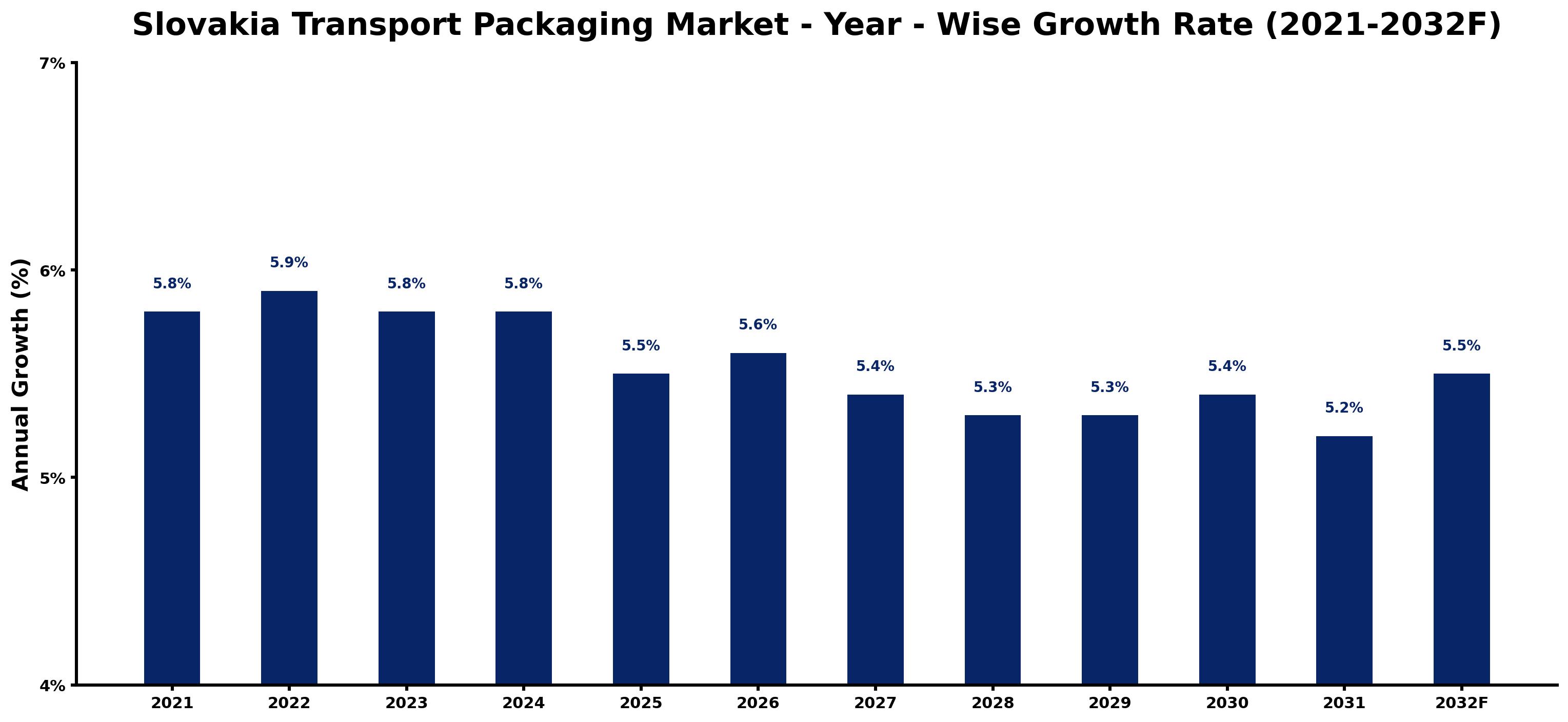
The table below presents the year wise growth rates along with the key drivers influencing the market
| Year | Growth Rate | Major Drivers |
| 2021 | 5.8% | Post-lockdown retail projects increased focus on efficient transport packaging solutions. |
| 2022 | 5.9% | E-commerce activities expanded, demanding innovative packaging for safe product delivery. |
| 2023 | 5.8% | Local manufacturers emphasized sustainability, shifting towards recyclable transport materials. |
| 2024 | 5.8% | Emerging startups in Slovakia introduced smart packaging technologies to enhance logistics. |
| 2025 | 5.5% | Collaboration among supply chain players improved packaging efficiency and reduced costs. |
| 2026 | 5.6% | Consumer preferences shifted towards minimalist packaging, encouraging redesigns in transport solutions. |
| 2027 | 5.4% | Economic recovery fostered increased production outputs, driving packaging needs across sectors. |
| 2028 | 5.3% | Technological integration in logistics optimized transport packaging for better inventory management. |
| 2029 | 5.3% | Competitive pressures prompted companies to innovate and differentiate their packaging offerings. |
| 2030 | 5.4% | Sustainability commitments from major brands accelerated the shift towards eco-friendly packaging. |
| 2031 | 5.2% | Urbanization trends in Slovakia necessitated adaptive transport solutions for densely populated areas. |
| 2032 | 5.5% | Collaboration with international firms introduced new standards for transport packaging efficiency. |
Note - Market size estimations and growth projections presented in this report are based on 6Wresearch's advanced forecasting approach, validated with industry datasets as of June 2026.
Slovakia Transport Packaging Market Synopsis
The Slovakia Transport Packaging Market is projected to reach 5.6% and witness significant growth during the forecast period (2026-2032). This growth is primarily attributed to the ongoing expansion of trade activities within the country, which is anticipated to bolster the demand for sophisticated transport packaging solutions. As Slovakia continues to enhance its positioning as a hub for logistics and trade, the necessity for efficient and secure packaging options is expected to rise in tandem, consequently providing a wealth of opportunities for stakeholders in the transport packaging sector.
Slovakia Transport Packaging Market Growth Drivers
Several factors are driving the growth of the Slovakia transport packaging market. First and foremost, the government is implementing initiatives aimed at encouraging foreign investments, which enhances overall industrial activity. This influx of investment is critical for developing transportation infrastructure, thereby increasing the demand for effective transport packaging solutions. Furthermore, consumer preferences are shifting towards sustainable packaging options as awareness about environmental impact grows among Slovak consumers. The rising popularity of materials such as paper and cardboard boxes, as well as advanced protective films, is indicative of this transition. Additionally, rapid industrialization across Europe, accompanied by improved logistics and supply chain infrastructure, is also contributing to the increasing demand for high-quality packaging materials.
Slovakia Transport Packaging Market Trends and Opportunities
A notable trend in the Slovakia transport packaging market is the growing emphasis on sustainability. As companies respond to evolving consumer expectations for eco-friendly products, many are investing in innovative packaging designs that minimize environmental impact. The emergence of biodegradable materials and recyclable packaging options are gaining traction, opening up new opportunities for market players to cater to environmentally conscious consumers. Moreover, the integration of technology in packaging solutions—such as smart packaging with embedded sensors—presents a unique avenue for growth. These advancements not only improve logistics efficiency but also enhance product tracking and traceability during transport.
Slovakia Transport Packaging Market Challenges and Restraints
Despite its growth prospects, the Slovakia transport packaging market faces certain challenges. The initial investment required for advanced packaging technologies can be substantial, posing a barrier for smaller companies. Additionally, fluctuating raw material prices can impede profit margins and make planning difficult for manufacturers. The increasing complexity of logistics processes, driven by globalization, may also create difficulties in maintaining consistent packaging standards across borders. Furthermore, regulatory compliance with environmental laws and packaging standards is becoming more stringent, necessitating continuous innovation and adaptation from market players.
Slovakia Transport Packaging Market Government Investment and Initiatives
The Slovak government has recognized the importance of the transport sector in fostering economic growth and has launched several initiatives aimed at enhancing infrastructure and attracting investments. Public spending on logistics hubs and transport routes has increased, thereby facilitating better access for businesses engaged in trade. Additionally, government grants and incentives are being offered to companies that adopt environmentally sustainable practices in packaging. This strategic focus on development is expected to significantly contribute to the evolution of the Slovakia transport packaging market, encouraging businesses to innovate and adopt more efficient processes.
Slovakia Transport Packaging Market Latest Developments (May 2025 - June 2026)
Recent developments in the Slovakia transport packaging market indicate a shift towards more innovative and sustainable packaging solutions. Over the past year, the industry has seen an uptick in the use of recyclable materials, with more companies committing to reduce their carbon footprint. Additionally, there has been a marked increase in partnerships between packaging firms and technology providers to integrate smart solutions into packaging, enabling better tracking and logistics management. This evolution aligns with the broader trends of digital transformation and sustainability that are influencing the entire packaging sector across Europe. Furthermore, workshops and forums focused on sustainable practices have gained popularity, providing stakeholders in the transport packaging industry opportunities to collaborate and share best practices.
Slovakia Transport Packaging Market - Key Attractiveness of the Report
- 10 Years of Market Numbers
- Historical Data Starting from 2022 to 2025
- Base Year: 2025
- Forecast Data until 2032
- Key Performance Indicators Impacting the Market
- Major Upcoming Developments and Projects
Key Highlights of the Report:
- Slovakia Transport Packaging Market Outlook
- Market Size of Slovakia Transport Packaging Market, 2025
- Forecast of Slovakia Transport Packaging Market, 2032F
- Historical Data and Forecast of Slovakia Transport Packaging Revenues & Volume for the Period 2022-2032F
- Slovakia Transport Packaging Market Trend Evolution
- Slovakia Transport Packaging Market Drivers and Challenges
- Slovakia Transport Packaging Price Trends
- Slovakia Transport Packaging Porter's Five Forces
- Slovakia Transport Packaging Industry Life Cycle
- Historical Data and Forecast of Slovakia Transport Packaging Market Revenues & Volume By Material Type for the Period 2022-2032F
- Historical Data and Forecast of Slovakia Transport Packaging Market Revenues & Volume By Plastic for the Period 2022-2032F
- Historical Data and Forecast of Slovakia Transport Packaging Market Revenues & Volume By Polyethylene (PE) for the Period 2022-2032F
- Historical Data and Forecast of Slovakia Transport Packaging Market Revenues & Volume By Polypropylene (PP) for the Period 2022-2032F
- Historical Data and Forecast of Slovakia Transport Packaging Market Revenues & Volume By Polyethylene Terephthalate (PET) for the Period 2022-2032F
- Historical Data and Forecast of Slovakia Transport Packaging Market Revenues & Volume By Paper & Paperboard for the Period 2022-2032F
- Historical Data and Forecast of Slovakia Transport Packaging Market Revenues & Volume By Metal for the Period 2022-2032F
- Historical Data and Forecast of Slovakia Transport Packaging Market Revenues & Volume By Wood for the Period 2022-2032F
- Historical Data and Forecast of Slovakia Plastic Transport Packaging Market Revenues & Volume By Others for the Period 2022-2032F
- Historical Data and Forecast of Slovakia Transport Packaging Market Revenues & Volume By Packaging Types for the Period 2022-2032F
- Historical Data and Forecast of Slovakia Transport Packaging Market Revenues & Volume By Cartons for the Period 2022-2032F
- Historical Data and Forecast of Slovakia Transport Packaging Market Revenues & Volume By Wooden crates for the Period 2022-2032F
- Historical Data and Forecast of Slovakia Transport Packaging Market Revenues & Volume By Containers for the Period 2022-2032F
- Historical Data and Forecast of Slovakia Transport Packaging Market Revenues & Volume By Corrugated boxes for the Period 2022-2032F
- Historical Data and Forecast of Slovakia Transport Packaging Market Revenues & Volume By Barrels for the Period 2022-2032F
- Historical Data and Forecast of Slovakia Transport Packaging Market Revenues & Volume By IBCs for the Period 2022-2032F
- Historical Data and Forecast of Slovakia Transport Packaging Market Revenues & Volume By Strapping for the Period 2022-2032F
- Historical Data and Forecast of Slovakia Transport Packaging Market Revenues & Volume By Others for the Period 2022-2032F
- Historical Data and Forecast of Slovakia Transport Packaging Market Revenues & Volume By End-users for the Period 2022-2032F
- Historical Data and Forecast of Slovakia Transport Packaging Market Revenues & Volume By Agriculture for the Period 2022-2032F
- Historical Data and Forecast of Slovakia Transport Packaging Market Revenues & Volume By Automotive for the Period 2022-2032F
- Historical Data and Forecast of Slovakia Transport Packaging Market Revenues & Volume By Building & Construction for the Period 2022-2032F
- Historical Data and Forecast of Slovakia Transport Packaging Market Revenues & Volume By Chemicals & Pharmaceuticals for the Period 2022-2032F
- Historical Data and Forecast of Slovakia Transport Packaging Market Revenues & Volume By Food & Beverages for the Period 2022-2032F
- Historical Data and Forecast of Slovakia Transport Packaging Market Revenues & Volume By Metallurgical for the Period 2022-2032F
- Historical Data and Forecast of Slovakia Transport Packaging Market Revenues & Volume By Electrical & Electronics for the Period 2022-2032F
- Historical Data and Forecast of Slovakia Transport Packaging Market Revenues & Volume By Others for the Period 2022-2032F
- Slovakia Transport Packaging Import Export Trade Statistics
- Market Opportunity Assessment By Material Type
- Market Opportunity Assessment By Packaging Types
- Market Opportunity Assessment By End-users
- Slovakia Transport Packaging Top Companies Market Share
- Slovakia Transport Packaging Competitive Benchmarking By Technical and Operational Parameters
- Slovakia Transport Packaging Company Profiles
- Slovakia Transport Packaging Key Strategic Recommendations






































