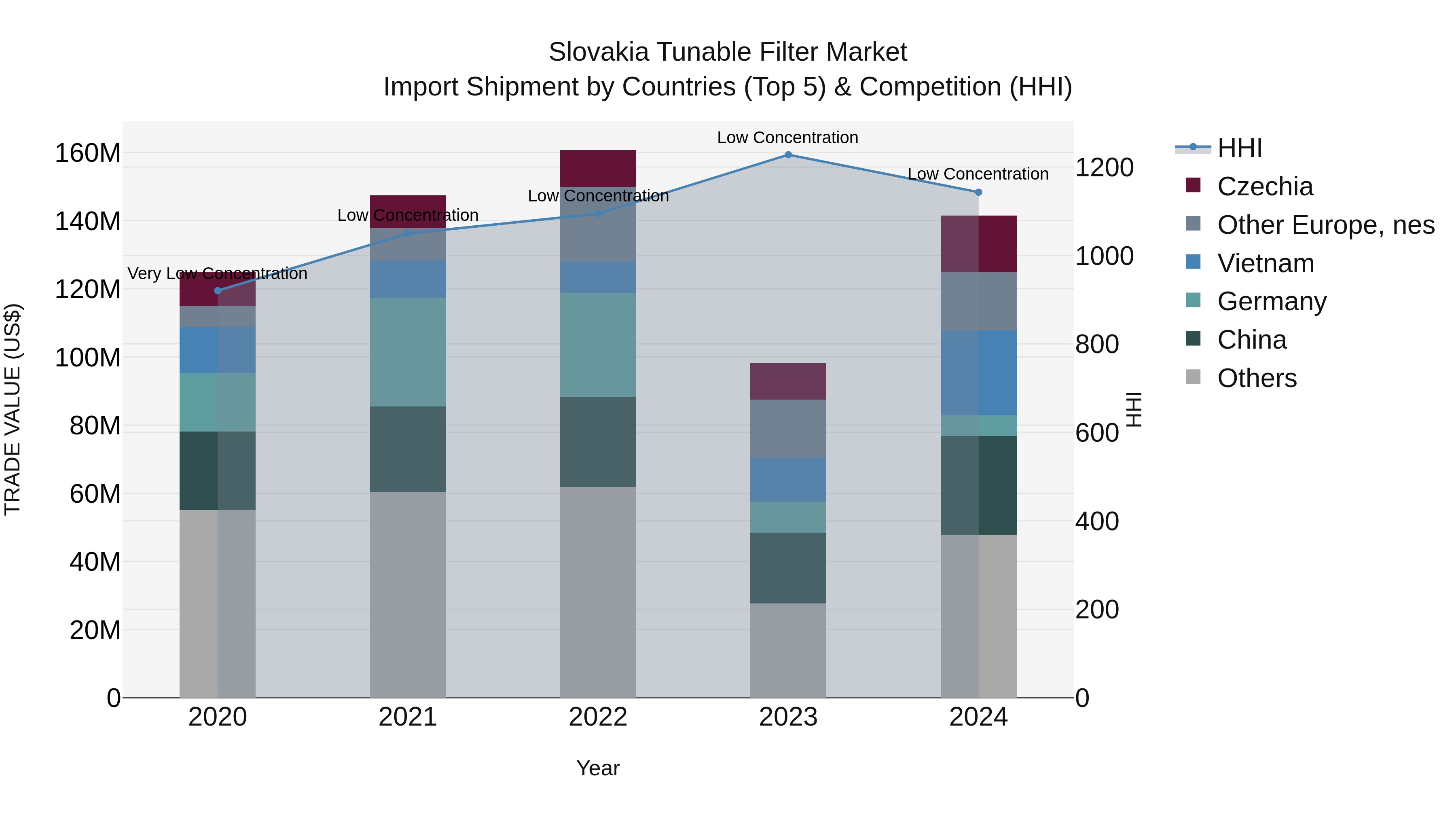
Slovakia Tunable Filter Market Top 5 Importing Countries and Market Competition (HHI) Analysis
Slovakia`s import shipments of tunable filters in 2024 were primarily sourced from China, Vietnam, Other Europe, Czechia, and South Korea, with a notable growth rate of 44.05% from 2023. Despite the increasing import volume, the Market Top 5 Importing Countries and Market Competition (HHI) Analysis remains diverse with low concentration, as indicated by the Herfindahl-Hirschman Index (HHI). The compound annual growth rate (CAGR) from 2020 to 2024 stood at a steady 3.13%, reflecting sustained demand and trade dynamics in the Slovakian Market Top 5 Importing Countries and Market Competition (HHI) Analysis for tunable filters.
Slovakia Tunable Filter Market Overview
The Slovakia tunable filter market is witnessing steady growth, driven by increasing demand from various industry verticals such as telecommunications, automotive, and healthcare. Tunable filters are gaining popularity due to their ability to adjust frequency characteristics, bandwidth, and other parameters, offering flexibility and customization in different applications. The market is also benefiting from technological advancements, such as the development of MEMS-based tunable filters, which provide improved performance and reliability. Key players in the Slovakia tunable filter market are focusing on product innovation and strategic partnerships to expand their market presence. With the growing adoption of wireless communication technologies and the increasing need for efficient spectrum management, the Slovakia tunable filter market is expected to continue its growth trajectory in the coming years.
Slovakia Tunable Filter Market Trends and Opportunities
The Slovakia Tunable Filter Market is witnessing significant growth due to the increasing demand for advanced communication technologies, such as 5G and IoT, in various industries including telecommunications, aerospace, and defense. The rise in data traffic and the need for higher bandwidths are driving the adoption of tunable filters for improved signal processing and frequency flexibility. Additionally, the growing focus on wireless networks and the expansion of mobile infrastructure are creating opportunities for tunable filter manufacturers to cater to the evolving needs of the market. With the increasing investments in research and development activities to enhance filter performance and efficiency, the Slovakia Tunable Filter Market is expected to experience steady growth in the coming years, presenting lucrative opportunities for industry players to expand their market presence and offerings.
Slovakia Tunable Filter Market Challenges
The Slovakia Tunable Filter Market faces challenges such as increasing competition from international players offering advanced technologies, limited awareness and understanding of tunable filter applications among potential end-users, and the high initial investment required for implementing tunable filter systems. Additionally, the relatively small size of the market in Slovakia compared to larger economies poses a constraint on the growth potential for tunable filter suppliers. Moreover, the economic uncertainty and fluctuations in the market can impact the purchasing decisions of businesses, potentially leading to delays or cancellations of tunable filter projects. To overcome these challenges, companies operating in the Slovakia Tunable Filter Market need to focus on educating the market about the benefits of tunable filters, offering competitive pricing strategies, and establishing strong partnerships with local businesses to expand their reach.
Slovakia Tunable Filter Market Drivers
The Slovakia Tunable Filter Market is primarily driven by the increasing demand for advanced communication networks and the growing adoption of tunable filters in various industries such as telecommunications, aerospace, and defense. The ability of tunable filters to provide precise frequency control and flexibility in adjusting signal frequencies to meet specific requirements is a key factor fueling market growth. Additionally, the rising investments in research and development activities to enhance the performance and efficiency of tunable filters, as well as the expanding applications in wireless communication systems and radar systems, are further contributing to the market`s expansion in Slovakia. Moreover, the need for improved signal quality, reduced interference, and enhanced signal processing capabilities are driving the demand for tunable filters in the country.
Slovakia Tunable Filter Market Government Policies
The Slovakia government has been supportive of the development and growth of the Tunable Filter Market through various policies and initiatives. These include offering financial incentives such as grants and subsidies to companies engaged in research and development in the field of tunable filters. Additionally, the government has implemented regulations to ensure quality standards and promote innovation in the market. Furthermore, Slovakia has focused on fostering collaboration between industry players, research institutions, and government bodies to drive technological advancements and competitiveness in the Tunable Filter Market. Overall, the government`s policies aim to create a favorable environment for businesses operating in this sector and to position Slovakia as a key player in the global tunable filter industry.
Slovakia Tunable Filter Market Future Outlook
The Slovakia Tunable Filter Market is poised for steady growth in the coming years, driven by increasing demand for advanced communication technologies and the expansion of the telecommunications sector. With the growing adoption of 5G networks and the Internet of Things (IoT) in Slovakia, there is a rising need for tunable filters to enhance signal processing and improve network performance. Additionally, the automotive industry in Slovakia is also expected to contribute to the market growth, as tunable filters are essential components in advanced driver assistance systems (ADAS) and connected vehicle technologies. Overall, the Slovakia Tunable Filter Market is projected to experience continuous expansion as industries continue to prioritize high-performance communication systems and connectivity solutions.
Key Highlights of the Report:
- Slovakia Tunable Filter Market Outlook
- Market Size of Slovakia Tunable Filter Market, 2024
- Forecast of Slovakia Tunable Filter Market, 2031
- Historical Data and Forecast of Slovakia Tunable Filter Revenues & Volume for the Period 2021 - 2031
- Slovakia Tunable Filter Market Trend Evolution
- Slovakia Tunable Filter Market Drivers and Challenges
- Slovakia Tunable Filter Price Trends
- Slovakia Tunable Filter Porter's Five Forces
- Slovakia Tunable Filter Industry Life Cycle
- Historical Data and Forecast of Slovakia Tunable Filter Market Revenues & Volume By Type for the Period 2021 - 2031
- Historical Data and Forecast of Slovakia Tunable Filter Market Revenues & Volume By Liquid Crystal Tunable Filters (LCTFs) for the Period 2021 - 2031
- Historical Data and Forecast of Slovakia Tunable Filter Market Revenues & Volume By Acousto-Optic Tunable Filters (AOTFs) for the Period 2021 - 2031
- Historical Data and Forecast of Slovakia Tunable Filter Market Revenues & Volume By Linear-Variable Tunable Filters (LVTFs) for the Period 2021 - 2031
- Historical Data and Forecast of Slovakia Tunable Filter Market Revenues & Volume By Other Tunable Filters for the Period 2021 - 2031
- Historical Data and Forecast of Slovakia Tunable Filter Market Revenues & Volume By System Type for the Period 2021 - 2031
- Historical Data and Forecast of Slovakia Tunable Filter Market Revenues & Volume By Military for the Period 2021 - 2031
- Historical Data and Forecast of Slovakia Tunable Filter Market Revenues & Volume By Commercial for the Period 2021 - 2031
- Historical Data and Forecast of Slovakia Tunable Filter Market Revenues & Volume By Application for the Period 2021 - 2031
- Historical Data and Forecast of Slovakia Tunable Filter Market Revenues & Volume By Military for the Period 2021 - 2031
- Historical Data and Forecast of Slovakia Tunable Filter Market Revenues & Volume By Commercial for the Period 2021 - 2031
- Slovakia Tunable Filter Import Export Trade Statistics
- Market Opportunity Assessment By Type
- Market Opportunity Assessment By System Type
- Market Opportunity Assessment By Application
- Slovakia Tunable Filter Top Companies Market Share
- Slovakia Tunable Filter Competitive Benchmarking By Technical and Operational Parameters
- Slovakia Tunable Filter Company Profiles
- Slovakia Tunable Filter Key Strategic Recommendations






































