Slovenia Ferrochrome Market Size (2020-2030)
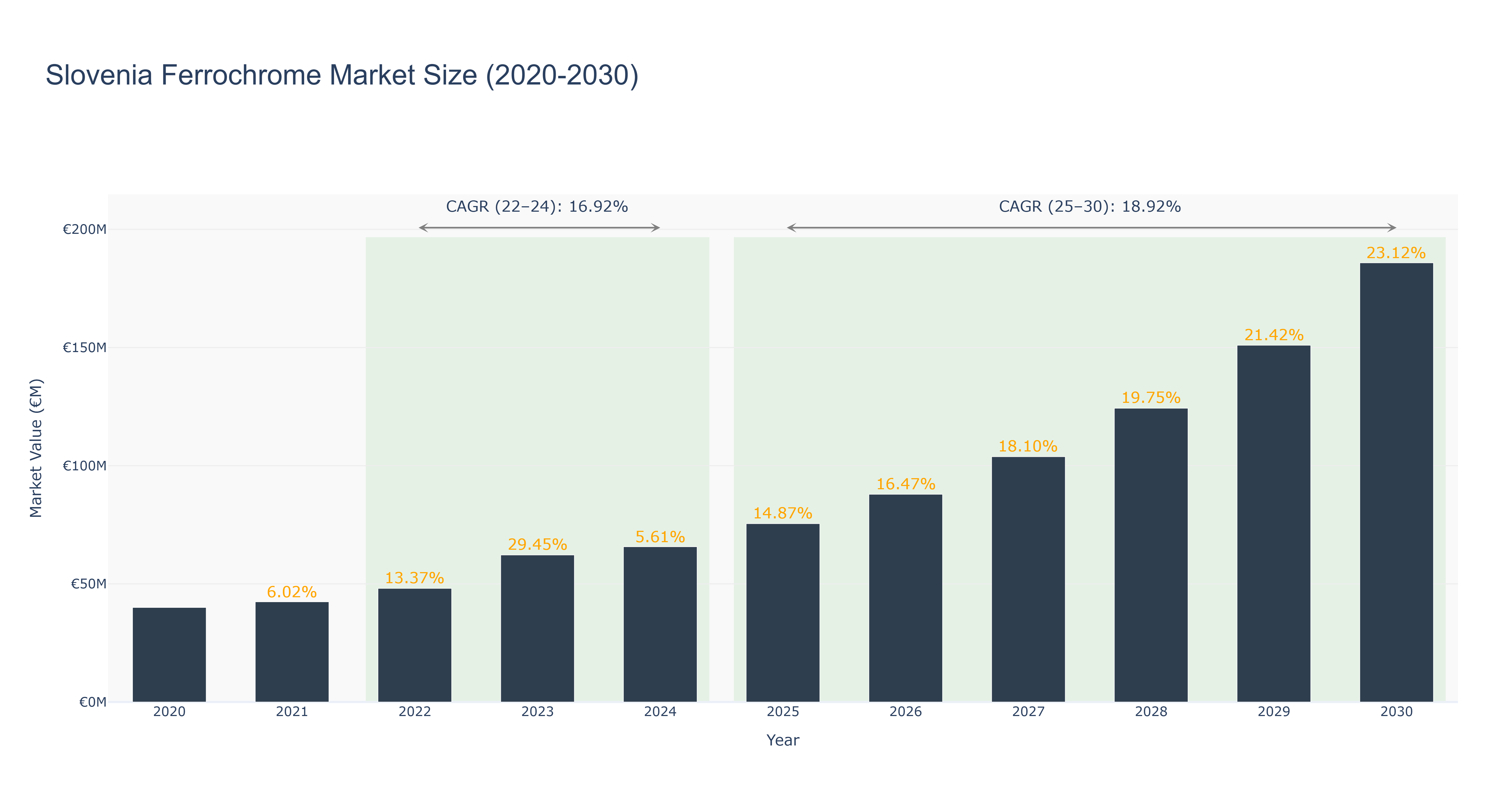
Slovenia's Ferrochrome Market has shown a positive trend over the years. The market size increased from €48.06 million in 2022 to €87.90 million in 2026, driven by a Compound Annual Growth Rate (CAGR) of 16.92% during 2022-2024 and 18.92% during 2025-2030. The peak market size of €185.84 million is forecasted for 2030. The market's growth can be attributed to increasing demand for ferrochrome in various industries, such as stainless steel production. Recent developments in the market include investments in technological advancements to enhance production efficiency and sustainability. Future projects focus on expanding export markets and improving supply chain logistics to meet growing global demand for ferrochrome. The market's upward trajectory is expected to continue, supported by industry drivers like infrastructure development and economic growth.
Slovenia Ferrochrome Market: Production & Trade Performance (2019-2025)
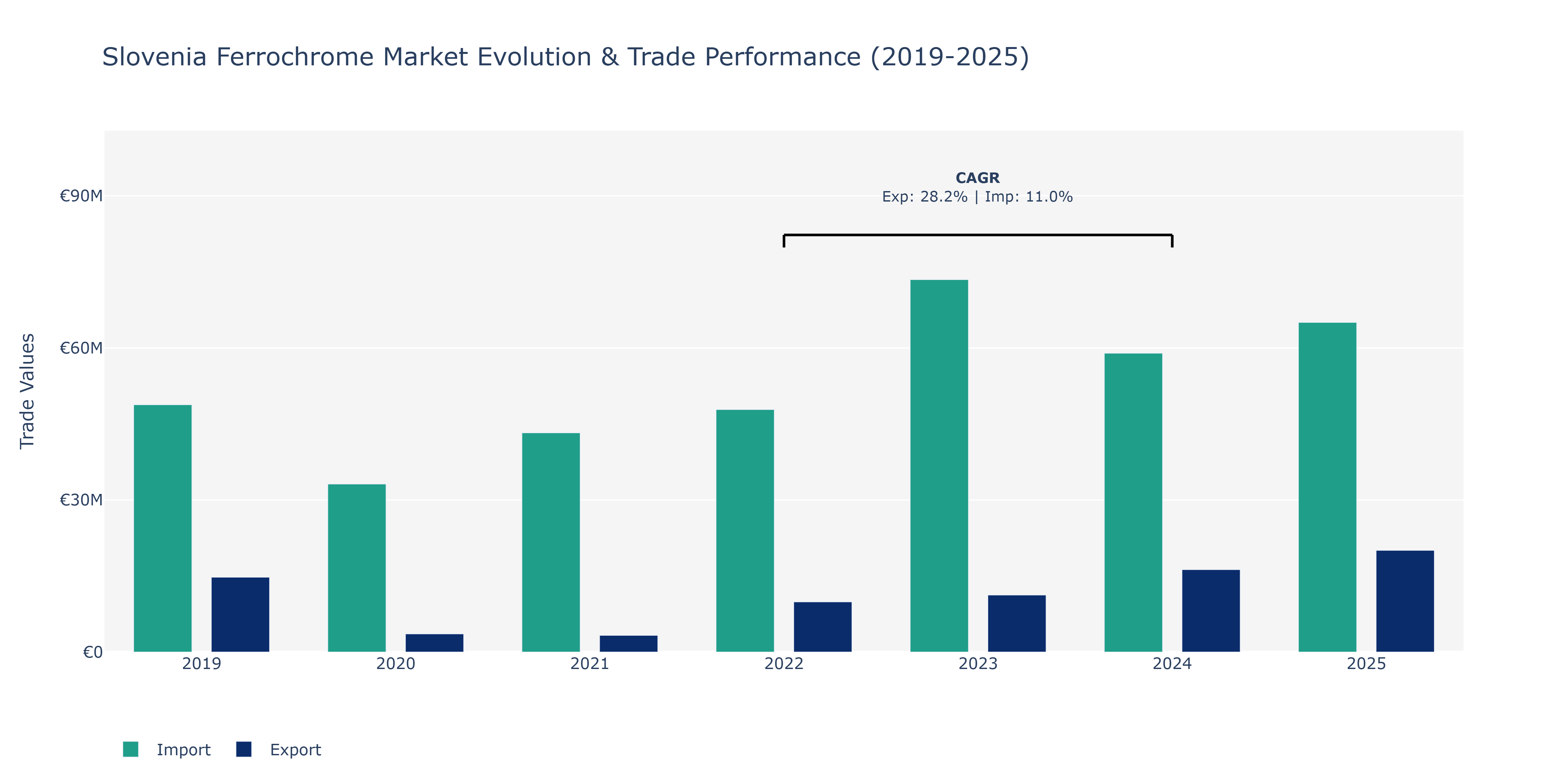
Between 2019 and 2025, Slovenia's Ferrochrome Market saw notable shifts in both exports and imports. Exports experienced a substantial decline from €14.75 million in 2019 to €3.58 million in 2020 before gradually recovering to €20.05 million in 2025, showing a peak in that year. In contrast, imports followed a fluctuating pattern, starting at €48.79 million in 2019, dipping to €33.13 million in 2020, and peaking at €73.46 million in 2023. The imports then decreased to €65.02 million in 2025, showcasing a slight downward trend. These movements can be attributed to global economic conditions influencing demand for ferrochrome, including shifts in industrial production levels, trade policies impacting import volumes, and the competitive landscape within the ferrochrome market. Rising global infrastructure projects and the automotive industry's demand for stainless steel likely fueled the increase in exports post-2020, while fluctuations in raw material prices and supply chain disruptions could have influenced the import variations.
Key Highlights of the Report:
- Slovenia Ferrochrome Market Outlook
- Market Size of Slovenia Ferrochrome Market, 2025
- Forecast of Slovenia Ferrochrome Market, 2032
- Historical Data and Forecast of Slovenia Ferrochrome Revenues & Volume for the Period 2022-2032F
- Slovenia Ferrochrome Market Trend Evolution
- Slovenia Ferrochrome Market Drivers and Challenges
- Slovenia Ferrochrome Price Trends
- Slovenia Ferrochrome Porter`s Five Forces
- Slovenia Ferrochrome Industry Life Cycle
- Historical Data and Forecast of Slovenia Ferrochrome Market Revenues & Volume By Type for the Period 2022-2032F
- Historical Data and Forecast of Slovenia Ferrochrome Market Revenues & Volume By High carbon for the Period 2022-2032F
- Historical Data and Forecast of Slovenia Ferrochrome Market Revenues & Volume By Medium carbon for the Period 2022-2032F
- Historical Data and Forecast of Slovenia Ferrochrome Market Revenues & Volume By Low carbon for the Period 2022-2032F
- Historical Data and Forecast of Slovenia Ferrochrome Market Revenues & Volume By Applications for the Period 2022-2032F
- Historical Data and Forecast of Slovenia Ferrochrome Market Revenues & Volume By Stainless steel for the Period 2022-2032F
- Historical Data and Forecast of Slovenia Ferrochrome Market Revenues & Volume By Other steels for the Period 2022-2032F
- Slovenia Ferrochrome Import Export Trade Statistics
- Market Opportunity Assessment By Type
- Market Opportunity Assessment By Applications
- Slovenia Ferrochrome Top Companies Market Share
- Slovenia Ferrochrome Competitive Benchmarking By Technical and Operational Parameters
- Slovenia Ferrochrome Company Profiles
- Slovenia Ferrochrome Key Strategic Recommendations






































