South Africa Bisphenol A Market Size Growth Rate
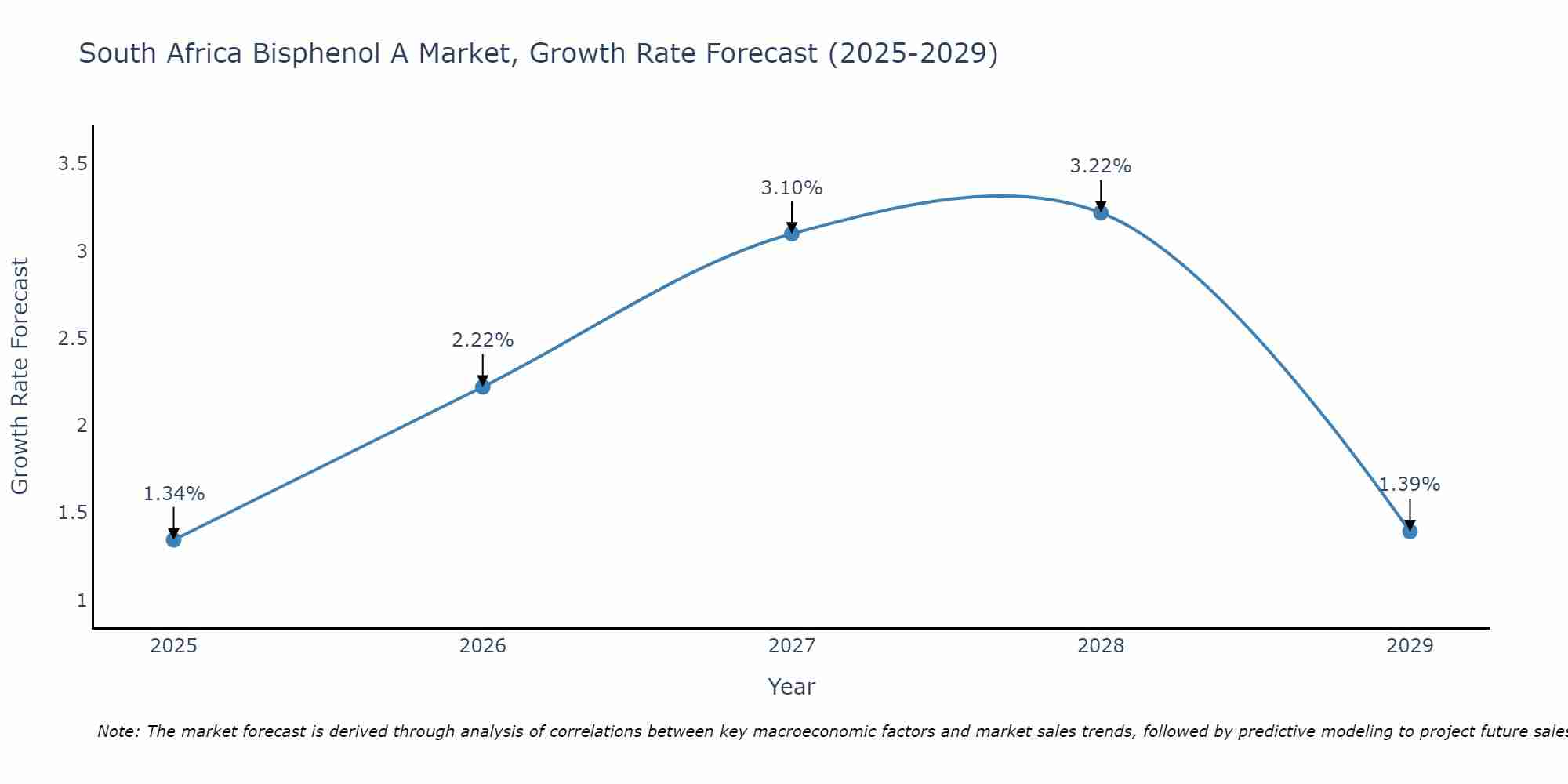
The South Africa Bisphenol A Market is projected to witness mixed growth rate patterns during 2025 to 2029. The growth rate begins at 1.34% in 2025, climbs to a high of 3.22% in 2028, and moderates to 1.39% by 2029.
South Africa Bisphenol A Market Overview
The South Africa Bisphenol A market is witnessing steady growth driven by increasing demand from various end-use industries such as automotive, electronics, and packaging. Bisphenol A is widely used in the production of polycarbonate plastics and epoxy resins, which are essential materials in these industries. The market is also influenced by growing awareness regarding the harmful effects of Bisphenol A on human health and the environment, leading to a shift towards alternative products. Regulatory initiatives aimed at restricting the use of Bisphenol A in certain applications are further shaping the market dynamics in South Africa. Key players in the market are focusing on product innovation and sustainable practices to cater to evolving consumer preferences and regulatory requirements. Overall, the South Africa Bisphenol A market is poised for continued growth, albeit with a focus on sustainability and regulatory compliance.
South Africa Bisphenol A Market Trends
The South Africa Bisphenol A market is experiencing a shift towards BPA-free alternatives due to increasing awareness of the potential health risks associated with BPA exposure. Consumers are seeking out products that are labeled as BPA-free, leading to a growing demand for non-BPA packaging materials and products. Regulatory bodies are also taking action to restrict the use of BPA in certain applications, further driving the market towards BPA alternatives. Additionally, manufacturers are investing in research and development to innovate and introduce safer alternatives to BPA in various industries such as food and beverage, healthcare, and consumer goods. Overall, the trend towards BPA-free products is expected to continue shaping the South Africa Bisphenol A market in the coming years.
South Africa Bisphenol A Market Challenges
In the South Africa Bisphenol A market, challenges are primarily driven by regulatory changes and increasing consumer awareness about the potential health risks associated with BPA exposure. The South African government has implemented stricter regulations on the use of BPA in certain products, leading to market uncertainty for manufacturers. Additionally, consumers are becoming more educated about the health implications of BPA, leading to a shift in preferences towards BPA-free products. This trend is putting pressure on companies to reformulate their products or find alternative packaging materials. Furthermore, the competitive landscape is intensifying as companies strive to differentiate themselves through innovation and sustainability practices to meet changing consumer demands and regulatory requirements, thus presenting a challenge for market players in the South Africa Bisphenol A market.
South Africa Bisphenol A Market Investment Opportunities
The South Africa Bisphenol A market presents various investment opportunities due to the growing demand for this chemical compound in the country`s manufacturing and packaging industries. With an increasing focus on sustainable and eco-friendly products, there is a rising need for Bisphenol A in the production of polycarbonate plastics, epoxy resins, and thermal paper coatings. Investors can capitalize on this trend by investing in companies involved in the manufacturing, distribution, and research of Bisphenol A, as well as those developing alternative solutions to meet the market demand. Furthermore, the government`s support for industrial development and innovation in South Africa creates a favorable environment for investment in the Bisphenol A market, making it an attractive opportunity for those looking to tap into the country`s chemical industry growth.
South Africa Bisphenol A Market Government Policy
The South African government has implemented various regulations and policies related to Bisphenol A (BPA). The Department of Health has set maximum allowable limits for BPA in food and food contact materials to ensure consumer safety. Additionally, the Department of Environmental Affairs is working on initiatives to reduce BPA pollution in the environment. The government has also encouraged the use of BPA-free alternatives in industries such as packaging and plastics manufacturing. Overall, these policies aim to regulate the use of BPA, protect public health, and promote the adoption of safer alternatives in the South African market.
South Africa Bisphenol A Market Future Outlook
The South Africa Bisphenol A market is expected to witness steady growth in the coming years, driven by increasing demand from industries such as automotive, electronics, and packaging. The growing awareness about the harmful effects of BPA on human health has led to a shift towards BPA-free alternatives, which may slightly hamper the market growth. However, the introduction of stringent regulations and the development of innovative applications for Bisphenol A are anticipated to create new opportunities for market expansion. The market players are focusing on research and development to enhance product quality and cater to the evolving consumer preferences. Overall, the South Africa Bisphenol A market is likely to experience moderate growth in the forecast period.
Key Highlights of the Report:
- South Africa Bisphenol A Market Outlook
- Market Size of South Africa Bisphenol A Market, 2021
- Forecast of South Africa Bisphenol A Market, 2031
- Historical Data and Forecast of South Africa Bisphenol A Revenues & Volume for the Period 2021 - 2031
- South Africa Bisphenol A Market Trend Evolution
- South Africa Bisphenol A Market Drivers and Challenges
- South Africa Bisphenol A Price Trends
- South Africa Bisphenol A Porter's Five Forces
- South Africa Bisphenol A Industry Life Cycle
- Historical Data and Forecast of South Africa Bisphenol A Market Revenues & Volume By Application for the Period 2021 - 2031
- Historical Data and Forecast of South Africa Bisphenol A Market Revenues & Volume By Polycarbonate Resin for the Period 2021 - 2031
- Historical Data and Forecast of South Africa Bisphenol A Market Revenues & Volume By Epoxy Resin for the Period 2021 - 2031
- Historical Data and Forecast of South Africa Bisphenol A Market Revenues & Volume By Unsaturated Polyester Resins for the Period 2021 - 2031
- Historical Data and Forecast of South Africa Bisphenol A Market Revenues & Volume By Flame Retardants for the Period 2021 - 2031
- Historical Data and Forecast of South Africa Bisphenol A Market Revenues & Volume By Others for the Period 2021 - 2031
- Historical Data and Forecast of South Africa Bisphenol A Market Revenues & Volume By End-use for the Period 2021 - 2031
- Historical Data and Forecast of South Africa Bisphenol A Market Revenues & Volume By Eye wear for the Period 2021 - 2031
- Historical Data and Forecast of South Africa Bisphenol A Market Revenues & Volume By Automotive component for the Period 2021 - 2031
- Historical Data and Forecast of South Africa Bisphenol A Market Revenues & Volume By Electronics for the Period 2021 - 2031
- Historical Data and Forecast of South Africa Bisphenol A Market Revenues & Volume By Wind Energy Composites for the Period 2021 - 2031
- Historical Data and Forecast of South Africa Bisphenol A Market Revenues & Volume By Paint and Coating for the Period 2021 - 2031
- Historical Data and Forecast of South Africa Bisphenol A Market Revenues & Volume By Green House for the Period 2021 - 2031
- Historical Data and Forecast of South Africa Bisphenol A Market Revenues & Volume By Others for the Period 2021 - 2031
- South Africa Bisphenol A Import Export Trade Statistics
- Market Opportunity Assessment By Application
- Market Opportunity Assessment By End-use
- South Africa Bisphenol A Top Companies Market Share
- South Africa Bisphenol A Competitive Benchmarking By Technical and Operational Parameters
- South Africa Bisphenol A Company Profiles
- South Africa Bisphenol A Key Strategic Recommendations






































