South Africa It Market: Import Trend Analysis
South Africa`s import trend for the IT market experienced a significant decline, with a growth rate plummeting by -99.25% from 2023 to 2024. The compound annual growth rate (CAGR) for the period 2020-2024 stood at -53.83%. This sharp downturn could be attributed to shifts in demand dynamics or evolving trade policies impacting market stability.
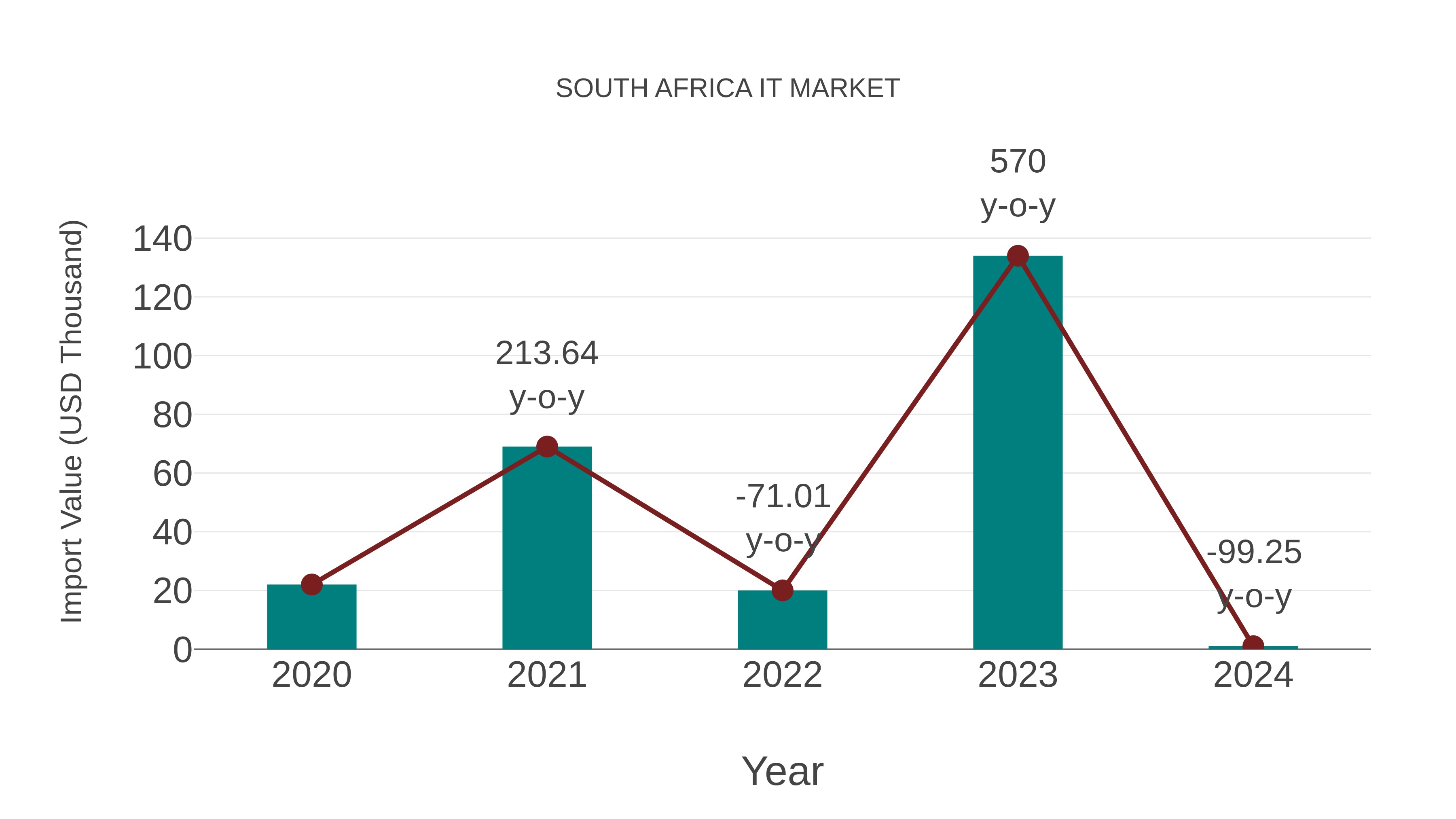
South Africa IT Market Growth Rate
According to 6Wresearch internal database and industry insights, the South Africa IT Market is projected to grow at a compound annual growth rate (CAGR) of 6.7% during the forecast period 2026–2032.
Five-Year Growth Trajectory of the South Africa IT Market with Core Drivers
Below mentioned are the evaluation of year-wise growth rate along with key drivers:
| Year | Est. Annual Growth (%) | Growth Drivers |
| 2021 | 5.3% | Increased usage of cloud computing solutions due to high demand for remote work infrastructure. |
| 2022 | 5.6% | Development of 4G and 5G networks, and major IT infrastructure investments. |
| 2023 | 5.8% | High demand for data security solutions and digital transformation among enterprises. |
| 2024 | 6% | Increased use of AI and machine learning solutions by businesses in many sectors. |
| 2025 | 6.1% | Government programs to support better digital economy and development of infrastructure. |
Topics Covered in the South Africa IT Market Report
The South Africa IT Market report thoroughly covers the market by enterprise size, end-user. It provides an unbiased and detailed analysis of ongoing market trends, opportunities, challenges, and market drivers, helping stakeholders align their strategies with current and future market dynamics.
South Africa IT Market Highlights
| Parameter | Details |
| Report Name | South Africa IT Market |
| Forecast Period | 2026–2032 |
| CAGR | 6.70% |
| Growing Sector | Banking, Financial Services, and Insurance (BFSI) |
South Africa IT Market Synopsis
South Africa IT Market is expected to grow rapidly due to the high demand for digital infrastructure development in many enterprises, increased demand for security of data, and strong government support for digital infrastructure development. South Africa's fastest growing economy, large number of enterprises, and high IT solution usage make it a better market for both domestic and international players. The market is also being reshaped by new technologies in cloud computing, AI, and 5G technologies. With the government's large investment in digital infrastructure and a strong focus on innovation, the South Africa IT Market is set for major growth.
Evaluation of Growth Drivers in the South Africa IT Market
Below mentioned are some prominent drivers and their influence on the South Africa IT Market dynamics:
| Drivers | Primary Segment Affected | Why It Matters (Evidence) |
| Digital Transformation Adoption | All Segments | Enterprises in many sectors are increasingly using digital solutions for better operations and better customer experience. |
| Government Support | All Segments | The government is pushing for digitalization by large investments in infrastructure, new innovation programs, and incentives for technology adoption. |
| Cybersecurity Threats | Cybersecurity Solutions | Growing cyber threats are pushing the demand for more advanced and comprehensive cybersecurity solutions. |
| AI and Big Data Analytics | All Segments | AI and big data analytics are being utilized by companies to optimize their operations and improve decision-making. |
| Cloud Adoption | Small and Medium Enterprises | Cloud computing is increasingly becoming an affordable solution, especially for SMEs that are using it to improve efficiency. |
South Africa IT Market Size is projected to grow at a compound annual growth rate (CAGR) of 6.7% from 2026 to 2032. The market is driven by major investments in IT infrastructure by government, the increasing usage of cloud computing, and the high demand for cybersecurity solutions. The demand for data security will also continue to increase due to growing cyber threats and the need for protecting sensitive business data. Government laws also play an important role in creating favourable conditions for the IT sector. South Africa's fastest growing economy, large number of enterprises, and high IT solution usage make it a better market for both domestic and international players. New technologies such as artificial intelligence, 5G infrastructure, and automation will also proliferate South Africa IT Market Growth.
Evaluation of Restraints in the South Africa IT Market
Below mentioned are some major restraints and their influence on the South Africa IT Market dynamics:
| Restraints | Primary Segment Affected | What This Means (Evidence) |
| High Competition | IT Providers | Major competition in the IT market may lead to price changes, reducing profits for providers. |
| Data Privacy Concerns | IT Solutions | Heightened concerns about data privacy may stop businesses from fully leveraging IT solutions, especially those which involves cloud services. |
| High Operational Costs | IT Providers | High cost of infrastructure development, including network and hardware investments, could reduce profits for smaller IT firms. |
| Talent Shortage | All Segments | The shortage of skilled IT professionals may slow down the pace of innovation and delay execution of project. |
| Regulatory Compliance | IT Providers | The strict rules around data privacy and cybersecurity are increasing the operational prices and different difficulties for IT providers. |
South Africa IT Market Challenges
South Africa IT Market faces many challenges such as high competition between major companies in the market, a shortage of skilled and trained professionals, complex laws regarding data privacy, and increasing operational prices. The market's growth will also be changed by the regulatory landscape, which can increase compliance prices for IT companies. Small and medium-sized enterprises (SMEs) may face difficulties in keeping up with the innovation pace set by larger companies due to these challenges. Companies will need to invest more in talent development and fulfil regulatory difficulties while pushing innovation and cybersecurity to stay competitive in the market.
South Africa IT Market Trends
Several notable trends are shaping the South Africa IT Market dynamics:
- Cloud Adoption: The trend towards cloud computing continues to dominate, with businesses wanting, affordable, and flexible IT solutions. Cloud usage among SMEs is particularly on the rise as it reduces upfront infrastructure prices.
- Cybersecurity Demand: As cyberattacks increase globally, the demand for better cybersecurity solutions, including AI-driven security measures and encryption, is increasing. South African businesses are investing more in network development.
- Government Support for Digital Transformation: The South African government is driving digital transformation programs such as the South African Digital Economy Strategy, which aims to increase internet use, 5G adoption, and the growth of e-commerce.
- AI and Big Data Integration: AI and big data analytics are changing industries like banking, retail, and government. South African businesses are using these technologies to optimize operations, predict trends, and better decision-making.
- 5G Infrastructure: The development of 5G networks in South Africa is expected to create better opportunities for IT companies to offer faster and more reliable services. The 5G revolution will increase the country's digital economy.
Investment Opportunities in the South Africa IT Industry
Some notable investment opportunities in the South Africa IT Industry are:
- Cloud Computing: Investing in cloud infrastructure and services to meet the growing demand for flexible, on-demand computing resources.
- Cybersecurity: Investing in cybersecurity technologies, including AI-powered security, encryption solutions, and threat detection systems to secure networks and systems.
- AI and Automation: Supporting AI startups that focus on machine learning, robotics, and automation tools to improve operational efficiency.
- 5G Networks and IoT: Investing in the development of 5G infrastructure and IoT technologies, which will drive the next wave of digital transformation in South Africa.
- Government Initiatives: Collaborating with the government on initiatives like the South African National Broadband Plan to provide funding for digital infrastructure and transformation projects.
Top 5 Leading Players in the South Africa IT Market
Below is the list of prominent companies leading in the South Africa IT Market:
1. SAP SE
| Company Name | SAP SE |
| Headquarters | Walldorf, Germany |
| Established | 1972 |
| official website | Click Here |
SAP provides enterprise software solutions for businesses, including cloud computing and data analytics, which are pivotal for the South African IT market. Their extensive offerings support digital transformation and automation across industries.
2. Dimension Data (NTT Ltd.)
| Company Name | Dimension Data (NTT Ltd.) |
| Headquarters | Johannesburg, South Africa |
| Established | 1983 |
| official website | Click Here |
Dimension Data, now part of NTT Ltd., is a major player in the South African IT market, providing cloud, cybersecurity, and network solutions to businesses. They are well-regarded for their work in enterprise IT transformation and cloud services.
3. MTN Group
| Company Name | MTN Group |
| Headquarters | Johannesburg, South Africa |
| Established | 1994 |
| official website | Click Here |
MTN Group is a telecommunications giant in Africa with a strong presence in IT services such as cloud computing, network infrastructure, and 5G technologies. MTN is investing heavily in IT infrastructure to support digital economy growth in South Africa.
4. IBM South Africa
| Company Name | IBM South Africa |
| Headquarters | Sandton, South Africa |
| Established | 1921 |
| official website | Click Here |
IBM offers a wide range of IT solutions, including AI, data analytics, and cloud computing, which are essential for the digital transformation of businesses in South Africa. IBM is known for its leadership in enterprise technology and IT consulting services.
5. Microsoft South Africa
| Company Name | Microsoft South Africa |
| Headquarters | Johannesburg, South Africa |
| Established | 1992 |
| official website | Click Here |
Microsoft is a key player in South Africa's IT market, offering cloud solutions through Azure, productivity tools via Office 365, and AI-driven business applications. Their extensive presence supports the country's growing IT ecosystem.
Government Regulations Introduced in the South Africa IT Market
According to South Africa’s government data, they have introduced many programs to increase digital transformation in the country which will likely to increase the growth of the digital economy in the country make sure access to better and secure technology. The South African Digital Economy Strategy also focuses on large investments in new infrastructure, e-commerce, and the usage of new technology in various sectors. The National ICT Policy White Paper promotes the expansion of broadband access, the development of new digital skills, and the establishment of better data security to support the digital transformation of businesses and the economy. The Protection of Personal Information Act (POPIA) is also an important data protection law that protect the privacy rights of South African citizens and change how businesses handle and safeguard personal data in the digital age.
Future Insights of the South Africa IT Market
South Africa IT Market is poised for a steady growth as it is driven by the increased usage of cloud computing, AI, cybersecurity solutions, and the government's major focus on digital transformation. The market is expected to be shaped by new advancements in technologies, high demand for data-driven solutions, and developing 5G infrastructure. The government's programs will continue to foster a better environment for growth of digital economy, making South Africa a better and profitable market for both local and international IT companies. Many businesses across sectors are embracing technological advancements to increase operational efficiency and customer experience.
Market Segmentation Analysis
The report offers a comprehensive study of the following market segments and their leading categories:
By Enterprise Size - Large Enterprises to dominate the market
According to Lakshita, Senior Research Analyst, 6Wresearch, Large enterprises are expected to dominate the South Africa IT Market Share due to their ability to invest in cutting-edge IT infrastructure and digital transformation initiatives. These businesses benefit from economies of scale and are more likely to adopt AI, cloud computing, and cybersecurity solutions at a faster pace.
By End-user - BFSI to dominate the market
BFSI (Banking, Financial Services, and Insurance) sector is expected to lead the market, driven by the increasing need for secure transactions, data analytics, and regulatory compliance.
Key Attractiveness of the Report
- 10 Years of Market Numbers.
- Historical Data Starting from 2022 to 2025.
- Base Year: 2025.
- Forecast Data until 2032.
- Key Performance Indicators Impacting the Market.
- Major Upcoming Developments and Projects.
Key Highlights of the Report:
- South Africa IT Market Outlook
- Market Size of South Africa IT Market, 2025
- Forecast of South Africa IT Market, 2032
- Historical Data and Forecast of South Africa IT Revenues & Volume for the Period 2022- 2032F
- South Africa IT Market Trend Evolution
- South Africa IT Market Drivers and Challenges
- South Africa IT Price Trends
- South Africa IT Porter's Five Forces
- South Africa IT Industry Life Cycle
- Historical Data and Forecast of South Africa IT Market Revenues & Volume By Enterprise Size for the Period 2022- 2032F
- Historical Data and Forecast of South Africa IT Market Revenues & Volume By Small and Medium Enterprises for the Period 2022- 2032F
- Historical Data and Forecast of South Africa IT Market Revenues & Volume By Large Enterprises for the Period 2022- 2032F
- Historical Data and Forecast of South Africa IT Market Revenues & Volume By End-user for the Period 2022- 2032F
- Historical Data and Forecast of South Africa IT Market Revenues & Volume By Retail for the Period 2022- 2032F
- Historical Data and Forecast of South Africa IT Market Revenues & Volume By Manufacturing for the Period 2022- 2032F
- Historical Data and Forecast of South Africa IT Market Revenues & Volume By BFSI for the Period 2022- 2032F
- Historical Data and Forecast of South Africa IT Market Revenues & Volume By Government for the Period 2022- 2032F
- Historical Data and Forecast of South Africa IT Market Revenues & Volume By IT and Telecom for the Period 2022- 2032F
- Historical Data and Forecast of South Africa IT Market Revenues & Volume By Other for the Period 2022- 2032F
- South Africa IT Import Export Trade Statistics
- Market Opportunity Assessment By Enterprise Size
- Market Opportunity Assessment By End-user
- South Africa IT Top Companies Market Share
- South Africa IT Competitive Benchmarking By Technical and Operational Parameters
- South Africa IT Company Profiles
- South Africa IT Key Strategic Recommendations
Market Covered
The report offers a comprehensive study of the following South Africa IT Market segments:
By Enterprise Size
- Small and Medium Enterprises
- Large Enterprises
By End-user
- Retail
- Manufacturing
- BFSI
- Government
- IT and Telecom
- Other






































