South Africa Optical Projector Market: Import Trend Analysis
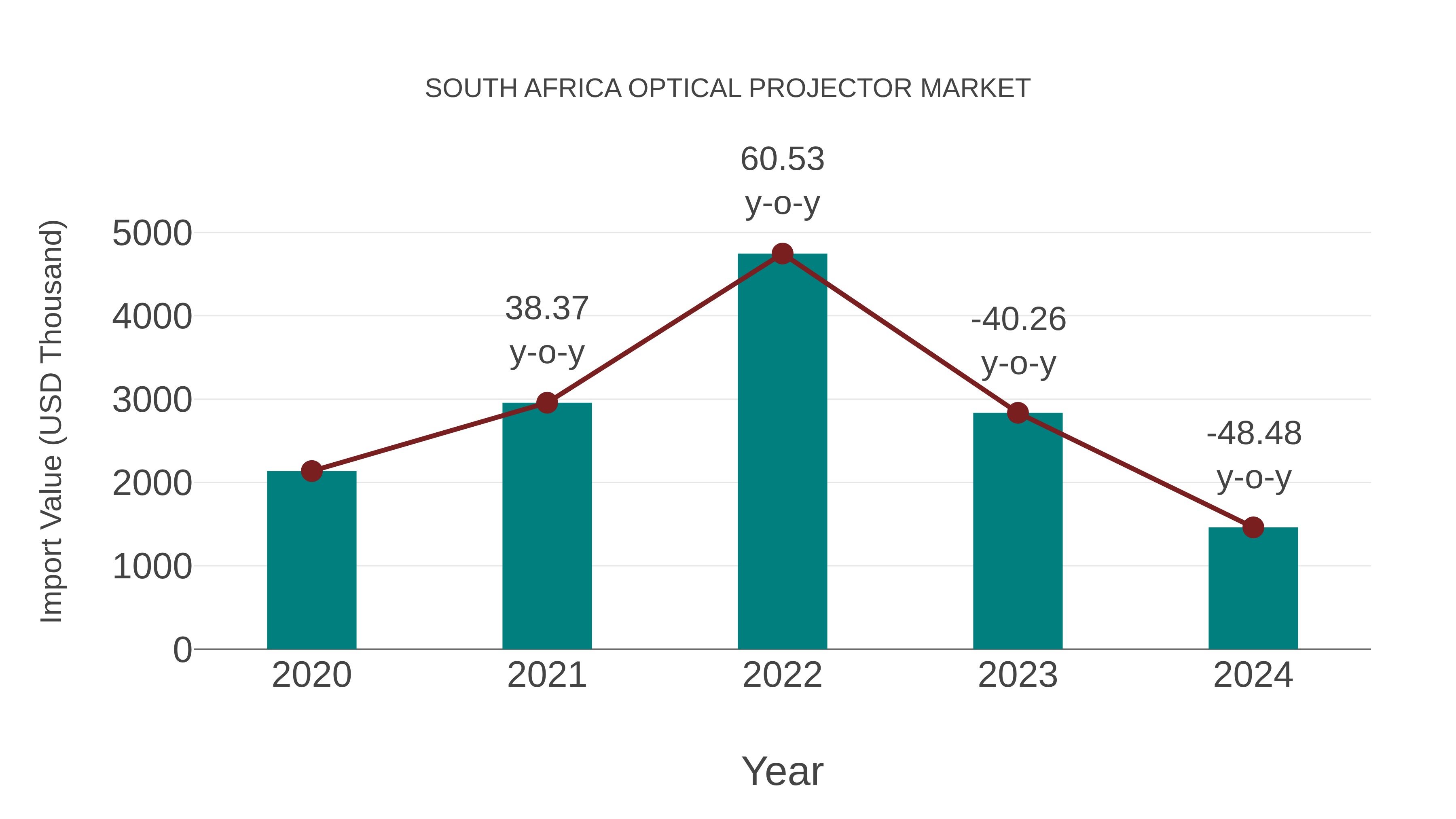
South Africa`s import trend for the optical projector market experienced a significant decline from 2023 to 2024, with a growth rate of -48.48%. The compound annual growth rate (CAGR) for the period 2020-2024 stood at -9.07%. This decline could be attributed to shifting consumer preferences, changes in technology, or fluctuations in global trade dynamics impacting the market stability.
South Africa Optical Projector Market Overview
The optical projector market in South Africa is growing, supported by its applications in education, entertainment, and corporate sectors. Projectors are essential for presentations, movie screenings, and interactive learning. The market benefits from advancements in projector technology, such as improved resolution and portability. The increasing adoption of e-learning and the rising demand for home entertainment systems are also contributing to market growth.
Drivers of the market
The optical projector market in South Africa is driven by the rising demand for advanced display solutions in education, corporate, and entertainment sectors. Technological advancements, including higher resolution and portable projectors, along with increasing adoption in home theaters, further fuel market growth.
Challenges of the market
The optical projector market in South Africa struggles with high import duties and taxes that raise the overall cost of products. Competition from alternative display technologies, such as LED and LCD screens, also poses a significant threat. Furthermore, economic instability can impact consumer spending on non-essential items like projectors.
Government Policy of the market
Government policies affecting the optical projector market in South Africa include regulations on import standards, safety, and educational technology adoption. The government sets quality standards for imported optical projectors to ensure safety and performance. There are also policies promoting the use of digital projectors in educational institutions to enhance learning experiences. Incentives are provided for schools and universities to adopt advanced visual technologies. Additionally, the government supports local distributors and service providers through preferential procurement policies and initiatives aimed at boosting the technology sector.
Key Highlights of the Report:
- South Africa Optical Projector Market Outlook
- Market Size of South Africa Optical Projector Market, 2025
- Forecast of South Africa Optical Projector Market, 2032
- Historical Data and Forecast of South Africa Optical Projector Revenues & Volume for the Period 2022-2032F
- South Africa Optical Projector Market Trend Evolution
- South Africa Optical Projector Market Drivers and Challenges
- South Africa Optical Projector Price Trends
- South Africa Optical Projector Porter's Five Forces
- South Africa Optical Projector Industry Life Cycle
- Historical Data and Forecast of South Africa Optical Projector Market Revenues & Volume By Type for the Period 2022-2032F
- Historical Data and Forecast of South Africa Optical Projector Market Revenues & Volume By Digital Light Processing (DLP) for the Period 2022-2032F
- Historical Data and Forecast of South Africa Optical Projector Market Revenues & Volume By Liquid Crystal Display (LCD) for the Period 2022-2032F
- Historical Data and Forecast of South Africa Optical Projector Market Revenues & Volume By Liquid Crystal on Silicon (LCoS) for the Period 2022-2032F
- Historical Data and Forecast of South Africa Optical Projector Market Revenues & Volume By Application for the Period 2022-2032F
- Historical Data and Forecast of South Africa Optical Projector Market Revenues & Volume By Residential for the Period 2022-2032F
- Historical Data and Forecast of South Africa Optical Projector Market Revenues & Volume By Commercial for the Period 2022-2032F
- Historical Data and Forecast of South Africa Optical Projector Market Revenues & Volume By Industrial for the Period 2022-2032F
- South Africa Optical Projector Import Export Trade Statistics
- Market Opportunity Assessment By Type
- Market Opportunity Assessment By Application
- South Africa Optical Projector Top Companies Market Share
- South Africa Optical Projector Competitive Benchmarking By Technical and Operational Parameters
- South Africa Optical Projector Company Profiles
- South Africa Optical Projector Key Strategic Recommendations






































