South Africa Spaghetti Market Size Growth Rate
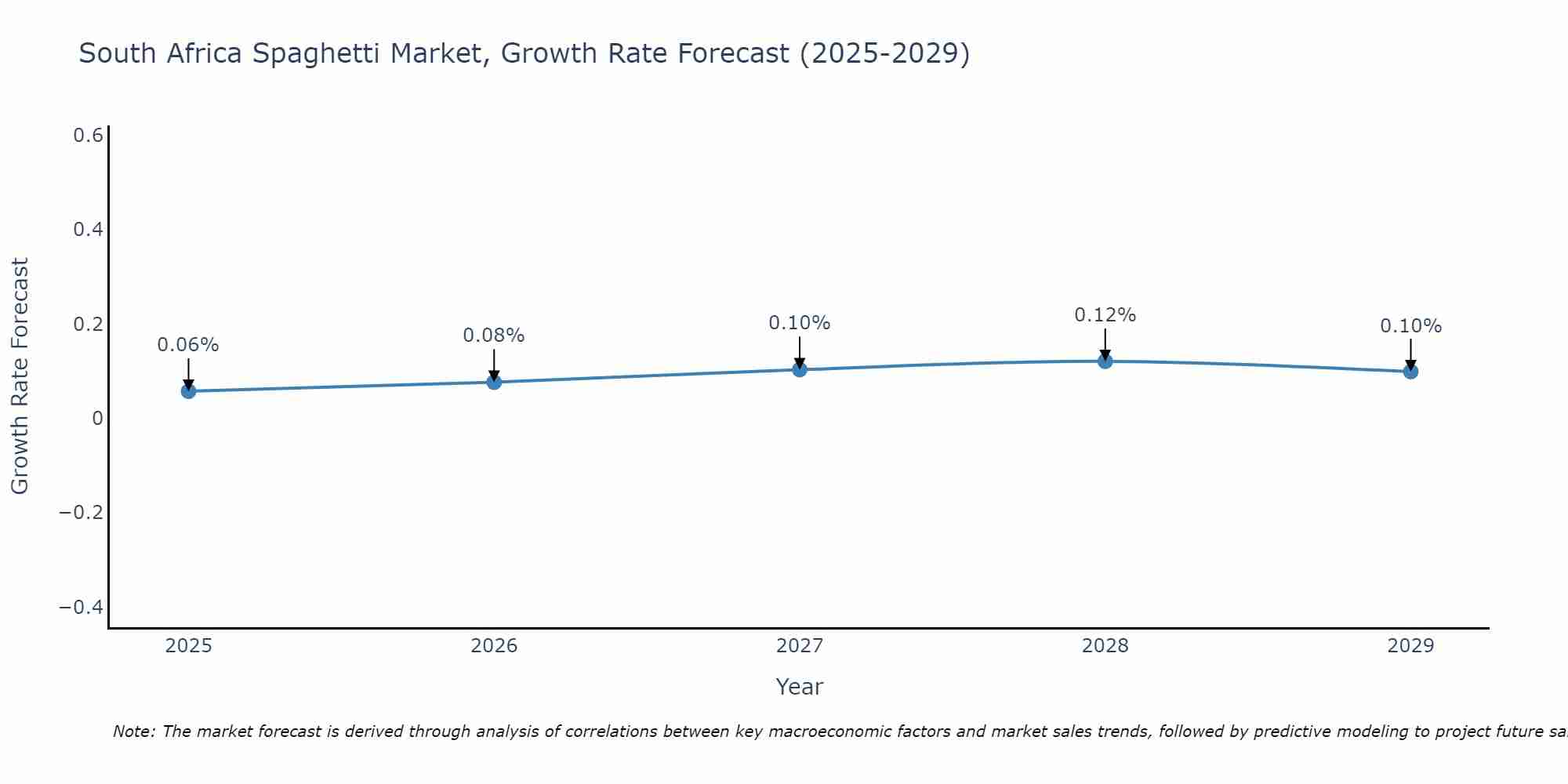
The South Africa Spaghetti Market is projected to witness mixed growth rate patterns during 2025 to 2029. Starting at 0.06% in 2025, the market peaks at 0.12% in 2028, and settles at 0.10% by 2029.
South Africa Spaghetti Market Overview
The South Africa spaghetti market is experiencing steady growth driven by the increasing adoption of Italian cuisine among South African consumers. The market is dominated by well-known brands such as Barilla, La Molisana, and Riscossa, while local brands are also gaining traction. Factors contributing to the market growth include the convenience of spaghetti as a quick and easy meal option, the rising trend of home cooking amid the COVID-19 pandemic, and the growing influence of international food trends in South Africa. Retail distribution channels, including supermarkets, hypermarkets, and online platforms, play a crucial role in making spaghetti products accessible to a wider consumer base. As consumer preferences shift towards healthier and organic options, there is also a rising demand for whole wheat and gluten-free spaghetti variants in the South African market.
South Africa Spaghetti Market Trends
The South Africa spaghetti market is experiencing a surge in demand for healthier and premium pasta options, driven by increasing health consciousness among consumers. Whole grain and gluten-free spaghetti varieties are gaining popularity as they are perceived as healthier alternatives. Convenience is also a key trend, with ready-to-eat and quick-cooking spaghetti products gaining traction among busy urban consumers. Additionally, there is a growing preference for organic and sustainably sourced spaghetti products, reflecting a shift towards environmentally friendly and ethical consumption habits. Flavored and exotic spaghetti variants are also witnessing increased interest among adventurous consumers looking for unique dining experiences. Overall, the South Africa spaghetti market is evolving to cater to diverse consumer preferences for healthier, convenient, and ethically produced pasta products.
South Africa Spaghetti Market Challenges
In the South Africa spaghetti market, some challenges faced include increasing competition from both local and imported pasta brands, fluctuating raw material prices affecting production costs, and the impact of economic conditions on consumer purchasing power. Additionally, logistical issues such as transportation and distribution complexities can hinder market growth and accessibility in certain regions. Moreover, changing consumer preferences towards healthier food choices and the rise of alternative pasta options made from ingredients like quinoa or lentils pose a threat to traditional spaghetti sales. Adapting to these challenges by innovating product offerings, optimizing supply chain efficiencies, and effectively marketing the nutritional benefits of spaghetti could help companies navigate the competitive landscape and sustain growth in the South Africa market.
South Africa Spaghetti Market Investment Opportunities
In the South Africa spaghetti market, there are several investment opportunities to consider. One potential opportunity lies in the growing demand for healthier and premium pasta options, such as whole wheat or gluten-free spaghetti, as consumers become more health-conscious. Investing in innovative product development to cater to this trend could be profitable. Additionally, there is a growing trend towards convenience foods in South Africa, presenting an opportunity for investment in ready-to-eat or quick-cook spaghetti products. Furthermore, with the increasing popularity of online grocery shopping in the region, investing in e-commerce platforms or partnerships could also be a lucrative avenue to explore. Overall, by tapping into the evolving consumer preferences and market trends, investors can capitalize on the diverse opportunities present in the South Africa spaghetti market.
South Africa Spaghetti Market Government Policy
The South African government has implemented various policies related to the spaghetti market aimed at promoting local production and ensuring food safety standards. These policies include import tariffs on foreign spaghetti to protect domestic manufacturers, quality control regulations to ensure that products meet health and safety standards, and support for small-scale farmers to increase local production of key ingredients such as wheat. Additionally, the government has introduced labeling requirements to provide consumers with information about the origin and nutritional content of spaghetti products. Overall, these policies are designed to stimulate economic growth in the agricultural sector, safeguard consumer health, and reduce dependency on imported goods in the South African spaghetti market.
South Africa Spaghetti Market Future Outlook
The South Africa spaghetti market is expected to experience steady growth in the coming years, driven by factors such as increasing disposable income, changing consumer preferences towards convenience foods, and a growing trend of adopting Western dietary habits. The market is also likely to benefit from the rising popularity of Italian cuisine and the expansion of international food retail chains in the region. However, challenges such as fluctuating raw material prices, competition from alternative pasta products, and economic uncertainties may pose some obstacles to the market`s growth. Overall, with a combination of favorable market drivers and potential challenges, the South Africa spaghetti market is forecasted to expand at a moderate pace in the foreseeable future.
Key Highlights of the Report:
- South Africa Spaghetti Market Outlook
- Market Size of South Africa Spaghetti Market, 2021
- Forecast of South Africa Spaghetti Market, 2031
- Historical Data and Forecast of South Africa Spaghetti Revenues & Volume for the Period 2018 - 2031
- South Africa Spaghetti Market Trend Evolution
- South Africa Spaghetti Market Drivers and Challenges
- South Africa Spaghetti Price Trends
- South Africa Spaghetti Porter's Five Forces
- South Africa Spaghetti Industry Life Cycle
- Historical Data and Forecast of South Africa Spaghetti Market Revenues & Volume By Product for the Period 2018 - 2031
- Historical Data and Forecast of South Africa Spaghetti Market Revenues & Volume By Fresh for the Period 2018 - 2031
- Historical Data and Forecast of South Africa Spaghetti Market Revenues & Volume By Dried for the Period 2018 - 2031
- Historical Data and Forecast of South Africa Spaghetti Market Revenues & Volume By End Use for the Period 2018 - 2031
- Historical Data and Forecast of South Africa Spaghetti Market Revenues & Volume By Mass Market Retail for the Period 2018 - 2031
- Historical Data and Forecast of South Africa Spaghetti Market Revenues & Volume By Horeca for the Period 2018 - 2031
- Historical Data and Forecast of South Africa Spaghetti Market Revenues & Volume By Distribution Channel for the Period 2018 - 2031
- Historical Data and Forecast of South Africa Spaghetti Market Revenues & Volume By Supermarket and Hypermarket for the Period 2018 - 2031
- Historical Data and Forecast of South Africa Spaghetti Market Revenues & Volume By Convenience Store for the Period 2018 - 2031
- Historical Data and Forecast of South Africa Spaghetti Market Revenues & Volume By Online for the Period 2018 - 2031
- Historical Data and Forecast of South Africa Spaghetti Market Revenues & Volume By Others for the Period 2018 - 2031
- South Africa Spaghetti Import Export Trade Statistics
- Market Opportunity Assessment By Product
- Market Opportunity Assessment By End Use
- Market Opportunity Assessment By Distribution Channel
- South Africa Spaghetti Top Companies Market Share
- South Africa Spaghetti Competitive Benchmarking By Technical and Operational Parameters
- South Africa Spaghetti Company Profiles
- South Africa Spaghetti Key Strategic Recommendations






































