South Korea 1-Decanol Market Growth Rate
According to 6Wresearch internal database and industry insights, the South Korea 1-Decanol Market is projected to grow at a compound annual growth rate (CAGR) of 6.2% during the forecast period (2026-2032).
South Korea 1-Decanol Market Year-wise Growth Rate and Key Drivers
This graph highlights how the South Korea 1-Decanol Market has steadily grown over the past five years, supported by major growth factors.
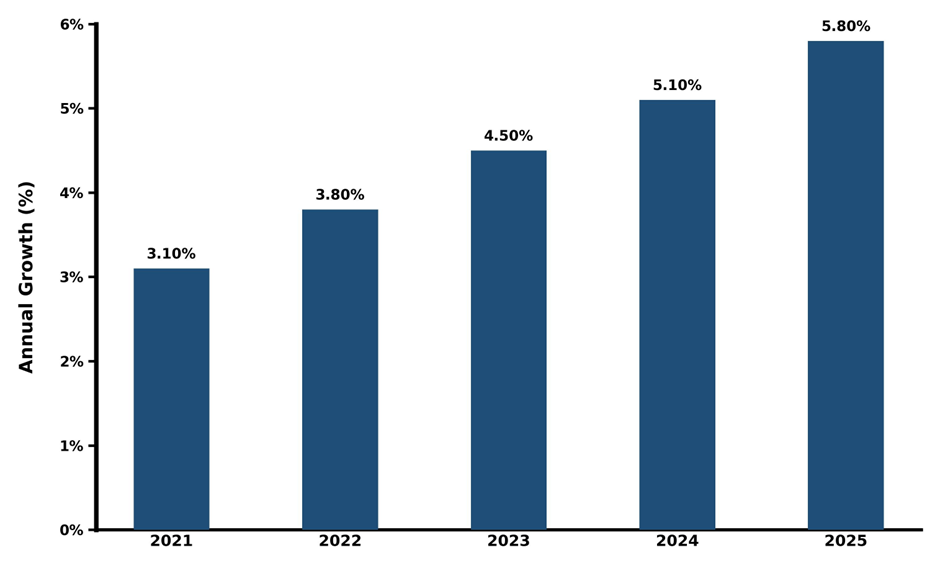
The table below presents the year‑wise growth rates along with the key drivers influencing the market
| Year | Est. Annual Growth (%) | Growth Drivers |
| 2021 | 3.1% | Recovery in industrial chemical consumption and steady detergent production demand |
| 2022 | 3.8% | Rising surfactant usage in personal care and cleaning formulations |
| 2023 | 4.5% | Expansion of oleochemical intermediates in specialty chemical manufacturing |
| 2024 | 5.1% | Increasing adoption in eco-friendly lubricants and plasticizer production |
| 2025 | 5.8% | Strong demand from cosmetics, pharmaceuticals, and industrial surfactants |
Topics Covered in the South Korea 1-Decanol Market Report
The South Korea 1-Decanol Market report thoroughly covers the market by Source and Application. The market report provides an unbiased and detailed analysis of ongoing market trends, opportunities/high growth areas, and market drivers, which help stakeholders devise and align their market strategies according to the current and future market dynamics.
South Korea 1-Decanol Market Highlights
| Report Name | South Korea 1-Decanol Market |
| Forecast period | 2026-2032 |
| CAGR | 6.2% |
| Growing Sector | Chemicals & Specialty Intermediates |
South Korea 1-Decanol Market Synopsis
South Korea 1-Decanol Market is anticipated to witness steady growth driven by increasing consumption in detergents, lubricants, cosmetics, and pharmaceutical applications. The expansion of South Korea’s chemical manufacturing base and rising demand for high-purity alcohol intermediates are strengthening market adoption. Additionally, growing focus on sustainable and bio-based chemical production is supporting long-term industrial transformation. Strong export-oriented chemical output and continuous innovation in downstream applications further enhance market development across the country’s specialty chemical ecosystem.
Evaluation of Growth Drivers in the South Korea 1-Decanol Market (2026-2032)
Below mentioned are some prominent drivers and their influence on the market dynamics:
| Drivers | Primary Segments Affected | Why it Matters (Evidence) |
| Rising demand for surfactants | Detergents & Cleaners, Cosmetics | Expands use in emulsifiers and cleaning agents |
| Growth in cosmetics industry | Cosmetics & Personal Care | Drives demand for fatty alcohol-based formulations |
| Petrochemical expansion | Petrochemical Based, Lubricants | Ensures stable raw material supply |
| Shift toward bio-based chemicals | Oleochemical Based, Pharmaceuticals | Supports sustainable production practices |
| Industrial lubricant demand | Lubricants, Automotive | Enhances efficiency in machinery applications |
South Korea 1-Decanol Market is expected to grow at a CAGR of 6.2% during 2026-2032. Growth is supported by rising demand from cosmetics, detergents, and specialty chemical industries. Increase in capacity for petrochemical production along with sustainable chemical processes will add to the dynamics of the market. Moreover, innovations in oleochemical processes and high demand for exports have contributed to market growth consistently.
Evaluation of Restraints in the South Korea 1-Decanol Market
Below mentioned are some major restraints and their influence on the market dynamics:
| Restraints | Primary Segments Affected | What This Means (Evidence) |
| Raw material price volatility | Petrochemical Based, Lubricants | Affects production cost stability |
| Strict environmental norms | Oleochemical Based, Detergents | Increases compliance burden |
| High production complexity | Pharmaceuticals, Cosmetics | Limits small-scale manufacturing |
| Import dependency | All segments | Impacts supply chain reliability |
| Limited bio-based infrastructure | Oleochemical Based | Slows sustainable transition |
South Korea 1-Decanol Market Challenges
South Korea 1-Decanol Market Growth faces challenges such as volatile petrochemical feedstock prices, strict environmental compliance requirements, and dependence on imported raw materials. In addition to this, the insufficient scalability of biological production and high operating expenses associated with specialty chemical production hinder its growth into wider markets. Disruptions in the supply chain and technological limitations in converting oleochemicals hinder the competitiveness of production in both local and export markets for chemicals.
South Korea 1-Decanol Market Trends
Some of the trends analyzing the South Korea 1-Decanol Market scenario include:
- Increasing Adoption of Bio-Alcohol: Increasing usage of 1-decanol obtained from oleochemicals for sustainable purposes is expected to drive the market due to increasing environmental issues linked with chemical usage in manufacturing industries.
- Rise in Usage in Personal Care Products: Increase in demand for 1-decanol in cosmetics is driving the need for fatty alcohols.
- Need for High-Performance Surfactants: Increasing adoption in detergents and industrial cleaners is anticipated to boost the usage of surfactant-grade 1-decanol.
- Increasing Demand in Lubricants: Rising demand in automotive and machinery lubricants is enhancing thermal stability.
Investment Opportunities in the South Korea 1-Decanol Market
The following are the significant investments expected in the South Korea 1-Decanol Market:
- Plants to Produce Bio-Based Chemicals - Establishing production facilities for producing oleochemicals in response to increasing demands for eco-friendly alcohols.
- Plants to Produce Cosmetic Ingredients - Constructing production facilities for producing high-purity 1-decanol for use in cosmetics.
- Facilities to Produce Surfactants & Detergents - Building facilities for producing chemicals for various surfactants and detergents.
- Specialty Chemical R&D Investments - Investing in research and development of advanced lubricant substances and chemical derivatives.
Top 5 Leading Players in the South Korea 1-Decanol Market
Some leading players operating in the South Korea 1-Decanol Market include:
1. BASF SE
| Company Name | BASF SE |
| Established Year | 1865 |
| Headquarters | Ludwigshafen, Germany |
| Official Website | Click Here |
BASF produces fatty alcohols including 1-decanol used in detergents, cosmetics, and industrial applications. The company focuses on sustainable chemical solutions and advanced formulation technologies supporting global specialty chemical industries.
2. Sasol Limited
| Company Name | Sasol Limited |
| Established Year | 1950 |
| Headquarters | Johannesburg, South Africa |
| Official Website | Click Here |
Sasol is a leading producer of long-chain alcohols used in surfactants, lubricants, and detergents. Its integrated chemical processes support large-scale industrial demand across Asia-Pacific markets including South Korea.
3. KLK OLEO
| Company Name | KLK OLEO |
| Established Year | 1906 |
| Headquarters | Selangor, Malaysia |
| Official Website | Click Here |
KLK OLEO manufactures oleochemical-based fatty alcohols used in personal care and cleaning products. The company focuses on sustainable palm-based chemical production for global markets.
4. LG Chem
| Company Name | LG Chem |
| Established Year | 1947 |
| Headquarters | Seoul, South Korea |
| Official Website | Click Here |
LG Chem is a major petrochemical company supplying intermediates used in specialty chemicals, lubricants, and industrial applications including alcohol-based derivatives like 1-decanol.
5. Kao Corporation
| Company Name | Kao Corporation |
| Established Year | 1887 |
| Headquarters | Tokyo, Japan |
| Official Website | Click Here |
Kao Corporation develops high-purity fatty alcohols used in cosmetics, detergents, and personal care products, supporting sustainable ingredient sourcing across Asia.
Government Regulations Introduced in the South Korea 1-Decanol Market
According to South Korean Government Data, Regulatory frameworks, for instance, the Korea Chemicals Management Act (K-REACH) launched in 2015 and updated in 2021, provide the means for the secure management of industrial chemicals like 1-decanol. Other environmental policies that have been put in place include the Ministry of Environment emission control regulations and green chemistry initiatives that promote sustainable production practices within the industry.
Future Insights of the South Korea 1-Decanol Market
South Korea 1-Decanol Industry is expected to witness steady growth driven by rising demand from cosmetics, detergents, pharmaceuticals, and lubricants. Increasing investment in bio-based chemical production, along with advancements in oleochemical processing technologies, will enhance production efficiency. Expanding export opportunities and growing sustainability initiatives are further expected to strengthen long-term market development across South Korea speciality chemical industry landscape.
Market Segmentation Analysis
The report offers a comprehensive study of the subsequent market segments and their leading categories:
Petrochemical Based to Dominate the Market- By Source
According to Sahil, Senior Research Analyst, 6Wresearch, Petrochemical Based segment dominates the South Korea 1-Decanol Market Share due to strong integration with refinery infrastructure and cost-efficient large-scale production. Its wide usage in detergents, lubricants, and industrial applications ensures consistent demand across manufacturing industries, making it the leading source segment.
Plasticizers to Dominate the Market- By Application
Plasticizers segment dominates the application landscape of the South Korea 1-Decanol Market due to rising demand for flexible PVC and polymer modification applications. Growth in construction, automotive, and industrial manufacturing sectors further strengthens usage in plasticizer production across the country.
Key Attractiveness of the Report
- 10 Years of Market Numbers
- Historical Data Starting from 2022 to 2025
- Base Year: 2025
- Forecast Data until 2032
- Key Performance Indicators Impacting the Market
- Major Upcoming Developments and Projects
Key Highlights of the Report:
- South Korea 1-Decanol Market Outlook
- Market Size of South Korea 1-Decanol Market, 2025
- Forecast of South Korea 1-Decanol Market, 2032
- Historical Data and Forecast of South Korea 1-Decanol Revenues & Volume for the Period 2022- 2032
- South Korea 1-Decanol Market Trend Evolution
- South Korea 1-Decanol Market Drivers and Challenges
- South Korea 1-Decanol Price Trends
- South Korea 1-Decanol Porter's Five Forces
- South Korea 1-Decanol Industry Life Cycle
- Historical Data and Forecast of South Korea 1-Decanol Market Revenues & Volume By Source for the Period 2022- 2032
- Historical Data and Forecast of South Korea 1-Decanol Market Revenues & Volume By Petrochemical Based for the Period 2022- 2032
- Historical Data and Forecast of South Korea 1-Decanol Market Revenues & Volume By Oleochemical Based for the Period 2022- 2032
- Historical Data and Forecast of South Korea 1-Decanol Market Revenues & Volume By Application for the Period 2022- 2032
- Historical Data and Forecast of South Korea 1-Decanol Market Revenues & Volume By Plasticizers for the Period 2022- 2032
- Historical Data and Forecast of South Korea 1-Decanol Market Revenues & Volume By Lubricants for the Period 2022- 2032
- Historical Data and Forecast of South Korea 1-Decanol Market Revenues & Volume By Detergents & Cleaners for the Period 2022- 2032
- Historical Data and Forecast of South Korea 1-Decanol Market Revenues & Volume By Cosmetics & Personal Care for the Period 2022- 2032
- Historical Data and Forecast of South Korea 1-Decanol Market Revenues & Volume By Pharmaceuticals for the Period 2022- 2032
- Historical Data and Forecast of South Korea 1-Decanol Market Revenues & Volume By Flavors & Fragrance for the Period 2022- 2032
- South Korea 1-Decanol Import Export Trade Statistics
- Market Opportunity Assessment By Source
- Market Opportunity Assessment By Application
- South Korea 1-Decanol Top Companies Market Share
- South Korea 1-Decanol Competitive Benchmarking By Technical and Operational Parameters
- South Korea 1-Decanol Company Profiles
- South Korea 1-Decanol Key Strategic Recommendations
Market Covered
The report offers a comprehensive study of the subsequent market segments:
By Source
- Petrochemical Based
- Oleochemical Based
By Application
- Plasticizers
- Lubricants
- Detergents & Cleaners
- Cosmetics & Personal Care
- Pharmaceuticals
- Flavors & Fragrance






































