South Korea 360-Degree Camera Market (2026-2032) | Growth, Industry, Revenue, Value, Companies, Trends, Size, Share, Analysis & Forecast
Market Forecast By Connectivity Type (Wired , Wireless), By Resolution (HD , UHD), By Vertical (Media & Entertainment, Consumer, Military & Defense, Travel & Tourism, Automotive, Commercial, Healthcare), By Camera Type (Single, Professional) And Competitive Landscape
| Product Code: ETC4458264 | Publication Date: Jul 2023 | Updated Date: May 2026 | Product Type: Report | |
| Publisher: 6Wresearch | Author: Ravi Bhandari | No. of Pages: 85 | No. of Figures: 45 | No. of Tables: 26 |
South Korea 360-Degree Camera Market Growth Rate
According to 6Wresearch internal database and industry insights, the South Korea 360-Degree Camera Market is projected to grow at a compound annual growth rate (CAGR) of 23.1% during the forecast period (2026-2032).
South Korea 360-Degree Camera Market Year-wise Growth Rate and Key Drivers
This graph highlights how the South Korea 360-Degree Camera Market has steadily grown over the past five years, supported by major growth factors.
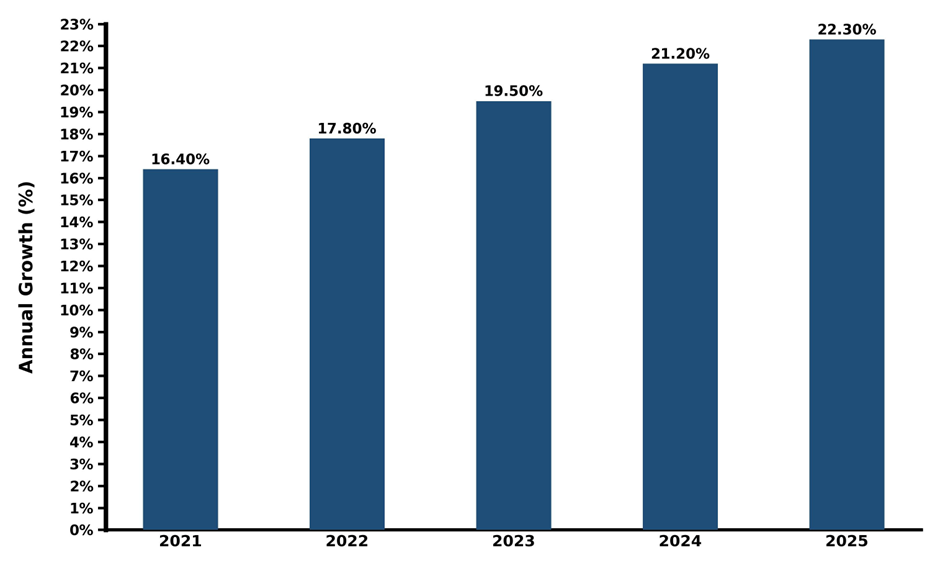
The table below presents the year‑wise growth rates along with the key drivers influencing the market
| Year | Est. Annual Growth (%) | Growth Drivers |
| 2021 | 16.4% | Surge in virtual real estate tours and remote industrial inspections. |
| 2022 | 17.8% | Rapid adoption of 360-degree dash-cams in autonomous vehicle testing. |
| 2023 | 19.5% | Growing demand for immersive K-Pop concert streaming and VR esports. |
| 2024 | 21.2% | Integration of AI-based stitching and high-speed 5G streaming capabilities. |
| 2025 | 22.3% | Expansion of smart city surveillance and advanced robotics perception. |
Topics Covered in the South Korea 360-Degree Camera Market Report
The South Korea 360-Degree Camera Market report thoroughly covers the market by connectivity type, resolution, vertical, and camera type. The market report provides an unbiased and detailed analysis of ongoing market trends, opportunities/high growth areas, and market drivers, which help stakeholders devise and align their market strategies according to the current and future market dynamics.
South Korea 360-Degree Camera Market Highlights
| Report Name |
South Korea 360-Degree Camera Market |
| Forecast period | 2026-2032 |
| CAGR | 23.1% |
| Market Size |
Media & Entertainment and Automotive Perception |
South Korea 360-Degree Camera Market Synopsis
The South Korea 360-Degree Camera Market is projected to experience significant growth on account of the country’s swift shift towards a digital-first economy alongside the implementation of 5G technology. Traditionally, there has been an increased demand for immersive videos on account of the adoption of 360-degree cameras by South Korean media companies and technological giants while integrating them within self-driving cars as well as realistic virtual reality applications. Moreover, the increasing trend of Metaverse and real-time broadcasting of cultural activities from around the world has further propelled technological adoption in the region.
Evaluation of Growth Drivers in the South Korea 360-Degree Camera Market (2026-2032)
Below mentioned are some prominent drivers and their influence on the market dynamics:
| Drivers | Primary Segments Affected | Why it Matters (Evidence) |
| Increase of 5G Infrastructure | Outdoor Wireless/Ultra High Definition | The high-speed network supports live-streaming without delay of 8K resolution. |
| Developments of Autonomous Vehicles | Professional/Automotive | 360-degree camera is necessary in the perceptual stack of level four autonomous vehicles. |
| Immersion of K-Content | Entertainment/Consumer | Global need for immersive K-Pop and K-drama content boosts professional rig sales. |
| Smart City Safety Initiatives | Wired/Commercial | Smart city safety projects use 360-degree view to cover the entire area. |
| Robotics and Drone Integration | Professional, Military & Defense | Omnidirectional vision is increasingly required for industrial automation and defence reconnaissance |
South Korea 360-Degree Camera Market is expected to grow at the CAGR of 23.1% during the forecast period of 2026-2032. Growth is driven by the rapid evolution of the domestic entertainment sector and the rising necessity for sophisticated spatial awareness in next-generation automotive applications. There are other contributions that come from the electronics manufacturing processes by the giant firms in the area as well as the integration of immersive technology into the digital transformation strategy by the government. This helps create an enabling environment for software and hardware developers of 360 visuals.
Evaluation of Restraints in the South Korea 360-Degree Camera Market
Below mentioned are some major restraints and their influence on the market dynamics:
| Restraints | Primary Segments Affected | What This Means (Evidence) |
| High Technical Complexity | Professional, Media | Specialized software and skills required for stitching and editing limit mass adoption. |
| Data Privacy Regulations | Commercial, Surveillance | Strict personal information protection laws restrict public 360-degree recording. |
| Large Storage Requirements | UHD, Consumer | Massive file sizes for 4K/8K 360 footage strain cloud and local storage capacities. |
| High Hardware Costs | Professional, Healthcare | Premium sensor arrays and multi-lens setups remain expensive for smaller enterprises. |
| Thermal Management Issues | Single, Consumer | Compact 360 cameras often overheat during extended high-resolution recording sessions |
South Korea 360-Degree Camera Market Challenges
Irrespective of massive growth and development, the South Korea 360-Degree Camera Market Industry faces several challenges such as stringent regulatory frameworks surrounding public surveillance and the technical difficulty of managing massive data throughput for ultra-high-definition content. In addition to this, the lack of standardised file formats for cross-platform interoperability and the significant learning curve for amateur users in post-production processing hinder broader growth. Addressing these socioeconomic and technical barriers remains essential for the sustained expansion of immersive imaging technologies.
South Korea 360-Degree Camera Market Trends
Key trends evaluating the landscape of the South Korea 360-Degree Camera Market are:
- AI-Enhanced Real-Time Stitching: Cameras are increasingly incorporating edge-AI chips to handle complex image stitching internally, allowing for immediate live-streaming without external processing.
- Expansion into 8K Resolution: There is a definitive shift toward 8K and beyond as professional broadcasters seek to provide the most realistic VR experiences for high-stakes esports and concerts.
- Cloud-Based 360 Video Management: The rise of dedicated cloud platforms for storing and sharing spherical content is simplifying the workflow for commercial real estate and industrial users.
- Integration with Smart Wearables: Increasing development of body-worn 360 cameras for law enforcement and outdoor sports enthusiasts who prioritize comprehensive "capture-everything" capabilities.
Investment Opportunities in the South Korea 360-Degree Camera Market
Some of the major investment opportunities in the South Korea 360-Degree Camera Market are as follows:
- Self-driving Vehicle Perception Modules: Investment in the manufacture of bespoke 360-degree camera modules using multiple sensors, aimed at use by local self-driving vehicle makers.
- VR/AR Studios for K-Content Generation: Construction of technologically sophisticated studios, leveraging 360-degree technology, to cater to the international demand for K-Content in immersive forms.
- Security Applications of 360-Degree Cameras: Development of applications that leverage 360-degree feed for crowd monitoring, facial recognition, and anomaly detection in public transit hubs.
- Remote Medical Education: Creation of remote education platforms based on 360-degree video feed to educate medical students about surgeries in a comprehensive manner.
Top 5 Leading Players in the South Korea 360-Degree Camera Market
Some leading players operating in the South Korea 360-Degree Camera Market include:
1. Samsung Electronics Co., Ltd.
| Company Name | Samsung Electronics Co., Ltd. |
|---|---|
| Established Year | 1969 |
| Headquarters | Suwon, South Korea |
| Official Website | Click Here |
Samsung is a dominant force in the local market, developing innovative consumer-grade 360 cameras and integrating immersive imaging capabilities into its broader ecosystem of mobile and wearable devices for global users.
2. LG Electronics Inc.
| Company Name | LG Electronics Inc. |
|---|---|
| Established Year | 1958 |
| Headquarters | Seoul, South Korea |
| Official Website | Click Here |
LG provides high-quality imaging solutions and 360-degree camera modules used in both consumer electronics and commercial vehicle components, focusing on seamless connectivity and high-definition visual output for diverse applications.
3. Insta360
| Company Name | Insta360 (Arashi Vision Inc.) |
|---|---|
| Established Year | 2015 |
| Headquarters | Shenzhen, China (Strong KR Presence) |
| Official Website | Click Here |
Insta360 leads the professional and action-camera segments in South Korea, offering cutting-edge AI-stabilized cameras that are widely adopted by the country’s top social media influencers and media production houses.
4. GoPro, Inc.
| Company Name | GoPro, Inc. |
|---|---|
| Established Year | 2002 |
| Headquarters | San Mateo, United States |
| Official Website | Click Here |
GoPro maintains a significant market share in the South Korean travel and tourism sector, providing durable 360-degree cameras that offer high-resolution spherical capture for outdoor enthusiasts and professional athletes.
5. Ricoh Company, Ltd.
| Company Name | Ricoh Company, Ltd. |
|---|---|
| Established Year | 1936 |
| Headquarters | Tokyo, Japan |
| Official Website | Click Here |
Ricoh is a pioneer in the 360-degree space, with its Theta series being a preferred choice for South Korean real estate professionals and commercial businesses for creating high-quality virtual tours.
Government Regulations Introduced in the South Korea 360-Degree Camera Market
According to South Korean Government Data, The Korean government through the Ministry of Science and ICT established the Framework Act on the Development of Artificial Intelligence (2024), which will impact the integration of 360-degree camera technology with artificial intelligence for surveillance purposes. The act calls for stringent measures that guarantee transparency and control of any high-impact AI system that includes smart city 360-degree surveillance technology, to ensure proper data usage and privacy of the citizens. In addition, there is the establishment of the “Immersive Content Vitalization Strategy,” whereby tax incentives and subsidies are offered for use of the technology in tourism and education.
Future Insights of the South Korea 360-Degree Camera Market
The outlook for the Market is promising due to the impact of improved 6G research and the deepening integration of the Industrial Internet of Things (IIoT). Increasing international support for standardized immersive formats, combined with heavy domestic investments in the Metaverse and autonomous mobility, will continue to drive the demand for high-resolution spherical sensors. As technical barriers like battery life and thermal management are solved through materials science, the proliferation of 360-degree visual data will ultimately boost opportunities for the South Korea 360-Degree Camera Market Growth.
Market Segmentation Analysis
The report offers a comprehensive study of the subsequent market segments and their leading categories:
Media & Entertainment to Dominate the Market- By Vertical
According to Taniya, Senior Research Analyst, 6Wresearch, the Media & Entertainment Vertical is expected to play a leading role in the South Korea 360-Degree Camera Market Share. The unparalleled demand for immersive K-Pop concerts and high-fidelity VR gaming experiences has pushed production houses to adopt 8K professional rigs. Moreover, consumers are increasingly seeking interactive storytelling and virtual fan-meeting experiences, which are facilitated by 360-degree broadcasting, driving the largest portion of market revenue in this segment.
Ultra-High Definition (UHD) to Be the Standard- By Resolution
In South Korea, the standard of Ultra HD is fast gaining ground as the baseline specification in all application areas. With advancements in display technology, demand for 4K and 8K 360 degrees video content has surged. The ultra high definition category leads in popularity owing to the preference for clear and sharp images for purposes such as professional inspections and medical training.
Professional Multi-Sensor Rigs to Hold Higher Value- By Camera Type
Whereas the consumer single body camera segment is quite common for recreational purposes, the Professional Multi-Sensor Rigs category makes up for a notable share of the total market value. This category plays a critical role in cinematography and vehicle perception as multiple camera lenses have to be used simultaneously with impeccable precision.
Key Attractiveness of the Report
- 10 Years of Market Numbers.
- Historical Data Starting from 2022 to 2025.
- Base Year: 2025.
- Forecast Data until 2032.
- Key Performance Indicators Impacting the Market.
- Major Upcoming Developments and Projects.
Key Highlights of the Report:
- South Korea 360-Degree Camera Market Outlook
- Market Size of South Korea 360-Degree Camera Market, 2025
- Forecast of South Korea 360-Degree Camera Market, 2032
- Historical Data and Forecast of South Korea 360-Degree Camera Revenues & Volume for the Period 2022 - 2032
- South Korea 360-Degree Camera Market Trend Evolution
- South Korea 360-Degree Camera Market Drivers and Challenges
- South Korea 360-Degree Camera Price Trends
- South Korea 360-Degree Camera Porter's Five Forces
- South Korea 360-Degree Camera Industry Life Cycle
- Historical Data and Forecast of South Korea 360-Degree Camera Market Revenues & Volume By Connectivity Type for the Period 2022 - 2032
- Historical Data and Forecast of South Korea 360-Degree Camera Market Revenues & Volume By Wired for the Period 2022 - 2032
- Historical Data and Forecast of South Korea 360-Degree Camera Market Revenues & Volume By Wireless for the Period 2022 - 2032
- Historical Data and Forecast of South Korea 360-Degree Camera Market Revenues & Volume By Resolution for the Period 2022 - 2032
- Historical Data and Forecast of South Korea 360-Degree Camera Market Revenues & Volume By HD for the Period 2022 - 2032
- Historical Data and Forecast of South Korea 360-Degree Camera Market Revenues & Volume By UHD for the Period 2022 - 2032
- Historical Data and Forecast of South Korea 360-Degree Camera Market Revenues & Volume By Vertical for the Period 2022 - 2032
- Historical Data and Forecast of South Korea 360-Degree Camera Market Revenues & Volume By Media & Entertainment for the Period 2022 - 2032
- Historical Data and Forecast of South Korea 360-Degree Camera Market Revenues & Volume By Consumer for the Period 2022 - 2032
- Historical Data and Forecast of South Korea 360-Degree Camera Market Revenues & Volume By Military & Defense for the Period 2022 - 2032
- Historical Data and Forecast of South Korea 360-Degree Camera Market Revenues & Volume By Travel & Tourism for the Period 2022 - 2032
- Historical Data and Forecast of South Korea 360-Degree Camera Market Revenues & Volume By Automotive for the Period 2022 - 2032
- Historical Data and Forecast of South Korea 360-Degree Camera Market Revenues & Volume By Commercial for the Period 2022 - 2032
- Historical Data and Forecast of South Korea 360-Degree Camera Market Revenues & Volume By Healthcare for the Period 2022 - 2032
- Historical Data and Forecast of South Korea 360-Degree Camera Market Revenues & Volume By Camera Type for the Period 2022 - 2032
- Historical Data and Forecast of South Korea 360-Degree Camera Market Revenues & Volume By Single for the Period 2022 - 2032
- Historical Data and Forecast of South Korea 360-Degree Camera Market Revenues & Volume By Professional for the Period 2022 - 2032
- South Korea 360-Degree Camera Import Export Trade Statistics
- Market Opportunity Assessment By Connectivity Type
- Market Opportunity Assessment By Resolution
- Market Opportunity Assessment By Vertical
- Market Opportunity Assessment By Camera Type
- South Korea 360-Degree Camera Top Companies Market Share
- South Korea 360-Degree Camera Competitive Benchmarking By Technical and Operational Parameters
- South Korea 360-Degree Camera Company Profiles
- South Korea 360-Degree Camera Key Strategic Recommendations
Market Covered
The report offers a comprehensive study of the subsequent market segments:
By Connectivity Type
- Wired
- Wireless
By Resolution
- High Definition (HD)
- Ultra-High Definition (UHD)
By Vertical
- Media & Entertainment
- Consumer
- Military & Defense
- Travel & Tourism
- Automotive
- Commercial
- Healthcare
By Camera Type
- Single
- Professional
South Korea 360-Degree Camera Market (2026-2032): FAQs
South Korea 360-Degree Camera Market is projected to grow at a CAGR of 23.1% between 2026-2032.
The direction that strategic investment is moving is fast turning towards automotive perception stacks in which 360-degree cameras will play their role in offering redundant safety cover in the level 4 autonomous driving systems.
The growing need for immersive contents based on K-Pop and virtual reality among international consumers has resulted in increased purchases of professional multisensor rigs from South Korea's media producers for 8K volumetric filming.
South Korea's dominant companies in the 360-degree camera market include Samsung Electronics, LG Electronics, Insta360, GoPro, and Ricoh.
6Wresearch actively monitors the South Korea 360-Degree Camera Market and publishes its comprehensive annual report, highlighting emerging trends, growth drivers, revenue analysis, and forecast outlook. Our insights help businesses to make data-backed strategic decisions with ongoing market dynamics. Our analysts track relevent industries related to the South Korea 360-Degree Camera Market, allowing our clients with actionable intelligence and reliable forecasts tailored to emerging regional needs.
Yes, we provide customisation as per your requirements. To learn more, feel free to contact us on sales@6wresearch.com
| 1 Executive Summary |
| 2 Introduction |
| 2.1 Key Highlights of the Report |
| 2.2 Report Description |
| 2.3 Market Scope & Segmentation |
| 2.4 Research Methodology |
| 2.5 Assumptions |
| 3 South Korea 360-Degree Camera Market Overview |
| 3.1 South Korea Country Macro Economic Indicators |
| 3.2 South Korea 360-Degree Camera Market Revenues & Volume, 2022 & 2032F |
| 3.3 South Korea 360-Degree Camera Market - Industry Life Cycle |
| 3.4 South Korea 360-Degree Camera Market - Porter's Five Forces |
| 3.5 South Korea 360-Degree Camera Market Revenues & Volume Share, By Connectivity Type, 2022 & 2032F |
| 3.6 South Korea 360-Degree Camera Market Revenues & Volume Share, By Resolution , 2022 & 2032F |
| 3.7 South Korea 360-Degree Camera Market Revenues & Volume Share, By Vertical, 2022 & 2032F |
| 3.8 South Korea 360-Degree Camera Market Revenues & Volume Share, By Camera Type, 2022 & 2032F |
| 4 South Korea 360-Degree Camera Market Dynamics |
| 4.1 Impact Analysis |
| 4.2 Market Drivers |
| 4.2.1 Increasing popularity of virtual reality (VR) and augmented reality (AR) technologies in South Korea. |
| 4.2.2 Growing demand for immersive content creation in various industries such as entertainment, tourism, and real estate. |
| 4.2.3 Technological advancements leading to improved camera quality and affordability. |
| 4.3 Market Restraints |
| 4.3.1 High initial cost of 360-degree cameras may limit adoption among price-sensitive consumers. |
| 4.3.2 Limited availability of high-quality 360-degree content and lack of awareness about the benefits of such technology. |
| 5 South Korea 360-Degree Camera Market Trends |
| 6 South Korea 360-Degree Camera Market, By Types |
| 6.1 South Korea 360-Degree Camera Market, By Connectivity Type |
| 6.1.1 Overview and Analysis |
| 6.1.2 South Korea 360-Degree Camera Market Revenues & Volume, By Connectivity Type, 2022 - 2032F |
| 6.1.3 South Korea 360-Degree Camera Market Revenues & Volume, By Wired , 2022 - 2032F |
| 6.1.4 South Korea 360-Degree Camera Market Revenues & Volume, By Wireless, 2022 - 2032F |
| 6.2 South Korea 360-Degree Camera Market, By Resolution |
| 6.2.1 Overview and Analysis |
| 6.2.2 South Korea 360-Degree Camera Market Revenues & Volume, By HD , 2022 - 2032F |
| 6.2.3 South Korea 360-Degree Camera Market Revenues & Volume, By UHD, 2022 - 2032F |
| 6.3 South Korea 360-Degree Camera Market, By Vertical |
| 6.3.1 Overview and Analysis |
| 6.3.2 South Korea 360-Degree Camera Market Revenues & Volume, By Media & Entertainment, 2022 - 2032F |
| 6.3.3 South Korea 360-Degree Camera Market Revenues & Volume, By Consumer, 2022 - 2032F |
| 6.3.4 South Korea 360-Degree Camera Market Revenues & Volume, By Military & Defense, 2022 - 2032F |
| 6.3.5 South Korea 360-Degree Camera Market Revenues & Volume, By Travel & Tourism, 2022 - 2032F |
| 6.3.6 South Korea 360-Degree Camera Market Revenues & Volume, By Automotive, 2022 - 2032F |
| 6.3.7 South Korea 360-Degree Camera Market Revenues & Volume, By Commercial, 2022 - 2032F |
| 6.4 South Korea 360-Degree Camera Market, By Camera Type |
| 6.4.1 Overview and Analysis |
| 6.4.2 South Korea 360-Degree Camera Market Revenues & Volume, By Single, 2022 - 2032F |
| 6.4.3 South Korea 360-Degree Camera Market Revenues & Volume, By Professional, 2022 - 2032F |
| 7 South Korea 360-Degree Camera Market Import-Export Trade Statistics |
| 7.1 South Korea 360-Degree Camera Market Export to Major Countries |
| 7.2 South Korea 360-Degree Camera Market Imports from Major Countries |
| 8 South Korea 360-Degree Camera Market Key Performance Indicators |
| 8.1 Average time spent on VR/AR content consumption per user in South Korea. |
| 8.2 Number of partnerships between 360-degree camera manufacturers and content creators in the market. |
| 8.3 Growth in the number of VR/AR applications and experiences utilizing 360-degree camera technology in South Korea. |
| 8.4 Adoption rate of 360-degree cameras in key industries such as media, tourism, and education. |
| 8.5 Number of tech events and exhibitions showcasing 360-degree camera technology in South Korea. |
| 9 South Korea 360-Degree Camera Market - Opportunity Assessment |
| 9.1 South Korea 360-Degree Camera Market Opportunity Assessment, By Connectivity Type, 2022 & 2032F |
| 9.2 South Korea 360-Degree Camera Market Opportunity Assessment, By Resolution , 2022 & 2032F |
| 9.3 South Korea 360-Degree Camera Market Opportunity Assessment, By Vertical, 2022 & 2032F |
| 9.4 South Korea 360-Degree Camera Market Opportunity Assessment, By Camera Type, 2022 & 2032F |
| 10 South Korea 360-Degree Camera Market - Competitive Landscape |
| 10.1 South Korea 360-Degree Camera Market Revenue Share, By Companies, 2025 |
| 10.2 South Korea 360-Degree Camera Market Competitive Benchmarking, By Operating and Technical Parameters |
| 11 Company Profiles |
| 12 Recommendations |
| 13 Disclaimer |
Global Go To Market Strategy - 2030
Export potential enables firms to identify high-growth global markets with greater confidence by combining advanced trade intelligence with a structured quantitative methodology. The framework analyzes emerging demand trends and country-level import patterns while integrating macroeconomic and trade datasets such as GDP and population forecasts, bilateral import–export flows, tariff structures, elasticity differentials between developed and developing economies, geographic distance, and import demand projections. Using weighted trade values from 2020–2024 as the base period to project country-to-country export potential for 2030, these inputs are operationalized through calculated drivers such as gravity model parameters, tariff impact factors, and projected GDP per-capita growth. Through an analysis of hidden potentials, demand hotspots, and market conditions that are most favorable to success, this method enables firms to focus on target countries, maximize returns, and global expansion with data, backed by accuracy.
By factoring in the projected importer demand gap that is currently unmet and could be potential opportunity, it identifies the potential for the Exporter (Country) among 190 countries, against the general trade analysis, which identifies the biggest importer or exporter.
To discover high-growth global markets and optimize your business strategy:
Click Here
Pricing
- Single User License$ 1,995
- Department License$ 2,400
- Site License$ 3,120
- Global License$ 3,795

Leadership Perspectives from Industry Events
Search
Thought Leadership and Analyst Meet





Our Clients








6WResearch In News
- Doha a strategic location for EV manufacturing hub: IPA Qatar
- Demand for luxury TVs surging in the GCC, says Samsung
- Empowering Growth: The Thriving Journey of Bangladesh’s Cable Industry
- Demand for luxury TVs surging in the GCC, says Samsung
- Video call with a traditional healer? Once unthinkable, it’s now common in South Africa
- Intelligent Buildings To Smooth GCC’s Path To Net Zero
Latest Reports
- Taiwan Airport Wireless Infrastructure Market (2026-2032)
- Vietnam Airport Wireless Infrastructure Market (2026-2032)
- Thailand Airport Wireless Infrastructure Market (2026-2032)
- South Korea Airport Wireless Infrastructure Market (2026-2032)
- Romania Airport Wireless Infrastructure Market (2026-2032)
- Qatar Airport Wireless Infrastructure Market (2026-2032)
- Philippines Airport Wireless Infrastructure Market (2026-2032)
- Japan Airport Wireless Infrastructure Market (2026-2032)
- Taiwan Airport Winter Services Market (2026-2032)
- Vietnam Airport Winter Services Market (2026-2032)
Industry Events and Analyst Meet

HIMTEX 2026

India Refining Summit 2026

India EV Show 2026

EV tech India Expo 2026

Auto Tech Asia 2026
Whitepaper
- Middle East & Africa Commercial Security Market Click here to view more.
- Middle East & Africa Fire Safety Systems & Equipment Market Click here to view more.
- GCC Drone Market Click here to view more.
- Middle East Lighting Fixture Market Click here to view more.
- GCC Physical & Perimeter Security Market Click here to view more.


