South Korea 3D Holographic Display and Services Market Size, Share & Growth Rate
The South Korea 3D Holographic Display and Services Market was estimated at USD 514 Million in 2025 and is projected to reach USD 740 Million by 2032, growing at a CAGR of 5.3% from 2026 to 2032. This growth trajectory is being driven by the increasing demand for immersive visual experiences across multiple sectors, including retail, healthcare, and entertainment. The market's expansion is also fueled by advances in technology, particularly in display resolution and content creation, which are enhancing the applications and usability of holographic displays.
South Korea 3D Holographic Display and Services Market Year-wise Growth Rate and Key Drivers
This graph highlights how the South Korea 3D Holographic Display and Services Market has steadily grown over the years, supported by major growth factors.
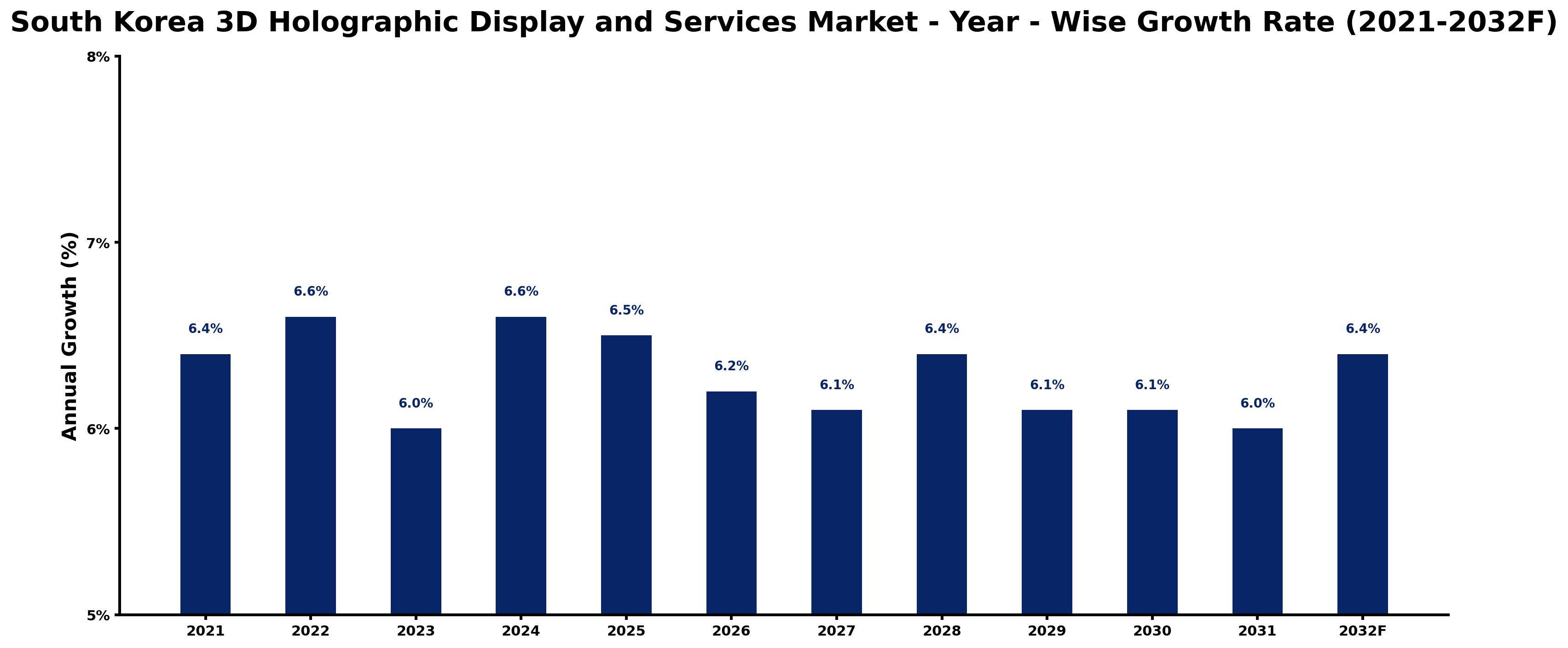
The table below presents the year‑wise growth rates along with the key drivers influencing the market
| Year | Growth Rate | Major Drivers |
| 2021 | 6.4% | Expansion of transportation and logistics networks |
| 2022 | 6.6% | Increasing industrial automation investments |
| 2023 | 6.0% | Government infrastructure modernization initiatives |
| 2024 | 6.6% | Increasing smart city development projects |
| 2025 | 6.5% | Growing urbanization and commercial development |
| 2026 | 6.2% | Increasing smart city development projects |
| 2027 | 6.1% | Expansion of transportation and logistics networks |
| 2028 | 6.4% | Growing renewable energy integration projects |
| 2029 | 6.1% | Rapid growth in telecom and data center sectors |
| 2030 | 6.1% | Increasing smart city development projects |
| 2031 | 6.0% | Expansion of manufacturing activities |
| 2032 | 6.4% | Expansion of commercial construction activities |
Note - Market size estimations and growth projections presented in this report are based on 6Wresearch’s advanced forecasting approach, validated with industry datasets as of June 2026.
South Korea 3D Holographic Display and Services Market Synopsis
A major force shaping the South Korea 3D holographic display and services market is the rapid adoption of these technologies in advertising and marketing. Companies are leveraging holographic displays for engaging product launches and innovative marketing campaigns, recognizing their potential to captivate audiences and enhance brand visibility.
Additionally, the growing interest from sectors such as healthcare and education is driving further exploration of holographic applications. As organizations seek novel solutions for presentations and training, the demand for comprehensive services surrounding 3D holographic displays continues to rise, underscoring the market's dynamic nature.
South Korea 3D Holographic Display and Services Market Key Takeaways
- Immersive visual experiences are increasingly favored in retail, healthcare, and education sectors.
- The market is poised for steady growth as businesses recognize the value of holographic technology in customer engagement.
- Advanced technologies in display resolution and visual effects are driving enhancements in user experience.
- Advertising and marketing applications are the primary growth drivers for 3D holographic displays in South Korea.
- Investments in R&D and strategic partnerships are crucial for overcoming existing market restraints.
Evaluation of Restraints in South Korea 3D Holographic Display and Services Market
Despite the promising growth of the 3D holographic display and services market in South Korea, several challenges inhibit its full potential. High development and implementation costs present a significant barrier, particularly for small and medium-sized enterprises looking to adopt this technology. Limited consumer awareness and understanding of the capabilities of 3D holographic displays also hinder widespread acceptance. Moreover, the necessity for advanced infrastructure can slow down integration into various sectors. Addressing these challenges will require concerted efforts from industry stakeholders, including enhanced marketing strategies and public education campaigns.
South Korea 3D Holographic Display and Services Market Trends
The market is currently witnessing a surge in demand for holographic displays, particularly for live events and product demonstrations. Companies are utilizing these technologies to create interactive experiences that engage customers more effectively. Furthermore, continuous advancements in augmented reality (AR) and virtual reality (VR) technologies are intertwining with holographic applications, leading to innovative product offerings. The integration of AI-driven content creation tools is also becoming prevalent, allowing for real-time adaptations of holographic displays that cater to audience preferences.
South Korea 3D Holographic Display and Services Market Opportunities
The South Korea 3D holographic display and services market presents numerous investment opportunities, particularly in sectors that are increasingly focusing on customer experience. Companies specializing in advanced holographic technologies and related content creation services are poised for growth as demand intensifies. Additionally, industries such as education and healthcare are ripe for innovation through holographic solutions, providing avenues for investors seeking to capitalize on emerging trends. As companies explore novel ways to attract and retain customers, the scope for successful ventures within this market continues to expand.
Government Initiatives in the South Korea 3D Holographic Display and Services Market
The South Korean government plays an active role in nurturing the 3D holographic display and services market through various supportive policies and funding initiatives. The Ministry of Science and ICT has introduced programs aimed at promoting research and development in this space, thereby fostering technological innovation. Regulatory frameworks have also been established to ensure product safety and quality, instilling consumer confidence. Collaborative efforts among government agencies, industry stakeholders, and research institutions further bolster the ecosystem, enhancing South Korea's competitive edge globally.
Future Insights of the South Korea 3D Holographic Display and Services Market
Looking ahead to 2026-2032, the South Korea 3D holographic display and services market is expected to witness remarkable growth, driven by ongoing technological advancements and an increasing emphasis on immersive consumer experiences. As sectors like healthcare and retail continue to embrace holographic solutions for their unique applications, the market is set to evolve significantly. The synergistic growth of AR and VR technologies will further energize demand for innovative holographic displays, positioning South Korea as a key player in the global landscape.
South Korea 3D Holographic Display and Services Market Latest Developments (May 2025 - June 2026)
In the recent months leading up to mid-2026, the industry has seen a notable shift toward the integration of AI with holographic technologies, enhancing the adaptability of content for user engagement. Companies are increasingly exploring partnerships to develop comprehensive solutions that blend holography with real-time data analytics. Additionally, emerging trends in augmented reality have inspired various sectors to invest more significantly in holographic display technologies, indicating a growing acceptance and integration into mainstream applications.
South Korea 3D Holographic Display and Services Market - Key Attractiveness of the Report
- 10 Years of Market Numbers
- Historical Data Starting from 2022 to 2025
- Base Year: 2025
- Forecast Data until 2032
- Key Performance Indicators Impacting the Market
- Major Upcoming Developments and Projects
Key Highlights of the Report:
- South Korea 3D Holographic Display and Services Market Outlook
- Market Size of South Korea 3D Holographic Display and Services Market, 2025
- Forecast of South Korea 3D Holographic Display and Services Market, 2032
- Historical Data and Forecast of South Korea 3D Holographic Display and Services Revenues & Volume for the Period 2022-2032F
- South Korea 3D Holographic Display and Services Market Trend Evolution
- South Korea 3D Holographic Display and Services Market Drivers and Challenges
- South Korea 3D Holographic Display and Services Price Trends
- South Korea 3D Holographic Display and Services Porter's Five Forces
- South Korea 3D Holographic Display and Services Industry Life Cycle
- Historical Data and Forecast of South Korea 3D Holographic Display and Services Market Revenues & Volume By End-users for the Period 2022-2032F
- Historical Data and Forecast of South Korea 3D Holographic Display and Services Market Revenues & Volume By Media and Entertainment for the Period 2022-2032F
- Historical Data and Forecast of South Korea 3D Holographic Display and Services Market Revenues & Volume By Consumer Electronics for the Period 2022-2032F
- Historical Data and Forecast of South Korea 3D Holographic Display and Services Market Revenues & Volume By Healthcare for the Period 2022-2032F
- Historical Data and Forecast of South Korea 3D Holographic Display and Services Market Revenues & Volume By Automotive for the Period 2022-2032F
- Historical Data and Forecast of South Korea 3D Holographic Display and Services Market Revenues & Volume By Retail for the Period 2022-2032F
- Historical Data and Forecast of South Korea 3D Holographic Display and Services Market Revenues & Volume By Others for the Period 2022-2032F
- South Korea 3D Holographic Display and Services Import Export Trade Statistics
- Market Opportunity Assessment By End-users
- South Korea 3D Holographic Display and Services Top Companies Market Share
- South Korea 3D Holographic Display and Services Competitive Benchmarking By Technical and Operational Parameters
- South Korea 3D Holographic Display and Services Company Profiles
- South Korea 3D Holographic Display and Services Key Strategic Recommendations






































