South Korea 5G NTN Market Size, Share & Growth Rate
The South Korea 5G NTN Market was estimated at USD 271 Million in 2025 and is projected to reach USD 368 Million by 2032, growing at a CAGR of 4.5% from 2026 to 2032. This anticipated growth is primarily fueled by the increasing demand for reliable high-speed connectivity, particularly in underserved rural regions and challenging terrains. As South Korea pioneers in technology innovation, advancements in satellite and drone communication are expected to significantly enhance the national communication infrastructure.
South Korea 5G NTN Market Year-wise Growth Rate and Key Drivers
This graph highlights how the South Korea 5G NTN Market has steadily grown over the years, supported by major growth factors.
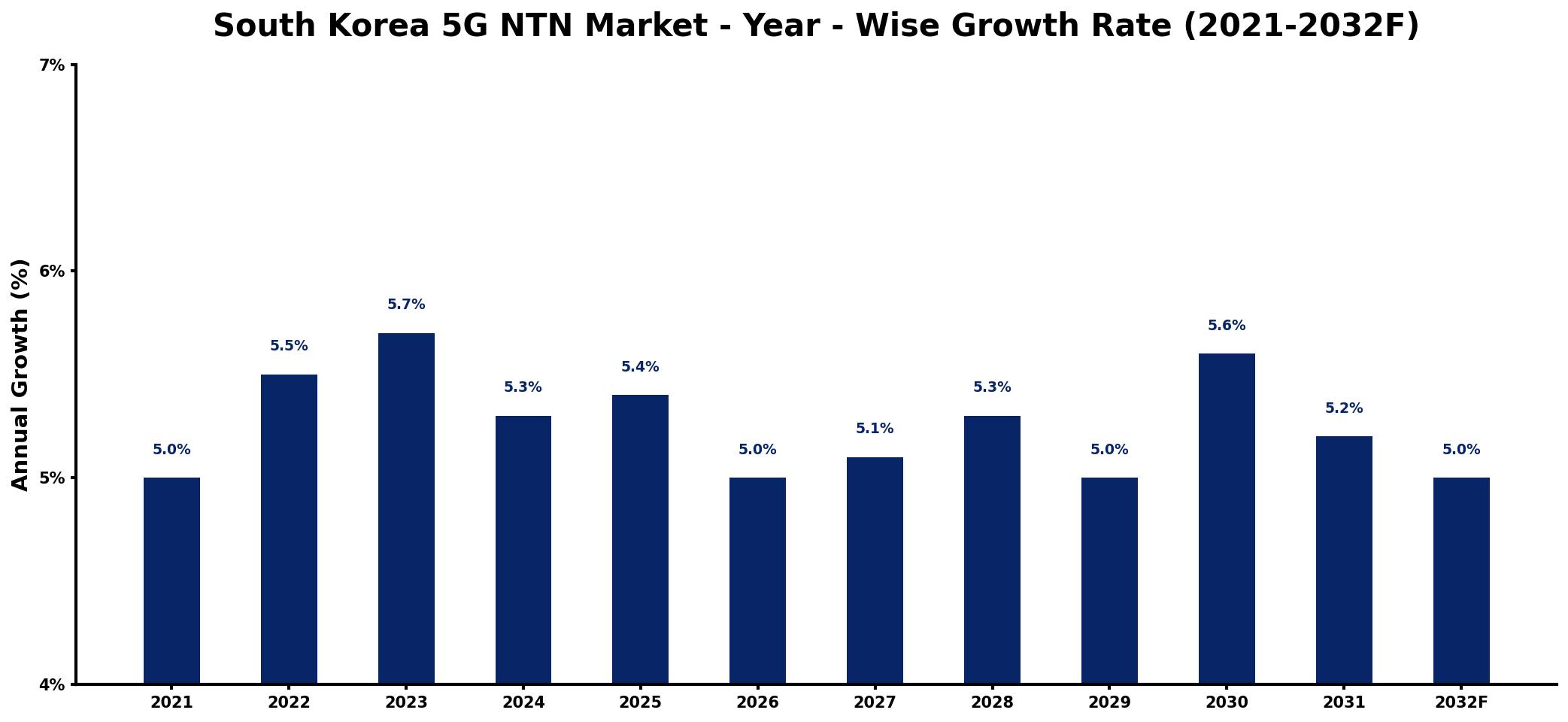
The table below presents the year‑wise growth rates along with the key drivers influencing the market
| Year | Growth Rate | Major Drivers |
| 2021 | 5.0% | Increased demand for connectivity solutions |
| 2022 | 5.5% | Expansion of smart city initiatives |
| 2023 | 5.7% | Rise in IoT adoption rates |
| 2024 | 5.3% | Growth in autonomous vehicle technology |
| 2025 | 5.4% | Investment in digital infrastructure projects |
| 2026 | 5.0% | Enhancement of mobile broadband services |
| 2027 | 5.1% | Surge in data-intensive applications |
| 2028 | 5.3% | Development of advanced telecommunications networks |
| 2029 | 5.0% | Increase in remote working trends |
| 2030 | 5.6% | Boost in entertainment streaming services |
| 2031 | 5.2% | growing automotive sector requirements |
| 2032 | 5.0% | growing commercial sector adoption |
Note: Market size estimations and growth projections presented in this report are based on 6Wresearch's proprietary forecasting methodology, utilizing the latest available industry data, government publications, and primary research inputs.
South Korea 5G NTN Market Synopsis
The South Korea 5G NTN market is rapidly evolving, driven by the nation's relentless pursuit of seamless connectivity solutions. With extensive investments in satellite technology, South Korea is leading the charge in implementing 5G NTN solutions that significantly enhance communication capabilities.
Currently, the focus is on bridging the digital divide, ensuring that even remote and mountainous areas have access to high-speed internet. Collaborations between technology firms and satellite providers highlight a concerted effort to expand NTN services nationwide, paving the way for a more connected future.
South Korea 5G NTN Market Key Takeaways
- The market is propelled by technological advancements in satellite and high-altitude communication platforms.
- Partnerships between telecom operators and satellite service providers are critical for infrastructure deployment.
- The integration of NTN solutions supports emerging applications, such as IoT and autonomous vehicles.
- Investment potential remains strong due to government incentives and the growing demand for connectivity.
- The focus on rural connectivity is reshaping traditional approaches to network coverage.
Evaluation of Restraints in South Korea 5G NTN Market
Despite its promising growth trajectory, the South Korea 5G NTN market faces several notable restraints. High infrastructure costs related to satellite deployment and maintenance are significant barriers to entry for potential market players. Additionally, regulatory complexities concerning spectrum allocation can hinder the swift rollout of NTN services. Integration challenges between terrestrial and non-terrestrial networks further complicate the landscape, necessitating a multifaceted approach to ensure operational cohesion across various technologies.
South Korea 5G NTN Market Trends
A surge in interest and investment towards satellite-based communication solutions is notably reshaping the South Korea 5G NTN market. Companies are increasingly exploring Low Earth Orbit (LEO) satellites and High Altitude Platform Stations (HAPS) to extend network capabilities. Moreover, the focus on smart cities and IoT applications is driving innovation in NTN technology, indicating a robust market evolution that aligns with the nation's digital transformation goals.
South Korea 5G NTN Market Opportunities
The South Korea 5G NTN market is rich with opportunities for investors and technology developers. The growing emphasis on expanding satellite communication services presents lucrative avenues for investment in satellite manufacturing and space technology development. There is also significant potential in companies that provide advanced equipment for NTN integration, such as ground stations and antennas, as demand for high-speed, reliable connectivity rises across various sectors.
Government Initiatives in the South Korea 5G NTN Market
The South Korean government has taken proactive measures to bolster the 5G NTN market through various policies and initiatives. This includes the allocation of spectrum specifically for satellite communications and the establishment of regulatory frameworks to facilitate NTN deployment. Furthermore, the government provides financial incentives for research and development, aiming to foster innovation and ensure that South Korea remains competitive in the global telecommunications arena.
Future Insights of the South Korea 5G NTN Market
Looking ahead to 2026-2032, the South Korea 5G NTN market is positioned for significant growth. The ongoing demand for enhanced connectivity, especially in rural and less accessible areas, will drive the adoption of NTN technologies. South Korea's commitment to innovation and infrastructure investment will accelerate the integration of NTN solutions, positioning the nation as a leader in advanced telecommunications technologies.
South Korea 5G NTN Market Latest Developments (2025 - 2026)
In recent months, the South Korean 5G NTN market has seen increased collaboration between telecom operators and satellite service providers, focusing on expanding the coverage and capabilities of NTN solutions. Technological advancements in satellite communications continue to emerge, with ongoing trials and pilots that aim to refine service offerings. Additionally, international partnerships are being explored to enhance the market landscape, reflecting a trend towards greater global integration in telecommunications.
South Korea 5G NTN Market - Key Attractiveness of the Report
- 10 Years of Market Numbers
- Historical Data Starting from 2022 to 2025
- Base Year: 2025
- Forecast Data until 2032
- Key Performance Indicators Impacting the Market
- Major Upcoming Developments and Projects
Key Highlights of the Report:
- South Korea 5G NTN Market Outlook
- Market Size of South Korea 5G NTN Market, 2025
- Forecast of South Korea 5G NTN Market, 2032
- Historical Data and Forecast of South Korea 5G NTN Revenues & Volume for the Period 2022-2032F
- South Korea 5G NTN Market Trend Evolution
- South Korea 5G NTN Market Drivers and Challenges
- South Korea 5G NTN Price Trends
- South Korea 5G NTN Porter's Five Forces
- South Korea 5G NTN Industry Life Cycle
- Historical Data and Forecast of South Korea 5G NTN Market Revenues & Volume By Component for the Period 2022-2032F
- Historical Data and Forecast of South Korea 5G NTN Market Revenues & Volume By Hardware for the Period 2022-2032F
- Historical Data and Forecast of South Korea 5G NTN Market Revenues & Volume By Solutions for the Period 2022-2032F
- Historical Data and Forecast of South Korea 5G NTN Market Revenues & Volume By Services for the Period 2022-2032F
- Historical Data and Forecast of South Korea 5G NTN Market Revenues & Volume By End-Use Industry for the Period 2022-2032F
- Historical Data and Forecast of South Korea 5G NTN Market Revenues & Volume By Maritime for the Period 2022-2032F
- Historical Data and Forecast of South Korea 5G NTN Market Revenues & Volume By Aerospace for the Period 2022-2032F
- Historical Data and Forecast of South Korea 5G NTN Market Revenues & Volume By Defense for the Period 2022-2032F
- Historical Data and Forecast of South Korea 5G NTN Market Revenues & Volume By Government for the Period 2022-2032F
- Historical Data and Forecast of South Korea 5G NTN Market Revenues & Volume By Mining for the Period 2022-2032F
- Historical Data and Forecast of South Korea 5G NTN Market Revenues & Volume By Application for the Period 2022-2032F
- Historical Data and Forecast of South Korea 5G NTN Market Revenues & Volume By EMBB for the Period 2022-2032F
- Historical Data and Forecast of South Korea 5G NTN Market Revenues & Volume By URLLC for the Period 2022-2032F
- Historical Data and Forecast of South Korea 5G NTN Market Revenues & Volume By MMTC for the Period 2022-2032F
- South Korea 5G NTN Import Export Trade Statistics
- Market Opportunity Assessment By Component
- Market Opportunity Assessment By End-Use Industry
- Market Opportunity Assessment By Application
- South Korea 5G NTN Top Companies Market Share
- South Korea 5G NTN Competitive Benchmarking By Technical and Operational Parameters
- South Korea 5G NTN Company Profiles
- South Korea 5G NTN Key Strategic Recommendations






































