South Korea Academic Medical Centers Market (2026-2032) | Segments, Industry, Strategy, Investment Trends, Forecast, Size, Strategic Insights, Competition, Analysis, Trends, Demand, Share, Companies, Restraints, Opportunities, Revenue, Pricing Analysis, Supply, Challenges, Value, Segmentation, Competitive, Outlook, Consumer Insights, Growth, Drivers
Market Forecast By Center Type (University Hospitals, Teaching Hospitals, Research Hospitals, Community Academic Centers), By Service Offering (Patient Care & Training, Specialized Clinical Services, Advanced Diagnostics, Integrated Care), By Research Focus (Translational Research, Biomedical Innovation, Clinical Trials, Collaborative Research) And Competitive Landscape
| Product Code: ETC11753386 | Publication Date: Apr 2025 | Updated Date: Jul 2026 | Product Type: Market Research Report | |
| Publisher: 6Wresearch | Author: Sachin Kumar Rai | No. of Pages: 70 | No. of Figures: 35 | No. of Tables: 5 |
South Korea Academic Medical Centers Market Growth Rate
According to 6Wresearch internal database and industry insights, the South Korea Academic Medical Centers Market is projected to grow at a compound annual growth rate (CAGR) of 7.6% during the forecast period (2026-2032).
South Korea Academic Medical Centers Market Year-wise Growth Rate and Key Drivers (2022-2032)
This graph illustrates the annual growth rates of the South Korea Academic Medical Centers Market from 2022 to 2032, highlighting a steady upward trajectory and projected market expansion over the forecast period.
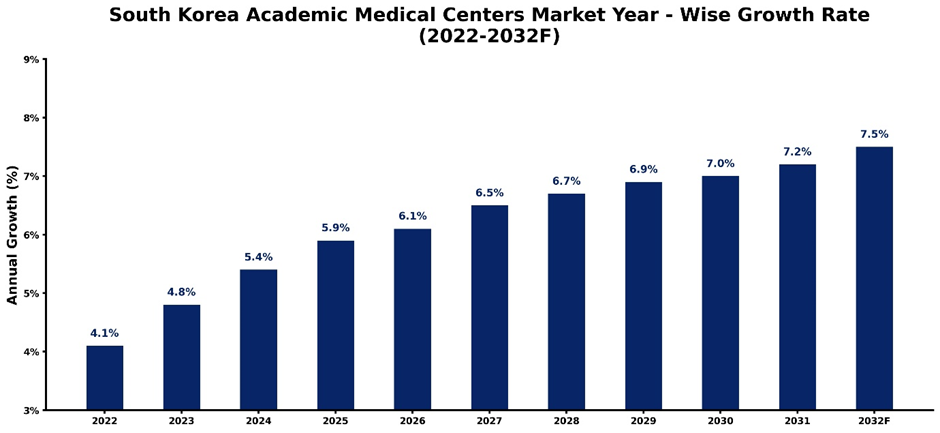 The following table summarizes the historical and forecasted growth rates of the South Korea Academic Medical Centers Market, along with the rationale behind each year’s performance.
| Year | Estimated Growth (%) | Market Rationale |
| 2022 | 4.1% | Increased government healthcare spending and reopening of clinical research programs improved market momentum. |
| 2023 | 4.8% | Expansion of precision medicine, oncology research, and digital healthcare adoption supported growth. |
| 2024 | 5.4% | Rising demand for advanced treatments, academic collaborations, and medical technology integration accelerated development. |
| 2025 | 5.9% | Growth driven by specialized clinical services, robotic procedures, and stronger clinical trial activity. |
| 2026 | 6.1% | Increased investment in smart hospitals, AI-based healthcare solutions, and research infrastructure supports expansion. |
| 2027 | 6.5% | Growth supported by aging population needs, chronic disease management programs, and integrated care models. |
| 2028 | 6.7% | Rising biomedical innovation, biotechnology partnerships, and advanced clinical research strengthen market growth. |
| 2029 | 6.9% | Expansion of precision oncology, digital health platforms, and international research collaborations boosts demand. |
| 2030 | 7% | Government healthcare modernization initiatives and skilled medical workforce development drive market advancement. |
| 2031 | 7.2% | Increased adoption of AI-enabled diagnostics, personalized medicine, and global clinical trial participation supports growth. |
| 2032 | 7.5% | Mature academic healthcare ecosystem, advanced research capabilities, and stronger international competitiveness sustain expansion. |
Topics Covered in the South Korea Academic Medical Centers Market Report
The South Korea Academic Medical Centers Market Report provides a comprehensive analysis based on Center Type, Service Offering, and Research Focus. It offers detailed insights into key industry trends, growth drivers, emerging opportunities, competitive developments, and high-growth segments. The report presents an objective assessment of current dynamics and future prospects, enabling stakeholders to make informed business decisions and develop effective strategies aligned with the evolving industry landscape.
South Korea Academic Medical Centers Market Highlights
| Report Name | South Korea Academic Medical Centers Market |
| Forecast period | 2026-2032 |
| CAGR | 7.6% |
| Growing Sector | Precision Medicine Research |
South Korea Academic Medical Centers Market Synopsis
The South Korea academic medical centers market is anticipated to witness continuous growth, driven by an increase in the awareness of male breast cancer, improvement in access to quality oncology services, and initiatives taken by the government to modernize healthcare facilities. Growing access to diagnostic services and screening facilities and focus on rare cancers in the clinical setting are leading to growing incidence of male breast cancer.
In addition, increasing engagement of non-governmental organizations and international healthcare organizations is aiding in creating better initiatives for early detection of male breast cancer, and providing cost-effective treatment facilities and developing skilled oncology workforce.
Evaluation of Growth Drivers in the South Korea Academic Medical Centers Market (2026-2032)
Below mentioned are some prominent drivers and their influence on the market dynamics:
| Drivers | Primary Segments Affected | Why it Matters (Evidence) |
| Accelerated Adoption of Medical Artificial Intelligence | Advanced Diagnostics, Research Hospitals | Commercial application of domestic AI diagnostic models streamlines complex image triage, dramatically shortening patient diagnostic timelines. |
| Escalating Super-Aged Demographic Demands | Patient Care & Training, University Hospitals | Rapidly rising geriatric populations suffering from multi-morbid conditions generate substantial volume requirements for tertiary clinical management. |
| Expansion of Local Translational Research Ecosystems | Translational Research, Biomedical Innovation | Direct financial collaborations between university medical labs and private bio-pharma entities expedite specialized clinical molecule validation. |
| Strategic Development of Intranational Telemedicine Hubs | Integrated Care, Community Academic Centers | Refined regulatory allowances enable top-tier urban medical specialists to conduct remote specialized consultation for provincial centers. |
| Government Multi-Omics Research Funding | Clinical Trials, Teaching Hospitals | National allocations for genomic sequencing databases provide academic institutions with necessary material to advance custom precision medicine. |
South Korea Academic Medical Centers Market is expected to grow at the CAGR of 7.6% during the forecast period of 2026-2032, driven by increasing investments in advanced healthcare infrastructure, expanding clinical research activities, and the rising adoption of specialized tertiary care services. In addition, the country's well-established healthcare system, strong government support for medical innovation, and growing demand for precision medicine continue to strengthen the market. South Korea has a population of approximately 51.7 million, with nearly 81% residing in urban areas. High urbanization, rising healthcare expenditure, and increasing disposable incomes are further supporting demand for high-quality medical services, advanced diagnostics, and specialized treatment offered by academic medical centers.
Evaluation of Restraints in the South Korea Academic Medical Centers Market
Below mentioned are some major restraints and their influence on the market dynamics:
| Restraints | Primary Segments Affected | What This Means (Evidence) |
| Severe Medical Labor Disputes and Shortages | Patient Care & Training, University Hospitals | Ongoing structural disagreements regarding medical student caps cause acute resident workforce deficits, limiting patient capacity. |
| Stringent Government Insurance Reimbursement Caps | Specialized Clinical Services, Teaching Hospitals | Rigid pricing frameworks enforced by national health schemes reduce profit margins on novel high-complexity medical procedures. |
| High Operational Maintenance Costs for Smart Infrastructure | Advanced Diagnostics, Research Hospitals | Heavy capital requirements for continuous software upgrades and cybersecurity infrastructure strain mid-tier institutional operational budgets. |
| Discrepancies in Regional Healthcare Delivery | Systematic Treatment, Academies in the Community | Patient overload in the capital area results in infrastructural constraints while regional centers are left untapped. |
| Lengthy Approval Procedures for Innovations in Treatments | Trial Studies, Translational Medicine | Long waiting times in ethical approval processes hinder the implementation of state-of-the-art human trials. |
South Korea Academic Medical Centers Market Challenges
Despite significant advancements and rapid expansion, the South Korea Academic Medical Centers Market Growth faces several challenges such as insufficient oncology infrastructure, high dependency on imported drugs, and limited awareness among men regarding early symptoms. Due to the high premium value associated with natural acerola extract, some low-quality manufacturers may incorporate synthetic ascorbic acid into their products while promoting them as being derived entirely from natural fruit sources. This practice can mislead consumers seeking authentic natural vitamin C formulations and has increased the need for greater transparency, quality verification, and regulatory oversight within the market.
South Korea Academic Medical Centers Market Trends
Significant trends driving the South Korea Academic Medical Centers Market are presented below:
- Deep Clinical Integration of Generative Artificial Intelligence Platforms: Academic medical institutions are increasingly deploying clinical-grade large language models to automate intricate electronic health record transcription, which directly lowers physician administrative workloads while maximizing accurate cross-departmental documentation efficiency.
- Commercialization Scale-Up of Institutional Bio-Clusters: Major university networks are establishing dedicated on-campus biotechnology incubators, allowing institutional medical researchers to seamlessly transition novel lab discoveries into active clinical-stage spin-off corporations.
- Widespread Deployment of Medical Virtual Reality Training Suites: Leading medical schools are adopting advanced, simulation-based virtual reality modules within their core curricula, providing surgical residents with high-fidelity, risk-free training environments for ultra-complex procedures.
- Focus on National Federated Genomic Data Repositories: Centers are forming secure, shared data-sharing consortia that allow distributed computing algorithms to analyze multi-center patient records simultaneously without compromising sensitive medical privacy parameters.
Investment Opportunities in the South Korea Academic Medical Centers Market
Promising investment avenues in the South Korea Academic Medical Centers Market are presented below:
- Infrastructure for Private and Academic Genomic Sequencing Projects: Making investments in expanding genomic sequencing infrastructure at universities gives private entities access to proprietary datasets and new therapies early on in development.
- Investments in Specialized Regional Clinical Trials Infrastructure: Investing in clinical trials infrastructure in regional medical facilities can help pharmaceutical companies avoid capital region constraints and utilize participants from regional areas.
- Creation of Medical Tourism Infrastructure: The creation of special wings with high-end infrastructure for foreigners who require specialized oncological and cardiovascular treatments is a way to generate revenue from unregulated streams.
Top Players in the South Korea Academic Medical Centers Market
A list of leading companies operating in the South Korea Academic Medical Centers Market is presented below:
1. Asan Medical Center
| Company Name | Asan Medical Center |
|---|---|
| Established Year | 1989 |
| Headquarters | Seoul, South Korea |
| Official Website | Click Here |
Asan Medical Center operates as a world-class tertiary facility, spearheading complex organ transplantation procedures and executing massive clinical research programs.
2. Samsung Medical Center
| Company Name | Samsung Medical Center |
|---|---|
| Established Year | 1994 |
| Headquarters | Seoul, South Korea |
| Official Website | Click Here |
Samsung Medical Center delivers high-end, digitally integrated medical care, focusing on advanced smart hospital engineering, oncology, and genomic medicine.
3. Seoul National University Hospital
| Company Name | Seoul National University Hospital |
|---|---|
| Established Year | 1946 |
| Headquarters | Seoul, South Korea |
| Official Website | Click Here |
Seoul National University Hospital serves as the nation’s central public teaching institution, leading medical student education and breakthrough translational research.
4. Severance Hospital (Yonsei University Health System)
| Company Name | Severance Hospital (Yonsei University Health System) |
|---|---|
| Established Year | 1885 |
| Headquarters | Seoul, South Korea |
| Official Website | Click Here |
Severance Hospital utilizes state-of-the-art robotic surgery platforms and heavy-ion therapies, driving international clinical trial protocols across East Asia.
5. The Catholic University of Korea Seoul St. Mary's Hospital
| Company Name | The Catholic University of Korea Seoul St. Mary's Hospital |
|---|---|
| Established Year | 1980 |
| Headquarters | Seoul, South Korea |
| Official Website | Click Here |
This institution excels in specialized hematology and bone marrow transplantation, offering extensive clinical training tracks and integrated patient care services.
Government Initiatives Being Implemented in the South Korea Academic Medical Centers Market
According to South Korean government initiatives, several programs that are strategic in nature have been proposed to help in strengthening the academic medical infrastructure, enhancing innovation in the healthcare sector, and increasing the research capacity in the clinics. In 2020, the Ministry of Health and Welfare developed a Master Plan for Smart Hospital Development which would provide funding for academic hospitals using smart technology like automated robotic logistics systems, patient real-time monitoring system, and AI-based clinical decision support systems.
Future Outlook of the South Korea Academic Medical Centers Market
The South Korea Academic Medical Centers industry is anticipated to witness steady growth during the coming years driven by constant improvement of healthcare facilities, increased spending on diagnostics, growth in digital health and telemedicine services, and an increased focus on early disease diagnosis and specialized training programs. The rise in scientific activities, especially in oncology and precision medicine fields, is expected to present substantial growth opportunities for academic medical centers through improvement in their healthcare practices and global competitiveness.
In 2032, the industry is predicted to be positively influenced by the adoption of advanced healthcare technology, collaboration between private and public institutions in researches, and growing demand for advanced healthcare services making South Korea a key player in the area of medical research and innovation in healthcare practices.
Market Segmentation Analysis
This report presents a detailed analysis of the market segments along with their leading categories:
By Center Type - University Hospitals Lead Market, Research Hospitals Show Rapid Growth
According to Sachin Kumar Rai, Senior Research Analyst, 6Wresearch, university hospitals secured a dominant 44.50% of the South Korea academic medical centers market share in 2025, driven by their massive tertiary bed capacities, comprehensive medical school integrations, and the critical role they play as final referral hubs for highly complex clinical cases.
Conversely, specialized research hospitals are projected to advance at a stellar CAGR of 6.15% during 2026–2032, fueled by targeted state investments, growing intellectual property commercialization, and increasing institutional focuses on turning laboratory discoveries into profitable proprietary medical spin-offs.
By Research Focus – Clinical Trials Maintain Market Leadership, While Biomedical Innovation Emerges as the Fastest-Growing Segment
By research focus, clinical trials have been the most prominent segment within the South Korea academic medical centers market, occupying a substantial 41.10% market share in 2025. The centralized database for healthcare in South Korea and advanced medical network has further boosted the attractiveness of South Korea as a destination for conducting large scale clinical trials. On the other hand, the biomedical innovations segment has been estimated to witness the highest CAGR of 6.42% during 2026 to 2032. Growth in this segment will be driven by increased usage of generative artificial intelligence, tissue engineering, and multi-omics analytical platforms.
Note: Market size estimations and growth projections presented in this report are based on 6Wresearch's proprietary forecasting methodology, utilizing the latest available industry data, government publications, and primary research inputs.
Key Attractiveness of the Report
- 10 Years of Market Numbers.
- Historical Data Starting from 2022 to 2025.
- Base Year: 2025.
- Forecast Data until 2032.
- Key Performance Indicators Impacting the Market.
- Major Upcoming Developments and Projects.
Key Highlights of the Report:
- South Korea Academic Medical Centers Market Outlook
- Market Size of South Korea Academic Medical Centers Market, 2025
- Forecast of South Korea Academic Medical Centers Market, 2032
- Historical Data and Forecast of South Korea Academic Medical Centers Revenues & Volume for the Period 2022-2032
- South Korea Academic Medical Centers Market Trend Evolution
- South Korea Academic Medical Centers Market Drivers and Challenges
- South Korea Academic Medical Centers Price Trends
- South Korea Academic Medical Centers Porter's Five Forces
- South Korea Academic Medical Centers Industry Life Cycle
- Historical Data and Forecast of South Korea Academic Medical Centers Market Revenues & Volume By Center Type for the Period 2022-2032
- Historical Data and Forecast of South Korea Academic Medical Centers Market Revenues & Volume By University Hospitals for the Period 2022-2032
- Historical Data and Forecast of South Korea Academic Medical Centers Market Revenues & Volume By Teaching Hospitals for the Period 2022-2032
- Historical Data and Forecast of South Korea Academic Medical Centers Market Revenues & Volume By Research Hospitals for the Period 2022-2032
- Historical Data and Forecast of South Korea Academic Medical Centers Market Revenues & Volume By Community Academic Centers for the Period 2022-2032
- Historical Data and Forecast of South Korea Academic Medical Centers Market Revenues & Volume By Service Offering for the Period 2022-2032
- Historical Data and Forecast of South Korea Academic Medical Centers Market Revenues & Volume By Patient Care & Training for the Period 2022-2032
- Historical Data and Forecast of South Korea Academic Medical Centers Market Revenues & Volume By Specialized Clinical Services for the Period 2022-2032
- Historical Data and Forecast of South Korea Academic Medical Centers Market Revenues & Volume By Advanced Diagnostics for the Period 2022-2032
- Historical Data and Forecast of South Korea Academic Medical Centers Market Revenues & Volume By Integrated Care for the Period 2022-2032
- Historical Data and Forecast of South Korea Academic Medical Centers Market Revenues & Volume By Research Focus for the Period 2022-2032
- Historical Data and Forecast of South Korea Academic Medical Centers Market Revenues & Volume By Translational Research for the Period 2022-2032
- Historical Data and Forecast of South Korea Academic Medical Centers Market Revenues & Volume By Biomedical Innovation for the Period 2022-2032
- Historical Data and Forecast of South Korea Academic Medical Centers Market Revenues & Volume By Clinical Trials for the Period 2022-2032
- Historical Data and Forecast of South Korea Academic Medical Centers Market Revenues & Volume By Collaborative Research for the Period 2022-2032
- South Korea Academic Medical Centers Import Export Trade Statistics
- Market Opportunity Assessment By Center Type
- Market Opportunity Assessment By Service Offering
- Market Opportunity Assessment By Research Focus
- South Korea Academic Medical Centers Top Companies Market Share
- South Korea Academic Medical Centers Competitive Benchmarking By Technical and Operational Parameters
- South Korea Academic Medical Centers Company Profiles
- South Korea Academic Medical Centers Key Strategic Recommendations
Market Covered
The report offers a comprehensive study of the subsequent market segments:
By Center Type
- University Hospitals
- Teaching Hospitals
- Research Hospitals
- Community Academic Centers
By Service Offering
- Patient Care & Training
- Specialized Clinical Services
- Advanced Diagnostics
- Integrated Care
By Research Focus
- Translational Research
- Biomedical Innovation
- Clinical Trials
- Collaborative Research
South Korea Academic Medical Centers Market (2026-2032): FAQs
South Korea Academic Medical Centers Market is projected to grow at a CAGR of 7.6% between 2026-2032.
Growth is driven by increasing investments in digital healthcare infrastructure and expanding collaborations between academic institutions and biotechnology companies.
The rapid deployment of medical generative AI solutions and the expansion of on-campus biotechnology research clusters are transforming healthcare delivery and research capabilities.
Key players include Asan Medical Center, Samsung Medical Center, Seoul National University Hospital, Severance Hospital, and Seoul St. Mary's Hospital.
6Wresearch actively monitors the South Korea Academic Medical Centers Market and publishes its comprehensive annual report, highlighting emerging trends, growth drivers, revenue analysis, and forecast outlook. Our insights help businesses to make data-backed strategic decisions with ongoing market dynamics. Our analysts track relevent industries related to the South Korea Academic Medical Centers Market, allowing our clients with actionable intelligence and reliable forecasts tailored to emerging regional needs.
Yes, we provide customisation as per your requirements. To learn more, feel free to contact us on sales@6wresearch.com
| 1 Executive Summary |
| 2 Introduction |
| 2.1 Key Highlights of the Report |
| 2.2 Report Description |
| 2.3 Market Scope & Segmentation |
| 2.4 Research Methodology |
| 2.5 Assumptions |
| 3 South Korea Academic Medical Centers Market Overview |
| 3.1 South Korea Country Macro Economic Indicators |
| 3.2 South Korea Academic Medical Centers Market Revenues & Volume, 2022 & 2032F |
| 3.3 South Korea Academic Medical Centers Market - Industry Life Cycle |
| 3.4 South Korea Academic Medical Centers Market - Porter's Five Forces |
| 3.5 South Korea Academic Medical Centers Market Revenues & Volume Share, By Center Type, 2022 & 2032F |
| 3.6 South Korea Academic Medical Centers Market Revenues & Volume Share, By Service Offering, 2022 & 2032F |
| 3.7 South Korea Academic Medical Centers Market Revenues & Volume Share, By Research Focus, 2022 & 2032F |
| 4 South Korea Academic Medical Centers Market Dynamics |
| 4.1 Impact Analysis |
| 4.2 Market Drivers |
| 4.2.1 Increasing demand for specialized healthcare services |
| 4.2.2 Growing emphasis on research and development activities in academic medical centers |
| 4.2.3 Government initiatives to promote academic medical centers |
| 4.3 Market Restraints |
| 4.3.1 Limited funding for academic medical centers |
| 4.3.2 Shortage of skilled healthcare professionals |
| 4.3.3 Regulatory challenges in healthcare sector |
| 5 South Korea Academic Medical Centers Market Trends |
| 6 South Korea Academic Medical Centers Market, By Types |
| 6.1 South Korea Academic Medical Centers Market, By Center Type |
| 6.1.1 Overview and Analysis |
| 6.1.2 South Korea Academic Medical Centers Market Revenues & Volume, By Center Type, 2022-2032F |
| 6.1.3 South Korea Academic Medical Centers Market Revenues & Volume, By University Hospitals, 2022-2032F |
| 6.1.4 South Korea Academic Medical Centers Market Revenues & Volume, By Teaching Hospitals, 2022-2032F |
| 6.1.5 South Korea Academic Medical Centers Market Revenues & Volume, By Research Hospitals, 2022-2032F |
| 6.1.6 South Korea Academic Medical Centers Market Revenues & Volume, By Community Academic Centers, 2022-2032F |
| 6.2 South Korea Academic Medical Centers Market, By Service Offering |
| 6.2.1 Overview and Analysis |
| 6.2.2 South Korea Academic Medical Centers Market Revenues & Volume, By Patient Care & Training, 2022- 2032F |
| 6.2.3 South Korea Academic Medical Centers Market Revenues & Volume, By Specialized Clinical Services, 2022-2032F |
| 6.2.4 South Korea Academic Medical Centers Market Revenues & Volume, By Advanced Diagnostics, 2022-2032F |
| 6.2.5 South Korea Academic Medical Centers Market Revenues & Volume, By Integrated Care, 2022-2032F |
| 6.3 South Korea Academic Medical Centers Market, By Research Focus |
| 6.3.1 Overview and Analysis |
| 6.3.2 South Korea Academic Medical Centers Market Revenues & Volume, By Translational Research, 2022-2032F |
| 6.3.3 South Korea Academic Medical Centers Market Revenues & Volume, By Biomedical Innovation, 2022-2032F |
| 6.3.4 South Korea Academic Medical Centers Market Revenues & Volume, By Clinical Trials, 2022-2032F |
| 6.3.5 South Korea Academic Medical Centers Market Revenues & Volume, By Collaborative Research, 2022-2032F |
| 7 South Korea Academic Medical Centers Market Import-Export Trade Statistics |
| 7.1 South Korea Academic Medical Centers Market Export to Major Countries |
| 7.2 South Korea Academic Medical Centers Market Imports from Major Countries |
| 8 South Korea Academic Medical Centers Market Key Performance Indicators |
| 8.1 Research publications and citations from academic medical centers |
| 8.2 Number of collaborations with international academic institutions |
| 8.3 Patient satisfaction scores and feedback from academic medical center services |
| 9 South Korea Academic Medical Centers Market - Opportunity Assessment |
| 9.1 South Korea Academic Medical Centers Market Opportunity Assessment, By Center Type, 2022 & 2032F |
| 9.2 South Korea Academic Medical Centers Market Opportunity Assessment, By Service Offering, 2022 & 2032F |
| 9.3 South Korea Academic Medical Centers Market Opportunity Assessment, By Research Focus, 2022 & 2032F |
| 10 South Korea Academic Medical Centers Market - Competitive Landscape |
| 10.1 South Korea Academic Medical Centers Market Revenue Share, By Companies, 2025 |
| 10.2 South Korea Academic Medical Centers Market Competitive Benchmarking, By Operating and Technical Parameters |
| 11 Company Profiles |
| 12 Recommendations |
| 13 Disclaimer |
Global Go To Market Strategy - 2030
Export potential enables firms to identify high-growth global markets with greater confidence by combining advanced trade intelligence with a structured quantitative methodology. The framework analyzes emerging demand trends and country-level import patterns while integrating macroeconomic and trade datasets such as GDP and population forecasts, bilateral import–export flows, tariff structures, elasticity differentials between developed and developing economies, geographic distance, and import demand projections. Using weighted trade values from 2020–2024 as the base period to project country-to-country export potential for 2030, these inputs are operationalized through calculated drivers such as gravity model parameters, tariff impact factors, and projected GDP per-capita growth. Through an analysis of hidden potentials, demand hotspots, and market conditions that are most favorable to success, this method enables firms to focus on target countries, maximize returns, and global expansion with data, backed by accuracy.
By factoring in the projected importer demand gap that is currently unmet and could be potential opportunity, it identifies the potential for the Exporter (Country) among 190 countries, against the general trade analysis, which identifies the biggest importer or exporter.
To discover high-growth global markets and optimize your business strategy:
Click Here
Request Primary Research & Report
- Single User License$ 1,995
- Department License$ 2,400
- Site License$ 3,120
- Global License$ 3,795

Leadership Perspectives from Industry Events
Search
6Wresearch in the News
 Forbes
Citing 6Wresearch analytics to map global infrastructure and pharmaceutical industry trajectories.
 Bloomberg Law
Direct syndication of 6Wresearch's macro data points, capturing complex supply chain shifts.
 Reuters
Tracking industrial manufacturing adjustments and electronic security ecosystem scaling.
 Mint
Mint
Utilizing deep-tech sector market sizing to analyze global automation and robotics.
 The Economic Times
Anchoring features on industrial IoT growth metrics and connected smart-grid devices.
 Business Standard
Featuring strategic evaluations of Advanced Driver Assistance Systems (ADAS) and AI road safety.
 The Hindu
Spotlighting core commercial metrics ranging from unmanned aerial vehicles (UAVs) to consumer durables.
 Financial Express
Anchoring quarterly reviews on cross-border real estate tech and structural hardware manufacturing.
 Yahoo Finance
Syndicating the tracker's $30.1 billion untapped-market findings, spotlighting Japan, the US and China as India's top new-potential importers.
 India Today
Carrying the release on smartphones leading India's export potential to $94 billion by 2031, per 6WExportGTM data.
 Dailyhunt
Distributing the tracker findings to its regional readership, framing India's export diversification into Japan and Mexico.
 PR Newswire Original release
Publishing the full India Export Attractiveness Tracker 2026, detailing new trade corridors across iron ore, LCVs and pharmaceuticals.
 The Industrial
Highlighting the tracker's read on India's semiconductor ambitions and long-term chip-assembly export potential.
 PTI News
Reporting on the $66.81 billion pharmaceuticals export opportunity flagged in the tracker, amid looming US generic-drug tariffs.
 Tribune India
Covering the tracker's tariff-versus-regulation analysis across India's mature export markets in the US, China and UAE.
 ANI News
Amplifying the report's findings on polished diamonds, refined petroleum and medicines as India's core export engines.
 International Business Magazine
Covering the report's insight into how AEB, blind spot detection, and driver monitoring are reshaping India's ADAS market.
 Focus Gaming News
Highlighting the research forecast for Egypt's gambling market, projecting steady growth through 2032.
Thought Leadership and Analyst Meet





Our Clients








Latest Reports
- Namibia Financial Asset Management Market (2026-2032)
- Mozambique Financial Asset Management Market (2026-2032)
- Montenegro Financial Asset Management Market (2026-2032)
- Mongolia Financial Asset Management Market (2026-2032)
- Monaco Financial Asset Management Market (2026-2032)
- Micronesia Financial Asset Management Market (2026-2032)
- Mauritius Financial Asset Management Market (2026-2032)
- Mauritania Financial Asset Management Market (2026-2032)
- Marshall Islands Financial Asset Management Market (2026-2032)
- Malta Financial Asset Management Market (2026-2032)
Industry Events and Analyst Meet

EV India Expo 2026

HIMTEX 2026

India Refining Summit 2026

India EV Show 2026

EV tech India Expo 2026
Whitepaper
- Middle East & Africa Commercial Security Market Click here to view more.
- Middle East & Africa Fire Safety Systems & Equipment Market Click here to view more.
- GCC Drone Market Click here to view more.
- Middle East Lighting Fixture Market Click here to view more.
- GCC Physical & Perimeter Security Market Click here to view more.


