South Korea Accelerometer Market Growth Rate
According to 6Wresearch internal database and industry insights, the South Korea Accelerometer Market is projected to grow at a compound annual growth rate (CAGR) of 7.4% during the forecast period (2026-2032).
South Korea Accelerometer Market Year-wise Growth Rate and Key Drivers (2022-2032)
This graph illustrates the annual growth rates of the South Korea Accelerometer Market from 2022 to 2032, highlighting a steady upward trajectory and projected market expansion over the forecast period.
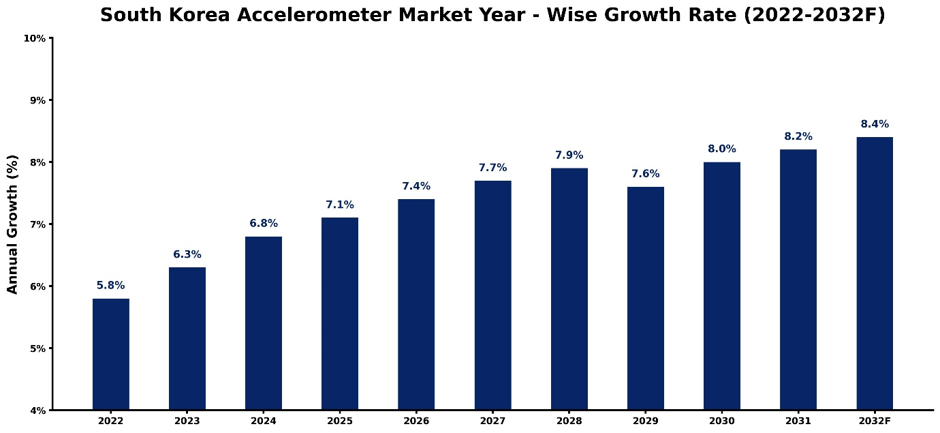
The following table summarizes the historical and forecasted growth rates of the South Korea Accelerometer Market, along with the rationale behind each year’s performance.
| Year | Estimated Growth (%) | Market Rationale |
| 2022 | 5.8% | Smart manufacturing and consumer electronics demand increased accelerometer adoption. |
| 2023 | 6.3% | EV growth and ADAS integration supported sensor demand. |
| 2024 | 6.8% | Robotics, semiconductors, and wearables accelerated market expansion. |
| 2025 | 7.1% | Automotive, IoT, and electronics applications boosted adoption. |
| 2026 | 7.4% | Autonomous mobility and smart factory deployment increased demand. |
| 2027 | 7.7% | AI monitoring and predictive maintenance applications expanded usage. |
| 2028 | 7.9% | Robotics growth and connected devices increased sensor requirements. |
| 2029 | 7.6% | Consumer market maturity slightly moderated growth momentum. |
| 2030 | 8% | Advanced mobility and semiconductor innovations created new opportunities. |
| 2031 | 8.2% | Smart mobility and healthcare electronics supported higher adoption. |
| 2032 | 8.4% | Industrial digitalization and compact sensor demand strengthened growth. |
Topics Covered in the South Korea Accelerometer Market Report
The South Korea Accelerometer Market Report provides a comprehensive analysis based on Type, Axis, and End User Industry. It offers detailed insights into key industry trends, growth drivers, emerging opportunities, competitive developments, and high-growth segments. The report presents an objective assessment of current dynamics and future prospects, enabling stakeholders to make informed business decisions and develop effective strategies aligned with the evolving industry landscape.
South Korea Accelerometer Market Highlights
| Report Name | South Korea Accelerometer Market |
| Forecast period | 2026-2032 |
| CAGR | 7.4% |
| Growing Sector | Automotive & Industrial Automation |
South Korea Accelerometer Market Synopsis
The South Korea Accelerometer Market is set to record considerable growth owing to the growing demand for motion sensing technology for automotive electronics, consumer electronics, and smart manufacturing. An accelerometer is an electronic sensor that measures the forces of acceleration, vibration, and movement. This market is gaining traction due to the growing adoption of automation, electric mobility, and connectivity. In addition to this, the country has developed excellent capabilities in semiconductors and electronics manufacturing.
Evaluation of Growth Drivers in the South Korea Accelerometer Market (2026-2032)
Below mentioned are some prominent drivers and their influence on the market dynamics:
| Drivers | Primary Segments Affected | Why it Matters (Evidence) |
| Production of Electric Vehicles | Ground Automotive, 3-axis Accelerometers | The growth of electric vehicles necessitates motion sensor technology. |
| Development of Smart Manufacturing | Industries, 3-axis Accelerometers | The development of industry 4.0 calls for vibration measurement technology. |
| Growing Consumer Electronics Innovation | Consumer Electronics, MEMS Accelerometers | Smartphones and video game systems need small and efficient motion sensing devices. |
| Increasing Adoption of Robotics | Industrial, Healthcare, Aerospace & Defense | Robotic systems depend on accelerometers for movement accuracy, balance control, and operational efficiency. |
| Semiconductor Technology Advancements | All Types, Automotive & Industrial | Local semiconductor expertise supports development of smaller, high-performance MEMS-based sensing solutions. |
South Korea Accelerometer Market is expected to grow at the CAGR of 7.4% during the forecast period of 2026-2032. This growth is supported by country’s strong electronics ecosystem, where semiconductor exports accounted for approximately 20% of total exports in recent years, creating favorable conditions for sensor manufacturing advancements. Additionally, the country’s industrial automation adoption rate remains among the highest globally, with thousands of smart factory initiatives accelerating demand for precision monitoring devices. Growing electric vehicle production, rising R&D spending exceeding 4% of GDP, and increasing integration of intelligent systems further enhance market opportunities.
Evaluation of Restraints in the South Korea Accelerometer Market
Below mentioned are some major restraints and their influence on the market dynamics:
| Restraints | Primary Segments Affected | What This Means (Evidence) |
| High Manufacturing Complexity | MEMS Accelerometers, Industrial | Precision fabrication requirements increase production costs and technical challenges. |
| Sensor Dependence on Advanced Semiconductors | All Categories, Consumer Electronics | Supplying difficulties may arise from the lack of advanced materials. |
| Fierce International Competition | Automotive, Industrial | The international makers of sensors exert price competition to domestic manufacturers. |
| Accuracy and Calibration Issues | Aerospace & Defence, Medical | High precision makes it necessary to have many tests and certifications. |
| Price Sensitivity in Consumer Appliances | Consumer Electronics | Price competitiveness of electronics hinders the use of premium sensor technologies. |
South Korea Accelerometer Market Challenges
South Korea accelerometer market growth faces challenges due to increasing competition among sensor manufacturers, complex semiconductor fabrication requirements, and rising pressure for cost-efficient solutions across industries. The rapid evolution of South Korea’s high-tech manufacturing landscape has increased the need for advanced sensing solutions; however, adoption barriers remain among small and medium-sized enterprises due to the financial burden associated with upgrading equipment and integrating smart monitoring platforms.
South Korea Accelerometer Market Trends
Important trends shaping the South Korea accelerometer market growth are detailed below:
- Integration of AI Based Analyzing of Sensors: Acceleration sensors have gained much attention in combination with AI based solutions for analyzing vibration, predicting failures, and increasing efficiency at smart manufacturing sites.
- MEMS Accelerometers in Shrinking Form: Companies focus on producing smaller acceleration sensors to be used in wearable devices, cell phones, and industrial equipment.
- Increasing Demand for Industrial IoT Monitoring: Connected factories are accelerating the deployment of accelerometers for real-time machinery health monitoring and predictive maintenance applications.
Investment Opportunities in the South Korea Accelerometer Market
Major investment opportunities in the South Korea Accelerometer Market are presented below:
- Smart Factory Sensor Infrastructure: Investment in sensor systems in industries could help to automate processes as well as monitor equipment in real time.
- Auto Sensing Technology: Development of accelerometers for use in electric and self-driving cars represents a major growth opportunity.
- MEMS Manufacturing Capacity: Expansion of local MEMS manufacturing capacity could reduce dependence on imports of sensors.
- Healthcare Wearable Technology Solutions: Investment in motion-based healthcare monitoring devices can support growing demand for remote patient tracking technologies.
Top Players in the South Korea Accelerometer Market
A detailed compilation of major companies active in the South Korea Accelerometer Market is presented below:
1. STMicroelectronics N.V.
| Company Name | STMicroelectronics N.V. |
|---|---|
| Established Year | 1987 |
| Headquarters | Geneva, Switzerland |
| Official Website | Click Here |
STMicroelectronics N.V. develops MEMS accelerometers widely used in automotive systems, industrial monitoring, smartphones, and consumer electronic applications globally.
2. Bosch Sensortec GmbH
| Company Name | Bosch Sensortec GmbH |
|---|---|
| Established Year | 2005 |
| Headquarters | Reutlingen, Germany |
| Official Website | Click Here |
Bosch Sensortec GmbH provides compact MEMS accelerometers designed for mobile devices, wearables, automotive systems, and industrial sensing applications.
3. Analog Devices Inc.
| Company Name | Analog Devices Inc. |
|---|---|
| Established Year | 1965 |
| Headquarters | Wilmington, USA |
| Official Website | Click Here |
Analog Devices Inc. manufactures precision accelerometers supporting industrial automation, healthcare equipment, aerospace systems, and advanced motion sensing applications.
4. Texas Instruments Incorporated
| Company Name | Texas Instruments Incorporated |
|---|---|
| Established Year | 1930 |
| Headquarters | Dallas, USA |
| Official Website | Click Here |
Texas Instruments Incorporated offers sensor solutions including accelerometers for automotive electronics, industrial control systems, and embedded applications.
5. Honeywell International Inc.
| Company Name | Honeywell International Inc. |
|---|---|
| Established Year | 1906 |
| Headquarters | Charlotte, USA |
| Official Website | Click Here |
Honeywell International Inc. supplies high-performance accelerometers used in aerospace, defense, industrial automation, and precision measurement applications.
Government Initiatives Being Implemented in the South Korea Accelerometer Market
The South Korean government is actively promoting the growth of the accelerometer market through policies focused on semiconductor innovation, smart manufacturing, digital transformation, and next-generation mobility.
Under the K-Semiconductor Strategy, the government is investing in expanding domestic semiconductor production, MEMS sensor research, and advanced chip fabrication, supporting the development of high-performance accelerometers used in consumer electronics, automotive systems, industrial equipment, and healthcare devices.
The Digital New Deal encourages the adoption of artificial intelligence (AI), the Internet of Things (IoT), and smart factories, increasing demand for motion sensors in automation and connected devices. Additionally, the Ministry of Trade, Industry and Energy (MOTIE) funds R&D projects related to intelligent sensors, robotics, and industrial automation, while the Korea Evaluation Institute of Industrial Technology (KEIT) supports innovation in precision sensor technologies.
Future Insights of the South Korea Accelerometer Market
The South Korea Accelerometer Industry is likely to witness sustained growth as intelligent sensing is used more frequently within the automotive sector, manufacturing industry, and electronics. Market forecast is driven by the presence of an advanced semiconductor industry in South Korea, where the research & development spending stands higher than 6% of the country’s GDP, allowing innovation in MEMS technology. By 2032, the demand for small and power-efficient accelerometers is set to increase sharply owing to growth in application areas such as electric mobility, robotics, and smart infrastructures.
Market Segmentation Analysis
This report presents a detailed analysis of the market segments along with their leading categories:
By Type- MEMS Accelerometers Dominate the Market, Piezoelectric Accelerometers Show Rapid Expansion
According to Sumit Sagar, Senior Research Analyst, 6Wresearch, MEMS accelerometers dominated the South Korea Accelerometer Market in 2025 with an estimated revenue share of 68.5%, driven by their compact design, low power consumption, cost efficiency, and extensive deployment across smartphones, automotive electronics, and industrial IoT systems.
Meanwhile, piezoelectric accelerometers are projected to register a CAGR of 8.1% during 2026–2032, supported by increasing demand for high-frequency vibration monitoring in manufacturing equipment, aerospace applications, and precision industrial machinery where enhanced measurement accuracy is essential.
By Axis- 3-Axis Accelerometers Lead the Market, 2-Axis Solutions Witness Faster Adoption
By axis, the 3-axis accelerometers captured about 61.2% of the South Korea Accelerometer market share in 2025 owing to high demand for such sensors in smartphones, wearable gadgets, automobile safety systems, and robotics that need detection of motion in multiple directions.
The segment is driven by rising needs for full motion sensing applications. On the other hand, the 2-axis accelerometers market is expected to grow at a CAGR of 7.8% up to 2032 on the back of rising usage in low-cost industrial and electronic monitoring systems.
By End-use Industry- Automotive Sector Dominates the Market, Industrial Applications Show Strong Growth Potential
The automotive industry was the dominant end-user industry within the South Korea Accelerometer Market in 2025, recorded a share of about 35.6%, owing to the increased production of electric vehicles, incorporation of ADAS, and increase in demand for vehicle stability systems. On the other hand, the industrial segment is projected to witness a CAGR of 8.3% during the forecast period 2026 to 2032 due to advancements in smart factories, predictive maintenance, and vibrations sensors use in automation industry.
Note: Market size estimations and growth projections presented in this report are based on 6Wresearch's proprietary forecasting methodology, utilizing the latest available industry data, government publications, and primary research inputs.
Key Attractiveness of the Report
- 10 Years of Market Numbers.
- Historical Data Starting from 2022 to 2025.
- Base Year: 2025.
- Forecast Data until 2032.
- Key Performance Indicators Impacting the Market.
- Major Upcoming Developments and Projects.
Key Highlights of the Report:
- South Korea Accelerometer Market Outlook
- Market Size of South Korea Accelerometer Market, 2025
- Forecast of South Korea Accelerometer Market, 2032
- Historical Data and Forecast of South Korea Accelerometer Revenues & Volume for the Period 2022-2032
- South Korea Accelerometer Market Trend Evolution
- South Korea Accelerometer Market Drivers and Challenges
- South Korea Accelerometer Price Trends
- South Korea Accelerometer Porter's Five Forces
- South Korea Accelerometer Industry Life Cycle
- Historical Data and Forecast of South Korea Accelerometer Market Revenues & Volume By Type for the Period 2022-2032
- Historical Data and Forecast of South Korea Accelerometer Market Revenues & Volume By AC Response for the Period 2022-2032
- Historical Data and Forecast of South Korea Accelerometer Market Revenues & Volume By DC Response for the Period 2022-2032
- Historical Data and Forecast of South Korea Accelerometer Market Revenues & Volume By Axis for the Period 2022-2032
- Historical Data and Forecast of South Korea Accelerometer Market Revenues & Volume By 1-Axis for the Period 2022-2032
- Historical Data and Forecast of South Korea Accelerometer Market Revenues & Volume By 2-Axis for the Period 2022-2032
- Historical Data and Forecast of South Korea Accelerometer Market Revenues & Volume By 3-Axis for the Period 2022-2032
- Historical Data and Forecast of South Korea Accelerometer Market Revenues & Volume By End-use Industry for the Period 2022-2032
- Historical Data and Forecast of South Korea Accelerometer Market Revenues & Volume By Consumer Electronics for the Period 2022-2032
- Historical Data and Forecast of South Korea Accelerometer Market Revenues & Volume By Automotive for the Period 2022-2032
- Historical Data and Forecast of South Korea Accelerometer Market Revenues & Volume By Healthcare for the Period 2022-2032
- Historical Data and Forecast of South Korea Accelerometer Market Revenues & Volume By Aerospace & Defense for the Period 2022-2032
- Historical Data and Forecast of South Korea Accelerometer Market Revenues & Volume By Industrial for the Period 2022-2032
- Historical Data and Forecast of South Korea Accelerometer Market Revenues & Volume By Others for the Period 2022-2032
- South Korea Accelerometer Import Export Trade Statistics
- Market Opportunity Assessment By Type
- Market Opportunity Assessment By Axis
- Market Opportunity Assessment By End-use Industry
- South Korea Accelerometer Top Companies Market Share
- South Korea Accelerometer Competitive Benchmarking By Technical and Operational Parameters
- South Korea Accelerometer Company Profiles
- South Korea Accelerometer Key Strategic Recommendations
Market Covered
The report offers a comprehensive study of the subsequent market segments:
By Type
- AC Response
- DC Response
By Axis
- 1-Axis
- 2-Axis
- 3-Axis
By End-use Industry
- Consumer Electronics
- Automotive
- Healthcare
- Aerospace & Defense
- Industrial
- Others






































