South Korea Acephate Market Growth Rate
According to 6Wresearch internal database and industry insights, the South Korea Acephate Market is projected to grow at a compound annual growth rate (CAGR) of 6.38% during the forecast period (2026-2032).
South Korea Acephate Market Year-wise Growth Rate and Key Drivers (2022-2032)
This graph illustrates the annual growth rates of the South Korea Acephate Market from 2022 to 2032, highlighting a steady upward trajectory and projected market expansion over the forecast period.
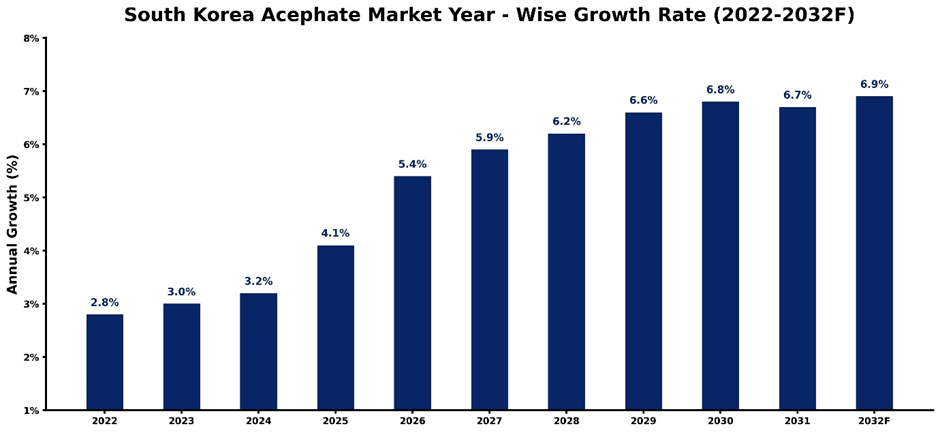
The following table summarizes the historical and forecasted growth rates of the South Korea Acephate Market, along with the rationale behind each year’s performance.
| Year | Estimated Growth (%) | Market Rationale |
| 2022 | 2.8% | Decline due to tighter pesticide usage controls and reduced application of older insecticides |
| 2023 | 3% | Recovery supported by pest outbreaks and demand for crop protection in fruit and vegetable farming |
| 2024 | 3.2% | Growth from continued agricultural productivity focus and need for insect control solutions |
| 2025 | 4.1% | Rising pest pressure and stable demand from commercial farming segments support growth |
| 2026 | 5.4% | Market expansion begins with improved crop protection demand and selective acephate usage |
| 2027 | 5.9% | Growth driven by increasing pest resistance issues requiring effective insecticide options |
| 2028 | 6.2% | Higher adoption supported by precision farming practices and crop yield protection needs |
| 2029 | 6.6% | Market gains from stronger demand in horticulture and specialty crop applications |
| 2030 | 6.8% | Continued growth due to food security initiatives and improved farm productivity requirements |
| 2031 | 6.7% | Growth moderates as regulatory scrutiny and alternative insecticide adoption increase |
| 2032 | 6.9% | Sustained demand from pest management needs despite competition from newer products |
Topics Covered in the South Korea Acephate Market Report
The South Korea Acephate Market Report provides a comprehensive analysis based on Type, Application, and End User. It offers detailed insights into key industry trends, growth drivers, emerging opportunities, competitive developments, and high-growth segments. The report presents an objective assessment of current dynamics and future prospects, enabling stakeholders to make informed business decisions and develop effective strategies aligned with the evolving industry landscape.
South Korea Acephate Market Highlights
| Report Name | South Korea Acephate Market |
| Forecast period | 2026-2032 |
| CAGR | 6.38% |
| Growing Sector | Agriculture & Commercial Crop Protection |
South Korea Acephate Market Synopsis
South Korea Acephate Market is projected to experience steady growth due to the efforts being made by the farmers in the pursuit of an efficient means of handling insect infestation to ensure crop quality and productivity. Acephate is a type of insecticide that is majorly an organophosphate and is commonly used in the elimination of sucking and chewing pests.
The market growth is attributed to factors such as advancements in technology and farming methods. Additionally, advancements in pesticide application methods are also aiding the accessibility of the market.
Evaluation of Growth Drivers in the South Korea Acephate Market (2026-2032)
Below mentioned are some prominent drivers and their influence on the market dynamics:
| Drivers | Primary Segments Affected | Why it Matters (Evidence) |
| Increasing Demand for Crop Protection Solutions | Agriculture, Commercial | Rising pest challenges and the need for stable agricultural output increase demand for effective insecticides. |
| Expanding Smart Farming Methods | Farming, Other | Methods for improving effectiveness of pesticides with smart farming techniques. |
| Increase in Planting of Crops with High Economic Value | Agriculture, Commercial | Greater plantings of vegetables, fruits, specialty crops increase demand for pest control chemicals. |
| Improved Formulations | All Markets, Agriculture | Improvements in formulations increase effectiveness and reduce chemical use. |
| Government Support for Agricultural Modernization | Agriculture, Others | Agricultural innovation programs encourage advanced crop management techniques and productivity improvement. |
South Korea Acephate Market is expected to grow at the CAGR of 6.38% during the forecast period of 2026-2032. The development profile of this product is supported by South Korea’s advanced agricultural ecosystem, where approximately 15% of the country’s total land area is utilized for agricultural activities and technology-driven farming continues expanding.
Additionally, the agricultural sector has increasingly adopted automation and precision farming methods, with smart farm adoption rising steadily across controlled cultivation facilities. Increasing investment in sustainable crop management, improved farm productivity, and efficient pesticide application techniques creates favourable conditions for market progression.
Evaluation of Restraints in the South Korea Acephate Market
Below mentioned are some major restraints and their influence on the market dynamics:
| Restraints | Primary Segments Affected | What This Means (Evidence) |
| Stringent Pesticide Regulations | All Types, Agriculture | Strict approval processes and residue limits can restrict product usage expansion. |
| Growing Preference for Bio-based Alternatives | Agriculture, Commercial | Increasing sustainability awareness encourages farmers to explore biological pest management solutions. |
| Environmental Concerns Regarding Chemical Usage | All Types, Others | Concerns related to soil and ecosystem impact influence pesticide consumption patterns. |
| Rising Development Costs for Compliant Products | Manufacturers, Commercial | Investment in safer formulations increases production and regulatory expenses. |
| Limited Adoption Among Small-scale Farmers | Agriculture | Cost sensitivity and changing farming practices may slow adoption among smaller agricultural operators. |
South Korea Acephate Market Challenges
The South Korea acephate market growth faces challenges from increasing environmental awareness, stricter pesticide regulations, and the transition toward sustainable farming practices. The country had a total area of agriculture land which was about 1.50 million hectares of which the paddy field was about 756 thousand hectares and the upland field was 744 thousand hectares.
With decreasing areas of land cultivation continuously, there is increasing pressure on farmers to enhance efficiency while ensuring that chemicals do not affect the soil or the environment negatively. Other factors like food safety regulations, pesticide residues, and integrated pest management are impacting the use of insecticides. Biologically based crop protection and precision farming practices might also affect the use of insecticides like acephate.
South Korea Acephate Market Trends
Some of the important market trends affecting the South Korea Acephate Market include:
- Incorporation of Precision Agriculture Techniques: More farmers are resorting to the use of digital monitoring devices, drones, and automated spraying machines to enhance accuracy in pesticide application and prevent unnecessary application of chemicals.
- Transition to Integrated Pest Management (IPM): The use of chemical and biological techniques in combination by agricultural farmers helps them to ensure efficiency and environmental sustainability.
- Creation of Low-Residue Products: Companies are working on producing better products that can help them to comply with regulations and also fulfill growing consumer requirements of agriculture.
- Increasing Trends towards Smart Greenhouses: Cultivation of crops through controlled systems will create more demand for pest control products for vegetables and specialty crops.
Investment Opportunities in the South Korea Acephate Market
Potential high-return investment prospects in the South Korea Acephate Market are listed below:
- Advanced Crop Protection Formulations – Investment in innovative acephate formulations with improved efficiency and reduced environmental impact can support future product differentiation.
- Precision Application Technology Partnerships – Collaboration between pesticide manufacturers and agricultural technology firms can create opportunities for automated and optimized pesticide delivery systems.
- Sustainable Pest Management Solutions – By companies making investments into integrated pest management solutions, there will be opportunities because of the growing need for a harmonious chemical and biological approach.
- Expansion of Agricultural Distribution Networks – By enhancing distribution networks through increased partnerships with other agricultural firms within various regions.
Top Players in the South Korea Acephate Market
The following includes major players operating in the South Korea Acephate Market:
1. UPL Limited
| Company Name | UPL Limited |
|---|---|
| Established Year | 1969 |
| Headquarters | Mumbai, India |
| Official Website | Click Here |
UPL Limited provides crop protection solutions, including insecticide products, supporting agricultural productivity through advanced pest management technologies.
2. ADAMA Ltd.
| Company Name | ADAMA Ltd. |
|---|---|
| Established Year | 1945 |
| Headquarters | Airport City, Israel |
| Official Website | Click Here |
ADAMA develops agricultural protection products, offering innovative insecticide solutions that improve crop health and support sustainable farming.
3. Sumitomo Chemical Co., Ltd.
| Company Name | Sumitomo Chemical Co., Ltd. |
|---|---|
| Established Year | 1913 |
| Headquarters | Tokyo, Japan |
| Official Website | Click Here |
Sumitomo Chemical manufactures agricultural chemicals and crop protection products focused on effective pest control and farming efficiency.
4. Nufarm Limited
| Company Name | Nufarm Limited |
|---|---|
| Established Year | 1916 |
| Headquarters | Melbourne, Australia |
| Official Website | Click Here |
Nufarm supplies herbicides, insecticides, and crop protection solutions that help farmers manage pests and improve crop productivity.
5. FMC Corporation
| Company Name | FMC Corporation |
|---|---|
| Established Year | 1883 |
| Headquarters | Philadelphia, USA |
| Official Website | Click Here |
FMC Corporation develops advanced agricultural technologies and crop protection solutions to enhance pest control, productivity, and farming sustainability.
Government Initiatives Being Implemented in the South Korea Acephate Market
According to South Korean Government Data, the government manages the use of acephate and other chemical substances employed in agriculture through the Agricultural Chemicals Control Act, which is controlled by the Ministry of Agriculture, Food and Rural Affairs (MAFRA), with support from the Rural Development Administration (RDA).
The government enforces the pesticide registration process, toxicity evaluation, authorized crops, and safety use directions to commercialize products. Projects like pesticide safety programs from the National Institute of Agricultural Sciences, agricultural chemical residue inspection, and smart farm projects promote proper pesticide application. The South Korean nation maintains a positive list policy for pesticide residues so that only acceptable pesticides may be applied on the crops.
Future Insights of the South Korea Acephate Market
The future of the South Korea acephate industry will be influenced by changing agricultural practices, pesticide regulations, and the country’s transition toward sustainable farming. South Korea has a population of over 51 million and one of Asia’s most advanced agricultural systems, supported by technology-driven farming methods.
The country continues to advocate for intelligent agriculture and precision farming as well as decreased chemical dependence. The demand for acephate in the future is expected to be influenced by the need for effective pest control in intensive cultivation systems under increased environmental and food safety restrictions.
Market Segmentation Analysis
This report presents a detailed analysis of the market segments along with their leading categories:
By Type - Organophosphorus Segment Dominates Market, Natural Sources Segment Shows Rising Expansion
According to Sachin Kumar Rai, Senior Research Analyst, 6Wresearch, organophosphorus-based acephate products accounted for the leading share of the market in 2025, capturing approximately 68.5% of market demand due to their established effectiveness against a wide range of agricultural pests and extensive usage in commercial crop protection.
Meanwhile, natural source-based alternatives are projected to witness faster adoption with an estimated CAGR of 6.7% during 2026-2032, supported by increasing sustainability awareness, regulatory pressure, and farmer interest in environmentally compatible pest management solutions.
By Application - Spray Application Leads Market, Dipping Vat Solutions Gain Gradual Adoption
Application-wise, the Spray Usage segment captured maximum market share of South Korea Acephate Market with more than 74.2% in 2025 because of ease of use, capacity to cover vast agricultural land, and applicability with farm machinery.
The segment continues to hold strong preference from commercial agricultural users of vegetables, fruits, and field crops. On the other hand, the Dipping Vat segment is forecasted to grow at a CAGR of 5.6% till 2032.
By End-User - Agriculture Sector Leads Market, Commercial Farming Shows Strong Growth Potential
As per end-user, agriculture accounted for the most dominant segment with around 79.6% market share in 2025, thanks to constant crop protection needs of vegetable producers, fruit growers, and field crop farmers.
Furthermore, initiatives related to agricultural modernization by the government further aid demand generation among the agricultural community. Demand among commercial users is forecast to grow at a CAGR of 5.4% during 2026-2032 on account of rising adoption of professional pest management system and large-scale farming operations.
Note: Market size estimations and growth projections presented in this report are based on 6Wresearch's proprietary forecasting methodology, utilizing the latest available industry data, government publications, and primary research inputs.
Key Attractiveness of the Report
- 10 Years of Market Numbers.
- Historical Data Starting from 2022 to 2025.
- Base Year: 2025.
- Forecast Data until 2032.
- Key Performance Indicators Impacting the Market.
- Major Upcoming Developments and Projects.
Key Highlights of the Report:
- South Korea Acephate Market Outlook
- Market Size of South Korea Acephate Market, 2025
- Forecast of South Korea Acephate Market, 2032
- Historical Data and Forecast of South Korea Acephate Revenues & Volume for the Period 2022-2032
- South Korea Acephate Market Trend Evolution
- South Korea Acephate Market Drivers and Challenges
- South Korea Acephate Price Trends
- South Korea Acephate Porter's Five Forces
- South Korea Acephate Industry Life Cycle
- Historical Data and Forecast of South Korea Acephate Market Revenues & Volume By Type for the Period 2022-2032
- Historical Data and Forecast of South Korea Acephate Market Revenues & Volume By Organo Chlorine for the Period 2022-2032
- Historical Data and Forecast of South Korea Acephate Market Revenues & Volume By Organo Phosphorus for the Period 2022-2032
- Historical Data and Forecast of South Korea Acephate Market Revenues & Volume By Carbamate for the Period 2022-2032
- Historical Data and Forecast of South Korea Acephate Market Revenues & Volume By Arsenicals for the Period 2022-2032
- Historical Data and Forecast of South Korea Acephate Market Revenues & Volume By Natural Sources for the Period 2022-2032
- Historical Data and Forecast of South Korea Acephate Market Revenues & Volume By Others for the Period 2022-2032
- Historical Data and Forecast of South Korea Acephate Market Revenues & Volume By Application for the Period 2022-2032
- Historical Data and Forecast of South Korea Acephate Market Revenues & Volume By Spray for the Period 2022-2032
- Historical Data and Forecast of South Korea Acephate Market Revenues & Volume By Dipping Vat for the Period 2022-2032
- Historical Data and Forecast of South Korea Acephate Market Revenues & Volume By Hand Dressing for the Period 2022-2032
- Historical Data and Forecast of South Korea Acephate Market Revenues & Volume By Others for the Period 2022-2032
- Historical Data and Forecast of South Korea Acephate Market Revenues & Volume By End-User for the Period 2022-2032
- Historical Data and Forecast of South Korea Acephate Market Revenues & Volume By Agriculture for the Period 2022-2032
- Historical Data and Forecast of South Korea Acephate Market Revenues & Volume By Animal Husbandry for the Period 2022-2032
- Historical Data and Forecast of South Korea Acephate Market Revenues & Volume By Commercial for the Period 2022-2032
- Historical Data and Forecast of South Korea Acephate Market Revenues & Volume By Others for the Period 2022-2032
- South Korea Acephate Import Export Trade Statistics
- Market Opportunity Assessment By Type
- Market Opportunity Assessment By Application
- Market Opportunity Assessment By End-User
- South Korea Acephate Top Companies Market Share
- South Korea Acephate Competitive Benchmarking By Technical and Operational Parameters
- South Korea Acephate Company Profiles
- South Korea Acephate Key Strategic Recommendations
Market Covered
The report offers a comprehensive study of the subsequent market segments:
By Type
- Organophosphorus
- Organo Chlorine
- Carbamate
- Arsenicals
- Natural Sources
- Others
By Application
- Spray
- Dipping Vat
- Hand Dressing
- Others
By End-User
- Agriculture
- Animal Husbandry
- Commercial
- Others






































