South Korea Acrolein Market Growth Rate
According to 6Wresearch internal database and industry insights, the South Korea Acrolein Market is projected to grow at a compound annual growth rate (CAGR) of 4.38% during the forecast period (2026-2032).
South Korea Acrolein Market Year-wise Growth Rate and Key Drivers (2022-2032)
This graph illustrates the annual growth rates of the South Korea Acrolein Market from 2022 to 2032, highlighting a steady upward trajectory and projected market expansion over the forecast period.
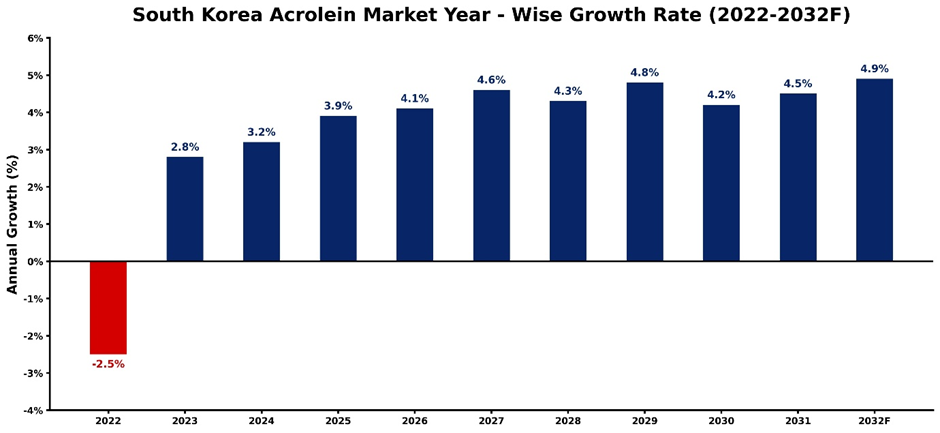
The following table summarizes the historical and forecasted growth rates of the South Korea Acrolein Market, along with the rationale behind each year’s performance.
| Year | Estimated Growth (%) | Market Rationale |
| 2022 | -2.5% | Supply disruptions and weaker industrial activity reduced chemical demand |
| 2023 | 2.8% | Recovery in manufacturing and gradual improvement in chemical consumption |
| 2024 | 3.2% | Growth supported by specialty chemicals and water treatment applications |
| 2025 | 3.9% | Stable demand from methionine, agrochemical, and industrial users |
| 2026 | 4.1% | Stronger chemical sector activity and improved production utilization |
| 2027 | 4.6% | Rising demand for chemical intermediates and sustainable industrial processes |
| 2028 | 4.3% | Expansion in electronics, coatings, and advanced materials applications |
| 2029 | 4.8% | Increased adoption in water treatment and specialty chemical production |
| 2030 | 4.2% | Growth moderates due to regulatory pressure and safety restrictions |
| 2031 | 4.5% | Continued industrial demand and improved manufacturing efficiency |
| 2032 | 4.9% | Long-term growth from diversified applications and regional chemical expansion |
Topics Covered in the South Korea Acrolein Market Report
The South Korea Acrolein Market Report provides a comprehensive analysis based on Application and Prevention. It offers detailed insights into key industry trends, growth drivers, emerging opportunities, competitive developments, and high-growth segments. The report presents an objective assessment of current dynamics and future prospects, enabling stakeholders to make informed business decisions and develop effective strategies aligned with the evolving industry landscape.
South Korea Acrolein Market Highlights
| Report Name | South Korea Acrolein Market |
| Forecast period | 2026-2032 |
| CAGR | 4.38% |
| Growing Sector | Methionine |
South Korea Acrolein Market HighlightsSouth Korea Acrolein Market Synopsis
South Korea Acrolein Market operates through an unsaturated aldehyde that is predominantly used as an intermediate chemical in the manufacturing of methionine and biocides, which are important for animal feed applications and water treatment processes. The market is expected to experience considerable growth in the coming period because of the rising demands for quality poultry and swine feed, which depend on methionine for improving the health status of livestock. It is due to the futuristic environmental requirements stipulated by the K-REACH as well as the promising 8.9% growth potential in bio-based options. Ultimately, this dynamic environment promises highly resilient operational stability and continuous technological innovation for all major stakeholders engaged in continuous production.
Evaluation of Growth Drivers in the South Korea Acrolein Market (2026-2032)
Below mentioned are some prominent drivers and their influence on the market dynamics:
| Drivers | Primary Segments Affected | Why it Matters (Evidence) |
| Rising Methionine Demand | Animal Feed Industry | Acrolein supports methionine production, driven by increasing livestock feed demand and animal nutrition needs. |
| Water Treatment Expansion | Municipal & Industrial Water Treatment | Growth in wastewater treatment projects increases demand for acrolein-based biocide applications. |
| Advanced Biocide Usage | Agriculture & Industrial Applications | Higher use of biocides for microbial control supports acrolein consumption in crop protection and industrial systems. |
| Glutaraldehyde Production | Healthcare & Sterilization | Acrolein is used in glutaraldehyde manufacturing, supporting demand from sterilization and disinfection applications. |
| Fungi Prevention Needs | Agriculture & Crop Protection | Humid conditions increase fungal risks, driving the need for effective crop protection solutions. |
South Korea Acrolein Market is expected to grow at the CAGR of 4.38% during the forecast period of 2026-2032. The market thrives on surging downstream consumption, primarily propelled by the exponential expansion of the high-performance agricultural and water treatment sectors. The synthesis of methionine, where animal feed applications absorb over 95% of total end-use volume, continues to demonstrate remarkable resilience. The industry indicators demonstrate that the specific liquid derivatives of methionine progress with an amazing rate of 8.24% per year.
Furthermore, the increasing national demands for efficient biocides in industrial cooling facilities result in the increase in the output, which, in its turn, prevents seasonal changes in the demand from affecting sales.
Evaluation of Restraints in the South Korea Acrolein Market
Below mentioned are some major restraints and their influence on the market dynamics:
| Restraints | Primary Segments Affected | What This Means (Evidence) |
| High Toxicity Levels | All Types | Requires specialized handling, storage and safety equipment, increasing operational costs and workplace-safety requirements. |
| Feedstock Price Volatility | Application | Propylene and other feedstock cost fluctuations can raise production expenses and reduce manufacturer margins. |
| Stringent Regulations | Application | Stricter chemical, environmental and safety regulations increase compliance costs and require additional testing and certification. |
| Alternative Substitutes | Prevention | Growing adoption of bio-based and alternative chemicals can reduce demand for conventional products in selected applications. |
| Transport Logistics | All Types | Hazardous-material transportation requires specialized logistics, increasing shipping costs and creating potential supply-chain delays. |
South Korea Acrolein Market Challenges
The market often faces strong headwinds in the form of significant economic headwinds as a result of extremely volatile feedstock and unexpected supply chain disruptions. The industry is highly vulnerable to global oil prices because traditional manufacturing processes utilize propylene oxidation extensively. Recent statistics show that sudden local price movements can reduce non-integrated business margins up to 15%.
Furthermore, upgrading specialized manufacturing lines to meet modern safety compliance standards demands exorbitant capital outlays, severely constraining immediate profitability for mid-tier processors. Overcoming these logistical and regulatory bottlenecks remains essential to sustain long-term South Korea Acrolein Market Growth while maintaining strict safety compliance standards across the industrial chemical supply chain.
South Korea Acrolein Market Trends
Significant trends driving the South Korea Acrolein Market are presented below:
- Bio-synthesis Approach: Moving from the conventional approach of propylene oxidation to glycerol dehydration process for developing an environmentally sound chemical profile and reducing carbon dioxide emission.
- Use of Automation in Handling: Use of smart sensors and closed loop pipes for increasing the safety of employees as well as minimizing toxic substances during synthesis process.
- Use of Precision Agriculture: Higher use in the development of acrolein based biocides specifically for fungi in high tech greenhouses.
- Application in Water Treatment Process: Higher use in zero liquid discharge (ZLD) process for eliminating biofouling in high saline industrial wastewater pipelines.
Investment Opportunities in the South Korea Acrolein Market
Promising investment avenues in the South Korea Acrolein Market are presented below:
- Acrolein Production Facilities: Establishing advanced production facilities for sustainable acrolein derived from bio-glycerol generated during biodiesel manufacturing, supporting cleaner production and alignment with South Korea's environmental and green-energy objectives.
- Storage Facilities: Developing climate- and process-controlled storage infrastructure for hazardous intermediate chemicals, incorporating advanced monitoring, safety systems and regulatory-compliant handling facilities.
- Environmentally Friendly Biocide Formulation: Investing in low-toxicity and environmentally friendly biocide and pesticide formulations that comply with domestic environmental requirements while maintaining effective antimicrobial and pest-control performance.
Top Players in the South Korea Acrolein Market
A list of leading companies operating in the South Korea Acrolein Market is presented below:
1. LG Chem
| Company Name | LG Chem |
|---|---|
| Established Year | 1947 |
| Headquarters | Seoul, South Korea |
| Official Website | Click Here |
LG Chem is one of South Korea’s largest chemical companies, operating integrated petrochemical businesses that supply essential raw materials, acrylic compounds, polymers, and advanced chemical solutions for various industrial applications.
2. BASF Korea
| Company Name | BASF Korea |
|---|---|
| Established Year | 1980 |
| Headquarters | Seoul, South Korea |
| Official Website | Click Here |
BASF Korea is the South Korean subsidiary of BASF, a global chemical leader providing specialty chemicals, performance materials, catalysts, and industrial solutions.
3. The Dow Chemical Company
| Company Name | The Dow Chemical Company |
|---|---|
| Established Year | 1897 |
| Headquarters | Midland, Michigan, United States |
| Official Website | Click Here |
The Dow Chemical Company, operating as Dow Inc., is a major global materials-science and chemical manufacturer supplying industrial intermediates, performance materials, polymers, and specialty chemical solutions.
4. Arkema Group
| Company Name | Arkema Group |
|---|---|
| Established Year | 2004 |
| Headquarters | Colombes, France |
| Official Website | Click Here |
Arkema is a global specialty-chemicals company with significant expertise in acrylic monomers, advanced materials, coating solutions, and high-performance polymers.
5. Evonik Industries AG
| Company Name | Evonik Industries AG |
|---|---|
| Established Year | 2007 |
| Headquarters | Essen, Germany |
| Official Website | Click Here |
Evonik Industries AG is a major global specialty-chemicals manufacturer serving applications across chemicals, materials, additives, and industrial intermediates.
Government Initiatives Being Implemented in the South Korea Acrolein Market
According to South Korean Government Data, the market operates under increasingly stringent domestic frameworks, profoundly reshaped by the 2025 legislative amendments to the Act on the Registration and Evaluation of Chemicals (K-REACH). The government enforced such a way that the new chemical substance notification thresholds should be accurately set below one ton per year, thus hastening the processes of compliance for importers. At the same time, the Chemical Substances Control Act still enforces strict measures for handling, which leads to less toxicity accidents in the workplaces, accounting for almost 15%.
Future Insights of the South Korea Acrolein Market
The South Korea Acrolein Industry is poised for substantial technological shifts, as future insights towards 2032 indicate a robust transition toward bio-based manufacturing pathways. Based on industry forecasts, it can be said that there will be a rise in the use of methodologies employing renewable glycerol by an estimated 8.9%, which will far exceed conventional petrochemical manufacturing process rates. With the country's exports of chemicals witnessing a remarkable 20.3% increase in the year-to-date period of mid-2026, the demand for methionine to be used as animal feed will act as a clear catalyst.
Market Segmentation Analysis
This report presents a detailed analysis of the market segments along with their leading categories:
By Application – Methionine Dominates the Market, Biocides Set for Rapid Expansion
According to Sumit Sagar, Senior Research Analyst, 6Wresearch, Methionine accounted for 32.50% of the South Korea Acrolein Market Share in 2025, primarily owing to its critical necessity in domestic poultry and swine nutrition, ensuring optimal livestock growth and health. Meanwhile, Biocides are anticipated to register the fastest CAGR of 2.62% during 2026–2032, supported by increasing agricultural pest control requirements, expanding municipal water treatment infrastructure, and strict sanitation mandates across industrial cooling systems requiring effective biofouling prevention.
By Prevention – Fungi Emerges as the Largest Segment, Rodents Records the Fastest Growth
The Fungi prevention segment accounted for the maximum market share of 25.30% in the year 2025. The factors driving the growth of this market include the rising prevalence of crop diseases in high-humidity agricultural zones and the extensive use of aldehyde-based formulations in commercial greenhouses. On the other hand, the Rodents segment is projected to grow at the maximum CAGR of 4.15% during the forecast period.
Note: Market size estimations and growth projections presented in this report are based on 6Wresearch's proprietary forecasting methodology, utilizing the latest available industry data, government publications, and primary research inputs.
Key Attractiveness of the Report
- 10 Years of Market Numbers.
- Historical Data Starting from 2022 to 2025.
- Base Year: 2025.
- Forecast Data until 2032.
- Key Performance Indicators Impacting the Market.
- Major Upcoming Developments and Projects.
Key Highlights of the Report:
- South Korea Acrolein Market Outlook
- Market Size of South Korea Acrolein Market, 2025
- Forecast of South Korea Acrolein Market, 2032
- Historical Data and Forecast of South Korea Acrolein Revenues & Volume for the Period 2022-2032
- South Korea Acrolein Market Trend Evolution
- South Korea Acrolein Market Drivers and Challenges
- South Korea Acrolein Price Trends
- South Korea Acrolein Porter's Five Forces
- South Korea Acrolein Industry Life Cycle
- Historical Data and Forecast of South Korea Acrolein Market Revenues & Volume By Application for the Period 2022-2032
- Historical Data and Forecast of South Korea Acrolein Market Revenues & Volume By Glutaraldehyde for the Period 2022-2032
- Historical Data and Forecast of South Korea Acrolein Market Revenues & Volume By Biocides for the Period 2022-2032
- Historical Data and Forecast of South Korea Acrolein Market Revenues & Volume By Pesticide for the Period 2022-2032
- Historical Data and Forecast of South Korea Acrolein Market Revenues & Volume By Methionine for the Period 2022-2032
- Historical Data and Forecast of South Korea Acrolein Market Revenues & Volume By Water Treatment Agent for the Period 2022-2032
- Historical Data and Forecast of South Korea Acrolein Market Revenues & Volume By Prevention for the Period 2022-2032
- Historical Data and Forecast of South Korea Acrolein Market Revenues & Volume By Fungi for the Period 2022-2032
- Historical Data and Forecast of South Korea Acrolein Market Revenues & Volume By Mollusks for the Period 2022-2032
- Historical Data and Forecast of South Korea Acrolein Market Revenues & Volume By Rodents for the Period 2022-2032
- South Korea Acrolein Import Export Trade Statistics
- Market Opportunity Assessment By Application
- Market Opportunity Assessment By Prevention
- South Korea Acrolein Top Companies Market Share
- South Korea Acrolein Competitive Benchmarking By Technical and Operational Parameters
- South Korea Acrolein Company Profiles
- South Korea Acrolein Key Strategic Recommendations
Market Covered
The report offers a comprehensive study of the subsequent market segments:
By Application
- Glutaraldehyde
- Biocides
- Pesticide
- Methionine
- Water Treatment Agent
By Prevention
- Fungi
- Mollusks
- Rodents






































