South Korea Acrylate Monomers Market Growth Rate
According to 6Wresearch internal database and industry insights, the South Korea Acrylate Monomers Market is projected to grow at a compound annual growth rate (CAGR) of 5.86% during the forecast period (2026-2032).
South Korea Acrylate Monomers Market Year-wise Growth Rate and Key Drivers (2022-2032)
This graph illustrates the annual growth rates of the South Korea Acrylate Monomers Market from 2022 to 2032, highlighting a steady upward trajectory and projected market expansion over the forecast period.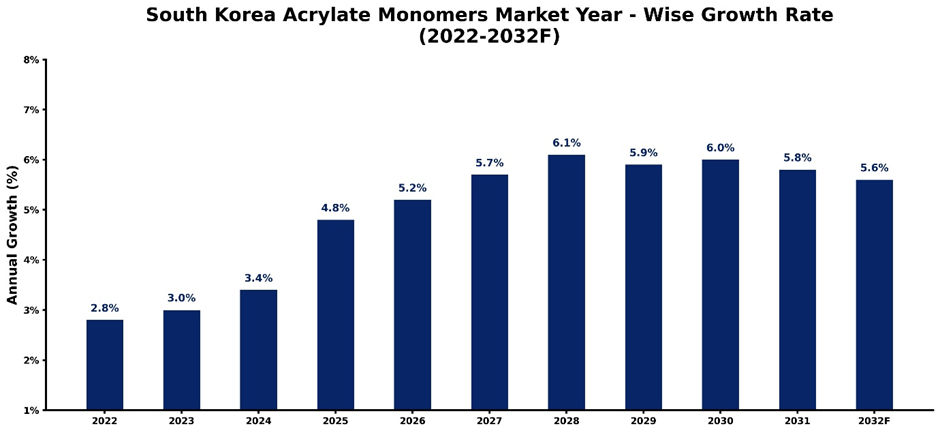
The following table summarizes the historical and forecasted growth rates of the South Korea Acrylate Monomers Market, along with the rationale behind each year’s performance.
| Year | Estimated Growth (%) | Market Rationale |
| 2022 | 2.8% | Industrial applications and coating demand supported market activity. |
| 2023 | 3% | Improving manufacturing output supported market growth. |
| 2024 | 3.4% | Growing use in coatings, adhesives, automotive, and electronics increased demand. |
| 2025 | 4.8% | Rising demand for specialty acrylates and sustainable coatings supported expansion. |
| 2026 | 5.2% | Increased use in construction coatings, packaging, and polymer applications supported growth. |
| 2027 | 5.7% | Growing automotive and adhesive applications increased market demand. |
| 2028 | 6.1% | Higher adoption in electronics coatings and specialty materials supported growth. |
| 2029 | 5.9% | Industrial coatings and sustainable polymer applications-maintained demand. |
| 2030 | 6% | Growing use of advanced materials and low-VOC coatings supported expansion. |
| 2031 | 5.8% | Continued demand from automotive, electronics, and packaging industries supported growth. |
| 2032 | 5.6% | Specialty acrylate applications and stable industrial demand supported market development. |
Topics Covered in the South Korea Acrylate Monomers Market Report
The South Korea Acrylate Monomers Market Report provides a comprehensive analysis based on Type, and Application. It offers detailed insights into key industry trends, growth drivers, emerging opportunities, competitive developments, and high-growth segments. The report presents an objective assessment of current dynamics and future prospects, enabling stakeholders to make informed business decisions and develop effective strategies aligned with the evolving industry landscape.
South Korea Acrylate Monomers Market Highlights
| Report Name | South Korea Acrylate Monomers Market |
| Forecast period | 2026-2032 |
| CAGR | 5.86% |
| Growing Sector | Paints and Coatings |
South Korea Acrylate Monomers Market Synopsis
South Korea Acrylate Monomers Market is expected to witness significant growth owing to the increasing rate of industrialization, rapid urbanization, and the rising demand for superior performance chemical derivatives. Essentially, acrylate monomers are flexible organic chemicals used to make polymers which find applications in adhesives, paints, and plastics. Notably, these products have excellent weathering properties. In addition, the increasing importance of environmentally friendly water-based coatings, together with considerable investments in manufacturing facilities, is facilitating the use of these advanced chemical intermediates in various industrial applications.
Evaluation of Growth Drivers in the South Korea Acrylate Monomers Market (2026-2032)
Below mentioned are some prominent drivers and their influence on the market dynamics:
| Drivers | Primary Segments Affected | Why it Matters (Evidence) |
| Surge in Construction Activities | Paints and Coatings | Expanding Infrastructure Projects |
| Shift to Waterborne Coatings | Butyl Acrylate | Eco-friendly Chemical Adoption |
| Growth in Electronics Packaging | Adhesives | High-Demand Consumer Goods |
| Automotive Sector Expansion | Paints and Coatings | Automotive Manufacturing Rebound |
| Textile Industry Upgrades | Methyl Acrylate | Advanced Fabric Treatments |
South Korea Acrylate Monomers Market Growth is expected to accelerate at a CAGR of 5.86% during the forecast period of 2026-2032. The market is gaining strong momentum from expanding industrial applications and increasing consumption across high-value manufacturing sectors. The paints and coatings industry remains the leading demand contributor, representing approximately 52.10% of total material consumption, supported by the accelerated shift toward water-based and environmentally sustainable coating systems.
Moreover, the ongoing constructions all around the region also help enhance the demand in the market, with the sector representing almost 37.05% of end-user consumption. Apart from conventional uses, increasing usage of pressure-sensitive adhesives, electronics materials, and UV-curable acrylates in semiconductor packaging are also offering avenues for growth. These developments are reinforcing the market’s position as a critical supplier for advanced industrial applications and future-oriented manufacturing solutions.
Evaluation of Restraints in the South Korea Acrylate Monomers Market
Below mentioned are some major restraints and their influence on the market dynamics:
| Restraints | Primary Segments Affected | What This Means (Evidence) |
| Raw Material Price Volatility | All Types | Fluctuating petrochemical costs heavily impact overall monomer production expenses. |
| Stringent Environmental Regulations | Paints and Coatings | Rigid emission standards require costly upgrades to existing manufacturing facilities. |
| High Transportation Costs | Plastics, Adhesives | Elevated logistics expenses reduce the profit margins for domestic suppliers. |
| Supply Chain Vulnerabilities | Ethyl Acrylate | Reliance on imported catalysts creates occasional disruptions in production schedules. |
| Availability of Substitutes | Adhesives, Printing Inks | Emerging alternative bio-polymers threaten the market share of traditional acrylates. |
South Korea Acrylate Monomers Market Challenges
Irrespective of massive growth and development, the chemical industry faces severe challenges that could impede South Korea Acrylate Monomers Market Growth, such as extreme volatility in global crude oil prices and highly stringent environmental compliance mandates. One of the most significant pressures stems from fluctuations in petrochemical feedstock prices, particularly propylene and acrylic acid, which remain vulnerable to global supply disruptions and substantial cost variations.
Furthermore, increasingly stringent rules concerning residual monomer safety and environmental issues are causing higher costs of operation for manufacturers, with compliance costs constantly affecting their bottom line. In addition, the industry faces stiff competition from rival technologies such as modern polyurethane dispersions, making the companies in the industry continuously work hard at improving their efficiencies and capabilities.
South Korea Acrylate Monomers Market Trends
Major trends influencing the South Korea Acrylate Monomers Market include the following:
- Use of Sustainable Bio-based Monomers: The use of sustainable and plant-based feedstock for the synthesis of acrylates is gaining popularity to achieve optimal environmental impacts and lower carbon dioxide emissions.
- Shift towards UV-Curable Adhesives: The trend towards the usage of UV-curable acrylate systems is gaining momentum to lower curing times without compromising adhesive performance.
- Growth of High-Solid Coatings: The trend towards high-solid architectural coatings is fueling the demand for unique butyl acrylate products that can comply with stringent volatile organic compound norms.
- Smart Packaging: Increasing inclination towards smart packaging solutions with better barrier and printing performance using special acrylate inks.
Investment Opportunities in the South Korea Acrylate Monomers Market
Key investment prospects in the South Korea Acrylate Monomers Market are outlined below:
- Development of Eco-Friendly Production Facilities: Creating high-tech, low-emissions manufacturing plants in leading industrial regions for meeting the needs of green chemistry.
- Distribution of Water-Based Coatings: Setting up efficient distribution channels for eco-safe coatings that can be used in the construction industry.
- Polymer Research and Development Units: Setting up research and development units for coming up with new uses of ethylhexyl acrylate in the electronics industry.
- Packaging Solutions: Providing government backed contracts for developing recyclable acrylate-based adhesives for packaging in domestic e-commerce industry.
Top Players in the South Korea Acrylate Monomers Market
A comprehensive list of major companies operating in the South Korea Acrylate Monomers Market is provided below:
1. LG Chem Ltd.
| Company Name | LG Chem Ltd. |
|---|---|
| Established Year | 1947 |
| Headquarters | Seoul, South Korea |
| Official Website | Click Here |
LG Chem produces acrylic acid and acrylate derivatives used in coatings, adhesives, superabsorbent polymers, and various industrial applications.
2. BASF SE
| Company Name | BASF SE |
|---|---|
| Established Year | 1865 |
| Headquarters | Ludwigshafen, Germany |
| Official Website | Click Here |
BASF supplies high-performance acrylic monomers and downstream dispersions, supporting South Korean industrial customers with advanced chemical solutions.
3. Arkema (Sartomer)
| Company Name | Arkema (Sartomer) |
|---|---|
| Established Year | 2004 |
| Headquarters | Colombes, France |
| Official Website | Click Here |
Arkema develops specialty acrylate monomers and oligomers, including UV-curable materials supporting electronics, coatings, and advanced manufacturing industries.
4. Mitsubishi Chemical Group
| Company Name | Mitsubishi Chemical Group |
|---|---|
| Established Year | 1933 |
| Headquarters | Tokyo, Japan |
| Official Website | Click Here |
Mitsubishi Chemical Group supplies methyl methacrylate and acrylic intermediates through regional partnerships, exports, and advanced chemical manufacturing operations.
5. Nippon Shokubai Co., Ltd.
| Company Name | Nippon Shokubai Co., Ltd. |
|---|---|
| Established Year | 1941 |
| Headquarters | Osaka, Japan |
| Official Website | Click Here |
Nippon Shokubai is a leading producer of acrylic acid and acrylate esters, supporting chemical processing industries across global markets.
6. Miwon Specialty Chemical Co., Ltd.
| Company Name | Miwon Specialty Chemical Co., Ltd. |
|---|---|
| Established Year | 1989 |
| Headquarters | Incheon, South Korea |
| Official Website | Click Here |
Miwon Specialty Chemical develops radiation-curing materials, including UV and EB acrylate monomers and oligomers for specialty applications.
Government Initiatives Being Implemented in the South Korea Acrylate Monomers Market
The South Korea Acrylate Monomers Market is developing in an environment where the chemical management is governed by stringent environmental protection and safety policies. The enforcement of revised K-REACH regulations along with changes brought about through Ministry of Environment Notice 2024 has led to strict supervision on chemicals, restricted substances, and residual monomer levels.
These developments are making it necessary for the manufacturers to adopt better compliance systems, safety measures in production, and chemical management techniques. On the other hand, government-sponsored sustainability programs in 2025 and 2026 are promoting investments in carbon emission reduction projects and low VOC coatings. As regulatory expectations continue to evolve, domestic producers are increasingly focusing on cleaner manufacturing processes and the development of sustainable bio-circular acrylate solutions aligned with South Korea’s long-term environmental objectives.
Future Insights of the South Korea Acrylate Monomers Market
The South Korea Acrylate Monomers Industry is expected to witness significant technological transformation and sustained expansion through 2032, supported by rising demand for advanced performance materials across diverse industries. By the close of the forecast period, the market is expected to register a compound annual growth rate of close to 5%, largely owing to rising demand for high-performance polymers used in certain applications.
Among all the segments, paints and coatings are expected to register high momentum with a projected CAGR of 5.45%, while healthcare and hygiene applications are evolving at 5.12% because of the need for functionally durable materials. Going forward, the future market trends will focus more on sustainable UV curable technologies, eco-friendly bio-resins, and acrylates for future application areas like 3D printing and bonding of electronics.
Market Segmentation Analysis
This report presents a detailed analysis of the market segments along with their leading categories:
By Type – Market Dominated by Butyl Acrylate, Ethylhexyl Acrylate Set for Rapid Expansion
According to Sumit Sagar, Senior Research Analyst, 6Wresearch, Butyl Acrylate accounted for 42.50% of the market share in 2025, primarily owing to its extensive utilization in architectural paints, excellent weatherability, superior flexibility, and widespread adoption across the booming domestic construction industry. Meanwhile, Ethylhexyl Acrylate is anticipated to register the fastest CAGR of 6.80% during 2026–2032, supported by increasing consumer awareness regarding advanced pressure-sensitive adhesives, rising adoption in the packaging sector, and growing acceptance of highly durable automotive coatings.
By Application – Market Dominated by Paints and Coatings, Adhesives Set for Rapid Expansion
Paints and Coatings accounted for 48.30% of the South Korea Acrylate Monomers Market Share in 2025, primarily driven by rapid urbanization, massive infrastructure development, rising demand for durable automotive finishes, and strict regulatory mandates favoring low-VOC waterborne architectural paint formulations. Meanwhile, Adhesives are anticipated to register the fastest CAGR of 7.20% during 2026–2032, supported by expanding e-commerce packaging needs, increasing electronics manufacturing, rising demand for pressure-sensitive tapes, and growing innovations in industrial bonding solutions.
Note: Market size estimations and growth projections presented in this report are based on 6Wresearch's proprietary forecasting methodology, utilizing the latest available industry data, government publications, and primary research inputs.
Key Attractiveness of the Report
- 10 Years of Market Numbers.
- Historical Data Starting from 2022 to 2025.
- Base Year: 2025.
- Forecast Data until 2032.
- Key Performance Indicators Impacting the Market.
- Major Upcoming Developments and Projects.
Key Highlights of the Report:
- South Korea Acrylate Monomers Market Outlook
- Market Size of South Korea Acrylate Monomers Market, 2025
- Forecast of South Korea Acrylate Monomers Market, 2032
- Historical Data and Forecast of South Korea Acrylate Monomers Revenues & Volume for the Period 2022-2032
- South Korea Acrylate Monomers Market Trend Evolution
- South Korea Acrylate Monomers Market Drivers and Challenges
- South Korea Acrylate Monomers Price Trends
- South Korea Acrylate Monomers Porter's Five Forces
- South Korea Acrylate Monomers Industry Life Cycle
- Historical Data and Forecast of South Korea Acrylate Monomers Market Revenues & Volume By Type for the Period 2022-2032
- Historical Data and Forecast of South Korea Acrylate Monomers Market Revenues & Volume By Butyl Acrylate for the Period 2022-2032
- Historical Data and Forecast of South Korea Acrylate Monomers Market Revenues & Volume By Ethyl Acrylate for the Period 2022-2032
- Historical Data and Forecast of South Korea Acrylate Monomers Market Revenues & Volume By Ethylhexyl Acrylate for the Period 2022-2032
- Historical Data and Forecast of South Korea Acrylate Monomers Market Revenues & Volume By Methyl Acrylate for the Period 2022-2032
- Historical Data and Forecast of South Korea Acrylate Monomers Market Revenues & Volume By Application for the Period 2022-2032
- Historical Data and Forecast of South Korea Acrylate Monomers Market Revenues & Volume By Paints and Coatings for the Period 2022-2032
- Historical Data and Forecast of South Korea Acrylate Monomers Market Revenues & Volume By Plastics for the Period 2022-2032
- Historical Data and Forecast of South Korea Acrylate Monomers Market Revenues & Volume By Adhesives for the Period 2022-2032
- Historical Data and Forecast of South Korea Acrylate Monomers Market Revenues & Volume By Printing Inks for the Period 2022-2032
- South Korea Acrylate Monomers Import Export Trade Statistics
- Market Opportunity Assessment By Type
- Market Opportunity Assessment By Application
- South Korea Acrylate Monomers Top Companies Market Share
- South Korea Acrylate Monomers Competitive Benchmarking By Technical and Operational Parameters
- South Korea Acrylate Monomers Company Profiles
- South Korea Acrylate Monomers Key Strategic Recommendations
Market Covered
The report offers a comprehensive study of the subsequent market egments:
By Type
- Butyl Acrylate
- Ethyl Acrylate
- Ethylhexyl Acrylate
- Methyl Acrylate
By Application
- Paints and Coatings
- Plastics
- Adhesives
- Printing Inks






































