South Korea Acrylic Sheet Market Growth Rate
According to 6Wresearch internal database and industry insights, the South Korea Acrylic Sheet Market is projected to grow at a compound annual growth rate (CAGR) of 7.33% during the forecast period (2026-2032).
South Korea Acrylic Sheet Market Year-wise Growth Rate and Key Drivers (2022-2032)
This graph illustrates the annual growth rates of the South Korea Acrylic Sheet Market from 2022 to 2032, highlighting a steady upward trajectory and projected market expansion over the forecast period.
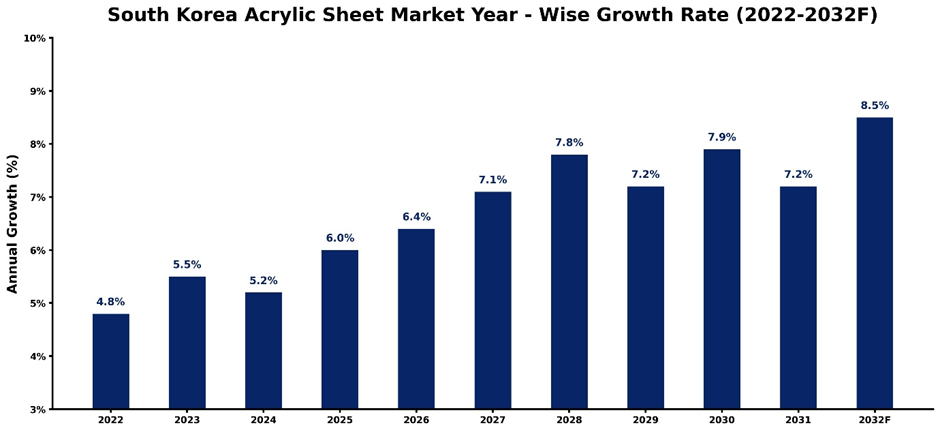
The following table presents the estimated annual growth rates of the market for each year, along with the key factors influencing market performance during the respective period. The values are intended to highlight year-wise drivers rather than provide a direct comparison between individual years.
| Year | Estimated Growth (%) | Market Rationale |
| 2022 | 4.8% | Increasing adoption of transparent panels in retail infrastructure supported market growth. |
| 2023 | 5.5% | Rising demand for lightweight structural materials in commercial spaces increased adoption. |
| 2024 | 5.2% | Growing integration in automotive displays and lighting systems supported expansion. |
| 2025 | 6% | Demand for customized interior solutions and modern aesthetics supported growth. |
| 2026 | 6.4% | Construction activities and urban architectural projects increased demand. |
| 2027 | 7.1% | Premium residential developments and furniture applications supported market expansion. |
| 2028 | 7.8% | Product innovation in scratch-resistant surfaces-maintained market growth. |
| 2029 | 7.2% | Commercial advertising boards and retail visual communications increased demand. |
| 2030 | 7.9% | Sustainable building initiatives and energy-efficient lighting applications supported growth. |
| 2031 | 7.2% | Healthcare facility upgrades and medical equipment applications supported steady expansion. |
| 2032 | 8.5% | Smart city infrastructure and advanced transportation networks supported long-term growth. |
Topics Covered in the South Korea Acrylic Sheet Market Report
The South Korea Acrylic Sheet Market Report provides a comprehensive analysis based on Technology and Application. It offers detailed insights into key industry trends, growth drivers, emerging opportunities, competitive developments, and high-growth segments. The report presents an objective assessment of current dynamics and future prospects, enabling stakeholders to make informed business decisions and develop effective strategies aligned with the evolving industry landscape.
South Korea Acrylic Sheet Market Highlights
| Report Name | South Korea Acrylic Sheet Market |
| Forecast period | 2026-2032 |
| CAGR | 7.33% |
| Growing Sector | Architecture & Construction |
South Korea Acrylic Sheet Market Synopsis
South Korea Acrylic Sheet Market is anticipated to record notable growth due to increasing urbanization, substantial investments in commercial real estate, and rapid expansion of the domestic automotive sector. Fundamentally, acrylic sheets are versatile, shatter-resistant thermoplastic polymers used extensively as lightweight alternatives to traditional glass in structural glazing, signage, and protective barriers. More than 60% of high-end fabrication processes make use of acrylic sheets as they offer better strength, optical clarity, and environmental benefits. The combination of the challenging goals of circular economy, electronics manufacturing, and innovations in products is likely to help maintain the competitive growth path of the market in the years to come.
Evaluation of Growth Drivers in the South Korea Acrylic Sheet Market (2026-2032)
Below mentioned are some prominent drivers and their influence on the market dynamics:
| Drivers | Primary Segments Affected | Why it Matters (Evidence) |
| Expansion of Commercial Infrastructure | Architecture & Construction | New retail malls and office spaces expand structural and decorative material usage. |
| Growth in Electric Vehicle Production | Automotive & Transportation | Automakers adopt lightweight materials for windows and digital display panels. |
| Rising Demand for Medical Barriers | Medical, Sanitary | Hospitals install transparent sanitary screens to enhance patient and staff safety. |
| Booming Retail Advertising Sector | Visual Comm. & Retail | Retailers utilize durable illuminated signages to improve brand visibility and customer attraction. |
| Advancements in Extrusion Manufacturing | Extruded, Continuous Cast | Improved production efficiencies lower raw material costs and expand high-volume applications. |
South Korea Acrylic Sheet Market Growth is expected to advance at a CAGR of 7.33% during the forecast period of 2026-2032. The market is primarily driven by the rapid expansion of the automotive and electronics industries, both of which increasingly rely on lightweight, high-performance materials. The annual growth rate of about 3.9% in vehicle production has increased the use of acrylic sheets in making lightweight vehicle parts, which is leading to reductions in the weight of vehicles and thereby increasing their fuel efficiency and battery efficiency in electric vehicles by almost 6% to 8%. At the same time, the electronics industry in the country is a global competitor and requires acrylic sheets for optical purposes for use in LED lights and other electronic products. Overall, general-purpose and cast acrylic products comprise almost 70% of the total consumption of material.
Evaluation of Restraints in the South Korea Acrylic Sheet Market
Below mentioned are some major restraints and their influence on the market dynamics:
| Restraints | Primary Segments Affected | What This Means (Evidence) |
| Volatile Petrochemical Prices | All Types, Extruded | Fluctuating raw material costs impact overall manufacturing budgets and final product pricing. |
| Stringent Environmental Regulations | Architecture & Construction | The regulatory regime demanding sustainable disposals raises operational costs for manufacturers. |
| Presence of Inexpensive Substitutes | Visual Communication & Retail | Substitutability of polycarbonate and ordinary glass materials lowers acceptance in cost-effective applications. |
| Challenging Recycling Procedures | All Categories, Sanitation | Regional inadequacies in recycling hinder circular economy efforts. |
| Dependence on Supply Chains | Automotive & Transportation | Dependence on imported specialty monomers hampers constant production capacity. |
South Korea Acrylic Sheet Market Challenges
Irrespective of massive development, the South Korea Acrylic Sheet Market Growth faces several challenges such as fluctuating crude oil pricing, stringent waste management mandates, and intense competition from alternative structural plastics. Inflation that has persisted at around 3.1% has increased the cost of producing acrylic sheet as a result of rising electricity, utility, and labor costs. In addition, political instability in Middle Eastern shipping lanes has led to an almost 6% rise in transport costs for imported monomers. Long delivery times and unreliable supply of raw materials have caused domestic inventory shortages and price instability.
South Korea Acrylic Sheet Market Trends
Key developments impacting the South Korea Acrylic Sheet Market are highlighted below:
- Intelligent Lighting Through Smart Panels: The use of edge-lit acrylic panels for intelligent building lighting is gaining popularity in order to increase efficiency in the use of energy in commercial buildings.
- Use of Hard Coatings: Different industries are now moving towards using hard coated acrylics in order to increase product life without compromising its optical clarity.
- Eco-Friendly Acrylic Sheets: With the increasing trend of sustainable production processes, the demand for eco-friendly acrylic sheets that can reduce carbon emissions is growing.
- Anti-Glare Screens for Automotive Industry: Increasing preference for matte sheet that provides anti-glare effect through light diffusion for automotive information systems.
Investment Opportunities in the South Korea Acrylic Sheet Market
Key investment prospects in the South Korea Acrylic Sheet Market are outlined below:
- Automotive Components Manufacturing: Setting up cutting-edge molding facilities that will manufacture light-weighted display screens for local electric car manufacturers.
- Green Production Line Development: Creating green manufacturing networks for recycled acrylics to enhance the sustainability ranking of the company.
- Medical Grade Manufacturing: Using special clean room manufacturing facilities to manufacture high-grade transparent screens for the health care sector.
- Smart City Signage Program: Getting contracts from government organizations for setting up weather-resistant illuminated information panels in new smart cities.
Top Players in the South Korea Acrylic Sheet Market
The following is a comprehensive list of key companies operating in the South Korea Acrylic Sheet Market:
1. LX Hausys
| Company Name | LX Hausys |
|---|---|
| Established Year | 2009 |
| Headquarters | Seoul, South Korea |
| Official Website | Click Here |
LX Hausys manufactures advanced building materials, engineered surfaces, and high-performance acrylic products, serving construction, interior design, automotive, and industrial markets across global regions.
2. LG Chem
| Company Name | LG Chem |
|---|---|
| Established Year | 1947 |
| Headquarters | Seoul, South Korea |
| Official Website | Click Here |
LG Chem produces specialty polymers, acrylic materials, and advanced chemical solutions, supplying high-performance products for automotive, electronics, construction, and industrial manufacturing applications.
3. Lotte Chemical
| Company Name | Lotte Chemical |
|---|---|
| Established Year | 1976 |
| Headquarters | Seoul, South Korea |
| Official Website | Click Here |
Lotte Chemical manufactures petrochemicals, acrylic materials, and high-value polymers, supporting automotive, packaging, construction, electronics, and industrial sectors with innovative chemical solutions.
4. Mitsubishi Chemical Corporation
| Company Name | Mitsubishi Chemical Corporation |
|---|---|
| Established Year | 1933 |
| Headquarters | Tokyo, Japan |
| Official Website | Click Here |
Mitsubishi Chemical Corporation develops advanced acrylic materials, specialty polymers, and performance chemicals, supplying innovative solutions for automotive, electronics, healthcare, and industrial applications worldwide.
5. Arkema
| Company Name | Arkema |
|---|---|
| Established Year | 2004 |
| Headquarters | Colombes, France |
| Official Website | Click Here |
Arkema, through its Altuglas brand, manufactures premium acrylic resins and PMMA materials, serving automotive, construction, electronics, signage, and industrial markets with high-performance solutions.
6. Evonik Industries
| Company Name | Evonik Industries |
|---|---|
| Established Year | 2007 |
| Headquarters | Essen, Germany |
| Official Website | Click Here |
Evonik Industries develops specialty chemicals, performance polymers, and advanced material solutions, supporting automotive, healthcare, construction, coatings, and industrial manufacturing industries globally.
Government Initiatives Being Implemented in the South Korea Acrylic Sheet Market
As per the data released by the South Korean government, the market is witnessing some major shifts owing to the environmental regulation and sustainability programs supported by the government. As a result of the implementation of the revised K-Circular Economy Transition Promotion Act in 2025, it is necessary that structural plastics contain 20% of chemically recycled feedstock. This will expedite the process of transition towards a circular economy among corporations. To make this transition possible, there have been notable investments made in advanced recycling facilities, such as pyrolysis plants capable of converting polymers back into usable materials. Such moves have resulted in notable efforts from many domestic petrochemical companies seeking Zero Waste to Landfill accreditation with recycling rates of about 98%.
Future Insights of the South Korea Acrylic Sheet Market
The South Korea acrylic sheet industry is poised for a transformative growth phase through 2032, supported by technological innovation, sustainability priorities, and expanding industrial applications. The market is forecasted to see a yearly growth rate of about 6.1% in terms of adoption of optical-grade acrylic sheets due to increased requirements for their use in OLED displays and semiconductors. Increasing incorporation of Polymethyl methacrylate (PMMA) within the electric vehicle value chain of the country is set to increase the consumption rates of the material up to 4.6%. High-end applications of the material within architectural glazing and decorative interiors are expected to increase manufacturing output.
Market Segmentation Analysis
This report presents a detailed analysis of the market segments along with their leading categories:
By Technology – Cell Cast Dominates the Market, Extruded Set for Rapid Expansion
According to Sumit Sagar, Senior Research Analyst, 6Wresearch, Cell Cast technology accounted for 54.20% of the South Korea Acrylic Sheet Market share in 2025 due to exceptional optical clarity, superior surface hardness, and widespread adoption in high-end architecture. Meanwhile, Extruded sheets will register a 6.54% CAGR (2026–2032), supported by cost-effective, high-volume retail display manufacturing.
By Application – Architecture & Construction Emerges as the Largest Segment, Automotive & Transportation Records the Fastest Growth
The Architecture & Construction segment accounted for the maximum market share of 38.60% in the year 2025. The factors driving this growth include the rising prevalence of modern structural glazing, interior design upgrades, and extensive usage of acoustic barriers in urban development. On the other hand, the Automotive & Transportation segment is projected to grow at the maximum CAGR of 7.15% during the forecast period.
Note: Market size estimations and growth projections presented in this report are based on 6Wresearch's proprietary forecasting methodology, utilizing the latest available industry data, government publications, and primary research inputs.
Key Attractiveness of the Report
- 10 Years of Market Numbers.
- Historical Data Starting from 2022 to 2025.
- Base Year: 2025.
- Forecast Data until 2032.
- Key Performance Indicators Impacting the Market.
- Major Upcoming Developments and Projects.
Key Highlights of the Report:
- South Korea Acrylic Sheet Market Outlook
- Market Size of South Korea Acrylic Sheet Market, 2025
- Forecast of South Korea Acrylic Sheet Market, 2032
- Historical Data and Forecast of South Korea Acrylic Sheet Revenues & Volume for the Period 2022-2032
- South Korea Acrylic Sheet Market Trend Evolution
- South Korea Acrylic Sheet Market Drivers and Challenges
- South Korea Acrylic Sheet Price Trends
- South Korea Acrylic Sheet Porter's Five Forces
- South Korea Acrylic Sheet Industry Life Cycle
- Historical Data and Forecast of South Korea Acrylic Sheet Market Revenues & Volume By Technology for the Period 2022-2032
- Historical Data and Forecast of South Korea Acrylic Sheet Market Revenues & Volume By Cell Cast for the Period 2022-2032
- Historical Data and Forecast of South Korea Acrylic Sheet Market Revenues & Volume By Extruded for the Period 2022-2032
- Historical Data and Forecast of South Korea Acrylic Sheet Market Revenues & Volume By Continuous Cast for the Period 2022-2032
- Historical Data and Forecast of South Korea Acrylic Sheet Market Revenues & Volume By Application for the Period 2022-2032
- Historical Data and Forecast of South Korea Acrylic Sheet Market Revenues & Volume By Architecture & Construction for the Period 2022-2032
- Historical Data and Forecast of South Korea Acrylic Sheet Market Revenues & Volume By Furniture & Design for the Period 2022-2032
- Historical Data and Forecast of South Korea Acrylic Sheet Market Revenues & Volume By Automotive & Transportation for the Period 2022-2032
- Historical Data and Forecast of South Korea Acrylic Sheet Market Revenues & Volume By Visual Comm. & Retail for the Period 2022-2032
- Historical Data and Forecast of South Korea Acrylic Sheet Market Revenues & Volume By Electronics & Energy for the Period 2022-2032
- Historical Data and Forecast of South Korea Acrylic Sheet Market Revenues & Volume By Medical for the Period 2022-2032
- Historical Data and Forecast of South Korea Acrylic Sheet Market Revenues & Volume By Sanitary for the Period 2022-2032
- South Korea Acrylic Sheet Import Export Trade Statistics
- Market Opportunity Assessment By Technology
- Market Opportunity Assessment By Application
- South Korea Acrylic Sheet Top Companies Market Share
- South Korea Acrylic Sheet Competitive Benchmarking By Technical and Operational Parameters
- South Korea Acrylic Sheet Company Profiles
- South Korea Acrylic Sheet Key Strategic Recommendations
Market Covered
The report offers a comprehensive study of the subsequent market segments:
By Technology
- Cell Cast
- Extruded
- Continuous Cast
By Application
- Architecture & Construction
- Furniture & Design
- Automotive & Transportation
- Visual Comm. & Retail
- Electronics & Energy
- Medical
- Sanitary






































