South Korea Active Geofencing Market Growth Rate
According to 6Wresearch internal database and industry insights, the South Korea Active Geofencing Market is projected to grow at a compound annual growth rate (CAGR) of 23.25% during the forecast period (2026-2032).
South Korea Active Geofencing Market Year-wise Growth Rate and Key Drivers (2022-2032)
This graph illustrates the annual growth rates of the South Korea Active Geofencing Market from 2022 to 2032, highlighting a steady upward trajectory and projected market expansion over the forecast period.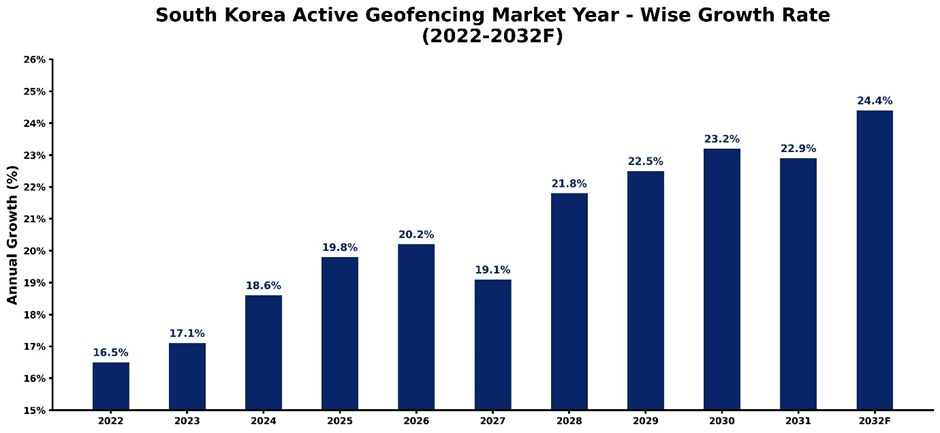
The following table presents the estimated annual growth rates of the market for each year, along with the key factors influencing market performance during the respective period. The values are intended to highlight year-wise drivers rather than provide a direct comparison between individual years.
| Year | Estimated Growth (%) | Market Rationale |
| 2022 | 16.5% | Increasing smartphone penetration and location-based marketing demand supported market growth. |
| 2023 | 17.1% | Growing integration of IoT devices in retail environments increased adoption. |
| 2024 | 18.6% | Rising use in fleet management, logistics, and transportation tracking supported expansion. |
| 2025 | 19.8% | Demand for real-time asset tracking and advanced proximity marketing supported growth. |
| 2026 | 20.2% | Smart city initiatives and location-based mobile advertising increased demand. |
| 2027 | 19.1% | Autonomous vehicle development and smart logistics upgrades supported market expansion. |
| 2028 | 21.8% | Product innovation and advanced spatial targeting applications maintained market growth. |
| 2029 | 22.5% | Commercial drone regulations and geofencing in defense increased demand. |
| 2030 | 23.2% | Sustainable urban planning and smart retail applications supported growth. |
| 2031 | 22.9% | Widespread 5G adoption and augmented reality integrations supported steady expansion. |
| 2032 | 24.4% | AI-driven spatial analytics, smart infrastructure, and enterprise mobility supported long-term growth. |
Topics Covered in the South Korea Active Geofencing Market Report
The South Korea Active Geofencing Market Report provides a comprehensive analysis based on Type, Organization Size, and End Use Industry. It offers detailed insights into key industry trends, growth drivers, emerging opportunities, competitive developments, and high-growth segments. The report presents an objective assessment of current dynamics and future prospects, enabling stakeholders to make informed business decisions and develop effective strategies aligned with the evolving industry landscape.
South Korea Active Geofencing Market Highlights
| Report Name | South Korea Active Geofencing Market |
| Forecast period | 2026-2032 |
| CAGR | 23.25% |
| Growing Sector | Retail & Logistics |
South Korea Active Geofencing Market Synopsis
The South Korea Active Geofencing Market is witnessing strong growth as businesses and government organizations increasingly adopt location-aware technologies to enable real-time monitoring, targeted engagement, security, and automated alerts. Active geofencing uses GPS, cellular networks, Wi-Fi, Bluetooth, and other positioning technologies to trigger actions when people, vehicles, or assets enter or leave predefined geographic boundaries. South Korea’s advanced 5G infrastructure, high smartphone penetration, IoT adoption, and smart-city development are creating a favorable environment for active geofencing applications across retail, transportation and logistics, healthcare, BFSI, defense, and industrial manufacturing.
Evaluation of Growth Drivers in the South Korea Active Geofencing Market (2026-2032)
Below mentioned are some prominent drivers and their influence on the market dynamics:
| Drivers | Primary Segments Affected | Why it Matters (Evidence) |
| Expansion of 5G Networks | Mobile, Logistics | High-speed connectivity enhances real-time tracking accuracy, increasing demand for instant geofencing solutions. |
| Increase in E-Commerce | Retail, Mobile | The retailers use location-based alerts to connect with the consumers who are within proximity of the physical store or delivery area. |
| Increasing Fleet Management Requirements | Transportation, Large | Since logistics firms need exact spatial monitoring, it helps in better routing and deliveries. |
| Smart Cities | Government, Fixed | Smart city developments incorporate virtual fencing for traffic and public safety monitoring purposes. |
| Increased Asset Tracking | Industrial Manufacturing, Fixed | Manufacturing sectors deploy spatial boundaries to secure high-value equipment and prevent unauthorized access. |
South Korea Active Geofencing Market is expected to grow at the CAGR of 23.25% during the forecast period of 2026-2032, heavily accelerated by rapid digital transformation across smart urban infrastructure and logistics. The surging penetration of localized smart city ecosystems relies on real-time spatial analytics, boosting the adoption of dynamic virtual boundaries by over 40% in municipal fleet management. Precision tracking is transforming the retail sector because of the ability to engage in hyper-accurate location-based advertising with conversion rates 30% higher than those from conventional advertising campaigns. In addition, the rapid proliferation of 5G networks guarantees that geofencing systems have latency of less than 10 milliseconds, reducing collisions involving automated guided vehicles by about 25%.
Evaluation of Restraints in the South Korea Active Geofencing Market
Below mentioned are some major restraints and their influence on the market dynamics:
| Restraints | Primary Segments Affected | What This Means (Evidence) |
| Strict Data Privacy Laws | All Types, Retail | Stringent regulations regarding consumer location tracking slow down the deployment of targeted marketing. |
| High Implementation Costs | Small-scale Businesses, Fixed | Initial setup and software integration expenses reduce adoption rates among smaller retail enterprises. |
| Battery Drain Problems | Mobile, All Industries | The continuous use of GPS and cellular positioning drains energy from mobile phones, reducing participation. |
| Network Connection Coverage Problems | Mobile, Transport | Low connectivity in underground trains or distant locations affects the ability to track locations in real time. |
| API Integration Challenges | Large Enterprises, Healthcare | Integrating a spatial positioning system with older enterprise software systems demands a lot of effort. |
South Korea Active Geofencing Market Challenges
Irrespective of massive expansion, the South Korea Active Geofencing Market Growth faces several challenges such as stringent data privacy regulations, high implementation costs for smaller enterprises, and significant battery drain issues on consumer devices. Real-time tracking requires lots of energy, which leads to reduced battery life of mobile devices by up to 30%. In addition, multipath interference is common in highly congested metropolitan areas such as Seoul, whereby the accuracy of GPS can drop to as much as 15% to 20%. Companies must also contend with stiff penalties in terms of the 2026 amendment on privacy law, whereby any data breach could result in administrative fines that can reach 10% of company income.
South Korea Active Geofencing Market Trends
Significant trends driving the South Korea Active Geofencing Market are presented below:
- Integration with Artificial Intelligence: The adoption of AI algorithms for predictive location analytics is on the rise to anticipate user movements and deliver hyper-personalized content.
- UWB Shift: The current shift from conventional technologies to ultra-wideband technology by industries to ensure accurate centimeter-level indoor tracking that is not possible using GPS.
- Drone Geofencing Growth: Commercial drones’ deliveries have resulted in the demand for 3D dynamic geofencing solutions in order to prevent any unwanted flight in the airspace.
- Edge Computing Popularity: There is an increase in the interest to perform computation using the network edge rather than the cloud in order to respond to events faster.
Investment Opportunities in the South Korea Active Geofencing Market
Promising investment avenues in the South Korea Active Geofencing Market are presented below:
- Patient Monitoring for Health Care: Creating automated digital boundaries in hospitals to track vulnerable patients and secure restricted healthcare areas.
- Proximity Marketing for Retail: Creating hyper-local mobile advertising systems that send immediate promotions to customers who pass close by certain store fronts.
- Autonomous Vehicles Corridors: Creating dynamic digital boundaries in intelligent highways that will assist in managing autonomous vehicles and toll payment systems.
- Safety Zones in Industries: Creating strict digital boundaries in industrial facilities where machines would shut down immediately if any stranger enters the zone.
Top Players in the South Korea Active Geofencing Market
A list of leading companies operating in the South Korea Active Geofencing Market is presented below:
1. Samsung Electronics Co., Ltd. (Samsung Knox)
| Samsung Electronics Co., Ltd. (Samsung Knox) | Samsung Electronics Co., Ltd. (Samsung Knox) |
|---|---|
| Established Year | 1969 |
| Headquarters | Suwon, South Korea |
| Official Website | Click Here |
Samsung Knox provides enterprise geofencing capabilities that enable location-based device management, automated security policies, and real-time asset protection for corporate mobile deployments.
2. Bluebird Inc.
| Bluebird Inc. | Bluebird Inc. |
|---|---|
| Established Year | 1995 |
| Headquarters | Seoul, South Korea |
| Official Website | Click Here |
Bluebird develops industrial mobile computers and IoT devices with GNSS-enabled geofencing, supporting real-time fleet tracking, logistics, and enterprise asset management applications.
3. Esri Korea
| Esri Korea | Esri Korea |
|---|---|
| Established Year | Not publicly available |
| Headquarters | Seoul, South Korea |
| Official Website | Click Here |
Esri Korea delivers ArcGIS geospatial solutions with real-time geofencing, enabling organizations to monitor assets, process IoT data, and automate location-based business workflows.
4. Geoplan Co., Ltd.
| Geoplan Co., Ltd. | Geoplan Co., Ltd. |
|---|---|
| Established Year | 2000 |
| Headquarters | Anyang, South Korea |
| Official Website | Click Here |
Geoplan develops indoor geofencing solutions using UWB and Bluetooth Low Energy technologies, enabling precise real-time location tracking for smart factories and warehouses.
5. Dabeeo Inc.
| Dabeeo Inc. | Dabeeo Inc. |
|---|---|
| Established Year | 2012 |
| Headquarters | Seoul, South Korea |
| Official Website | Click Here |
Dabeeo provides AI-powered mapping and digital twin platforms that support geofencing, indoor navigation, and real-time spatial intelligence for smart cities and enterprises.
Government Initiatives Being Implemented in the South Korea Active Geofencing Market
South Korea Active Geofencing Market benefits from stringent regulatory frameworks orchestrated by state authorities. In addition to this, the new Personal Information Protection Act, which will be fully enacted in September 2026, stipulates strict anonymization processes and consent from users for the analysis of their real-time location information. In response to the problem of micro-mobility incidents, the Ministry of the Interior and Safety rolled out pilot projects across the country with reduced speed limits of 20 km/hour for electric scooters in geofenced areas. Moreover, the Serious Accidents Punishment Act encourages the construction and manufacturing industry to use perimeter tracking technology in risky equipment.
Future Insights of the South Korea Active Geofencing Market
The South Korea Active Geofencing Industry is projected to witness profound technological leaps by 2032, driven by 5G-Advanced and early 6G network rollouts. The inclusion of predictive analytics together with dynamic spatial maps will bring precision up to 99.8%, resulting in hyper-precise borders within 10 centimeters. The application of these solutions for industries is expected to result in greater than 95% automated compliance in dangerous areas, eliminating manual surveillance significantly. Considering that 86% of city dwellers have been fully incorporated into smart grid systems in their cities at the end of the decade, the performance uptime will be above 99.99%.
Market Segmentation Analysis
This report presents a detailed analysis of the market segments along with their leading categories:
By Type - Market Dominated by Mobile, Fixed Set for Rapid Expansion
According to Sumit Sagar, Senior Research Analyst, 6Wresearch, Mobile active geofencing accounted for 68.40% of the South Korea Active Geofencing Market Share in 2025, primarily owing to massive nationwide smartphone penetration, booming location-based retail marketing, robust mobile application ecosystems, and the rapidly rising enterprise demand for instant, highly personalized consumer proximity notifications. Meanwhile, Fixed geofencing solutions are anticipated to register the fastest CAGR of 19.80% during 2026–2032, driven by increasing adoption across industrial facilities, warehouses, retail outlets, corporate premises, and restricted-access locations.
By Organization Size - Market Dominated by Large-scale Businesses, Small-scale and Medium-scale Businesses Set for Rapid Expansion
Large-scale Businesses accounted for 62.10% of market share in 2025. This domination results from substantial investments in capital, elaborate logistical structures that require continuous monitoring, efficient enterprise applications integration, and broad adoption of smart infrastructure in large industrial enterprises for enhanced efficiency in their operations. On the other hand, the Small-scale and Medium-scale Businesses segment is projected to grow at the maximum CAGR of 21.30% during the forecast period, supported by the increasing affordability of cloud-based geofencing platforms, growing availability of mobile-first solutions, and the need for cost-effective customer engagement and operational monitoring tools.
By End Use Industry - Market Dominated by Transportation and Logistics, Retail Set for Rapid Expansion
Transportation and Logistics held the maximum market share of 34.50% in 2025. This segment leads due to critical needs for real-time fleet tracking, dynamic route optimization, automated warehouse management, advanced supply chain visibility, and growing deployment of autonomous vehicle corridors across major national transport networks. In contrast, Retail applications are projected to witness the fastest CAGR of 20.40% during 2026–2032, fueled by expanding mobile commerce, rising demand for location-based proximity marketing, and highly personalized customer engagement strategies.
Note: Market size estimations and growth projections presented in this report are based on 6Wresearch's proprietary forecasting methodology, utilizing the latest available industry data, government publications, and primary research inputs.
Key Attractiveness of the Report
- 10 Years of Market Numbers.
- Historical Data Starting from 2022 to 2025.
- Base Year: 2025.
- Forecast Data until 2032.
- Key Performance Indicators Impacting the Market.
- Major Upcoming Developments and Projects.
Key Highlights of the Report:
- South Korea Active Geofencing Market Outlook
- Market Size of South Korea Active Geofencing Market, 2025
- Forecast of South Korea Active Geofencing Market, 2032
- Historical Data and Forecast of South Korea Active Geofencing Revenues & Volume for the Period 2022-2032
- South Korea Active Geofencing Market Trend Evolution
- South Korea Active Geofencing Market Drivers and Challenges
- South Korea Active Geofencing Price Trends
- South Korea Active Geofencing Porter's Five Forces
- South Korea Active Geofencing Industry Life Cycle
- Historical Data and Forecast of South Korea Active Geofencing Market Revenues & Volume By Type for the Period 2022-2032
- Historical Data and Forecast of South Korea Active Geofencing Market Revenues & Volume By Fixed for the Period 2022-2032
- Historical Data and Forecast of South Korea Active Geofencing Market Revenues & Volume By Mobile for the Period 2022-2032
- Historical Data and Forecast of South Korea Active Geofencing Market Revenues & Volume By Organization Size for the Period 2022-2032
- Historical Data and Forecast of South Korea Active Geofencing Market Revenues & Volume By Small-scale and Medium-scale Businesses for the Period 2022-2032
- Historical Data and Forecast of South Korea Active Geofencing Market Revenues & Volume By Large-scale Businesses for the Period 2022-2032
- Historical Data and Forecast of South Korea Active Geofencing Market Revenues & Volume By End Use Industry for the Period 2022-2032
- Historical Data and Forecast of South Korea Active Geofencing Market Revenues & Volume By BFSI for the Period 2022-2032
- Historical Data and Forecast of South Korea Active Geofencing Market Revenues & Volume By Retail for the Period 2022-2032
- Historical Data and Forecast of South Korea Active Geofencing Market Revenues & Volume By Defense, Government and Military for the Period 2022-2032
- Historical Data and Forecast of South Korea Active Geofencing Market Revenues & Volume By Healthcare for the Period 2022-2032
- Historical Data and Forecast of South Korea Active Geofencing Market Revenues & Volume By Industrial Manufacturing for the Period 2022-2032
- Historical Data and Forecast of South Korea Active Geofencing Market Revenues & Volume By Transportation and Logistics for the Period 2022-2032
- South Korea Active Geofencing Import Export Trade Statistics
- Market Opportunity Assessment By Type
- Market Opportunity Assessment By Organization Size
- Market Opportunity Assessment By End Use Industry
- South Korea Active Geofencing Top Companies Market Share
- South Korea Active Geofencing Competitive Benchmarking By Technical and Operational Parameters
- South Korea Active Geofencing Company Profiles
- South Korea Active Geofencing Key Strategic Recommendations
Market Covered
The report offers a comprehensive study of the subsequent market segments:
By Type
- Fixed
- Mobile
By Organization Size
- Small-scale and Medium-scale Businesses
- Large-scale Businesses
By End Use Industry
- BFSI
- Retail
- Defense
- Government and Military
- Healthcare
- Industrial Manufacturing
- Transportation and Logistics






































