South Korea Adjuvants Market Growth Rate
According to 6Wresearch internal database and industry insights, the South Korea Adjuvants Market is projected to grow at a compound annual growth rate (CAGR) of 6.28% during the forecast period (2026-2032).
South Korea Adjuvants Market Year-wise Growth Rate and Key Drivers (2022-2032)
This graph illustrates the annual growth rates of the South Korea Adjuvants Market from 2022 to 2032, highlighting a steady upward trajectory and projected market expansion over the forecast period.
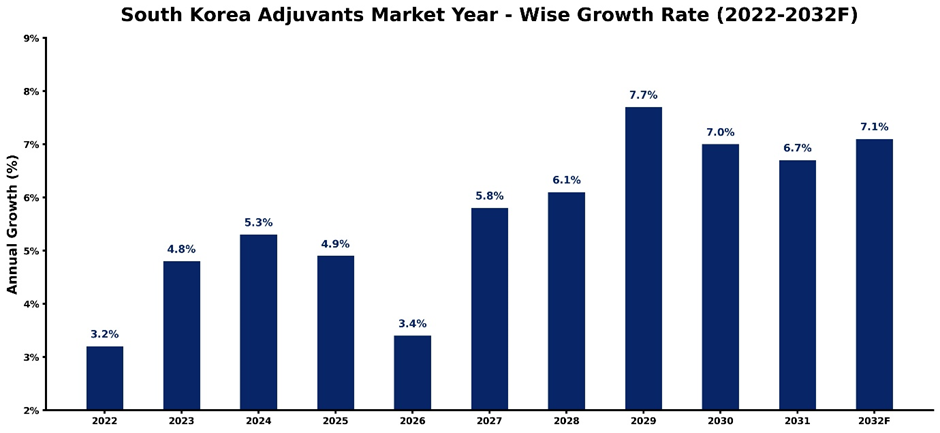
The following table presents the estimated annual growth rates of the market for each year, along with the key factors influencing market performance during the respective period. The values are intended to highlight year-wise drivers rather than provide a direct comparison between individual years.
| Year | Estimated Growth (%) | Market Rationale |
| 2022 | 3.2% | Increasing demand for advanced agrochemicals supported market growth. |
| 2023 | 4.8% | Rising investments in human vaccine development increased adoption. |
| 2024 | 5.3% | Growing need for high-yield agricultural practices supported expansion. |
| 2025 | 4.9% | Demand for specialized pharmaceutical formulations supported growth. |
| 2026 | 3.4% | Precision farming initiatives and biopesticide usage increased demand. |
| 2027 | 5.8% | Veterinary healthcare infrastructure upgrades supported market expansion. |
| 2028 | 6.1% | Product innovation in eco-friendly chemical applications-maintained market growth. |
| 2029 | 7.7% | Commercial agriculture and high-performance herbicides increased demand. |
| 2030 | 7% | Sustainable farming methods and modern biotechnology applications supported growth. |
| 2031 | 6.7% | Replacement demand for synthetic chemicals supported steady expansion. |
| 2032 | 7.1 | Smart agricultural practices, premium materials, and vaccine demand supported long-term growth. |
Topics Covered in the South Korea Adjuvants Market Report
The South Korea Adjuvants Market Report provides a comprehensive analysis based on Type and Application. It offers detailed insights into key industry trends, growth drivers, emerging opportunities, competitive developments, and high-growth segments. The report presents an objective assessment of current dynamics and future prospects, enabling stakeholders to make informed business decisions and develop effective strategies aligned with the evolving industry landscape.
South Korea Adjuvants Market Highlights
| Report Name | South Korea Adjuvants Market |
| Forecast period | 2026-2032 |
| CAGR | 6.28% |
| Growing Sector | Herbicides & Human Vaccines |
South Korea Adjuvants Market Synopsis
South Korea Adjuvants Market is anticipated to record notable growth due to escalating requirements for enhanced agricultural productivity and rapidly expanding local biopharmaceutical manufacturing capabilities. Essentially, adjuvants are specialized pharmacological or agricultural additives designed to magnify the primary efficacy of vaccines or agrochemicals efficiently. Although inflation, regulatory complexity, and global supply vulnerabilities remain significant considerations, government incentives and regional manufacturing support are helping build domestic capacity. With more than 108 active development pipelines, the market is progressing toward a more diversified and locally integrated ecosystem with potential to strengthen South Korea’s position in preventive healthcare.
Evaluation of Growth Drivers in the South Korea Adjuvants Market (2026-2032)
Below mentioned are some prominent drivers and their influence on the market dynamics:
| Drivers | Primary Segments Affected | Why it Matters (Evidence) |
| Surging Biopharmaceutical R&D | Human Vaccines | Expanded clinical trials for endemic diseases require advanced immunological boosters. |
| Adoption of Precision Agriculture | Herbicides, Insecticides | Farmers utilize targeted spraying techniques that mandate highly efficient chemical enhancers. |
| Rising Livestock Health Standards | Veterinary Vaccines | Stricter meat export regulations compel rigorous immunization protocols for farm animals. |
| Development of Eco-friendly Formulations | Saponins, Microbial Products | Environmental safety guidelines push manufacturers to utilize biodegradable chemical additives. |
| Enhanced Crop Yield Requirements | Fungicides, Oil Emulsions | Shrinking arable land forces agricultural enterprises to maximize output through optimized spraying. |
South Korea Adjuvants Market is expected to grow at the CAGR of 6.28% during the forecast period of 2026-2032. The growth is being reinforced by expanding domestic pharmaceutical innovation and a broader clinical development pipeline. By late 2025, at least 36 Korean companies were managing more than 108 research pipelines, creating a wider foundation for specialized immunological technologies. Domestic production also recorded a 2.7% year over year increase, reflecting improving manufacturing activity. In addition, 23 locally produced formulations achieved World Health Organization prequalification, providing further evidence of advancing technical capabilities and supporting the broader commercialization of domestically developed immunization products.
Evaluation of Restraints in the South Korea Adjuvants Market
Below mentioned are some major restraints and their influence on the market dynamics:
| Restraints | Primary Segments Affected | What This Means (Evidence) |
| Stringent Chemical Regulations | Oil Emulsions, Herbicides | Lengthy approval processes for new active ingredients delay commercial product launches. |
| High Development Costs | Cytokins, Human Vaccines | Extensive clinical testing requirements increase the financial burden on pharmaceutical innovators. |
| Toxicity and Environmental Issues | Mineral Salts, Fungicides | Contamination concerns of the soil limit the use of inorganic compounds. |
| Unstable Prices in the Supply Chain | All Types | Raw materials cost fluctuations affect the profitability of local producers negatively. |
| Limited Knowledge of Small Farms | Insecticides, Others | Conventional farmers refrain from using expensive chemical solutions in agriculture. |
South Korea Adjuvants Market Challenges
Irrespective of massive growth and development, the South Korea Adjuvants Market Growth faces several challenges such as rigorous environmental compliance protocols, heavy reliance on imported raw materials, and intense pricing pressures from generic alternatives. Approximately 72.7% of crucial components required for immunizations come from external sources, thus showing the shortfall in domestic production. Additionally, regulations and complicated clinical development process might prolong commercialization periods for even more than 60%, especially for new formulations. Meanwhile, inflation of around 3.5% continues to increase manufacturing and operational expenses, creating additional pressure for emerging biopharmaceutical companies seeking to scale new adjuvant technologies.
South Korea Adjuvants Market Trends
Several key trends are shaping the South Korea Adjuvants Market which includes:
- Move toward Biosurfactants: The use of biological surfactants and other surface-active substances that have been derived biologically in the agricultural industry is becoming more common.
- Nanoparticle Delivery System: Continuous research at pharmaceutical companies to utilize nanotechnology-based delivery systems to enhance the targeted and efficient delivery of active compounds in next generation vaccines and other preventive medicines is another major trend.
- Drone Spraying: As drone spraying becomes more common in agriculture, there will be a need for specific formulation of adjuvants, which include components that reduce drift or improve deposition.
Investment Opportunities in the South Korea Adjuvants Market
Promising investment avenues in the South Korea Adjuvants Market are presented below:
- Adjuvants Research and Development Collaboration: Collaborating with biotechnology firms and other research centers in order to generate specialized adjuvants technologies in terms of vaccines and immunology would provide chances in the rapidly expanding biopharmaceutical market in South Korea.
- Automated Formulations Technologies: Utilizing advanced technology in order to enhance the process of mixing, blending, and synthesis in the case of high-end special chemical formulas and emulsions would be beneficial.
- Export-Based Manufacturing: Formulation of customized adjuvants and animal products that would meet the requirements of regulatory approval from neighboring Asian countries could facilitate expansion into the region and consolidate South Korea’s position as an export-based manufacturing facility.
Top Players in the South Korea Adjuvants Market
A list of leading companies operating in the South Korea Adjuvants Market is presented below:
1. BASF SE
| Company Name | BASF SE |
|---|---|
| Established Year | 1865 |
| Headquarters | Ludwigshafen, Germany |
| Official Website | Click Here |
BASF develops high-performance surfactants and organosilicone-based agricultural adjuvants, supporting crop protection applications and agricultural productivity across South Korea and regional markets.
2. Bayer CropScience
| Company Name | Bayer CropScience |
|---|---|
| Established Year | 1863 |
| Headquarters | Monheim am Rhein, Germany |
| Official Website | Click Here |
Bayer CropScience provides integrated crop solutions and precision agriculture technologies, supporting effective crop protection and optimized agricultural chemical applications in South Korea.
3. Syngenta
| Company Name | Syngenta |
|---|---|
| Established Year | 2000 |
| Headquarters | Basel, Switzerland |
| Official Website | Click Here |
Syngenta offers crop protection products and specialized adjuvants, combining agricultural chemical solutions with technologies designed to improve application performance and crop productivity.
4. FMC Corporation
| Company Name | FMC Corporation |
|---|---|
| Established Year | 1883 |
| Headquarters | Philadelphia, Pennsylvania, United States |
| Official Website | Click Here |
FMC develops agricultural solutions including crop protection products and targeted adjuvant technologies designed to support high-value fruit, vegetable, and specialty crop production.
5. Adama Agricultural Solutions
| Company Name | Adama Agricultural Solutions |
|---|---|
| Established Year | 1945 |
| Headquarters | Airport City, Israel |
| Official Website | Click Here |
Adama provides agricultural crop protection products and adjuvant solutions, emphasizing accessible and cost-effective technologies for farmers across South Korea and global markets.
6. Nufarm
| Company Name | Nufarm |
|---|---|
| Established Year | 1956 |
| Headquarters | Melbourne, Australia |
| Official Website | Click Here |
Nufarm supplies agricultural chemicals, spray adjuvants, and bio-performance solutions designed to improve application efficiency and enhance the effectiveness of crop protection products.
Government Initiatives Being Implemented in the South Korea Adjuvants Market
Based on South Korean Government Information, the market is receiving increasing government support as government officials focus on securing their health and more control over key supply chains. Amendments to the Special Taxation Restriction Act proposed for 2026 aim at ensuring that there are sufficient incentives for production of vital components for immunization inside the country. Tax advantages associated with local production can serve as a mechanism for mitigating risk from overseas supply chain disruptions. Regional multipliers of up to 1.5 have been assigned to messenger RNA platforms due to policy support, adding another motivation for geographic diversification of biopharmaceutical manufacturing capabilities.
Future Insights of the South Korea Adjuvants Market
The South Korea Adjuvants Industry is set for significant development as the country strengthens its biotechnology infrastructure through 2032. With an expected proportion of the older population to rise above 20%, there will be the need for effective immunization methods that will result in higher use of adjuvants. There are also plans for increased self-sufficiency of vaccines within the country from 27.3% to 80% above by 2032. It is also expected that there will be research spending and biohealth spending greater than 5% of GDP.
Market Segmentation Analysis
This report presents a detailed analysis of the market segments along with their leading categories:
By Type – Market Dominated by Oil Emulsions, Microbial Products Set for Rapid Expansion
According to Sumit Sagar, Senior Research Analyst, 6Wresearch, Oil Emulsions accounted for 42.15% of the South Korea Adjuvants Market Share in 2025, primarily owing to their exceptional spreading capabilities, cost-effectiveness, high compatibility with diverse active ingredients, and widespread adoption across large-scale commercial farming operations. In contrast, Microbial Products segment is forecasted to exhibit a remarkable CAGR of 8.24% through 2026-2032, underpinned by strict environmental norms, high demand for environmentally friendly products, better bio-formulation stability, and increasing adoption of green farming practices.
By Application – Herbicides Maintain Market Leadership, Human Vaccines Accelerates
Herbicides dominated the market with an estimated 39.45% share in 2025, supported by increasing agricultural labor shortages, aggressive weed resistance management strategies, rising biopesticide integrations, and the critical need for maximized crop yields across all major domestic provincial farming regions today. On the other hand, the Human Vaccines application is anticipated to experience the highest growth rate of 9.15% during 2026-2032 on account of growing domestic production of biopharmaceuticals, increasing investments from the government on preventive care and high demand for highly effective vaccines against novel infections.
Note: Market size estimations and growth projections presented in this report are based on 6Wresearch's proprietary forecasting methodology, utilizing the latest available industry data, government publications, and primary research inputs.
Key Attractiveness of the Report
- 10 Years of Market Numbers.
- Historical Data Starting from 2022 to 2025.
- Base Year: 2025.
- Forecast Data until 2032.
- Key Performance Indicators Impacting the Market.
- Major Upcoming Developments and Projects.
Key Highlights of the Report:
- South Korea Adjuvants Market Outlook
- Market Size of South Korea Adjuvants Market, 2025
- Forecast of South Korea Adjuvants Market, 2032
- Historical Data and Forecast of South Korea Adjuvants Revenues & Volume for the Period 2022-2032
- South Korea Adjuvants Market Trend Evolution
- South Korea Adjuvants Market Drivers and Challenges
- South Korea Adjuvants Price Trends
- South Korea Adjuvants Porter's Five Forces
- South Korea Adjuvants Industry Life Cycle
- Historical Data and Forecast of South Korea Adjuvants Market Revenues & Volume By Type for the Period 2022-2032
- Historical Data and Forecast of South Korea Adjuvants Market Revenues & Volume By Oil Emulsions for the Period 2022-2032
- Historical Data and Forecast of South Korea Adjuvants Market Revenues & Volume By Mineral Salts for the Period 2022-2032
- Historical Data and Forecast of South Korea Adjuvants Market Revenues & Volume By Microbial Products for the Period 2022-2032
- Historical Data and Forecast of South Korea Adjuvants Market Revenues & Volume By Cytokins for the Period 2022-2032
- Historical Data and Forecast of South Korea Adjuvants Market Revenues & Volume By Saponins for the Period 2022-2032
- Historical Data and Forecast of South Korea Adjuvants Market Revenues & Volume By Others for the Period 2022-2032
- Historical Data and Forecast of South Korea Adjuvants Market Revenues & Volume By Application for the Period 2022-2032
- Historical Data and Forecast of South Korea Adjuvants Market Revenues & Volume By Herbicides for the Period 2022-2032
- Historical Data and Forecast of South Korea Adjuvants Market Revenues & Volume By Insecticides for the Period 2022-2032
- Historical Data and Forecast of South Korea Adjuvants Market Revenues & Volume By Fungicides for the Period 2022-2032
- Historical Data and Forecast of South Korea Adjuvants Market Revenues & Volume By Human Vaccines for the Period 2022-2032
- Historical Data and Forecast of South Korea Adjuvants Market Revenues & Volume By Veterinary Vaccines for the Period 2022-2032
- Historical Data and Forecast of South Korea Adjuvants Market Revenues & Volume By Others for the Period 2022-2032
- South Korea Adjuvants Import Export Trade Statistics
- Market Opportunity Assessment By Type
- Market Opportunity Assessment By Application
- South Korea Adjuvants Top Companies Market Share
- South Korea Adjuvants Competitive Benchmarking By Technical and Operational Parameters
- South Korea Adjuvants Company Profiles
- South Korea Adjuvants Key Strategic Recommendations
Market Covered
The report offers a comprehensive study of the subsequent market segments:
By Type
- Oil Emulsions
- Mineral Salts
- Microbial Products
- Cytokins
- Saponins
- Others
By Application
- Herbicides
- Insecticides
- Fungicides
- Human Vaccines
- Veterinary Vaccines
- Others






































