South Korea Apparel Accessories Market Size, Share & Growth Rate
The South Korea Apparel Accessories Market was estimated at USD 192 Million in 2025 and is projected to reach USD 260 Million by 2032, growing at a CAGR of 4.4% from 2026 to 2032. This growth trajectory is primarily fueled by the countrys vibrant fashion culture, increasing disposable income, and a shift towards sustainable and personalized accessory options. Consumers in South Korea are increasingly seeking high-quality and stylish products, further driving demand for a diverse range of accessories.
South Korea Apparel Accessories Market Year-wise Growth Rate and Key Drivers
This graph highlights how the South Korea Apparel Accessories Market has steadily grown over the years, supported by major growth factors.
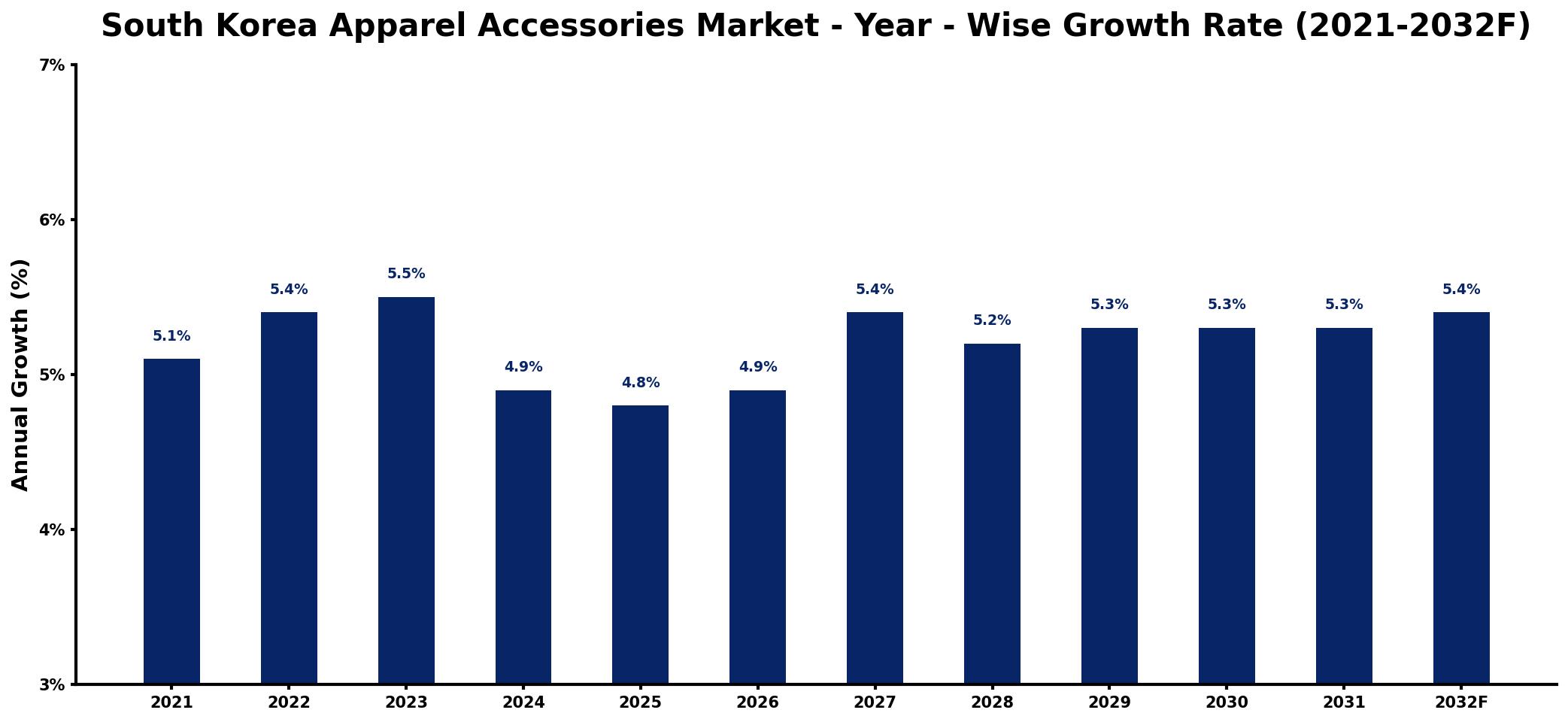
The table below presents the year‑wise growth rates along with the key drivers influencing the market
| Year | Growth Rate | Major Drivers |
| 2021 | 5.1% | Rising consumer spending on fashion |
| 2022 | 5.4% | Growth in e-commerce platforms |
| 2023 | 5.5% | Increased focus on sustainability |
| 2024 | 4.9% | Expansion of international brands |
| 2025 | 4.8% | Emergence of regional fashion trends |
| 2026 | 4.9% | Boost in social media influence |
| 2027 | 5.4% | Surge in online shopping convenience |
| 2028 | 5.2% | Rising demand for customization options |
| 2029 | 5.3% | rising export shipment volumes |
| 2030 | 5.3% | Increased investment in technology |
| 2031 | 5.3% | increased capital investment inflows |
| 2032 | 5.4% | Strengthened collaborations with designers |
Note: Market size estimations and growth projections presented in this report are based on 6Wresearch's proprietary forecasting methodology, utilizing the latest available industry data, government publications, and primary research inputs.
South Korea Apparel Accessories Market Synopsis
The South Korea Apparel Accessories Market is witnessing remarkable evolution, characterized by the fusion of traditional craftsmanship with contemporary styles. An informed consumer base seeks not only aesthetic appeal but also ethical production practices, leading to a growing demand for eco-friendly and sustainable accessories.
With the rise of e-commerce and social media, access to a vast array of products has transformed shopping habits, making online platforms a critical channel for sales. Brands, both local and international, are adapting swiftly to these shifts, exploring innovative marketing strategies to capture the attention of the fashion-savvy South Korean populace.
South Korea Apparel Accessories Market Key Takeaways
- The market is experiencing a notable shift towards sustainable and eco-friendly accessory options, driven by consumer awareness.
- Online shopping and social media are pivotal in influencing purchasing behavior and expanding market reach.
- Personalization trends are gaining traction, with consumers favoring unique accessories that reflect individual styles.
- The interplay of traditional and modern styles is shaping product offerings, catering to diverse consumer preferences.
- Investment opportunities exist in trendy accessories, especially those that leverage innovative designs and sustainable materials.
Evaluation of Restraints in South Korea Apparel Accessories Market
Despite its growth, the South Korea Apparel Accessories Market faces several restraints that could limit its potential. Intense competition from both domestic and international brands complicates market entry for new players, necessitating a robust understanding of consumer preferences and rapid adaptability to fashion trends. Additionally, the prominence of e-commerce poses a significant challenge for traditional retail outlets, prompting them to enhance their digital strategies. Moreover, economic fluctuations and shifts in consumer preferences can lead to unpredictable demand patterns, making it imperative for businesses to stay agile and responsive.
South Korea Apparel Accessories Market Trends
Current trends within the South Korea Apparel Accessories Market show a marked preference for sustainable practices, with products made from recycled and organic materials gaining popularity. The rise of multifunctional accessories that blend style with practicality is also notable, as consumers seek versatile options that complement their lifestyles. Furthermore, social media influencers are increasingly shaping consumer preferences, leading to the rapid growth of specific accessory trends and styles.
South Korea Apparel Accessories Market Opportunities
The market presents genuine growth opportunities for innovative brands that prioritize sustainable practices and cater to the fashion-forward sensibilities of consumers. Key areas ripe for investment include trendy handbags, jewelry, and eco-conscious accessories that resonate with the increasing demand for ethical fashion. The global popularity of Korean culture and fashion also opens avenues for local manufacturers to explore export opportunities, enhancing their market reach.
Government Initiatives in the South Korea Apparel Accessories Market
The South Korean government has enacted various policies to promote the apparel accessories market, focusing on product safety, quality standards, and fair competition. Initiatives supporting sustainability within the industry encourage manufacturers to adopt eco-friendly practices and materials. Furthermore, import and export regulations are established to manage the flow of apparel accessories, ensuring compliance with trade agreements while protecting the domestic market.
Future Insights of the South Korea Apparel Accessories Market
Looking ahead to 2026-2032, the South Korea Apparel Accessories Market is poised for robust growth fueled by ongoing consumer interest in trendy and sustainable products. The influence of K-Pop culture is expected to further invigorate the market, particularly among younger demographics. As brands continue to innovate and align their offerings with ethical practices, there will be significant opportunities for growth and differentiation in an increasingly competitive landscape.
South Korea Apparel Accessories Market Latest Developments (2025 - 2026)
Recent developments in the South Korea Apparel Accessories Market indicate a strong focus on digital transformation, with brands investing heavily in online platforms to enhance customer engagement and streamline shopping experiences. Collaborations with social media influencers are becoming more common as brands seek to tap into the insights and trends shaping consumer preferences. Moreover, sustainability initiatives continue to gain traction, with manufacturers innovating production processes to minimize environmental impact.
South Korea Apparel Accessories Market - Key Attractiveness of the Report
- 10 Years of Market Numbers
- Historical Data Starting from 2022 to 2025
- Base Year: 2025
- Forecast Data until 2032
- Key Performance Indicators Impacting the Market
- Major Upcoming Developments and Projects
Key Highlights of the Report:
- South Korea Apparel Accessories Market Outlook
- Market Size of South Korea Apparel Accessories Market, 2025
- Forecast of South Korea Apparel Accessories Market, 2032
- Historical Data and Forecast of South Korea Apparel Accessories Revenues & Volume for the Period 2022-2032F
- South Korea Apparel Accessories Market Trend Evolution
- South Korea Apparel Accessories Market Drivers and Challenges
- South Korea Apparel Accessories Price Trends
- South Korea Apparel Accessories Porter's Five Forces
- South Korea Apparel Accessories Industry Life Cycle
- Historical Data and Forecast of South Korea Apparel Accessories Market Revenues & Volume By Product for the Period 2022-2032F
- Historical Data and Forecast of South Korea Apparel Accessories Market Revenues & Volume By Belts for the Period 2022-2032F
- Historical Data and Forecast of South Korea Apparel Accessories Market Revenues & Volume By Handbags for the Period 2022-2032F
- Historical Data and Forecast of South Korea Apparel Accessories Market Revenues & Volume By Scarves for the Period 2022-2032F
- Historical Data and Forecast of South Korea Apparel Accessories Market Revenues & Volume By Eye wear for the Period 2022-2032F
- Historical Data and Forecast of South Korea Apparel Accessories Market Revenues & Volume By Jewelry for the Period 2022-2032F
- Historical Data and Forecast of South Korea Apparel Accessories Market Revenues & Volume By Neckties for the Period 2022-2032F
- Historical Data and Forecast of South Korea Apparel Accessories Market Revenues & Volume By Gloves for the Period 2022-2032F
- Historical Data and Forecast of South Korea Belts Apparel Accessories Market Revenues & Volume By Others for the Period 2022-2032F
- Historical Data and Forecast of South Korea Apparel Accessories Market Revenues & Volume By Demographic for the Period 2022-2032F
- Historical Data and Forecast of South Korea Apparel Accessories Market Revenues & Volume By Men for the Period 2022-2032F
- Historical Data and Forecast of South Korea Apparel Accessories Market Revenues & Volume By Women for the Period 2022-2032F
- Historical Data and Forecast of South Korea Apparel Accessories Market Revenues & Volume By Children for the Period 2022-2032F
- Historical Data and Forecast of South Korea Apparel Accessories Market Revenues & Volume By Price for the Period 2022-2032F
- Historical Data and Forecast of South Korea Apparel Accessories Market Revenues & Volume By Economical Apparel Accessories for the Period 2022-2032F
- Historical Data and Forecast of South Korea Apparel Accessories Market Revenues & Volume By Mid-range Apparel Accessories for the Period 2022-2032F
- Historical Data and Forecast of South Korea Apparel Accessories Market Revenues & Volume By Premium Apparel Accessories for the Period 2022-2032F
- Historical Data and Forecast of South Korea Apparel Accessories Market Revenues & Volume By Super-premium Apparel Accessories for the Period 2022-2032F
- Historical Data and Forecast of South Korea Apparel Accessories Market Revenues & Volume By Sales Channel for the Period 2022-2032F
- Historical Data and Forecast of South Korea Apparel Accessories Market Revenues & Volume By Apparel Accessories Sold through Modern Trade for the Period 2022-2032F
- Historical Data and Forecast of South Korea Apparel Accessories Market Revenues & Volume By Apparel Accessories Sold at Franchise Outlets for the Period 2022-2032F
- Historical Data and Forecast of South Korea Apparel Accessories Market Revenues & Volume By Apparel Accessories Sold at Specialty Stores for the Period 2022-2032F
- Historical Data and Forecast of South Korea Apparel Accessories Market Revenues & Volume By Others for the Period 2022-2032F
- South Korea Apparel Accessories Import Export Trade Statistics
- Market Opportunity Assessment By Product
- Market Opportunity Assessment By Demographic
- Market Opportunity Assessment By Price
- Market Opportunity Assessment By Sales Channel
- South Korea Apparel Accessories Top Companies Market Share
- South Korea Apparel Accessories Competitive Benchmarking By Technical and Operational Parameters
- South Korea Apparel Accessories Company Profiles
- South Korea Apparel Accessories Key Strategic Recommendations






































