South Korea Automotive Drive Shaft Market Size, Share & Growth Rate
The South Korea Automotive Drive Shaft Market was estimated at USD 346 Million in 2025 and is projected to reach USD 486 Million by 2032, growing at a CAGR of 5.0% from 2026 to 2032. This growth trajectory is significantly influenced by the rising demand for passenger vehicles and an accelerating shift towards electric and hybrid models. Furthermore, advancements in drive shaft technologies that prioritize lightweight materials and enhanced fuel efficiency are helping to catalyze this expansion.
South Korea Automotive Drive Shaft Market Year-wise Growth Rate and Key Drivers
This graph highlights how the South Korea Automotive Drive Shaft Market has steadily grown over the years, supported by major growth factors.
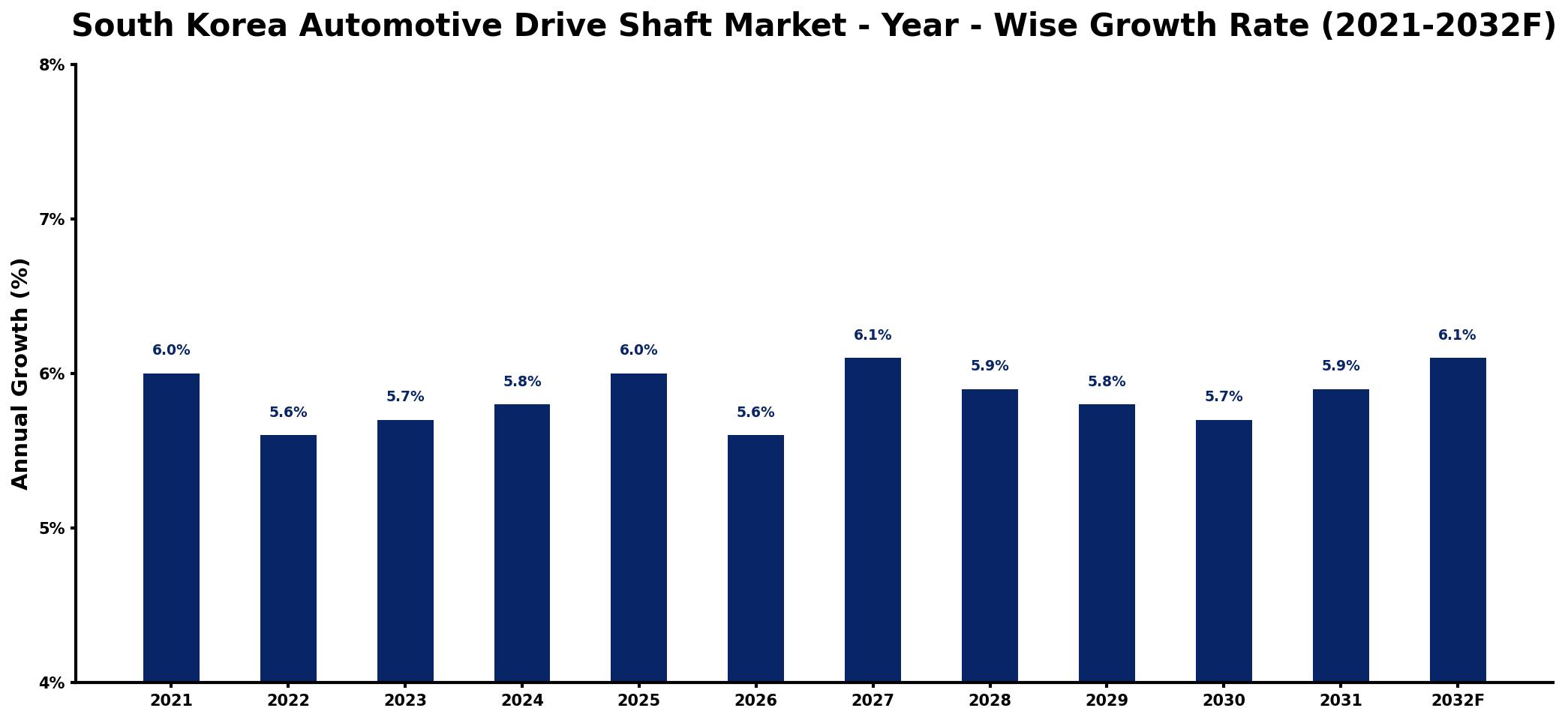
The table below presents the year‑wise growth rates along with the key drivers influencing the market
| Year | Growth Rate | Major Drivers |
| 2021 | 6.0% | Rising electric vehicle adoption |
| 2022 | 5.6% | Increased manufacturing capacity investments |
| 2023 | 5.7% | Growing demand for lightweight materials |
| 2024 | 5.8% | Expansion of renewable energy initiatives |
| 2025 | 6.0% | Technological advancements in production |
| 2026 | 5.6% | growing emerging market penetration |
| 2027 | 6.1% | Enhanced focus on sustainability practices |
| 2028 | 5.9% | Growth in shared mobility services |
| 2029 | 5.8% | Investment in smart transportation systems |
| 2030 | 5.7% | Demand for high-performance components |
| 2031 | 5.9% | Increase in regional trade agreements |
| 2032 | 6.1% | Development of autonomous vehicle technologies |
Note: Market size estimations and growth projections presented in this report are based on 6Wresearch's proprietary forecasting methodology, utilizing the latest available industry data, government publications, and primary research inputs.
South Korea Automotive Drive Shaft Market Synopsis
A notable force shaping the South Korea Automotive Drive Shaft Market is the increasing integration of innovative materials such as carbon fiber and aluminum. These materials not only enhance performance but also address the growing concerns regarding vehicle emissions and fuel consumption.
Moreover, government initiatives aimed at promoting electric vehicles play a crucial role in redefining market dynamics. As domestic manufacturers adjust their strategies to accommodate evolving consumer preferences, the demand for high-quality, technologically advanced drive shafts is surging.
South Korea Automotive Drive Shaft Market Key Takeaways
- The market is projected to grow at a CAGR of 5.0%, highlighting robust demand.
- Key drivers include a surge in passenger vehicle production and advancements in lightweight materials.
- Electric and hybrid vehicle adoption is shaping the future of drive shaft technologies.
- Government policies are fostering innovation and sustainability in the automotive sector.
- Investments in advanced drive shaft technologies present significant growth opportunities.
Evaluation of Restraints in South Korea Automotive Drive Shaft Market
Despite the promising outlook, several restraints challenge the South Korea Automotive Drive Shaft Market. Intense competition among local and international players necessitates constant innovation, placing pressure on profit margins. Additionally, fluctuations in raw material prices can disrupt supply chains and impact production costs. Manufacturers are compelled to navigate these hurdles while adhering to stringent regulatory requirements that govern vehicle emissions and safety, which can inhibit operational flexibility.
South Korea Automotive Drive Shaft Market Trends
The market is currently seeing a pronounced trend towards lightweight drive shafts aimed at maximizing fuel efficiency and minimizing carbon footprints. Manufacturers are increasingly adopting advanced materials to create more durable and efficient components. Additionally, the shift towards electric and hybrid vehicles is generating demand for specialized drive shaft solutions that cater to the unique needs of these powertrains, resulting in a transformative impact on product development.
South Korea Automotive Drive Shaft Market Opportunities
As the South Korean automotive landscape evolves, significant investment opportunities are emerging. Companies focusing on the development of innovative drive shaft technologies utilizing lightweight and high-performance materials stand to gain a competitive edge. Moreover, collaboration with local automotive manufacturers can facilitate market entry and expansion. The government's commitment to promoting sustainable and eco-friendly vehicles further amplifies demand for advanced drive shaft solutions.
Government Initiatives in the South Korea Automotive Drive Shaft Market
South Korea's government is actively engaged in shaping the automotive drive shaft market through various policies aimed at technological advancement and sustainability. These include regulations that ensure compliance with high-quality performance and safety standards for drive shafts. Additionally, the government provides incentives for research and development projects focused on eco-friendly manufacturing processes, reinforcing its commitment to sustainability and competitive positioning in the global market.
Future Insights of the South Korea Automotive Drive Shaft Market
Looking ahead to 2026-2032, the South Korea Automotive Drive Shaft Market is expected to flourish, driven by continuous growth in vehicle production and a heightened focus on fuel-efficient solutions. Innovations in materials and designs are anticipated to gain momentum, particularly in response to the rising popularity of electric and hybrid vehicles. While challenges such as raw material price volatility remain, the overarching trend towards sustainable automotive solutions will pave the way for substantial growth opportunities.
South Korea Automotive Drive Shaft Market Latest Developments (2025 - 2026)
In recent months, the South Korea Automotive Drive Shaft Market has witnessed a notable increase in investment aimed at technological advancements in drive shaft design. There has been a growing focus on partnerships between manufacturers and automotive companies to enhance product offerings. Additionally, ongoing discussions about regulatory measures reflect an industry-wide commitment to sustainability and performance improvements, indicating a forward-thinking approach among market participants.
South Korea Automotive Drive Shaft Market - Key Attractiveness of the Report
- 10 Years of Market Numbers
- Historical Data Starting from 2022 to 2025
- Base Year: 2025
- Forecast Data until 2032
- Key Performance Indicators Impacting the Market
- Major Upcoming Developments and Projects
Key Highlights of the Report:
- South Korea Automotive Drive Shaft Market Outlook
- Market Size of South Korea Automotive Drive Shaft Market, 2025
- Forecast of South Korea Automotive Drive Shaft Market, 2032
- Historical Data and Forecast of South Korea Automotive Drive Shaft Revenues & Volume for the Period 2022-2032F
- South Korea Automotive Drive Shaft Market Trend Evolution
- South Korea Automotive Drive Shaft Market Drivers and Challenges
- South Korea Automotive Drive Shaft Price Trends
- South Korea Automotive Drive Shaft Porter's Five Forces
- South Korea Automotive Drive Shaft Industry Life Cycle
- Historical Data and Forecast of South Korea Automotive Drive Shaft Market Revenues & Volume By Design Type for the Period 2022-2032F
- Historical Data and Forecast of South Korea Automotive Drive Shaft Market Revenues & Volume By Hollow Shaft for the Period 2022-2032F
- Historical Data and Forecast of South Korea Automotive Drive Shaft Market Revenues & Volume By Solid Shaft for the Period 2022-2032F
- Historical Data and Forecast of South Korea Automotive Drive Shaft Market Revenues & Volume By Position Type for the Period 2022-2032F
- Historical Data and Forecast of South Korea Automotive Drive Shaft Market Revenues & Volume By Rear Axle for the Period 2022-2032F
- Historical Data and Forecast of South Korea Automotive Drive Shaft Market Revenues & Volume By Front Axle for the Period 2022-2032F
- Historical Data and Forecast of South Korea Automotive Drive Shaft Market Revenues & Volume By Vehicle Type for the Period 2022-2032F
- Historical Data and Forecast of South Korea Automotive Drive Shaft Market Revenues & Volume By Passenger Cars for the Period 2022-2032F
- Historical Data and Forecast of South Korea Automotive Drive Shaft Market Revenues & Volume By Commercial Vehicles for the Period 2022-2032F
- South Korea Automotive Drive Shaft Import Export Trade Statistics
- Market Opportunity Assessment By Design Type
- Market Opportunity Assessment By Position Type
- Market Opportunity Assessment By Vehicle Type
- South Korea Automotive Drive Shaft Top Companies Market Share
- South Korea Automotive Drive Shaft Competitive Benchmarking By Technical and Operational Parameters
- South Korea Automotive Drive Shaft Company Profiles
- South Korea Automotive Drive Shaft Key Strategic Recommendations






































