South Korea Automotive Engine Market Size, Share & Growth Rate
The South Korea Automotive Engine Market was estimated at USD 1403 Million in 2025 and is projected to reach USD 2058 Million by 2032, growing at a CAGR of 5.6% from 2026 to 2032. This upward trajectory is primarily driven by the escalating demand for fuel-efficient and eco-friendly engines, as consumers and regulatory bodies increasingly prioritize sustainability. Additionally, the rapid advancements in electric and hybrid vehicle technologies are further catalyzing market expansion, positioning South Korea as a pivotal player in the automotive engine landscape.
South Korea Automotive Engine Market Year-wise Growth Rate and Key Drivers
This graph highlights how the South Korea Automotive Engine Market has steadily grown over the years, supported by major growth factors.
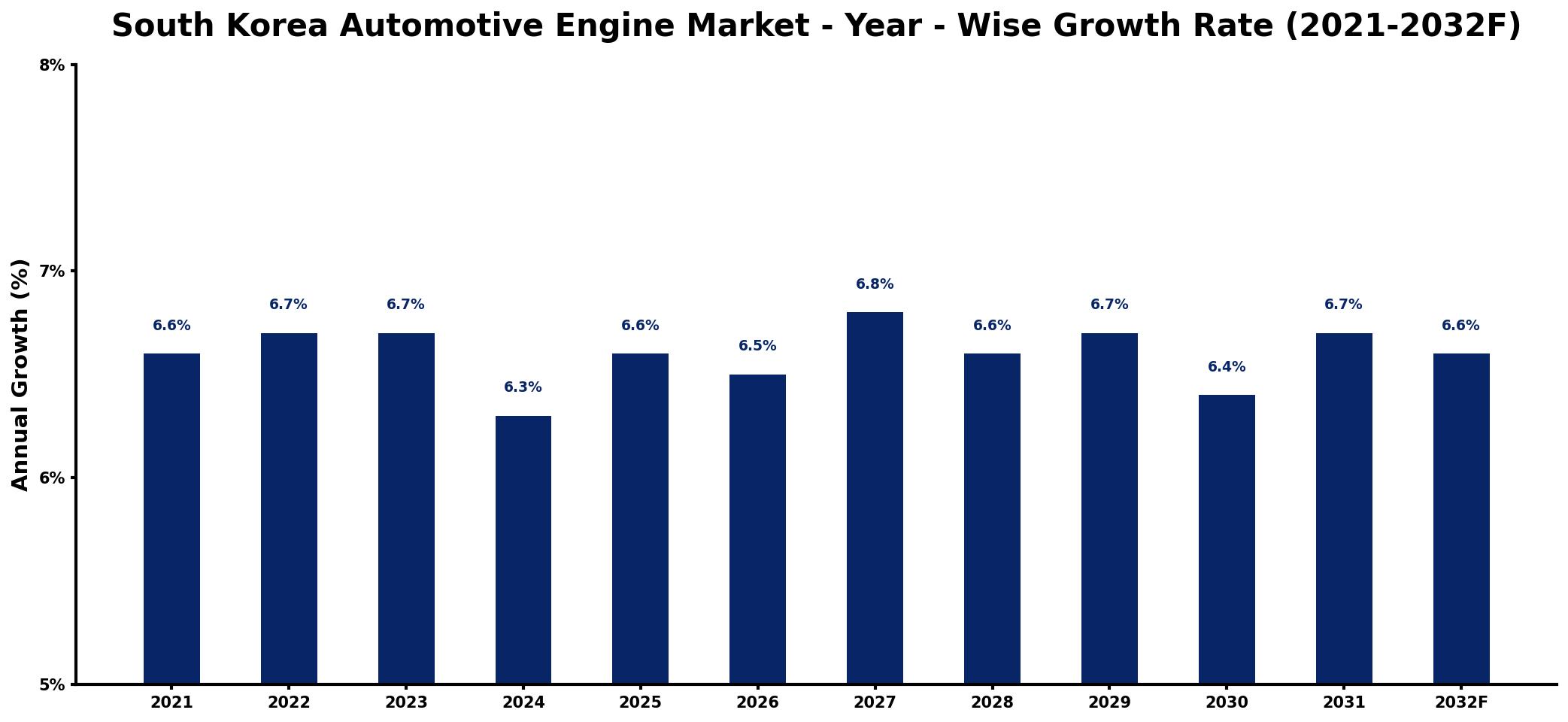
The table below presents the year‑wise growth rates along with the key drivers influencing the market
| Year | Growth Rate | Major Drivers |
| 2021 | 6.6% | Rising consumer preference for efficiency |
| 2022 | 6.7% | Expansion of electric vehicle infrastructure |
| 2023 | 6.7% | Increased investments in technology |
| 2024 | 6.3% | Growing demand for hybrid models |
| 2025 | 6.6% | Strengthening supply chain partnerships |
| 2026 | 6.5% | Emergence of sustainable manufacturing practices |
| 2027 | 6.8% | Advancements in performance optimization techniques |
| 2028 | 6.6% | Enhanced regulatory support for innovation |
| 2029 | 6.7% | Surge in global market collaborations |
| 2030 | 6.4% | Focus on renewable energy integration |
| 2031 | 6.7% | Development of smart mobility solutions |
| 2032 | 6.6% | Growing interest in alternative fuels |
Note: Market size estimations and growth projections presented in this report are based on 6Wresearch's proprietary forecasting methodology, utilizing the latest available industry data, government publications, and primary research inputs.
South Korea Automotive Engine Market Synopsis
The most significant force currently shaping the South Korea Automotive Engine Market is the transition towards electric and hybrid vehicles. As environmental concerns mount and government mandates grow more stringent, automakers are investing heavily in developing advanced powertrain technologies that minimize emissions while maximizing performance.
This shift is also complemented by the increasing consumer appetite for smart and connected vehicles, as innovation in engine technology becomes paramount. Manufacturers are now looking to integrate smart features that enhance fuel efficiency and overall driving experience, marking a critical evolution in the automotive engine sector.
South Korea Automotive Engine Market Key Takeaways
- The market is witnessing robust growth fueled by the rising demand for eco-friendly and fuel-efficient engines.
- Electric and hybrid vehicle adoption is a key trend reshaping engine technology and consumer preferences.
- Significant investments in research and development are critical for adapting to rapidly evolving automotive technologies.
- Government incentives for clean energy vehicles are bolstering market growth.
- Challenges related to competition and supply chain issues remain pertinent in the current landscape.
Evaluation of Restraints in South Korea Automotive Engine Market
Despite the promising outlook, the South Korea Automotive Engine Market faces several constraints. Notably, escalating competition from both domestic and international manufacturers intensifies the need for continuous innovation. Additionally, the rapid pace of technological advancements leads to heightened research and development costs, straining resources. Furthermore, fluctuating raw material prices and supply chain disruptions add another layer of complexity, compelling manufacturers to adopt more agile operational strategies to maintain competitive advantages.
South Korea Automotive Engine Market Trends
Several current trends are shaping the South Korea Automotive Engine Market. The emphasis on electric and hybrid vehicles is paramount, with manufacturers prioritizing advancements in battery technology and electric propulsion systems. Concurrently, there is a growing focus on optimizing internal combustion engines through innovations such as turbocharging and downsizing, which help enhance fuel economy and reduce emissions. The adoption of connected vehicles is also increasing, as consumers seek integrated solutions that offer advanced features and improved user experiences.
South Korea Automotive Engine Market Opportunities
The South Korea Automotive Engine Market offers a plethora of investment opportunities. With the government's supportive policies promoting electric and hybrid vehicles, investors can tap into the burgeoning market for sustainable automotive technologies. Opportunities also exist in research and development, particularly in areas focused on smart engine technologies and connectivity features. As companies pivot towards sustainability, investments in eco-friendly innovations stand to yield significant returns in this dynamic marketplace.
Government Initiatives in the South Korea Automotive Engine Market
The South Korean government has established numerous initiatives to foster growth within the automotive engine sector. Subsidies and tax incentives are provided for manufacturers focusing on electric and hybrid vehicles, aimed at accelerating the transition towards cleaner transportation. Furthermore, public spending on research and development is directed towards improving engine efficiency and reducing emissions. Policies also support advancements in smart transportation systems and autonomous vehicles, encouraging innovation throughout the automotive industry.
Future Insights of the South Korea Automotive Engine Market
Looking ahead to 2026-2032, the South Korea Automotive Engine Market appears poised for substantial growth. The escalating emphasis on technological advancements, coupled with a burgeoning demand for electric vehicles, will likely drive market dynamics. As automakers enhance engine performance and fuel efficiency, adherence to stricter emission regulations will become essential. Overall, the market is expected to benefit from South Korea's robust manufacturing capabilities and established infrastructure, ensuring a competitive edge in the evolving automotive landscape.
South Korea Automotive Engine Market Latest Developments (2025 - 2026)
In recent months, there have been notable movements within the South Korea Automotive Engine Market. Key manufacturers are advancing their electric and hybrid engine portfolios, with several partnerships established to enhance battery technology and efficiency. Additionally, investments in smart engine technologies are gaining traction, as companies seek to integrate advanced connectivity features into their offerings. The industry remains dynamic, with ongoing research efforts aimed at meeting the dual objectives of performance and sustainability.
South Korea Automotive Engine Market - Key Attractiveness of the Report
- 10 Years of Market Numbers
- Historical Data Starting from 2022 to 2025
- Base Year: 2025
- Forecast Data until 2032
- Key Performance Indicators Impacting the Market
- Major Upcoming Developments and Projects
Key Highlights of the Report:
- South Korea Automotive Engine Market Outlook
- Market Size of South Korea Automotive Engine Market, 2025
- Forecast of South Korea Automotive Engine Market, 2032
- Historical Data and Forecast of South Korea Automotive Engine Revenues & Volume for the Period 2022-2032F
- South Korea Automotive Engine Market Trend Evolution
- South Korea Automotive Engine Market Drivers and Challenges
- South Korea Automotive Engine Price Trends
- South Korea Automotive Engine Porter's Five Forces
- South Korea Automotive Engine Industry Life Cycle
- Historical Data and Forecast of South Korea Automotive Engine Market Revenues & Volume By Placement Type for the Period 2022-2032F
- Historical Data and Forecast of South Korea Automotive Engine Market Revenues & Volume By In-line Engine for the Period 2022-2032F
- Historical Data and Forecast of South Korea Automotive Engine Market Revenues & Volume By W Engine for the Period 2022-2032F
- Historical Data and Forecast of South Korea Automotive Engine Market Revenues & Volume By V-Type for the Period 2022-2032F
- Historical Data and Forecast of South Korea Automotive Engine Market Revenues & Volume By Vehicle Type for the Period 2022-2032F
- Historical Data and Forecast of South Korea Automotive Engine Market Revenues & Volume By Passenger Car for the Period 2022-2032F
- Historical Data and Forecast of South Korea Automotive Engine Market Revenues & Volume By Commercial Vehicle for the Period 2022-2032F
- Historical Data and Forecast of South Korea Automotive Engine Market Revenues & Volume By Fuel Type for the Period 2022-2032F
- Historical Data and Forecast of South Korea Automotive Engine Market Revenues & Volume By Gasoline for the Period 2022-2032F
- Historical Data and Forecast of South Korea Automotive Engine Market Revenues & Volume By Diesel for the Period 2022-2032F
- Historical Data and Forecast of South Korea Automotive Engine Market Revenues & Volume By Other Fuel Types for the Period 2022-2032F
- South Korea Automotive Engine Import Export Trade Statistics
- Market Opportunity Assessment By Placement Type
- Market Opportunity Assessment By Vehicle Type
- Market Opportunity Assessment By Fuel Type
- South Korea Automotive Engine Top Companies Market Share
- South Korea Automotive Engine Competitive Benchmarking By Technical and Operational Parameters
- South Korea Automotive Engine Company Profiles
- South Korea Automotive Engine Key Strategic Recommendations






































