South Korea Automotive Smart Antenna Market Growth Rate
According to 6Wresearch internal database and industry insights, the South Korea Automotive Smart Antenna Market is growing at a compound annual growth rate (CAGR) of 8.15% during the forecast period (2026-2032).
South Korea Automotive Smart Antenna Market Year-wise Growth Rate and Key Drivers
This graph highlights how the South Korea Automotive Smart Antenna Market has steadily grown over the past five years, supported by major growth factors.
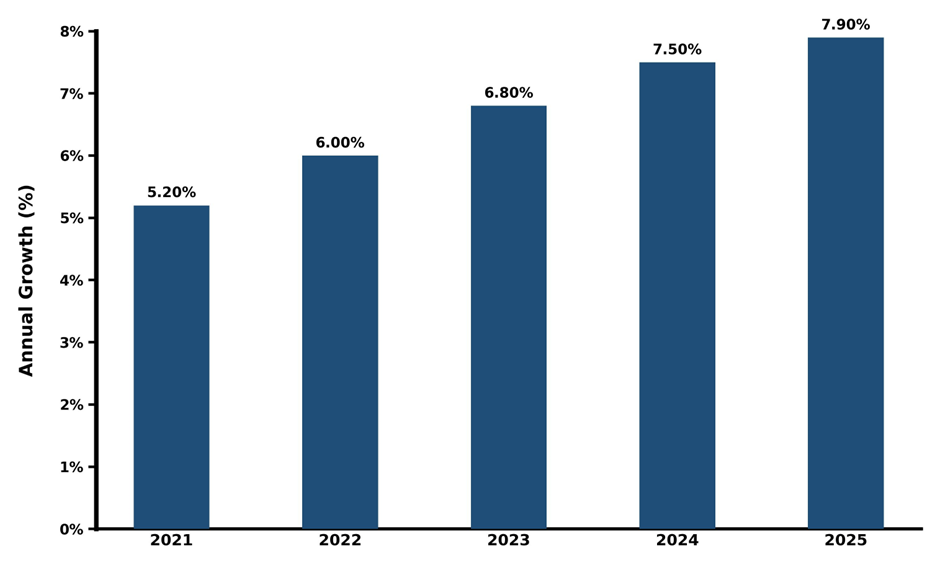
The table below presents the year‑wise growth rates along with the key drivers influencing the market
| Years | Est. Annual Growth in % | Growth Drivers |
| 2021 | 5.2% | Rising adoption of connected vehicles and infotainment systems |
| 2022 | 6.0% | Increased integration of telematics and navigation technologies |
| 2023 | 6.8% | Government push for smart mobility and V2X communication |
| 2024 | 7.5% | Expansion of 5G infrastructure supporting automotive connectivity |
| 2025 | 7.9% | Growing demand for advanced driver assistance systems (ADAS) |
Topics Covered in the South Korea Automotive Smart Antenna Market Report
South Korea Automotive Smart Antenna Market report thoroughly covers the market by vehicle, frequency, and component. The market report provides an unbiased and detailed analysis of ongoing market trends, opportunities/high growth areas, and market drivers, which would help stakeholders devise and align their market strategies according to the current and future market dynamics.
South Korea Automotive Smart Antenna Market Highlights
| Report Name | South Korea Automotive Smart Antenna Market |
| Forecast period | 2026-2032 |
| CAGR | 8.15% |
| Growing Sector | Automotive |
South Korea Automotive Smart Antenna Market Synopsis
The South Korea Automotive Smart Antenna Market is predicted to witness a steady growth. The market is led by the rapid evolution of connected and autonomous vehicle technologies, along with an increasing demand for high-speed communication systems in automobiles. The rise in the penetration of 5G networks, together with the advancements in infotainment and telematics, is further expanding market demand. Furthermore, the presence of driving automotive OEMs and electronics manufacturers in South Korea is supporting significantly to the development of advanced antenna solutions.
Evaluation of Growth Drivers in the South Korea Automotive Smart Antenna Market (2026-2032)
Below mentioned some growth drivers and their impact on market dynamics:
| Drivers | Primary Segments Affected | Why It Matters |
| 5G Network Expansion | Frequency (Ultra-High) | Enables faster data transmission and encourage real-time vehicle connectivity. |
| Connected Vehicle Adoption | Vehicle (Light Duty Vehicle) | Expands demand for smart antennas as vehicles require seamless communication systems. |
| Government Smart Mobility Initiatives | Component (ECU, Transceivers) | Supports innovation through investing, policies, and infrastructure development. |
| Growth of ADAS Technologies | Component (Transceivers) | Encourages security features by providing reliable data transmission between systems. |
| Rising Infotainment Demand | Frequency (High, Very High) | Improves user experience with enhanced connectivity and entertainment features. |
The South Korea Automotive Smart Antenna Market is projected to grow significantly, with a CAGR of 8.15% during the forecast period of 2026-2032. The market is growing owing to its rising adoption of connected vehicles and advancements in communication technologies such as 5G and V2X. Also, the government programs promotes smart transportation systems and autonomous driving are further fueling the growth. Besides, the rising consumer expectations for seamless connectivity and improved in-vehicle experiences are leading the adoption of advanced smart antenna systems.
Evaluation of Restraints in the South Korea Automotive Smart Antenna Market
Below mentioned are some major restraints and their influence on market dynamics:
| Restraints | Primary Segments Affected | What This Means |
| High Installation Costs | All Segments | Lowers adoption in budget vehicles owing to higher system costs |
| Complex Integration | Component (ECU) | Raises design challenges due to system complexity |
| Signal Interference Issues | Frequency Segments | Impacts performance reliability in certain environments |
| Dependence on Advanced Infrastructure | Frequency (Ultra-High) | Delays rural adoption due to limited network availability |
| Supply Chain Constraints | Components | Slows production timelines due to component shortages |
South Korea Automotive Smart Antenna Market Challenges
The South Korea Automotive Smart Antenna Market confronts a lot of challenges such as high system combination of complexity and cost barriers, especially for mid-range vehicles. Also, signal interference and performance inconsistencies in dense urban environments also pose technical challenges. In addition to, the reliance on advanced communication infrastructure like 5G networks may restrict the consistent adoption across various regions. Furthermore, the supply chain disruptions for semiconductor components also impacts production efficiency.
South Korea Automotive Smart Antenna Market Trends
Some major trends contributing to the South Korea Automotive Smart Antenna Market Growth are:
- Multi-Band Antenna Systems: Development of antennas capable of handling multiple communication standards which enables seamless connectivity and lowers system complexity.
- Vehicle-to-Everything (V2X) Communication: Adoption of smart antennas while enabling real-time communication between vehicles and infrastructure, also improves safety and traffic efficiency.
- Miniaturization of Components: Compact antenna designs also enhance vehicle aesthetics and space efficiency while maintaining the performance.
Investment Opportunities in the South Korea Automotive Smart Antenna Market
Below mentioned are some investment opportunities in the South Korea Automotive Smart Antenna Industry:
- Advanced Antenna Technologies: Investing in multi-functional antennas that support 5G, GNSS, and Wi-Fi to enhance connectivity and communication efficiency in vehicles.
- Smart Mobility Solutions: The opportunities in V2X communication systems are for autonomous vehicles, improving safety, navigation, and real-time data sharing.
- Component Manufacturing: Growth in production of transceivers and ECUs for automotive applications to meet the rising demand for advanced electronic systems.
Top 5 Leading Players in the South Korea Automotive Smart Antenna Market
Here are some top companies operating in the market:
1. LG Innotek
| Company Name | LG Innotek |
|---|---|
| Established Year | 1970 |
| Headquarters | Seoul, South Korea |
| Official Website | Click Here |
LG Innotek is a leading electronics manufacturer specializing in advanced automotive components, including smart antennas and communication modules. The company focuses on integrating cutting-edge connectivity solutions for modern vehicles.
2. Hyundai Mobis
| Company Name | Hyundai Mobis |
|---|---|
| Established Year | 1977 |
| Headquarters | Seoul, South Korea |
| Official Website | Click Here |
Hyundai Mobis develops automotive modules and parts, including smart antenna systems that support connected and autonomous driving technologies.
3. Samsung Electro-Mechanics
| Company Name | Samsung Electro-Mechanics |
|---|---|
| Established Year | 1973 |
| Headquarters | Suwon, South Korea |
| Official Website | Click Here |
Samsung Electro-Mechanics offers high-performance communication components, including automotive antenna solutions designed for high-frequency applications.
4. Amotech Co., Ltd.
| Company Name | Amotech Co., Ltd. |
|---|---|
| Established Year | 1994 |
| Headquarters | Incheon, South Korea |
| Official Website | Click Here |
Amotech specializes in RF components and antennas, providing innovative solutions for automotive connectivity and communication systems.
5. Partron Co., Ltd.
| Company Name | Partron Co., Ltd. |
|---|---|
| Established Year | 2003 |
| Headquarters | Hwaseong, South Korea |
| Official Website | Click Here |
Partron manufactures advanced antenna modules and communication devices, focusing on enhancing vehicle connectivity and wireless performance.
Government Regulations Introduced in the South Korea Automotive Smart Antenna Market
According to South Korean government data, this development of the South Korea Automotive Smart Antenna Market is steadily influenced by guidelines. The government has introduced programs such as the “Korean New Deal” and “Smart Mobility Roadmap,” which promotes the adoption of connected and autonomous vehicles. Along with that, the Ministry of Land, Infrastructure and Transport (MOLIT) supports V2X communication trials and 5G-enabled transportation systems. Also, the regulations ensures electromagnetic compatibility (EMC) and communication standards are being executed to improve safety and reliability in automotive systems.
Future Insights of the South Korea Automotive Smart Antenna Market
The upcoming years for the South Korea Automotive Smart Antenna Market appears to be promising, with a strong growth potential. The increase in adoption of autonomous driving technologies and connected vehicle ecosystems will continue to fuel demand. The growth of 5G networks and advancements in V2X communication are predicted to further improve market opportunities. Moreover, the continuous innovation in antenna design and combination will support the development of next-generation vehicles, making sure of sustained market’s growth.
Market Segmentation Analysis
The report offers a comprehensive study of the subsequent market segments and their leading categories.
Light Duty Vehicle to Dominate the Market - By Vehicle
According to Mansi Ahuja, Senior Research Analyst at 6Wresearch, light duty vehicles dominate the segment due to their higher production volume and increasing integration of connected technologies. These vehicles are globally equipped with infotainment systems, navigation, and telematics, which require advanced smart antenna systems. The increasing demand for passenger cars with improved connectivity features further strengthens this segment’s dominance.
Ultra-High Frequency to Dominate the Market – By Frequency
Ultra-High Frequency (UHF) leads the segment owing to its ability to support high-speed data transmission required for 5G, GPS, and V2X communication. The expanding adoption of connected vehicle technologies and real-time data exchange systems makes UHF antennas essential, especially for the advanced automotive applications.
Transceivers to Dominate the Market – By Component
Transceivers dominate the component segment as they plays an essential role in transmitting and receiving signals across multiple communication platforms. Their importance in enabling seamless connectivity for infotainment, navigation, and safety systems makes them a main component in modern automotive smart antenna systems.
Key attractiveness of the report
- 10 Years Market Numbers.
- Historical Data Starting from 2022 to 2025.
- Base Year: 2025
- Forecast Data until 2032.
- Key Performance Indicators Impacting the Market.
- Major Upcoming Developments and Projects.
Key Highlights of the Report:
- South Korea Automotive Smart Antenna Market Outlook
- Market Size of South Korea Automotive Smart Antenna Market, 2025
- Forecast of South Korea Automotive Smart Antenna Market, 2032
- Historical Data and Forecast of South Korea Automotive Smart Antenna Revenues & Volume for the Period 2022-2032
- South Korea Automotive Smart Antenna Market Trend Evolution
- South Korea Automotive Smart Antenna Market Drivers and Challenges
- South Korea Automotive Smart Antenna Price Trends
- South Korea Automotive Smart Antenna Porter's Five Forces
- South Korea Automotive Smart Antenna Industry Life Cycle
- Historical Data and Forecast of South Korea Automotive Smart Antenna Market Revenues & Volume By Vehicle for the Period 2022-2032
- Historical Data and Forecast of South Korea Automotive Smart Antenna Market Revenues & Volume By Light Duty Vehicle for the Period 2022-2032
- Historical Data and Forecast of South Korea Automotive Smart Antenna Market Revenues & Volume By Commercial Vehicle for the Period 2022-2032
- Historical Data and Forecast of South Korea Automotive Smart Antenna Market Revenues & Volume By Frequency for the Period 2022-2032
- Historical Data and Forecast of South Korea Automotive Smart Antenna Market Revenues & Volume By High for the Period 2022-2032
- Historical Data and Forecast of South Korea Automotive Smart Antenna Market Revenues & Volume By Very High for the Period 2022-2032
- Historical Data and Forecast of South Korea Automotive Smart Antenna Market Revenues & Volume By Ultra-High for the Period 2022-2032
- Historical Data and Forecast of South Korea Automotive Smart Antenna Market Revenues & Volume By Component for the Period 2022-2032
- Historical Data and Forecast of South Korea Automotive Smart Antenna Market Revenues & Volume By Transceivers for the Period 2022-2032
- Historical Data and Forecast of South Korea Automotive Smart Antenna Market Revenues & Volume By ECU for the Period 2022-2032
- Historical Data and Forecast of South Korea Automotive Smart Antenna Market Revenues & Volume By Others for the Period 2022-2032
- South Korea Automotive Smart Antenna Import Export Trade Statistics
- Market Opportunity Assessment By Vehicle
- Market Opportunity Assessment By Frequency
- Market Opportunity Assessment By Component
- South Korea Automotive Smart Antenna Top Companies Market Share
- South Korea Automotive Smart Antenna Competitive Benchmarking By Technical and Operational Parameters
- South Korea Automotive Smart Antenna Company Profiles
- South Korea Automotive Smart Antenna Key Strategic Recommendations
Market covered
The report subsequently covers the market by following segments and subsegments.
By Vehicle
- Light Duty Vehicle
- Commercial Vehicle
By Frequency
- High
- Very High
- Ultra-High
By Component
- Transceivers
- ECU
- Others






































