South Korea Aviation Test Equipment Market Size, Share & Growth Rate
The South Korea Aviation Test Equipment Market was estimated at USD 458 Million in 2025 and is projected to reach USD 612 Million by 2032, growing at a CAGR of 4.2% from 2026 to 2032. This positive trajectory is primarily driven by the surge in air passenger traffic and the continued expansion of the aviation sector, which necessitates advanced testing solutions. Furthermore, the emphasis on stringent safety regulations is compelling manufacturers to innovate and enhance their product offerings to meet these rising demands.
South Korea Aviation Test Equipment Market Year-wise Growth Rate and Key Drivers
This graph highlights how the South Korea Aviation Test Equipment Market has steadily grown over the years, supported by major growth factors.
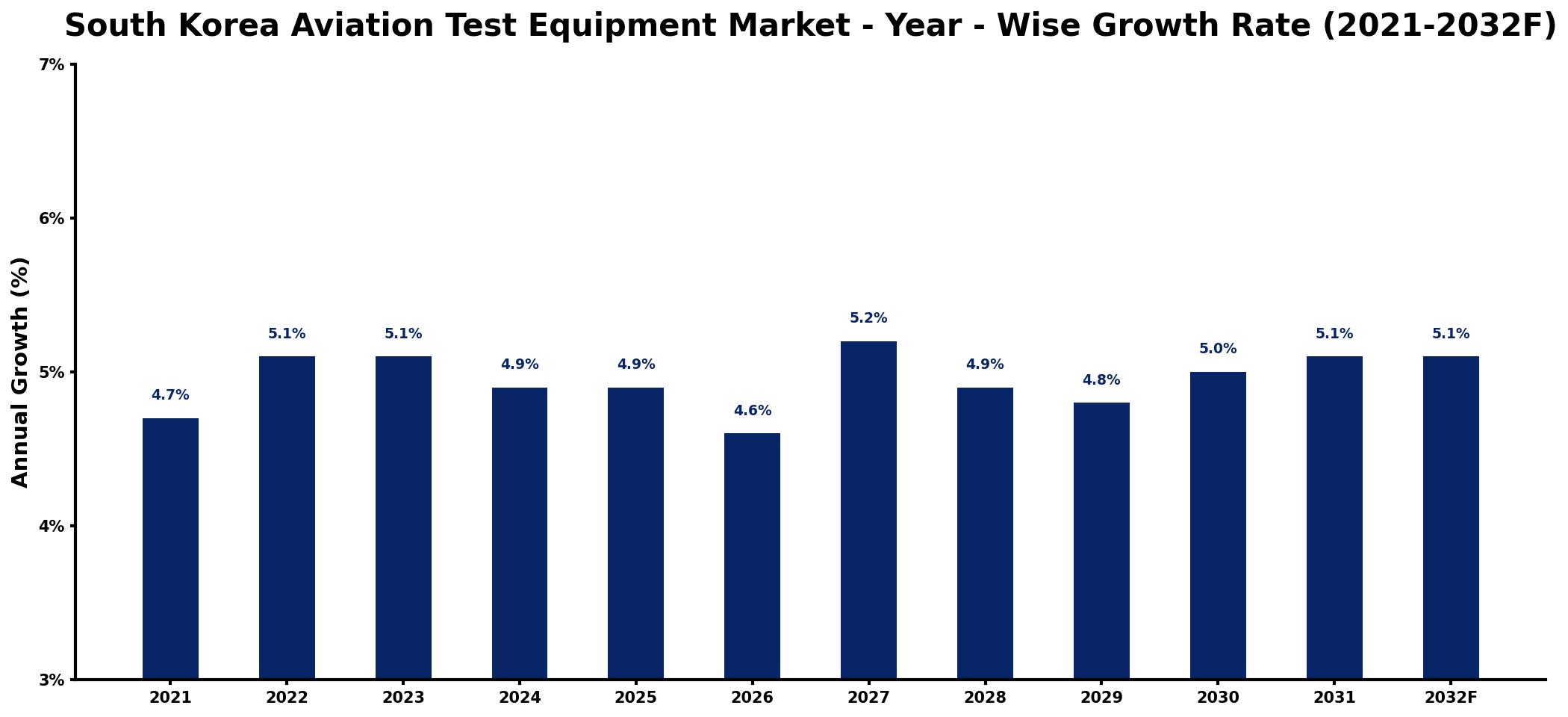
The table below presents the year‑wise growth rates along with the key drivers influencing the market
| Year | Growth Rate | Major Drivers |
| 2021 | 4.7% | Rising investment in aerospace sector |
| 2022 | 5.1% | Increased demand for simulation technologies |
| 2023 | 5.1% | Growth in defense spending initiatives |
| 2024 | 4.9% | Expansion of commercial flight operations |
| 2025 | 4.9% | Technological advancements in training |
| 2026 | 4.6% | Emergence of new regulatory standards |
| 2027 | 5.2% | rising end-use demand growth |
| 2028 | 4.9% | Higher utilization of digital solutions |
| 2029 | 4.8% | Demand for enhanced safety protocols |
| 2030 | 5.0% | expanding industrial usage applications |
| 2031 | 5.1% | Increased focus on sustainability practices |
| 2032 | 5.1% | rising procurement volume requirements |
Note: Market size estimations and growth projections presented in this report are based on 6Wresearch's proprietary forecasting methodology, utilizing the latest available industry data, government publications, and primary research inputs.
South Korea Aviation Test Equipment Market Synopsis
In recent years, the South Korea Aviation Test Equipment Market has gained momentum, fueled by technological advancements and increased air travel. However, the market is now transitioning toward more sophisticated, automated testing solutions to align with the growing complexities of aviation technologies.
As the aviation industry evolves, the focus has shifted towards sustainability and precision, marking a critical juncture for equipment manufacturers. By prioritizing these developments, the market is set to not only meet regulatory standards but also ensure the highest levels of safety and efficiency in aviation operations.
South Korea Aviation Test Equipment Market Key Takeaways
- Innovative testing solutions are in high demand due to the growing complexity of aircraft systems.
- Government investments in airport infrastructure modernization are bolstering market growth.
- The shift towards automated and digitized test equipment is shaping future market dynamics.
- Compliance with strict safety regulations remains a key factor for equipment manufacturers.
- Investment opportunities exist in specialized equipment development and technician training programs.
Evaluation of Restraints in South Korea Aviation Test Equipment Market
Despite its promising growth, the South Korea Aviation Test Equipment Market faces significant challenges. The increasing complexity of aircraft systems demands more advanced testing equipment, often requiring significant investment in research and development. Additionally, stringent regulatory requirements complicate compliance, placing a burden on manufacturers. The fierce competition from international players also heightens the pressure to innovate and keep pace with global trends, while geopolitical tensions may introduce further uncertainties affecting market dynamics.
South Korea Aviation Test Equipment Market Trends
Key trends shaping the South Korea Aviation Test Equipment Market include the integration of advanced technologies such as automation, artificial intelligence, and data analytics into testing solutions. This shift not only enhances testing precision but also streamlines processes, thereby improving operational efficiency. Furthermore, the growing focus on sustainability is pushing manufacturers towards developing eco-friendly testing solutions, making it a significant trend in the industry.
South Korea Aviation Test Equipment Market Opportunities
The South Korea Aviation Test Equipment Market offers lucrative investment opportunities, particularly in the development of specialized aviation test equipment tailored to meet the demands of modern aircraft technologies. Additionally, calibration services for existing testing equipment present a vital area for growth, ensuring compliance and accuracy within the industry. Training services aimed at equipping aviation technicians and engineers with the skills necessary for operating advanced test systems also represent a significant growth potential.
Government Initiatives in the South Korea Aviation Test Equipment Market
Government policies play a crucial role in shaping the South Korea Aviation Test Equipment Market. The Ministry of Land, Infrastructure, and Transport (MOLIT) and the Civil Aviation Authority of Korea (CAAK) enforce rigorous safety and quality standards for aviation test equipment. They also support research and development initiatives aimed at fostering innovation in the sector through funding programs and collaborations with industry stakeholders. Such initiatives aim to enhance the growth and competitiveness of the market while adhering to stringent safety protocols.
Future Insights of the South Korea Aviation Test Equipment Market
Looking ahead to 2026-2032, the South Korea Aviation Test Equipment Market is poised for substantial growth. The combination of an expanding aviation sector and increasing regulatory scrutiny will drive demand for advanced testing solutions. Technological innovations, particularly in automation and sustainability, are expected to be pivotal in shaping market dynamics. Additionally, government initiatives aimed at enhancing aerospace infrastructure will continue to create fertile ground for investment and innovation within the market.
South Korea Aviation Test Equipment Market Latest Developments (2025 - 2026)
Recent developments within the South Korea Aviation Test Equipment Market indicate a robust movement towards enhanced testing capabilities, with many companies investing in next-generation automated systems. Concurrently, the emphasis on sustainable practices has led to research into eco-friendly testing methodologies. There is also a notable trend of collaborations between manufacturers and research institutions aimed at accelerating technological advancements and fostering innovation across the industry.
South Korea Aviation Test Equipment Market - Key Attractiveness of the Report
- 10 Years of Market Numbers
- Historical Data Starting from 2022 to 2025
- Base Year: 2025
- Forecast Data until 2032
- Key Performance Indicators Impacting the Market
- Major Upcoming Developments and Projects
Key Highlights of the Report:
- South Korea Aviation Test Equipment Market Outlook
- Market Size of South Korea Aviation Test Equipment Market, 2025
- Forecast of South Korea Aviation Test Equipment Market, 2032
- Historical Data and Forecast of South Korea Aviation Test Equipment Revenues & Volume for the Period 2022-2032F
- South Korea Aviation Test Equipment Market Trend Evolution
- South Korea Aviation Test Equipment Market Drivers and Challenges
- South Korea Aviation Test Equipment Price Trends
- South Korea Aviation Test Equipment Porter's Five Forces
- South Korea Aviation Test Equipment Industry Life Cycle
- Historical Data and Forecast of South Korea Aviation Test Equipment Market Revenues & Volume By Product for the Period 2022-2032F
- Historical Data and Forecast of South Korea Aviation Test Equipment Market Revenues & Volume By Electrical Aviation Test Equipment for the Period 2022-2032F
- Historical Data and Forecast of South Korea Aviation Test Equipment Market Revenues & Volume By Hydraulic Aviation Test Equipment for the Period 2022-2032F
- Historical Data and Forecast of South Korea Aviation Test Equipment Market Revenues & Volume By Power Aviation Test Equipment for the Period 2022-2032F
- Historical Data and Forecast of South Korea Aviation Test Equipment Market Revenues & Volume By Pneumatic Aviation Test Equipment for the Period 2022-2032F
- Historical Data and Forecast of South Korea Aviation Test Equipment Market Revenues & Volume By End User for the Period 2022-2032F
- Historical Data and Forecast of South Korea Aviation Test Equipment Market Revenues & Volume By Commercial for the Period 2022-2032F
- Historical Data and Forecast of South Korea Aviation Test Equipment Market Revenues & Volume By Defense/Military Sector for the Period 2022-2032F
- South Korea Aviation Test Equipment Import Export Trade Statistics
- Market Opportunity Assessment By Product
- Market Opportunity Assessment By End User
- South Korea Aviation Test Equipment Top Companies Market Share
- South Korea Aviation Test Equipment Competitive Benchmarking By Technical and Operational Parameters
- South Korea Aviation Test Equipment Company Profiles
- South Korea Aviation Test Equipment Key Strategic Recommendations






































