South Korea Base Metals Market Size, Share & Growth Rate
The South Korea Base Metals Market was estimated at USD 825 Million in 2025 and is projected to reach USD 1178 Million by 2032, growing at a CAGR of 5.2% from 2026 to 2032. This upward trajectory is primarily driven by the increasing demand for base metals within the automotive and electronics sectors, along with significant investments in infrastructure development. As South Korea continues to modernize and innovate, the critical role of base metals in supporting these sectors remains undeniable.
South Korea Base Metals Market Year-wise Growth Rate and Key Drivers
This graph highlights how the South Korea Base Metals Market has steadily grown over the years, supported by major growth factors.
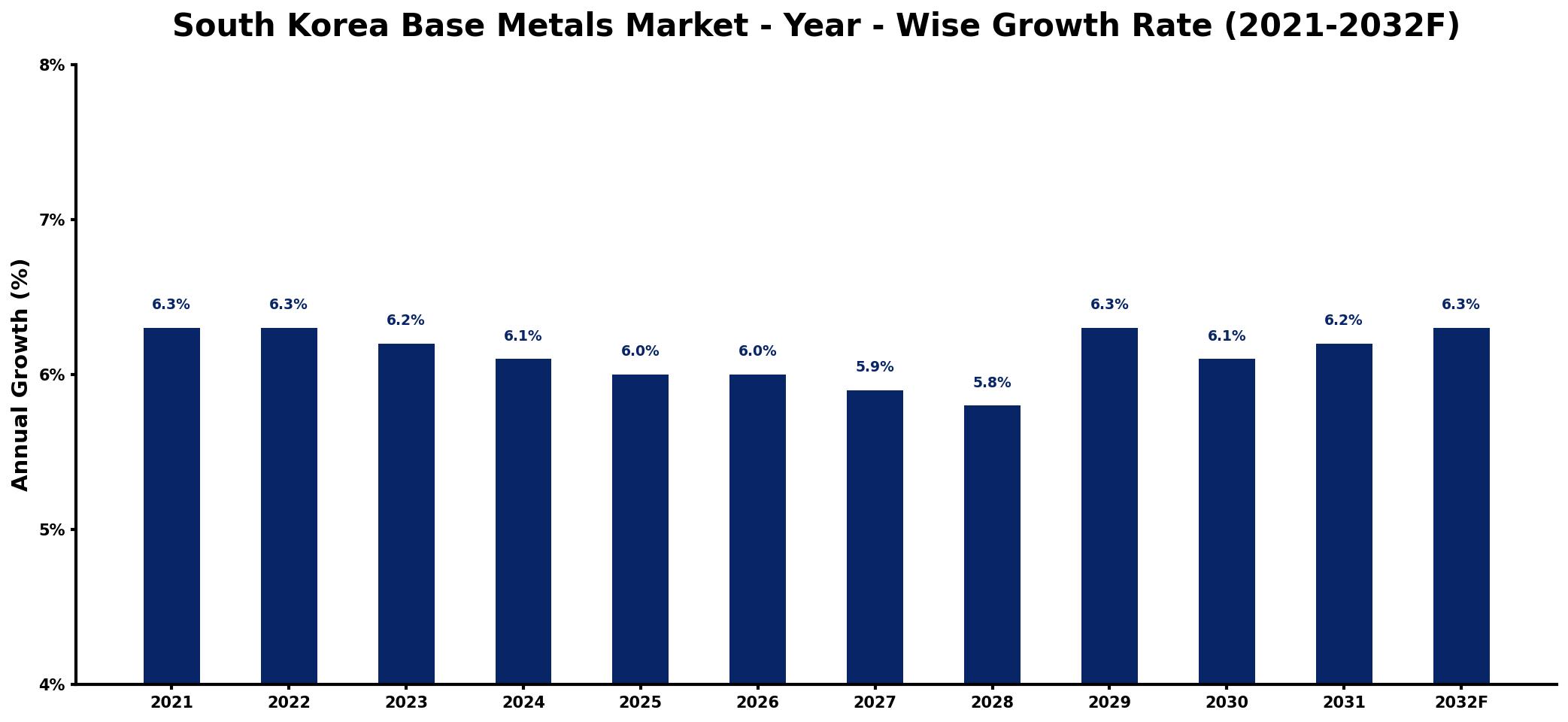
The table below presents the year‑wise growth rates along with the key drivers influencing the market
| Year | Growth Rate | Major Drivers |
| 2021 | 6.3% | Rising construction sector investments |
| 2022 | 6.3% | Increased automotive manufacturing demand |
| 2023 | 6.2% | Growing renewable energy projects |
| 2024 | 6.1% | Expansion of electronics production facilities |
| 2025 | 6.0% | Boost in infrastructure development initiatives |
| 2026 | 6.0% | Surge in telecommunications investments |
| 2027 | 5.9% | Growing demand for electric vehicles |
| 2028 | 5.8% | Increased urbanization driving consumption |
| 2029 | 6.3% | Revival of industrial manufacturing activities |
| 2030 | 6.1% | expanding industrial usage applications |
| 2031 | 6.2% | Rising consumer electronics sales |
| 2032 | 6.3% | Growth in aerospace industry investments |
Note: Market size estimations and growth projections presented in this report are based on 6Wresearch's proprietary forecasting methodology, utilizing the latest available industry data, government publications, and primary research inputs.
South Korea Base Metals Market Synopsis
In recent years, the South Korea Base Metals Market has exhibited robust growth, driven by an industrial landscape characterized by high demand from manufacturing and construction. However, as the country pivots toward sustainable practices, the market is expected to undergo significant transformations, with innovation at the forefront.
The emphasis on clean energy solutions and advanced manufacturing technologies is reshaping demand dynamics in the South Korea Base Metals Market. While traditional drivers remain influential, emerging trends signal a shift towards more environmentally responsible practices, positioning the market for future growth amidst evolving economic conditions.
South Korea Base Metals Market Key Takeaways
- The market is characterized by a strong demand from automotive and electronics manufacturing sectors.
- Sustainable mining practices and technological advancements are becoming increasingly vital.
- Government policies support domestic production, emphasizing environmental regulations.
- Global economic fluctuations and geopolitical factors continue to impact pricing and supply dynamics.
- Investment opportunities abound in renewable energy and infrastructure development projects.
Evaluation of Restraints in South Korea Base Metals Market
Despite the market's potential, several real restraints are impeding growth. Fluctuating global demand for base metals creates uncertainty, while competition from other countries intensifies. The heavy reliance on imports introduces vulnerability to supply chain disruptions, compounded by geopolitical tensions in the region. Furthermore, stringent environmental regulations necessitate significant investments in clean technologies, which may pose financial challenges for producers. Collectively, these factors necessitate strategic planning and adaptability to ensure sustained market competitiveness.
South Korea Base Metals Market Trends
Current trends in the South Korea Base Metals Market highlight a shift towards sustainability and technological innovation. Companies are increasingly investing in advanced production techniques aimed at minimizing environmental impact. Additionally, the burgeoning electric vehicle industry and initiatives surrounding renewable energy are generating heightened demand for metals such as copper and aluminum, crucial for modern applications. Such trends not only address current market demands but also pave the way for a more resilient industrial framework.
South Korea Base Metals Market Opportunities
Investment opportunities within the South Korea Base Metals Market are flourishing, largely due to the countrys pivotal role in the global supply chain for electronics and automotive manufacturing. The ongoing expansion of infrastructure projects further elevates the demand for essential base metals. Investors are also encouraged by South Korea's robust focus on renewable energy initiatives, which create additional avenues for growth, especially in sectors utilizing metals integral to green technology applications.
Government Initiatives in the South Korea Base Metals Market
The South Korean government has implemented a range of policies designed to bolster the base metals market. These include trade regulations and environmental standards aimed at promoting sustainable mining practices. Furthermore, incentives such as subsidies and tax benefits for domestic production enhance local industry capabilities. Such government initiatives play a crucial role in ensuring a competitive market while addressing environmental concerns and supporting economic growth.
Future Insights of the South Korea Base Metals Market
Looking ahead to the period from 2026 to 2032, the South Korea Base Metals Market is expected to thrive as the government continues to prioritize domestic manufacturing and technological advancements. The growing focus on green technologies, especially related to electric vehicles and renewable energy infrastructure, will likely sustain demand for essential base metals. However, external economic uncertainties and commodity price fluctuations may pose challenges, necessitating vigilance and adaptability within the sector.
South Korea Base Metals Market Latest Developments (2025 - 2026)
Recent developments in the South Korea Base Metals Market indicate a strategic pivot towards enhancing production efficiency and sustainability. Many companies are exploring partnerships aimed at integrating advanced technologies into their operations. Furthermore, public interest in cleaner energy solutions is prompting increased collaboration between government entities and industry players to align production practices with environmental goals. These movements signal a significant trend toward a more sustainable and innovative future for the market.
South Korea Base Metals Market - Key Attractiveness of the Report
- 10 Years of Market Numbers
- Historical Data Starting from 2022 to 2025
- Base Year: 2025
- Forecast Data until 2032
- Key Performance Indicators Impacting the Market
- Major Upcoming Developments and Projects
Key Highlights of the Report:
- South Korea Base Metals Market Outlook
- Market Size of South Korea Base Metals Market, 2025
- Forecast of South Korea Base Metals Market, 2032
- Historical Data and Forecast of South Korea Base Metals Revenues & Volume for the Period 2022-2032F
- South Korea Base Metals Market Trend Evolution
- South Korea Base Metals Market Drivers and Challenges
- South Korea Base Metals Price Trends
- South Korea Base Metals Porter's Five Forces
- South Korea Base Metals Industry Life Cycle
- Historical Data and Forecast of South Korea Base Metals Market Revenues & Volume By Type for the Period 2022-2032F
- Historical Data and Forecast of South Korea Base Metals Market Revenues & Volume By Copper for the Period 2022-2032F
- Historical Data and Forecast of South Korea Base Metals Market Revenues & Volume By Zinc for the Period 2022-2032F
- Historical Data and Forecast of South Korea Base Metals Market Revenues & Volume By Lead for the Period 2022-2032F
- Historical Data and Forecast of South Korea Base Metals Market Revenues & Volume By Nickel for the Period 2022-2032F
- Historical Data and Forecast of South Korea Base Metals Market Revenues & Volume By Aluminum for the Period 2022-2032F
- Historical Data and Forecast of South Korea Base Metals Market Revenues & Volume By Tin for the Period 2022-2032F
- Historical Data and Forecast of South Korea Base Metals Market Revenues & Volume By End-user Industry for the Period 2022-2032F
- Historical Data and Forecast of South Korea Base Metals Market Revenues & Volume By Construction for the Period 2022-2032F
- Historical Data and Forecast of South Korea Base Metals Market Revenues & Volume By Automotive and Transportation for the Period 2022-2032F
- Historical Data and Forecast of South Korea Base Metals Market Revenues & Volume By Electrical and Electronics for the Period 2022-2032F
- Historical Data and Forecast of South Korea Base Metals Market Revenues & Volume By Consumer Products for the Period 2022-2032F
- Historical Data and Forecast of South Korea Base Metals Market Revenues & Volume By Medical Devices for the Period 2022-2032F
- Historical Data and Forecast of South Korea Base Metals Market Revenues & Volume By Others for the Period 2022-2032F
- South Korea Base Metals Import Export Trade Statistics
- Market Opportunity Assessment By Type
- Market Opportunity Assessment By End-user Industry
- South Korea Base Metals Top Companies Market Share
- South Korea Base Metals Competitive Benchmarking By Technical and Operational Parameters
- South Korea Base Metals Company Profiles
- South Korea Base Metals Key Strategic Recommendations






































