South Korea Belt and Chain Drives Market Size, Share & Growth Rate
The South Korea Belt and Chain Drives Market was estimated at USD 1154 Million in 2025 and is projected to reach USD 1914 Million by 2032, growing at a CAGR of 7.5% from 2026 to 2032. This robust growth is primarily fueled by the rapid advancements in industrial automation and the increasing demand from the manufacturing sector for reliable power transmission solutions. Additionally, the ongoing push towards energy-efficient systems in South Korea is creating a significant appetite for these essential components.
South Korea Belt and Chain Drives Market Year-wise Growth Rate and Key Drivers
This graph highlights how the South Korea Belt and Chain Drives Market has steadily grown over the years, supported by major growth factors.
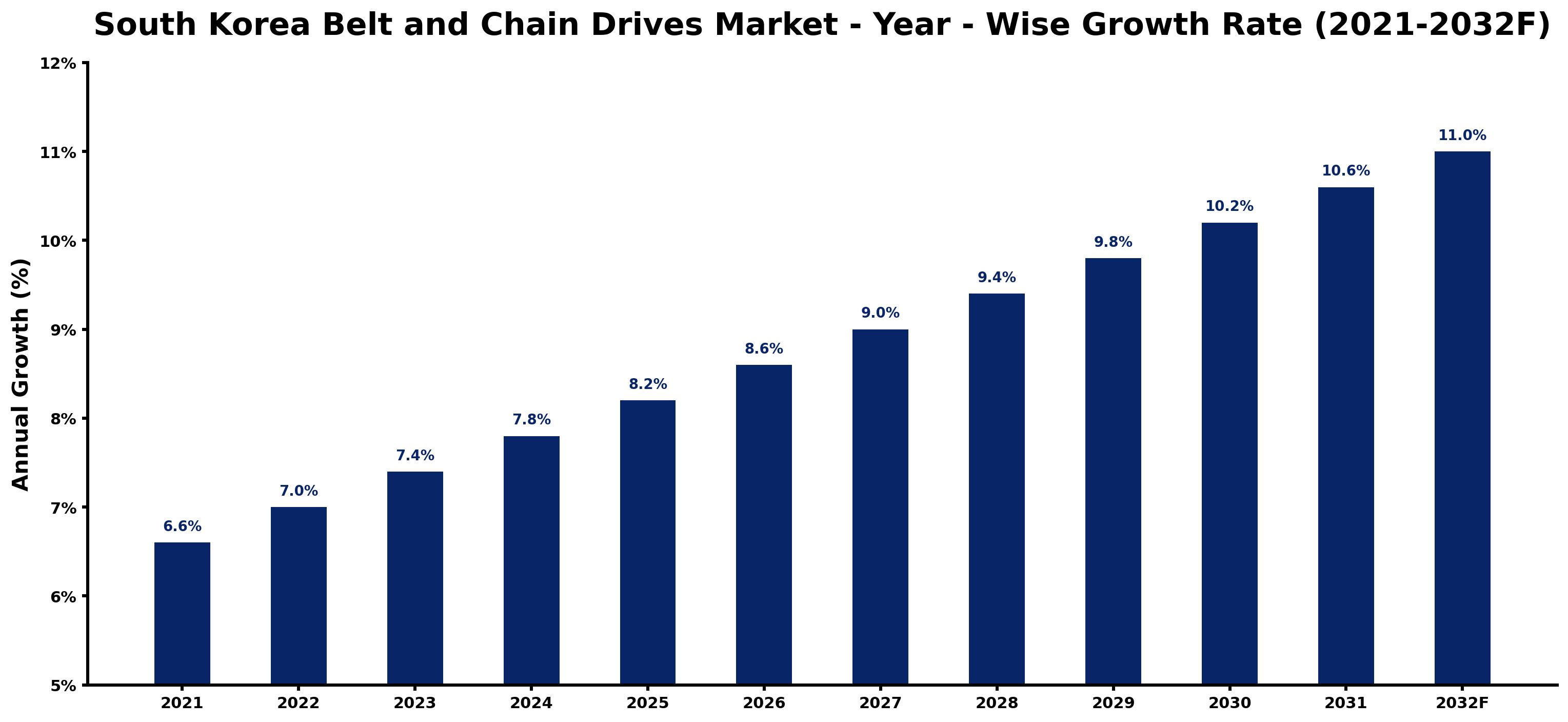
The table below presents the year‑wise growth rates along with the key drivers influencing the market
| Year | Growth Rate | Major Drivers |
| 2021 | 6.6% | Increasing adoption of advanced technologies |
| 2022 | 7.0% | Expansion of commercial construction activities |
| 2023 | 7.4% | Increasing industrial automation investments |
| 2024 | 7.8% | Increasing industrial automation investments |
| 2025 | 8.2% | Increasing industrial infrastructure investments |
| 2026 | 8.6% | Increasing adoption of advanced technologies |
| 2027 | 9.0% | Expansion of manufacturing activities |
| 2028 | 9.4% | Expansion of transportation and logistics networks |
| 2029 | 9.8% | Expansion of commercial construction activities |
| 2030 | 10.2% | Rising electricity demand across industries |
| 2031 | 10.6% | Increasing adoption of advanced technologies |
| 2032 | 11.0% | Increasing industrial infrastructure investments |
Note - Market size estimations and growth projections presented in this report are based on 6Wresearch’s advanced forecasting approach, validated with industry datasets as of June 2026.
South Korea Belt and Chain Drives Market Synopsis
In South Korea, the belt and chain drives market is experiencing a surge in demand as various industries strive for enhanced operational efficiency. The integration of these drive systems within machinery is pivotal for manufacturers looking to improve production rates and reduce downtime.
Furthermore, the growing trend towards automation and smart manufacturing systems is driving the adoption of advanced belt and chain drives. These systems are not only critical for power transmission but also play a crucial role in achieving higher productivity and sustainability in operations.
South Korea Belt and Chain Drives Market Key Takeaways
- The market is expected to experience significant growth driven by industrial automation and manufacturing advancements.
- Technological innovations are enhancing the efficiency and reliability of belt and chain drive systems.
- Government initiatives are encouraging the adoption of energy-efficient and reliable power transmission solutions.
- Competitive pressures from alternative drive systems could influence market dynamics.
- Regular maintenance and replacement cycles are key considerations for end-users in this sector.
Evaluation of Restraints in South Korea Belt and Chain Drives Market
Despite the market's growth prospects, there are notable restraints affecting its trajectory. The high level of competition from alternative drive systems, such as direct drives and gear drives, poses a challenge for traditional belt and chain systems. Furthermore, the requirement for regular maintenance and eventual replacement of belts and chains can deter some potential customers from investing in these solutions, especially when alternative systems promise lower maintenance needs. These factors could hinder the market's growth and adoption rate.
South Korea Belt and Chain Drives Market Trends
One of the most significant trends in the South Korea Belt and Chain Drives Market is the increasing implementation of smart technology within these systems. Integrating IoT solutions allows for better monitoring and predictive maintenance, thereby reducing downtime and improving efficiency. Additionally, there is a rising demand for eco-friendly materials and designs, as companies strive to align with sustainability goals.
Furthermore, the push for energy efficiency is influencing the development of belts and chains that require less energy to operate, thereby addressing both cost and environmental concerns. Manufacturers are focusing on these innovations to stay competitive in a rapidly evolving marketplace.
South Korea Belt and Chain Drives Market Opportunities
Opportunities in the South Korea Belt and Chain Drives Market are abundant, particularly in sectors that are prioritizing automation and efficiency. The rise of smart factories and Industry 4.0 practices is creating avenues for the adoption of advanced drive systems that offer enhanced performance. Additionally, as businesses seek to reduce operational costs and enhance productivity, investment in more reliable belt and chain drives presents a compelling case.
Emerging sectors, such as renewable energy and electric vehicles, also offer fresh opportunities for belt and chain drive applications, further expanding the market landscape. Companies that can innovate and respond to these industry shifts will likely capture significant market share.
Government Initiatives in the South Korea Belt and Chain Drives Market
The South Korean government plays a pivotal role in shaping the belt and chain drives market through various initiatives aimed at promoting industrial efficiency and technological advancement. Policies are in place to incentivize the adoption of innovative technologies, aimed at boosting productivity and reducing maintenance costs. Moreover, there are frameworks to ensure compliance with environmental regulations, supporting the development of sustainable manufacturing practices.
Public spending on infrastructure projects that utilize advanced manufacturing techniques also supports growth in this sector. By fostering research collaborations and training programs, the government is ensuring that the workforce is equipped to meet the evolving demands of the industry.
Future Insights of the South Korea Belt and Chain Drives Market
Looking ahead to 2026-2032, the South Korea Belt and Chain Drives Market is expected to embrace further technological innovations and improvements in operational efficiencies. As the industrial landscape evolves with the adoption of more sophisticated automation systems, the demand for high-performance belt and chain drives will likely increase. Moreover, the emphasis on energy conservation will drive the development of even more efficient systems, positioning this market for sustained growth.
South Korea Belt and Chain Drives Market Latest Developments (May 2025 - June 2026)
Recent industry directions indicate a stronger focus on integrating advanced technologies within belt and chain drive systems. Companies are exploring partnerships and collaborations to enhance research and development efforts, particularly in smart technology applications. Additionally, emerging trends related to sustainability are prompting manufacturers to innovate with eco-friendly materials and processes, reflecting broader market demands.
South Korea Belt and Chain Drives Market - Key Attractiveness of the Report
- 10 Years of Market Numbers
- Historical Data Starting from 2022 to 2025
- Base Year: 2025
- Forecast Data until 2032
- Key Performance Indicators Impacting the Market
- Major Upcoming Developments and Projects
Key Highlights of the Report:
- South Korea Belt and Chain Drives Market Outlook
- Market Size of South Korea Belt and Chain Drives Market, 2025
- Forecast of South Korea Belt and Chain Drives Market, 2032
- Historical Data and Forecast of South Korea Belt and Chain Drives Revenues & Volume for the Period 2022-2032F
- South Korea Belt and Chain Drives Market Trend Evolution
- South Korea Belt and Chain Drives Market Drivers and Challenges
- South Korea Belt and Chain Drives Price Trends
- South Korea Belt and Chain Drives Porter's Five Forces
- South Korea Belt and Chain Drives Industry Life Cycle
- Historical Data and Forecast of South Korea Belt and Chain Drives Market Revenues & Volume By Type for the Period 2022-2032F
- Historical Data and Forecast of South Korea Belt and Chain Drives Market Revenues & Volume By Transmission Chain for the Period 2022-2032F
- Historical Data and Forecast of South Korea Belt and Chain Drives Market Revenues & Volume By Silent Chain for the Period 2022-2032F
- Historical Data and Forecast of South Korea Belt and Chain Drives Market Revenues & Volume By Leaf Chain for the Period 2022-2032F
- Historical Data and Forecast of South Korea Belt and Chain Drives Market Revenues & Volume By Roller Chain for the Period 2022-2032F
- Historical Data and Forecast of South Korea Belt and Chain Drives Market Revenues & Volume By Others for the Period 2022-2032F
- Historical Data and Forecast of South Korea Belt and Chain Drives Market Revenues & Volume By End users for the Period 2022-2032F
- Historical Data and Forecast of South Korea Belt and Chain Drives Market Revenues & Volume By Automotive for the Period 2022-2032F
- Historical Data and Forecast of South Korea Belt and Chain Drives Market Revenues & Volume By Industrial Machinery for the Period 2022-2032F
- Historical Data and Forecast of South Korea Belt and Chain Drives Market Revenues & Volume By Agriculture for the Period 2022-2032F
- Historical Data and Forecast of South Korea Belt and Chain Drives Market Revenues & Volume By Others for the Period 2022-2032F
- South Korea Belt and Chain Drives Import Export Trade Statistics
- Market Opportunity Assessment By Type
- Market Opportunity Assessment By End users
- South Korea Belt and Chain Drives Top Companies Market Share
- South Korea Belt and Chain Drives Competitive Benchmarking By Technical and Operational Parameters
- South Korea Belt and Chain Drives Company Profiles
- South Korea Belt and Chain Drives Key Strategic Recommendations






































