South Korea Beverage Dispenser Market Summary
The south korea beverage dispenser market was estimated at USD 312 Million in 2025 and is projected to reach USD 546 Million by 2032, growing at a CAGR of 9.6% from 2026 to 2032.
South Korea Beverage Dispenser Market Year-wise Growth Rate and Key Drivers
This graph highlights how the South Korea Beverage Dispenser Market has steadily grown over the past five years, supported by major growth factors.
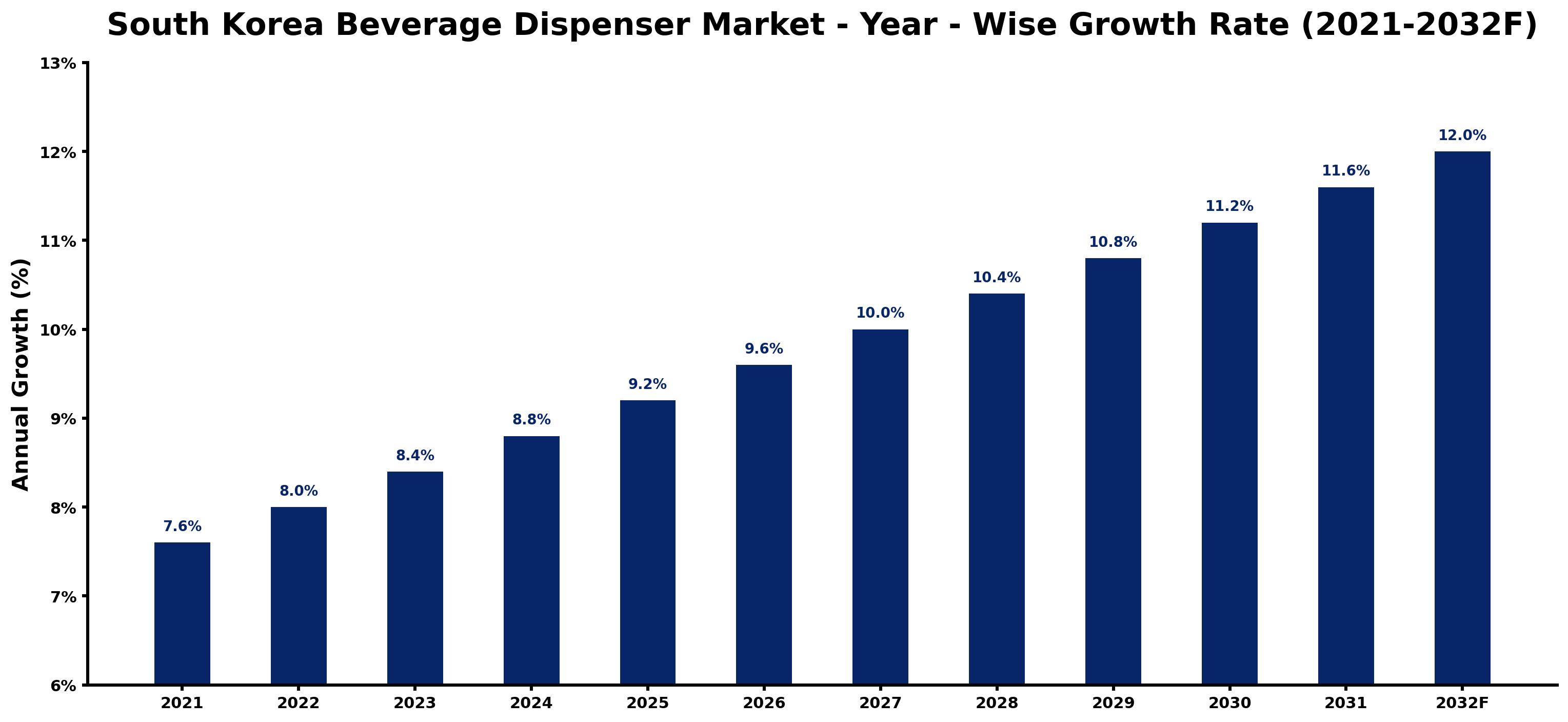
The table below presents the year wise growth rates along with the key drivers influencing the market
| Year | Growth Rate | Major Drivers |
| 2021 | 7.6% | Post-lockdown retail projects sparked a renewed interest in consumer convenience solutions. |
| 2022 | 8.0% | Local manufacturers expanded, reducing dependency on imports and enhancing customization opportunities. |
| 2023 | 8.4% | Consumer preferences shifted towards healthier beverage options, influencing dispenser designs accordingly. |
| 2024 | 8.8% | Technological integration facilitated remote monitoring and maintenance, benefiting operational efficiency. |
| 2025 | 9.2% | Rising awareness about sustainability prompted eco-friendly materials in beverage dispenser construction. |
| 2026 | 9.6% | Emerging café culture encouraged personalized drink experiences through advanced beverage dispensers. |
| 2027 | 10.0% | Increased urbanization resulted in higher foot traffic, boosting demand in commercial settings. |
| 2028 | 10.4% | Collaborations between beverage brands and dispenser manufacturers enhanced product visibility and sales. |
| 2029 | 10.8% | Growing interest in home automation led to smart beverage dispensers gaining traction. |
| 2030 | 11.2% | Catering to diverse consumer tastes, custom flavors became a key focus for dispensers. |
| 2031 | 11.6% | Technological innovations introduced cashless payment options, simplifying transaction processes. |
| 2032 | 12.0% | A focus on wellness led to dispensers offering functional beverages, driving market expansion. |
Note - Market size estimations and growth projections presented in this report are based on 6Wresearch's advanced forecasting approach, validated with industry datasets as of June 2026.
South Korea Beverage Dispenser Market Synopsis
The South Korea Beverage Dispenser Market is projected to reach 9.6% and witness significant growth during the forecast period (2026-2032). This market's expansion is spurred by increasing consumer demand for convenient and hygienic beverage dispensing solutions across various settings such as restaurants, cafes, offices, and households. As trends evolve, the industry is adapting to meet the diverse preferences of consumers by offering a variety of dispensers, including cold drink dispensers, hot drink dispensers, and multi-functional models.
South Korea Beverage Dispenser Market Growth Drivers
Several factors are fueling growth in the South Korea Beverage Dispenser Market. Firstly, the rising demand for hygienic beverage options, especially in public venues, is increasing the adoption of advanced dispensing solutions. Secondly, technological advancements, such as touchless and IoT-enabled dispensers, are enhancing user experience and operational efficiency.
- The increasing trend of customization in beverage options is attracting consumers who prefer personalized experiences when selecting their drinks.
- Health-conscious consumers are driving the demand for dispensers that not only offer beverage variety but also emphasize hygiene and sustainability.
- The growing culture of home entertaining and small gatherings is leading to a rise in demand for compact and stylish beverage dispensers suitable for personal use.
- As urbanization continues, the need for space-saving, multifunctional dispensers that cater to diverse beverage requirements in smaller living spaces is also influencing market growth.
- There is a significant push towards eco-friendly and energy-efficient products, aligning with consumer preferences for sustainable solutions.
South Korea Beverage Dispenser Market Trends and Opportunities
The South Korea Beverage Dispenser Market is currently undergoing a transformation characterized by innovative and technologically advanced solutions. Key trends shaping the market include the increasing preference for touchless operations, automatic portion control, and connectivity features that enable data analytics and remote monitoring.
- Smart dispensers equipped with advanced technology are gaining traction as consumers seek convenience and ease of use, particularly in high-traffic commercial settings.
- Health and sustainability concerns are prevalent, with a growing focus on dispensers that promote hygiene practices, reduce waste, and incorporate eco-friendly materials.
- The evolution of consumer behavior towards at-home dining experiences has created a niche for domestic beverage dispensers that appeal to aesthetics and functionality.
- Customization options for beverage recipes and personalized settings are becoming essential for consumer engagement and satisfaction.
- With the rise of online foodservice platforms, opportunities exist for integrating beverage dispensers into delivery models, catering to demand for convenient beverage options in dining experiences.
South Korea Beverage Dispenser Market Challenges and Restraints
Despite the positive outlook, the South Korea Beverage Dispenser Market faces several challenges. Intense competition among various suppliers is a significant factor that creates pressure to innovate continually.
- Rapidly changing consumer preferences necessitate constant market adaptation, making it challenging for businesses to keep pace with emerging trends and technologies.
- Rising production costs can impact profitability, particularly when balancing the demand for premium features with the need for cost-effective manufacturing.
- Maintaining compliance with stringent safety and quality standards poses an ongoing challenge for manufacturers, particularly in a highly regulated environment.
- Environmental regulations surrounding manufacturing processes require significant investment in sustainable practices, which can strain operational budgets.
- Additionally, companies must navigate consumer concerns regarding product longevity and reliability, which can affect market credibility and trust.
South Korea Beverage Dispenser Market Investment Opportunities
The South Korea Beverage Dispenser Market encapsulates various investment opportunities, particularly arising from the increased demand for innovative solutions in foodservice and hospitality sub-sectors.
- Investments directed toward developing smart dispensing technology can capitalize on consumer preferences for touchless and data-driven decisions in beverage selection.
- Companies focusing on aesthetically pleasing and customizable dispensers can tap into the at-home entertainment trends, appealing to consumers looking for stylish home appliances.
- Investment in eco-friendly dispensing solutions can align with national sustainability initiatives, providing a competitive edge in the rapidly evolving market landscape.
- Collaborating with local distributors can facilitate market entry and help establish brand presence in the competitive South Korean beverage dispenser market.
- Leveraging digital marketing strategies to promote innovative features of new products can enhance visibility and attract a broader consumer base.
South Korea Beverage Dispenser Market Government Investment and Initiatives
The South Korean government has established various policies aimed at regulating the Beverage Dispenser Market, focusing on safety, quality standards, and sustainability. The Ministry of Food and Drug Safety (MFDS) oversees regulatory frameworks that govern the manufacturing and labeling of beverage dispensers, ensuring consumer protection and health safety.
- Government initiatives promote eco-friendly practices and sustainable production processes, encouraging manufacturers to adopt greener technologies in their operations.
- Incentives for companies implementing energy-efficient solutions are part of broader efforts to reduce the carbon footprint associated with beverage dispenser production.
- Stringent advertising guidelines are imposed to maintain transparency and fair competition within the market, ensuring that consumer rights are respected.
- Public spending in research and development for innovative beverage dispensing solutions is being encouraged, fostering a culture of innovation within the industry.
- Overall, government policies aim to create a robust environment conducive to the growth of the beverage dispenser market while safeguarding consumer interests and promoting sustainability.
South Korea Beverage Dispenser Market Latest Developments (May 2025 - June 2026)
During the period from May 2025 to June 2026, the South Korea Beverage Dispenser Market has seen noteworthy developments, driven primarily by technological advancements and shifting consumer preferences. The introduction of smart dispensers featuring touchless operation and advanced analytics capabilities has gained momentum, attracting both commercial establishments and individual consumers seeking enhanced user experiences.
- A greater emphasis on sustainability has led to an influx of eco-friendly beverage dispensers that align with governmental initiatives and consumer demands for environmentally conscious products.
- Innovations in design and technology have opened new avenues for compact dispensers suitable for personal use, catering to the growing trend of home dining and recreational gatherings.
- Market players are increasingly focusing on digital marketing strategies to promote new features and improve consumer engagement in competitive segments.
- Investment in research and development has intensified, with firms exploring cutting-edge technologies to enhance dispenser functionality and operational efficiency.
- Collaboration with foodservice sectors has become more common, allowing for integrated solutions that enhance the consumer experience in dining establishments.
South Korea Beverage Dispenser Market - Key Attractiveness of the Report
- 10 Years of Market Numbers
- Historical Data Starting from 2022 to 2025
- Base Year: 2025
- Forecast Data until 2032
- Key Performance Indicators Impacting the Market
- Major Upcoming Developments and Projects
Key Highlights of the Report:
- South Korea Beverage Dispenser Market Outlook
- Market Size of South Korea Beverage Dispenser Market, 2025
- Forecast of South Korea Beverage Dispenser Market, 2032
- Historical Data and Forecast of South Korea Beverage Dispenser Revenues & Volume for the Period 2022-2032F
- South Korea Beverage Dispenser Market Trend Evolution
- South Korea Beverage Dispenser Market Drivers and Challenges
- South Korea Beverage Dispenser Price Trends
- South Korea Beverage Dispenser Porter's Five Forces
- South Korea Beverage Dispenser Industry Life Cycle
- Historical Data and Forecast of South Korea Beverage Dispenser Market Revenues & Volume By Product Type for the Period 2022-2032F
- Historical Data and Forecast of South Korea Beverage Dispenser Market Revenues & Volume By Refrigerated Dispenser for the Period 2022-2032F
- Historical Data and Forecast of South Korea Beverage Dispenser Market Revenues & Volume By Uninsulated Dispenser for the Period 2022-2032F
- Historical Data and Forecast of South Korea Beverage Dispenser Market Revenues & Volume By Insulated Dispenser for the Period 2022-2032F
- Historical Data and Forecast of South Korea Beverage Dispenser Market Revenues & Volume By Others? for the Period 2022-2032F
- Historical Data and Forecast of South Korea Beverage Dispenser Market Revenues & Volume By Beverage for the Period 2022-2032F
- Historical Data and Forecast of South Korea Beverage Dispenser Market Revenues & Volume By Alcoholic for the Period 2022-2032F
- Historical Data and Forecast of South Korea Beverage Dispenser Market Revenues & Volume By Non-alcoholic for the Period 2022-2032F
- Historical Data and Forecast of South Korea Beverage Dispenser Market Revenues & Volume By Dairy for the Period 2022-2032F
- Historical Data and Forecast of South Korea Beverage Dispenser Market Revenues & Volume By Material for the Period 2022-2032F
- Historical Data and Forecast of South Korea Beverage Dispenser Market Revenues & Volume By Stainless Steel for the Period 2022-2032F
- Historical Data and Forecast of South Korea Beverage Dispenser Market Revenues & Volume By Glass and Acrylic for the Period 2022-2032F
- Historical Data and Forecast of South Korea Beverage Dispenser Market Revenues & Volume By Plastic for the Period 2022-2032F
- Historical Data and Forecast of South Korea Beverage Dispenser Market Revenues & Volume By Others for the Period 2022-2032F
- Historical Data and Forecast of South Korea Beverage Dispenser Market Revenues & Volume By Component for the Period 2022-2032F
- Historical Data and Forecast of South Korea Beverage Dispenser Market Revenues & Volume By Filtration for the Period 2022-2032F
- Historical Data and Forecast of South Korea Beverage Dispenser Market Revenues & Volume By Blend & Mixing for the Period 2022-2032F
- Historical Data and Forecast of South Korea Beverage Dispenser Market Revenues & Volume By Heat Exchange for the Period 2022-2032F
- Historical Data and Forecast of South Korea Beverage Dispenser Market Revenues & Volume By Carbonated for the Period 2022-2032F
- Historical Data and Forecast of South Korea Beverage Dispenser Market Revenues & Volume By Application for the Period 2022-2032F
- Historical Data and Forecast of South Korea Beverage Dispenser Market Revenues & Volume By Food Chains for the Period 2022-2032F
- Historical Data and Forecast of South Korea Beverage Dispenser Market Revenues & Volume By Stadiums for the Period 2022-2032F
- Historical Data and Forecast of South Korea Beverage Dispenser Market Revenues & Volume By Hospitality & Retail for the Period 2022-2032F
- Historical Data and Forecast of South Korea Beverage Dispenser Market Revenues & Volume By Hotels & Bars for the Period 2022-2032F
- Historical Data and Forecast of South Korea Beverage Dispenser Market Revenues & Volume By Theatres for the Period 2022-2032F
- Historical Data and Forecast of South Korea Beverage Dispenser Market Revenues & Volume By Others for the Period 2022-2032F
- South Korea Beverage Dispenser Import Export Trade Statistics
- Market Opportunity Assessment By Product Type
- Market Opportunity Assessment By Beverage
- Market Opportunity Assessment By Material
- Market Opportunity Assessment By Component
- Market Opportunity Assessment By Application
- South Korea Beverage Dispenser Top Companies Market Share
- South Korea Beverage Dispenser Competitive Benchmarking By Technical and Operational Parameters
- South Korea Beverage Dispenser Company Profiles
- South Korea Beverage Dispenser Key Strategic Recommendations






































