South Korea Bottle Filling Machine Market Size, Share & Growth Rate
The South Korea Bottle Filling Machine Market was estimated at USD 718 Million in 2025 and is projected to reach USD 1052 Million by 2032, growing at a CAGR of 5.6% from 2026 to 2032. This growth trajectory can be attributed to the increasing demand for bottled beverages, pharmaceuticals, and personal care products, all sectors where South Korea excels. The heightened focus on automation and operational efficiency in manufacturing processes significantly contributes to the market expansion.
South Korea Bottle Filling Machine Market Year-wise Growth Rate and Key Drivers
This graph highlights how the South Korea Bottle Filling Machine Market has steadily grown over the years, supported by major growth factors.
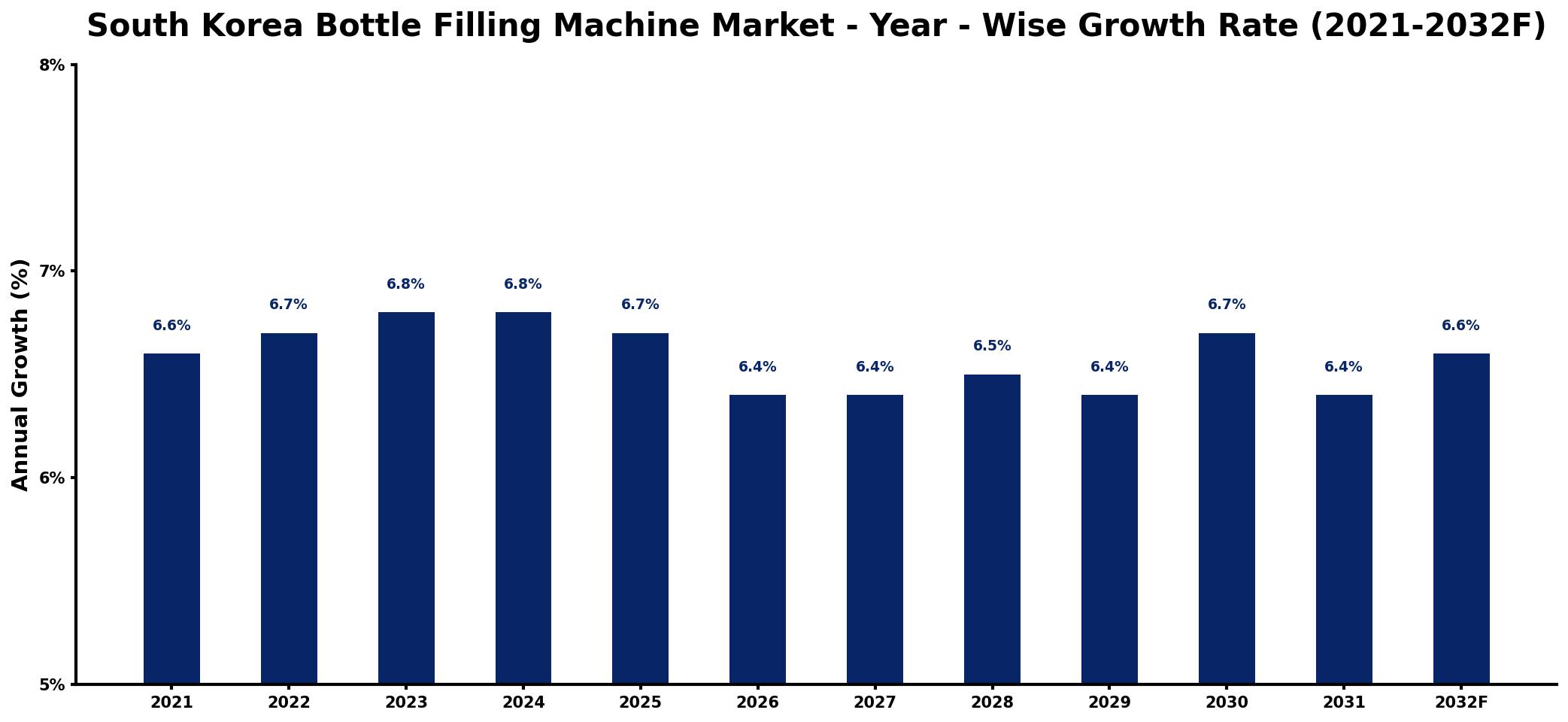
The table below presents the year‑wise growth rates along with the key drivers influencing the market
| Year | Growth Rate | Major Drivers |
| 2021 | 6.6% | Rising demand for automation technologies |
| 2022 | 6.7% | Increased investment in manufacturing efficiency |
| 2023 | 6.8% | Growing focus on sustainable practices |
| 2024 | 6.8% | Expansion of beverage production facilities |
| 2025 | 6.7% | Emerging markets driving consumption rates |
| 2026 | 6.4% | Technological advancements in production processes |
| 2027 | 6.4% | Strengthened supply chain collaborations |
| 2028 | 6.5% | Regulatory support for operational upgrades |
| 2029 | 6.4% | Adoption of smart factory initiatives |
| 2030 | 6.7% | Diversification of product offerings |
| 2031 | 6.4% | Enhanced customer experience expectations |
| 2032 | 6.6% | Innovations in packaging solutions |
Note: Market size estimations and growth projections presented in this report are based on 6Wresearch's proprietary forecasting methodology, utilizing the latest available industry data, government publications, and primary research inputs.
South Korea Bottle Filling Machine Market Synopsis
The demand for high-speed and automated bottle filling solutions is rising sharply in South Korea, particularly within the food and beverage sector. As consumer preferences evolve, manufacturers are increasingly seeking innovative and efficient filling technologies to maintain competitive advantage.
Additionally, the growing emphasis on sustainability is prompting the industry to adapt eco-friendly practices. This shift not only addresses consumer demand for greener products but also aligns with governmental initiatives aimed at promoting environmental responsibility.
South Korea Bottle Filling Machine Market Key Takeaways
- The market is significantly influenced by rising automation in production processes across various industries.
- Sustainability trends are pushing manufacturers to adopt eco-friendly filling solutions.
- Technological advancements, such as IoT and AI integration, are enhancing the efficiency and monitoring capabilities of filling machines.
- Customization in equipment design is becoming essential to accommodate diverse bottle shapes and sizes.
- Intense competition and evolving consumer demands present challenges that require strategic adaptation by manufacturers.
Evaluation of Restraints in South Korea Bottle Filling Machine Market
While the South Korea Bottle Filling Machine Market is positioned for growth, it faces several noteworthy challenges. Intense competition among manufacturers leads to price wars, which can impact profitability. Additionally, companies must continually innovate to keep pace with rapidly evolving technology and consumer expectations. Stringent regulatory frameworks regarding food safety and packaging standards necessitate compliance, adding complexity to operations. Furthermore, fluctuations in raw material prices and broader global economic conditions may hinder consistent market performance.
South Korea Bottle Filling Machine Market Trends
Key trends influencing the South Korea Bottle Filling Machine Market include a marked increase in the demand for automated and high-speed filling machines. These technologies are essential for improving efficiency within the beverage and pharmaceutical sectors. Concurrently, there is a growing commitment to sustainability, which is driving the design and implementation of energy-efficient, low-waste filling machines.
Moreover, the integration of advanced technologies such as IoT and artificial intelligence is enhancing the monitoring and control capabilities of filling machinery. Manufacturers are increasingly focused on customization, with flexible solutions that cater to a wide variety of bottle sizes and shapes becoming critical to meet diverse production requirements.
South Korea Bottle Filling Machine Market Opportunities
Investment opportunities abound in the South Korea Bottle Filling Machine Market, particularly driven by the expanding beverage industry and a growing demand for automated packaging solutions. Companies can explore partnerships with local producers and focus on developing innovative, customized technologies that align with industry demands. The increased emphasis on sustainable practices opens avenues for investments in eco-friendly filling solutions and green technologies, making this an attractive landscape for investors looking to capitalize on the booming beverage sector.
Government Initiatives in the South Korea Bottle Filling Machine Market
The South Korean government has enacted several policies aimed at fostering efficiency and sustainability within the bottle filling machine market. Notable among these is the Eco-Friendly Industrial Complex Act, which incentivizes businesses to adopt energy-efficient practices, including the use of advanced filling machines. Furthermore, the Recycling Promotion Act encourages the recycling of plastic bottles, increasing the demand for filling machines with integrated recycling capabilities. These initiatives create a favorable environment for market growth and encourage manufacturers to prioritize sustainable practices.
Future Insights of the South Korea Bottle Filling Machine Market
Looking ahead to 2026-2032, the South Korea Bottle Filling Machine Market is set for steady growth driven by rising demands from the food and beverage, pharmaceutical, and cosmetic sectors. The need for automation and strict adherence to quality standards will continue to drive investment in advanced technologies. With a robust manufacturing base and ongoing innovations, South Korea is likely to maintain a competitive edge in the global bottle filling machine landscape, making it a focal point for future investments and technological advancements.
South Korea Bottle Filling Machine Market Latest Developments (2025 - 2026)
Recent developments in the South Korea Bottle Filling Machine Market indicate a strong push towards incorporating artificial intelligence and IoT technology into machinery for better monitoring and control. Many manufacturers are also beginning to adopt greener production methods in response to both market demand and government regulations. Furthermore, customization trends are evolving, with equipment increasingly designed to accommodate a wider range of bottle sizes and shapes, ensuring manufacturers can meet diverse consumer needs effectively.
South Korea Bottle Filling Machine Market - Key Attractiveness of the Report
- 10 Years of Market Numbers
- Historical Data Starting from 2022 to 2025
- Base Year: 2025
- Forecast Data until 2032
- Key Performance Indicators Impacting the Market
- Major Upcoming Developments and Projects
Key Highlights of the Report:
- South Korea Bottle Filling Machine Market Outlook
- Market Size of South Korea Bottle Filling Machine Market, 2025
- Forecast of South Korea Bottle Filling Machine Market, 2032
- Historical Data and Forecast of South Korea Bottle Filling Machine Revenues & Volume for the Period 2022-2032F
- South Korea Bottle Filling Machine Market Trend Evolution
- South Korea Bottle Filling Machine Market Drivers and Challenges
- South Korea Bottle Filling Machine Price Trends
- South Korea Bottle Filling Machine Porter's Five Forces
- South Korea Bottle Filling Machine Industry Life Cycle
- Historical Data and Forecast of South Korea Bottle Filling Machine Market Revenues & Volume By Bottle Type for the Period 2022-2032F
- Historical Data and Forecast of South Korea Bottle Filling Machine Market Revenues & Volume By PET Bottles for the Period 2022-2032F
- Historical Data and Forecast of South Korea Bottle Filling Machine Market Revenues & Volume By Glass Bottles for the Period 2022-2032F
- Historical Data and Forecast of South Korea Bottle Filling Machine Market Revenues & Volume By Others for the Period 2022-2032F
- Historical Data and Forecast of South Korea Bottle Filling Machine Market Revenues & Volume By Application for the Period 2022-2032F
- Historical Data and Forecast of South Korea Bottle Filling Machine Market Revenues & Volume By Food Products for the Period 2022-2032F
- Historical Data and Forecast of South Korea Bottle Filling Machine Market Revenues & Volume By Beverages for the Period 2022-2032F
- Historical Data and Forecast of South Korea Bottle Filling Machine Market Revenues & Volume By Chemicals & Pharmaceuticals for the Period 2022-2032F
- Historical Data and Forecast of South Korea Bottle Filling Machine Market Revenues & Volume By Cosmetics for the Period 2022-2032F
- South Korea Bottle Filling Machine Import Export Trade Statistics
- Market Opportunity Assessment By Bottle Type
- Market Opportunity Assessment By Application
- South Korea Bottle Filling Machine Top Companies Market Share
- South Korea Bottle Filling Machine Competitive Benchmarking By Technical and Operational Parameters
- South Korea Bottle Filling Machine Company Profiles
- South Korea Bottle Filling Machine Key Strategic Recommendations






































