South Korea Bulletproof Vest Market Summary
The south korea bulletproof vest market was estimated at USD 302 Million in 2025 and is projected to reach USD 412 Million by 2032, growing at a CAGR of 5.1% from 2026 to 2032.
South Korea Bulletproof Vest Market Year-wise Growth Rate and Key Drivers
This graph highlights how the South Korea Bulletproof Vest Market has steadily grown over the past five years, supported by major growth factors.
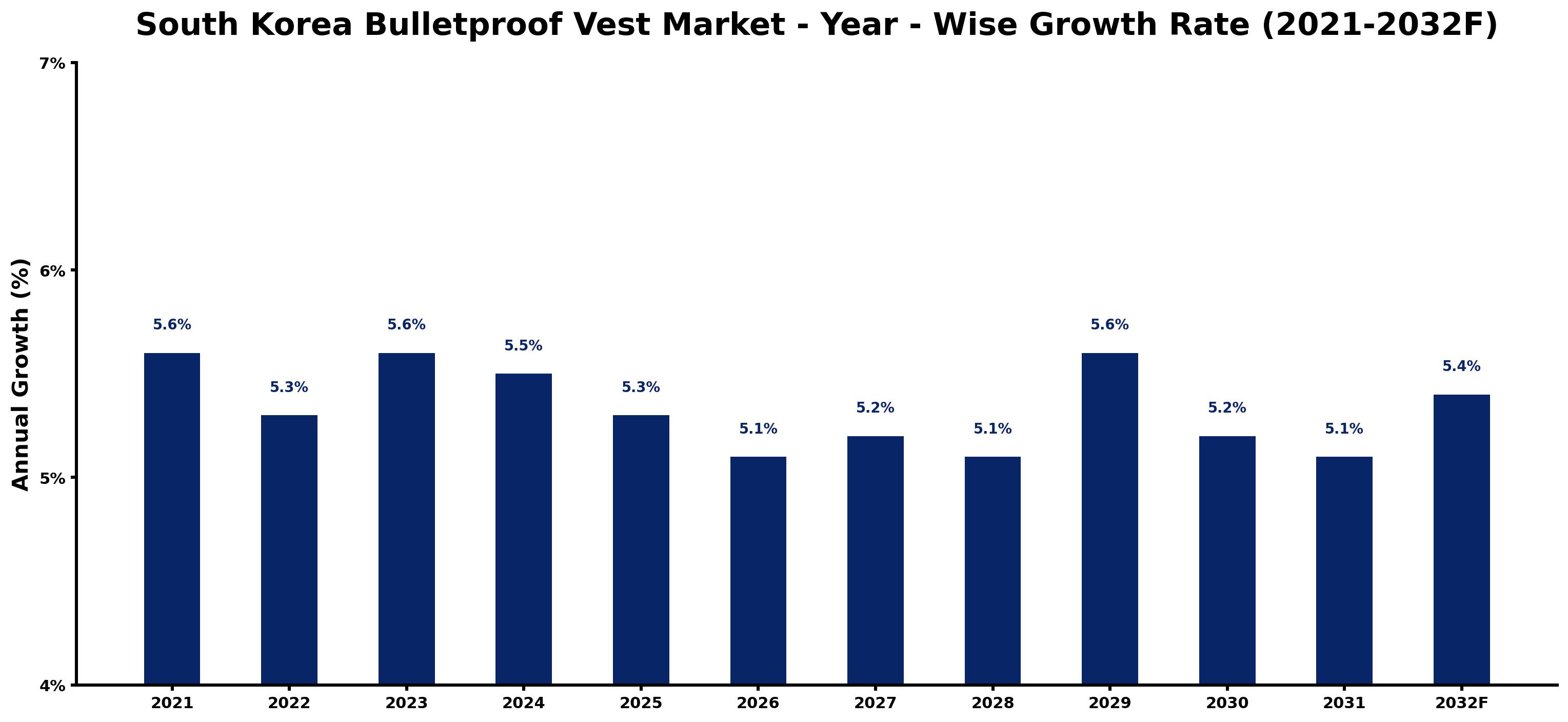
The table below presents the year wise growth rates along with the key drivers influencing the market
| Year | Growth Rate | Major Drivers |
| 2021 | 5.6% | Post-pandemic, security focus intensified among businesses and individuals in South Korea. |
| 2022 | 5.3% | Local manufacturers began innovating lightweight materials for enhanced comfort and protection. |
| 2023 | 5.6% | Emerging threats in urban areas heightened the perception of personal safety needs. |
| 2024 | 5.5% | Corporate budgets increasingly allocate funds for employee safety measures and protective gear. |
| 2025 | 5.3% | Demand for personalized protective equipment options gained traction among various demographics. |
| 2026 | 5.1% | Technological advancements in armor design improved functionality and reduced weight significantly. |
| 2027 | 5.2% | Investment in public safety initiatives catalyzed increased procurement of bulletproof vests. |
| 2028 | 5.1% | Common use by security personnel normalized bulletproof vests in everyday settings. |
| 2029 | 5.6% | Heightened public awareness on active shooter incidents spurred personal defense purchases. |
| 2030 | 5.2% | Supply chain enhancements facilitated local production, reducing costs and delivery times. |
| 2031 | 5.1% | Integration of smart technology within vests attracted interest from tech-savvy consumers. |
| 2032 | 5.4% | Collaborative efforts between private firms and government strengthened industry standards and regulations. |
Note - Market size estimations and growth projections presented in this report are based on 6Wresearch's advanced forecasting approach, validated with industry datasets as of June 2026.
South Korea Bulletproof Vest Market Synopsis
The South Korea Bulletproof Vest Market is projected to reach 5.1% and witness significant growth during the forecast period (2026-2032). This market has shown steady advancement over recent years, primarily driven by increased demand for advanced police and military equipment. The South Korean armed forces are emphasizing high-tech protective gear to safeguard their personnel from evolving threats, leading to a heightened requirement for sophisticated bulletproof vests that surpass the capabilities of conventional body armor.
South Korea Bulletproof Vest Market Growth Drivers
The growth of the South Korea Bulletproof Vest Market can be attributed to several key factors:
- The rising security concerns in both military and civilian sectors have led to an increased emphasis on protective gear, driving the demand for high-performance bulletproof vests.
- Technological advancements in materials science have resulted in the development of lightweight, durable vests that offer enhanced protection against modern ammunition types, thus appealing to both military and law enforcement entities.
- Government initiatives aimed at enhancing national security have spurred investments in military modernization, including the procurement of advanced protective equipment, further boosting market growth.
- The expansion of organized crime and terrorist threats necessitates a robust response from law enforcement agencies, thereby increasing the requirement for specialized protective gear such as bulletproof vests.
- Collaboration between public and private sectors in research and development has led to innovative solutions in the design and functionality of bulletproof vests, increasing their market availability.
South Korea Bulletproof Vest Market Challenges and Restraints
Despite the growth potential, the South Korea Bulletproof Vest Market faces several challenges:
- The high costs associated with advanced bulletproof vests can limit procurement budgets for smaller law enforcement agencies and military units, which may opt for less effective alternatives.
- The rapid pace of technological advancements may render existing products obsolete, creating pressure on manufacturers to continuously innovate and invest in research and development.
- Concerns regarding the comfort and wearability of bulletproof vests may deter individuals from using them for extended periods, impacting overall effectiveness during critical operations.
- Regulatory issues surrounding the testing and certification of protective gear can delay product introduction to the market and complicate compliance for manufacturers.
- The potential for misinformation about the effectiveness of bulletproof vests could lead to hesitance among potential buyers, affecting market growth.
South Korea Bulletproof Vest Market Investment Opportunities
Investment opportunities in the South Korea Bulletproof Vest Market are emerging due to several factors:
- The ongoing urbanization and population growth necessitate enhanced public safety measures, which include the procurement of protective gear for law enforcement agencies.
- With the increasing incidence of mass shootings and public safety threats, governments are likely to allocate more funding toward protective equipment for first responders and military personnel.
- The demand for custom solutions that cater to specific operational needs presents an entry point for manufacturers focused on niche market segments.
- Expanding e-commerce platforms and digital marketing strategies can create new sales channels for bulletproof vest manufacturers, reaching wider audiences.
- Partnerships with technology firms to incorporate smart features into bulletproof vests, such as integrated communication systems and health monitoring, represent a frontier for innovation and investment.
South Korea Bulletproof Vest Market Government Investment and Initiatives
The South Korean government has shown a sustained commitment to enhancing national security through significant investment in military and law enforcement capabilities, particularly in protective equipment like bulletproof vests. Policies emphasizing the modernization of the armed forces and strengthening law enforcement agencies have led to increased public spending on advanced protective gear. This government focus translates into funding for research initiatives aimed at developing new materials and technologies that improve the safety and effectiveness of bulletproof vests. Moreover, various public-private partnerships are being encouraged to foster innovation in the industry, ensuring that South Korean forces are equipped with cutting-edge protective solutions.
South Korea Bulletproof Vest Market Latest Developments (May 2025 - June 2026)
Recent developments in the South Korea Bulletproof Vest Market indicate a period of dynamic change characterized by advancements in technology and policy shifts. Manufacturers have been focusing on integrating smart technology into bulletproof vests, enhancing functionality and user experience. The government has also initiated new funding programs aimed at accelerating the research and development of advanced protective gear. Additionally, there has been a notable increase in collaboration within the industry, as companies partner with research institutions to innovate and improve existing products. As a result, the market is witnessing a gradual shift towards more customized solutions that cater to the specific needs of military and police forces, thereby bolstering the effectiveness of protective gear.
South Korea Bulletproof Vest Market - Key Attractiveness of the Report
- 10 Years of Market Numbers
- Historical Data Starting from 2022 to 2025
- Base Year: 2025
- Forecast Data until 2032
- Key Performance Indicators Impacting the Market
- Major Upcoming Developments and Projects
Key Highlights of the Report:
- South Korea Bulletproof Vest Market Outlook
- Market Size of South Korea Bulletproof Vest Market, 2025
- Forecast of South Korea Bulletproof Vest Market, 2032
- Historical Data and Forecast of South Korea Bulletproof Vest Revenues & Volume for the Period 2022-2032
- South Korea Bulletproof Vest Market Trend Evolution
- South Korea Bulletproof Vest Market Drivers and Challenges
- South Korea Bulletproof Vest Price Trends
- South Korea Bulletproof Vest Porter's Five Forces
- South Korea Bulletproof Vest Industry Life Cycle
- Historical Data and Forecast of South Korea Bulletproof Vest Market Revenues & Volume By Type for the Period 2022-2032
- Historical Data and Forecast of South Korea Bulletproof Vest Market Revenues & Volume By Soft Vest for the Period 2022-2032
- Historical Data and Forecast of South Korea Bulletproof Vest Market Revenues & Volume By Hard Vest for the Period 2022-2032
- Historical Data and Forecast of South Korea Bulletproof Vest Market Revenues & Volume By Purpose for the Period 2022-2032
- Historical Data and Forecast of South Korea Bulletproof Vest Market Revenues & Volume By Military for the Period 2022-2032
- Historical Data and Forecast of South Korea Bulletproof Vest Market Revenues & Volume By Civilian for the Period 2022-2032
- South Korea Bulletproof Vest Import Export Trade Statistics
- Market Opportunity Assessment By Type
- Market Opportunity Assessment By Purpose
- South Korea Bulletproof Vest Top Companies Market Share
- South Korea Bulletproof Vest Competitive Benchmarking By Technical and Operational Parameters
- South Korea Bulletproof Vest Company Profiles
- South Korea Bulletproof Vest Key Strategic Recommendations






































