South Korea Canvas Market Size, Share & Growth Rate
The South Korea Canvas Market was estimated at USD 255 Million in 2025 and is projected to reach USD 333 Million by 2032, growing at a CAGR of 3.9% from 2026 to 2032. This growth trajectory is primarily fueled by the increasing demand across artistic, industrial, and consumer goods sectors. As South Korean consumers increasingly prioritize sustainability and aesthetic appeal in their purchases, the versatility and durability of canvas fabrics play a significant role in meeting these evolving preferences.
South Korea Canvas Market Year-wise Growth Rate and Key Drivers
This graph highlights how the South Korea Canvas Market has steadily grown over the years, supported by major growth factors.
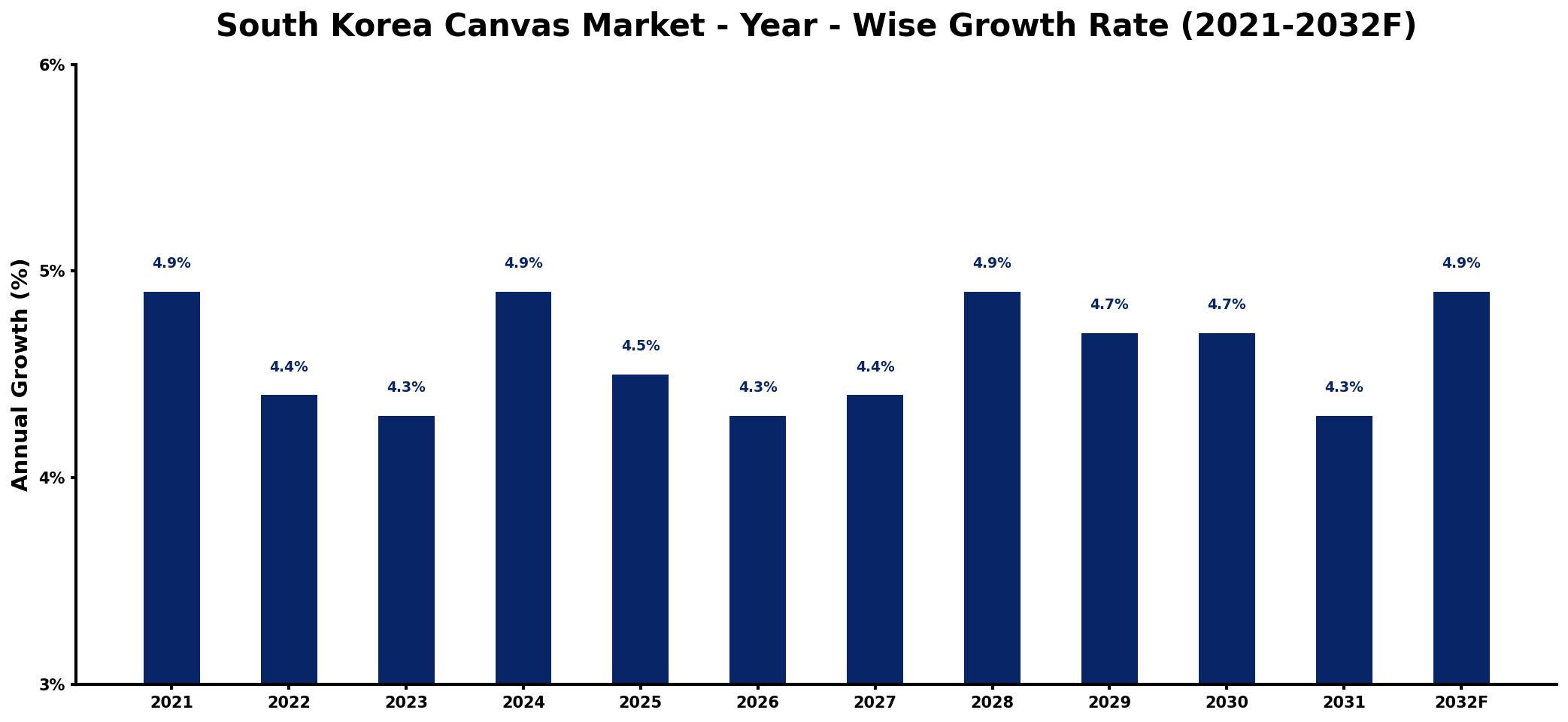
The table below presents the year‑wise growth rates along with the key drivers influencing the market
| Year | Growth Rate | Major Drivers |
| 2021 | 4.9% | Rising interest in art education |
| 2022 | 4.4% | Increased demand for creative hobbies |
| 2023 | 4.3% | Growth in online art platforms |
| 2024 | 4.9% | Expansion of art therapy programs |
| 2025 | 4.5% | Surge in eco-friendly materials |
| 2026 | 4.3% | Higher investment in local artists |
| 2027 | 4.4% | Emergence of digital art tools |
| 2028 | 4.9% | Boost in community art projects |
| 2029 | 4.7% | Popularity of DIY home decor |
| 2030 | 4.7% | growing automotive sector requirements |
| 2031 | 4.3% | Increased focus on sustainability |
| 2032 | 4.9% | growing regional consumption patterns |
Note: Market size estimations and growth projections presented in this report are based on 6Wresearch's proprietary forecasting methodology, utilizing the latest available industry data, government publications, and primary research inputs.
South Korea Canvas Market Synopsis
The South Korea Canvas Market is witnessing a notable surge in demand, particularly in the artistic sector. Artists and designers are increasingly opting for high-quality canvas due to its ability to provide a durable yet flexible surface for their creative endeavors. Moreover, the rise of eco-conscious consumerism has further propelled the demand for canvas materials that support sustainability.
The industrial applications of canvas are also expanding, with businesses utilizing this material in a variety of products ranging from durable bags to specialized equipment covers. This diversification of applications is crucial, as it encourages innovation within the sector and ensures resilience against market fluctuations.
South Korea Canvas Market Key Takeaways
- The market is expected to grow significantly, reflecting trends towards sustainability and creative expression.
- Canvas fabrics are increasingly favored in the production of art supplies, apparel, and functional goods.
- Environmental policies are prompting manufacturers to adapt their practices towards eco-friendly production methods.
- Government initiatives are fostering modernization within the textile industry, enhancing competitiveness.
- Consumer trends are shifting towards materials that blend aesthetic appeal with durability.
Evaluation of Restraints in South Korea Canvas Market
Despite its promising growth, the South Korea Canvas Market faces certain restraints that could impede progress. One notable challenge is the shift in consumer preferences towards synthetic materials, which often promise lower costs and a wider variety of finishes. This shift raises concerns about the long-term demand for traditional canvas. Additionally, environmental regulations impose stringent requirements on production processes, which may limit the flexibility manufacturers have in sourcing materials and could increase production costs. Striking a balance between maintaining the quality and sustainability of canvas fabric while adapting to these evolving market demands remains a significant challenge for industry players.
South Korea Canvas Market Trends
Emerging trends in the South Korea Canvas Market reflect an increasing integration of technology and sustainability. Digital printing technologies are transforming how canvas is utilized in the artistic sector, allowing for more intricate and vibrant designs that appeal to modern consumers. Furthermore, the trend towards minimalism in home décor is leading to increased interest in canvas-based furnishings, as these products align well with aesthetic and environmental values.
The rise of ethical fashion is also influencing the canvas apparel segment. Consumers are increasingly drawn to brands that prioritize sustainability, prompting manufacturers to invest in eco-friendly processes and raw materials. This alignment with consumer values not only fosters brand loyalty but also helps businesses in establishing themselves as leaders within the marketplace.
South Korea Canvas Market Opportunities
There are abundant opportunities for growth within the South Korea Canvas Market, particularly as businesses tap into the growing demand for sustainable practices. As manufacturers adopt eco-friendly materials and processes, there is potential for new product lines that cater to environmentally-conscious consumers. Additionally, the intersection of art and technology presents an exciting avenue for innovation. Companies that explore partnerships with tech firms to develop advanced printing techniques or smart textiles may find unique market advantages.
Government Initiatives in the South Korea Canvas Market
The South Korean government actively supports the canvas market through various initiatives aimed at promoting sustainability and modernization within the textile industry. Policies focus on enhancing manufacturing standards, ensuring compliance with environmental regulations, and fostering innovation in eco-friendly production techniques. Financial incentives are often available for companies adopting green practices or investing in new technologies, further bolstering the market's growth potential.
Future Insights of the South Korea Canvas Market
Looking ahead to 2026-2032, the South Korea Canvas Market is poised for robust growth driven by ongoing trends in sustainability and consumer demand for high-quality, versatile products. The artistic sector will continue to thrive, supported by an expanding community of artists and creative professionals. Meanwhile, industrial applications are expected to diversify, creating new revenue streams. By embracing innovative technologies and sustainable practices, businesses can position themselves at the forefront of this evolving market landscape.
South Korea Canvas Market Latest Developments (2025 - 2026)
Recent developments in the South Korea Canvas Market indicate a shift towards more innovative production techniques as manufacturers strive to meet the demands for eco-friendly and durable materials. Collaborations between textile producers and technology firms are becoming more common, leading to advancements in digital printing and material sourcing. Concurrently, government programs focusing on sustainable practices are helping to facilitate a more eco-conscious approach across the industry.
South Korea Canvas Market - Key Attractiveness of the Report
- 10 Years of Market Numbers
- Historical Data Starting from 2022 to 2025
- Base Year: 2025
- Forecast Data until 2032
- Key Performance Indicators Impacting the Market
- Major Upcoming Developments and Projects
Key Highlights of the Report:
- South Korea Canvas Market Outlook
- Market Size of South Korea Canvas Market, 2025
- Forecast of South Korea Canvas Market, 2032
- Historical Data and Forecast of South Korea Canvas Revenues & Volume for the Period 2022-2032F
- South Korea Canvas Market Trend Evolution
- South Korea Canvas Market Drivers and Challenges
- South Korea Canvas Price Trends
- South Korea Canvas Porter's Five Forces
- South Korea Canvas Industry Life Cycle
- Historical Data and Forecast of South Korea Canvas Market Revenues & Volume By Types for the Period 2022-2032F
- Historical Data and Forecast of South Korea Canvas Market Revenues & Volume By Plane Canvas for the Period 2022-2032F
- Historical Data and Forecast of South Korea Canvas Market Revenues & Volume By Duck Canvas for the Period 2022-2032F
- Historical Data and Forecast of South Korea Canvas Market Revenues & Volume By Application for the Period 2022-2032F
- Historical Data and Forecast of South Korea Canvas Market Revenues & Volume By Tent for the Period 2022-2032F
- Historical Data and Forecast of South Korea Canvas Market Revenues & Volume By Luggage Fabric for the Period 2022-2032F
- Historical Data and Forecast of South Korea Canvas Market Revenues & Volume By Automotive Fabric for the Period 2022-2032F
- Historical Data and Forecast of South Korea Canvas Market Revenues & Volume By Apparel for the Period 2022-2032F
- Historical Data and Forecast of South Korea Canvas Market Revenues & Volume By Others for the Period 2022-2032F
- South Korea Canvas Import Export Trade Statistics
- Market Opportunity Assessment By Types
- Market Opportunity Assessment By Application
- South Korea Canvas Top Companies Market Share
- South Korea Canvas Competitive Benchmarking By Technical and Operational Parameters
- South Korea Canvas Company Profiles
- South Korea Canvas Key Strategic Recommendations






































