South Korea Case Management Market Size & Growth Rate (2026-2032)
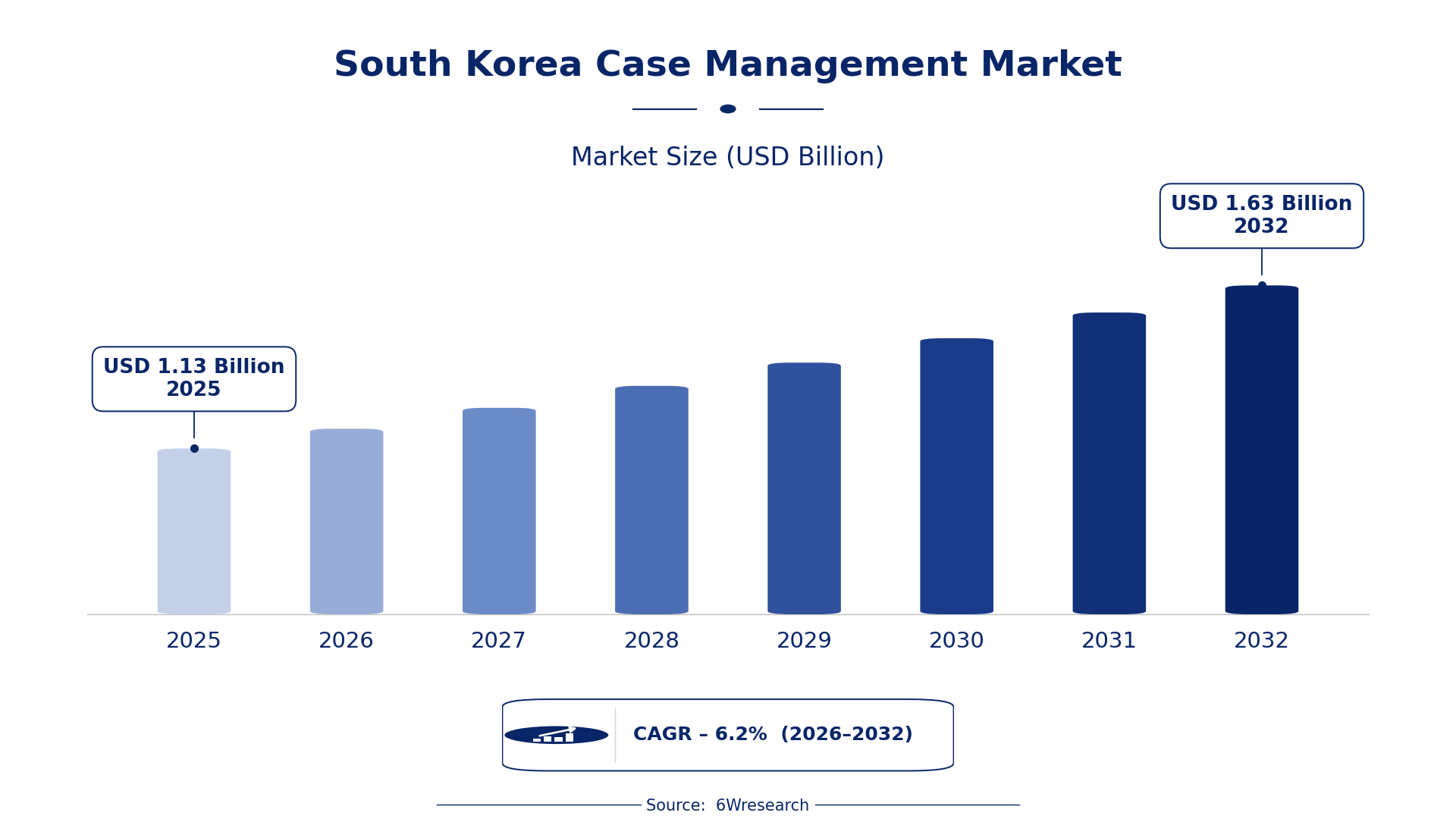
The South Korea Case Management Market was estimated at USD 1127 Million in 2025 and is projected to reach USD 1626 Million by 2032, growing at a CAGR of 6.2% from 2026 to 2032.
South Korea Case Management Market Synopsis
The most significant force shaping the South Korea Case Management Market is the ongoing healthcare reform aimed at enhancing patient-centered care. This initiative is transforming how healthcare providers manage cases, focusing on improving coordination and outcomes across various healthcare settings.
Additionally, the adoption of digital health technologies is gaining momentum, offering innovative solutions for case management. This trend is critical as it enables healthcare professionals to streamline processes, ultimately leading to better patient engagement and satisfaction.
South Korea Case Management Market Year-wise Growth Rate and Key Drivers
This graph illustrates the annual growth rates of the South Korea Case Management Market from 2021 to 2032, highlighting a steady upward trajectory and projected expansion over the forecast period.
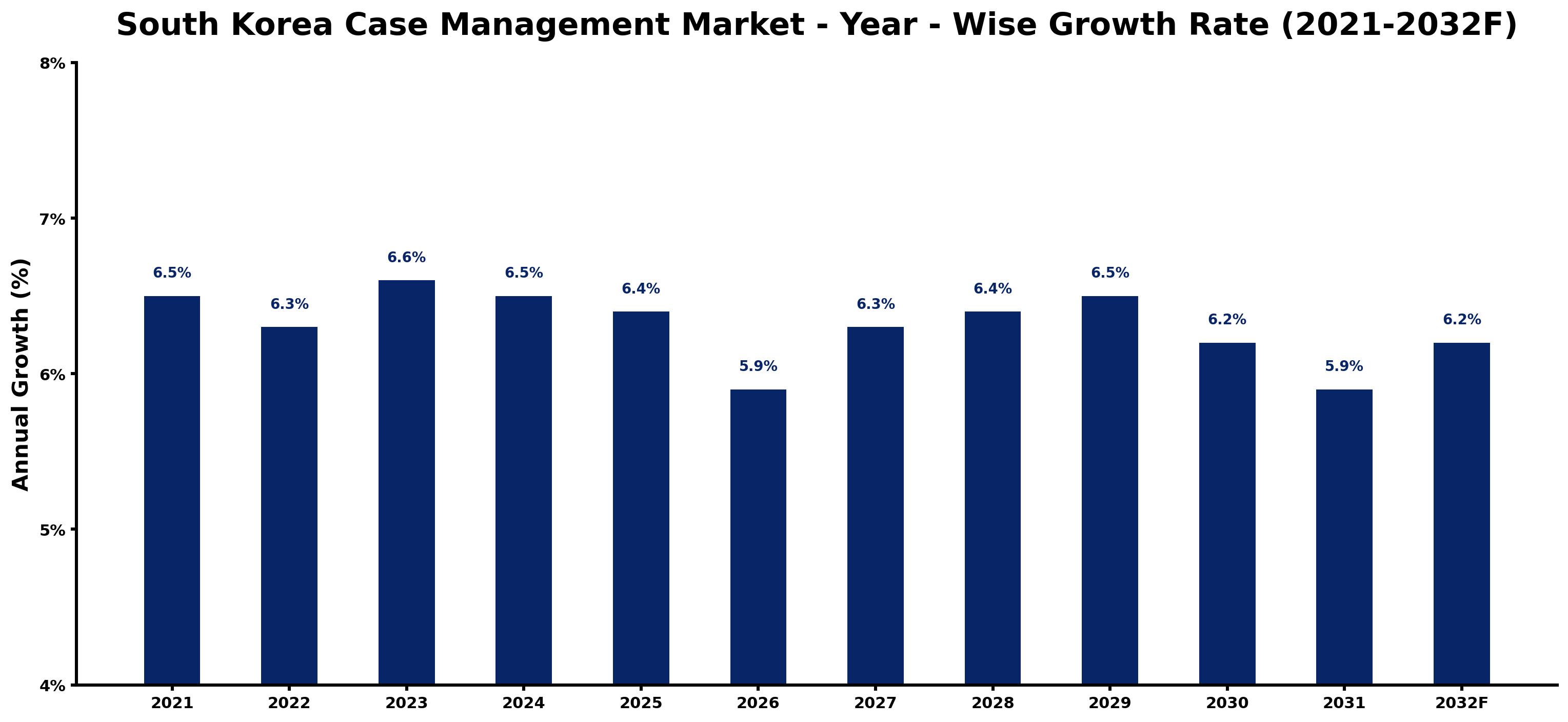
The table below presents the year‑wise growth rates along with the key drivers influencing the market
| Year | Growth Rate | Major Drivers |
| 2021 | 6.5% | Government prioritization of digital transformation in justice sector. |
| 2022 | 6.3% | Judicial system adopting electronic filing and management solutions. |
| 2023 | 6.6% | Increased demand for virtual court proceedings and case handling. |
| 2024 | 6.5% | Rising investments in legal tech startups and innovation. |
| 2025 | 6.4% | Strong emphasis on improving efficiency in public administration. |
| 2026 | 5.9% | Demand for integrated case management platforms surging. |
| 2027 | 6.3% | Legal professionals upskilling with technology-focused training programs. |
| 2028 | 6.4% | Municipalities implementing smart city case management initiatives. |
| 2029 | 6.5% | Growing public awareness of legal rights and access. |
| 2030 | 6.2% | Involvement of NGOs in promoting case resolution services. |
| 2031 | 5.9% | Increasing complexity of cases driving advanced management solutions. |
| 2032 | 6.2% | Boost in government funding for judicial efficiency projects. |
Note: Market size estimations and growth projections presented in this report are based on 6Wresearch's proprietary forecasting methodology, utilizing the latest available industry data, government publications, and primary research inputs.
South Korea Case Management Market Key Takeaways
Below are some of the specific key takeaways from the market, including:
- The market is driven by increasing healthcare reforms and a shift towards patient-centric care models.
- Digital health technologies are becoming integral to case management solutions, enhancing efficiency.
- Interoperability and data security remain significant challenges for widespread adoption.
- Government initiatives are playing a crucial role in shaping policies related to case management.
- Future growth opportunities lie in expanding digital infrastructure and improving service delivery frameworks.
Evaluation of Restraints in South Korea Case Management Market
Despite positive growth trajectories, several restraints hinder the South Korea Case Management Market. One of the primary challenges is the integration of diverse case management systems across various healthcare providers. This lack of interoperability complicates data sharing and can lead to inconsistencies in patient care. Additionally, ensuring compliance with stringent data security and privacy regulations adds another layer of complexity for organizations. Many facilities are grappling with the need for significant investments in technology to enhance their case management capabilities, which can be a deterrent to adoption.
South Korea Case Management Market Trends
A few trends are particularly noteworthy in the South Korea Case Management Market. The rise of telehealth services has accelerated the demand for case management solutions that can support remote patient monitoring and care coordination. on top of that, artificial intelligence is increasingly being utilized to analyze case data, predict patient outcomes, and optimize treatment plans. This technological shift is not just about efficiency; it's also about improving the quality of care provided to patients. The growing emphasis on real-time data access is reshaping case management practices, pushing providers to adopt more agile and responsive systems.
South Korea Case Management Market Opportunities
The opportunities for growth in the South Korea Case Management Market are substantial. With government support for digital transformation in healthcare, organizations have the chance to invest in advanced case management software that enhances operational efficiency. There's a growing demand for solutions that integrate with existing electronic health records, which could streamline workflows and improve patient outcomes. on top of that, public-private partnerships aimed at expanding digital health infrastructure present lucrative opportunities for stakeholders interested in this sector. The increasing focus on preventive care will also drive the need for comprehensive case management solutions.
Government Initiatives in the South Korea Case Management Market
Government policies are significantly influencing the South Korea Case Management Market, focusing on improving judicial efficiency and access to justice. Recent initiatives have aimed at modernizing case management systems to ensure transparency and fairness in legal processes. These regulatory measures are vital for fostering public trust and enhancing the effectiveness of legal service delivery.
- A recent initiative launched in early 2025 focuses on implementing technology solutions to streamline court workflows and enhance case tracking.
- Currently underway is a regulatory framework that mandates compliance with data privacy standards across all case management systems.
- A planned public sector initiative aims to expand legal aid programs by 2028, enhancing access to justice for underserved populations.
- An upcoming project set to commence in 2026 will focus on integrating AI technologies into case management systems to improve decision-making processes.
- Ongoing efforts to standardize legal documentation practices across courts are expected to be completed by mid-2026.
Future Insights of the South Korea Case Management Market
Looking ahead to 2026-2032, the South Korea Case Management Market is on track for transformative growth. The continued emphasis on integrating technology into case management practices will likely yield more sophisticated solutions that cater to the dynamic needs of healthcare providers. Expect to see an increased focus on interoperability and user-friendly interfaces that facilitate better data management. As the market matures, collaboration between healthcare entities and tech providers will be crucial in driving innovation and improving patient care outcomes.
South Korea Case Management Market Latest Developments
In the last 12-14 months, the South Korea Case Management Market has witnessed several notable developments that reflect its rapid evolution. Stakeholders are keenly focused on technological advancements that enhance efficiency and patient engagement. These developments indicate a shift towards a more integrated and responsive approach to case management.
- A technology vendor launched a new case management platform in Q2 2025, which features advanced analytics and reporting tools to improve healthcare outcomes.
- A major healthcare provider is currently implementing an ongoing initiative that integrates telehealth capabilities into its case management system, expected to complete by late 2025.
- A partnership between regional healthcare systems was announced in early 2025 to share case management best practices and standardize procedures.
- By the end of 2026, an upcoming project will introduce mobile case management solutions aimed at enhancing patient accessibility and engagement.
- A completed project in early 2025 focused on upgrading existing case management software to support better data analytics and reporting functionalities.
South Korea Case Management Market - Key Attractiveness of the Report
- 10 Years of Market Numbers
- Historical Data Starting from 2022 to 2025
- Base Year: 2025
- Forecast Data until 2032
- Key Performance Indicators Impacting the Market
- Major Upcoming Developments and Projects
Key Highlights of the Report:
- South Korea Case Management Market Outlook
- Market Size of South Korea Case Management Market, 2025
- Forecast of South Korea Case Management Market, 2032
- Historical Data and Forecast of South Korea Case Management Revenues & Volume for the Period 2022-2032F
- South Korea Case Management Market Trend Evolution
- South Korea Case Management Market Drivers and Challenges
- South Korea Case Management Price Trends
- South Korea Case Management Porter's Five Forces
- South Korea Case Management Industry Life Cycle
- Historical Data and Forecast of South Korea Case Management Market Revenues & Volume By Component for the Period 2022-2032F
- Historical Data and Forecast of South Korea Case Management Market Revenues & Volume By Solution for the Period 2022-2032F
- Historical Data and Forecast of South Korea Case Management Market Revenues & Volume By Services for the Period 2022-2032F
- Historical Data and Forecast of South Korea Case Management Market Revenues & Volume By Deployment Mode for the Period 2022-2032F
- Historical Data and Forecast of South Korea Case Management Market Revenues & Volume By Cloud for the Period 2022-2032F
- Historical Data and Forecast of South Korea Case Management Market Revenues & Volume By On-premises for the Period 2022-2032F
- Historical Data and Forecast of South Korea Case Management Market Revenues & Volume By Service for the Period 2022-2032F
- Historical Data and Forecast of South Korea Case Management Market Revenues & Volume By Professional Services for the Period 2022-2032F
- Historical Data and Forecast of South Korea Case Management Market Revenues & Volume By Managed Services for the Period 2022-2032F
- Historical Data and Forecast of South Korea Case Management Market Revenues & Volume By Business Function for the Period 2022-2032F
- Historical Data and Forecast of South Korea Case Management Market Revenues & Volume By Service request for the Period 2022-2032F
- Historical Data and Forecast of South Korea Case Management Market Revenues & Volume By Fraud detection and anti-money laundering for the Period 2022-2032F
- Historical Data and Forecast of South Korea Case Management Market Revenues & Volume By Incident management for the Period 2022-2032F
- Historical Data and Forecast of South Korea Case Management Market Revenues & Volume By Investigation management for the Period 2022-2032F
- Historical Data and Forecast of South Korea Case Management Market Revenues & Volume By Legal workflow management for the Period 2022-2032F
- Historical Data and Forecast of South Korea Case Management Market Revenues & Volume By Organization Size for the Period 2022-2032F
- Historical Data and Forecast of South Korea Case Management Market Revenues & Volume By Large enterprises for the Period 2022-2032F
- Historical Data and Forecast of South Korea Case Management Market Revenues & Volume By Small and Medium-sized Enterprises (SMEs) for the Period 2022-2032F
- Historical Data and Forecast of South Korea Case Management Market Revenues & Volume By Vertical for the Period 2022-2032F
- Historical Data and Forecast of South Korea Case Management Market Revenues & Volume By Banking, Financial Services, and Insurance (BFSI) for the Period 2022-2032F
- Historical Data and Forecast of South Korea Case Management Market Revenues & Volume By Government for the Period 2022-2032F
- Historical Data and Forecast of South Korea Case Management Market Revenues & Volume By Healthcare for the Period 2022-2032F
- Historical Data and Forecast of South Korea Case Management Market Revenues & Volume By IT and telecom for the Period 2022-2032F
- Historical Data and Forecast of South Korea Case Management Market Revenues & Volume By Retail for the Period 2022-2032F
- Historical Data and Forecast of South Korea Case Management Market Revenues & Volume By Manufacturing for the Period 2022-2032F
- Historical Data and Forecast of South Korea Case Management Market Revenues & Volume By Others for the Period 2022-2032F
- South Korea Case Management Import Export Trade Statistics
- Market Opportunity Assessment By Component
- Market Opportunity Assessment By Deployment Mode
- Market Opportunity Assessment By Service
- Market Opportunity Assessment By Business Function
- Market Opportunity Assessment By Organization Size
- Market Opportunity Assessment By Vertical
- South Korea Case Management Top Companies Market Share
- South Korea Case Management Competitive Benchmarking By Technical and Operational Parameters
- South Korea Case Management Company Profiles
- South Korea Case Management Key Strategic Recommendations






































